
[ultimatemember form_id=3702]
16. Cargo securement
A professional commercial vehicle driver is responsible for the safe transporting of goods while they’re in transit. In addition to sound driving skills, professional drivers must have basic skills on how to properly handle cargo. This unit will provide you with the knowledge to inspect, handle, load, secure and transport cargo in ways that keep it secure and prevent damage. Frequently used cargo securement terms are provided for your reference at the end of this unit.
This unit will help you learn to:
• Comply with basic cargo securement regulations and practices
• Explain the importance of properly handling, loading and securing cargo
• Explain principles of cargo loading and weight distribution
• Ensure the cargo doesn’t exceed vehicle weight capacity
• Describe methods of cargo securement
• Describe common cargo loading equipment
• Describe common devices used to secure a load
• Inspect cargo for proper securement
• Explain reasons for increased security measures within the transport industry
• Describe ways to increase the security of the rig and cargo
• Explain how to ensure personal safety when working with or around cargo
In Canada, National Safety Code (NSC) Standard 10 — Cargo Securement, provides best practice guidelines for securing loads to commercial vehicles to ensure they don’t shift, move or spill onto the roadway. British Columbia has adopted the NSC Standard 10 guidelines as a requirement under MVAR Division 35 — Cargo Securement. Drivers and carriers of vehicles transporting cargo on a highway, and vehicles exceeding a licensed GVW of 5,000 kg (11,023 lb) must ensure that cargo is transported safely and securely in accordance with NSC 10 and B.C. regulations. The NSC Standard 10 document, which contains detailed guidance and information on cargo securement requirements, can be found on the Canadian Council of Motor Transport Administrators (CCMTA) website at ccmta.ca.
Review these cargo securement requirements:
1. A carrier shall not permit a driver to operate a commercial vehicle where the cargo transported in or on the vehicle isn’t contained, immobilized or secured in accordance with the NSC Standard as it relates to the particular type of commercial vehicle.
2. A driver shall not operate a commercial vehicle where the cargo transported in or on the vehicle isn’t contained, immobilized, or secured in accordance with the NSC Standard as it relates to the particular type of commercial vehicle.
3. A driver or carrier must ensure that cargo transported by a commercial vehicle is contained, immobilized or secured so that it can’t:
a. Leak, spill, blow off, fall from, fall through or otherwise be dislodged from the vehicle
b. Shift upon or within the vehicle to such an extent that the vehicle’s stability or manoeuvrability is adversely affected
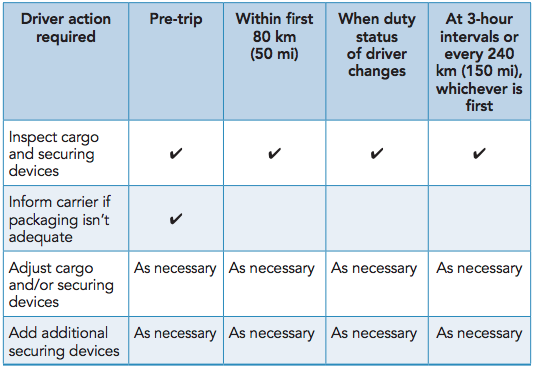
4. Drivers must regularly inspect the vehicle’s cargo and cargo securement systems and make necessary adjustments before driving the vehicle and not more than 80 km (50 mi) from where the cargo was loaded.
5. Drivers must re-inspect cargo and the cargo securement system and make any necessary adjustments at specified intervals (whichever of the below occurs first):
a. There’s a change in duty status of the driver.
b. The vehicle has been driven for three hours.
c. The vehicle has been driven for 240 km (150 mi).
6. Inspection requirements immediately above don’t apply if the cargo is sealed and the driver has been ordered not to open it to inspect it or if the cargo was loaded in a way that makes it, or portions of it, inaccessible.
7. If cargo isn’t properly secured, the driver, carrier or shipper could face fines and penalties.
8. If an enforcement officer has reasonable and probable grounds to believe that a vehicle carrying cargo is unsafe for use on a highway because of the method of cargo securement, the officer may order the driver of the vehicle to stop and secure the cargo before proceeding.
The driver is responsible to inspect the cargo securement at the following points:
Withstand force — Each cargo securement system must be able to withstand a minimum amount of force in each direction.
• Forward force = 80 percent of cargo weight when braking while driving straight ahead.
• Rearward force = 50 percent of cargo weight when accelerating, shifting gears while climbing a hill or braking in reverse.
• Sideways force = 50 percent of cargo weight when turning, changing lanes or braking while turning.
• Upward force = 20 percent of cargo weight when travelling over bumps in the road or cresting a hill if the load is not fully contained within the structure of the vehicle.
Regulations are in place requiring that you must secure the following vehicle structures and equipment, if applicable:
• Doors
• Tarps
• Spare tires
• Tailgates/tailboards
• Cargo securing equipment
• Other equipment used in the vehicle’s operation
Cargo isn’t safely secured if it gets in your way or causes a distraction. The cargo or any other object must not interfere with the driver’s ability to drive the vehicle safely (such as free movement of the driver’s arm and leg). Cargo must be loaded onto a vehicle so that it doesn’t:
• Cause a distraction due to loose or flapping securement devices
• Block vehicle entry or exit for the driver or passengers
• Obstruct the driver’s view to the front, right or left sides
• Prevent easy access to emergency equipment
• Interfere with your control of the vehicle
Personal safety when working with cargo and when around cargo loading facilities must be top priority.
• Wear appropriate personal safety equipment, such as hi-visibility clothing, gloves, boots, safety glasses and hard hat (if required).
• Be careful when opening cargo doors as the load may have shifted during transit and may fall on you as you open the doors.
• Always secure the doors of the trailer in the open or closed position so they don’t swing or get blown by the wind damaging other vehicles or injuring you or other bystanders.
• Watch for moving equipment on the ground and overhead.
• Always walk in the designated crosswalks or pedestrian walkways.
• Using hazard lights can help make others aware of moving vehicles.
• Don’t walk close to the front of vehicles — the driver may not see you.
• Ensure you can hear parking brakes being applied before walking behind a vehicle or into a pinch point.
• Never take a shortcut and go underneath trailers.
• Make eye contact with others working in the area.
• Always agree on hand signals with other operators or guides.
• Stay out of the pinch points at all times.
Shipping documents for dangerous goods must be carried in a pocket on the driver’s door or within the driver’s reach. When the driver leaves the cab, the shipping documents must be left on the seat, in the pocket of the driver’s door or in a location that’s clearly visible to anyone entering through the driver’s door.
The driver is responsible for ensuring that the cargo documentation is complete and legible according to carrier policy and that the cargo load and paperwork match. More detailed information on cargo documentation is covered in the chapter Documents and Regulatory Requirements.
While many drivers don’t load or supervise cargo loading, they’re responsible for verifying that the cargo they’ll be transporting is properly secured and matches the documentation. Depending on what you’re carrying, you’ll also have to inspect your load for adequate:
• Blocking, bracing and dunnage (i.e., loose materials used to keep cargo in position)
• Tie downs to secure the load
• Covering of the load
If you’re transporting a sealed or containerized load, you won’t be able to inspect it for proper packaging. You must still ensure that it doesn’t exceed the vehicle’s weight capacity. If your load has a container seal, make sure that it’s not broken before you accept the load. The seal shows that the container has been properly closed at origin. Since it can only be removed once, it ensures that the container remains unopened during the trip. This deters theft and minimizes the risk of an unauthorized person accessing the container to transport illegal cargo such as contraband and/or drugs. If a seal is broken, the shipment could be rejected when you deliver it.
If it has a customs seal, don’t tamper with it. In the event of a fire or other emergency, have a witness (preferably a law enforcement officer) sign a statement describing the conditions under which the seal was removed.
Prior to moving the vehicle, conduct a cargo pre-trip inspection. Depending on the location of and accessibility to the cargo, the check should include:
• Walking around the vehicle to check for any leaks that may indicate that the cargo is damaged
• Ensuring that you know the weight of the cargo you intend to transport, which can be done by adding all weight outlined on the shipping document
• Ensuring that weight distribution is as low as possible to help keep the rig’s centre of gravity low
• Ensuring that documentation matches the freight and the count matches the shipper’s count
• Ensuring that there’s no loose freight and that the cargo is properly secured by load securement devices
• Ensuring that heavy loads aren’t loaded high in the trailer or positioned where they could fall on other cargo when transporting
• Ensuring that all parts necessary for hauling, containing and protecting the cargo are secured including tailgates, tailboards, doors, tarps and headboards
• Ensuring that the weight of the vehicle doesn’t exceed weight limits for the route
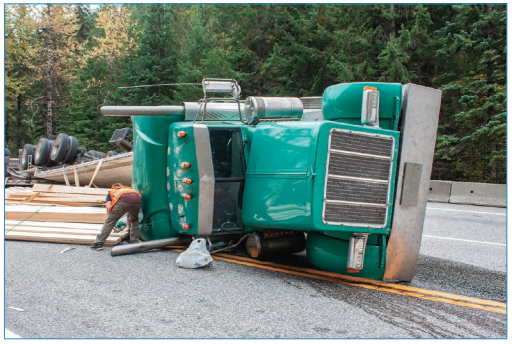
Cargo that is not properly secured may result in:
• Loss of life
• Loss of goods
• Damage to the cargo
• Possible collision with other road users
• Injury to other road users
• Delays for other road users due to roads being closed
• Damage to the vehicle you’re driving and/or other vehicles you’re sharing the road with
• Fines or penalties
• The vehicle being placed out-of-service
The rules of loading docks can vary from location to location. Be alert and ask questions when loading at an unfamiliar dock. Take notice of the dock area and any special procedures or traffic direction indicators.
When your vehicle is properly aligned to the dock and ready to load or unload, you must be ready to design a loading pattern. Careful planning is very important to protect the security of the load and prevent weight imbalances.
Ensure you’re wearing appropriate personal protective equipment whenever working with cargo.
Loading considerations
It requires skill while loading in order to maximize the payload. It’s important not to be overweight, but also important to haul the maximum load that your cargo space allows. This ensures success in a highly competitive hauling business. Truckers must learn to load the maximum allowable cargo by making economical use of all available space.
• Check container markings that refer to loading, such as this end up and fragile.
• Place heavy goods on the bottom.
• Place light and fragile goods on top.
• Block and brace any items that may shift in transit.
• Don’t mix incompatible cargo.
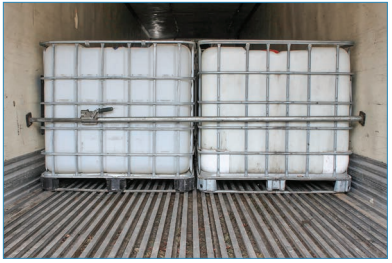
• To help prevent load shifts, use load locks or straps whenever they’re available as they help to stabilize cargo when you don’t have a full load.
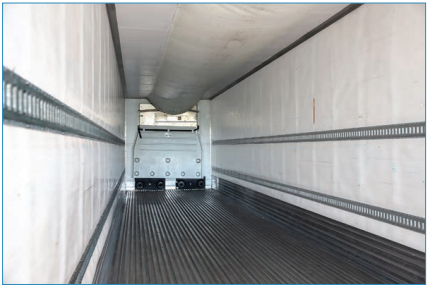
Cargo loading equipment
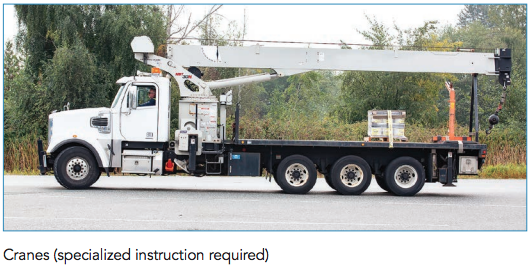
Using proper loading equipment makes loading easier and prevents damage to cargo through mishandling. Proper equipment can also help prevent back injuries and other incidents during loading. You’ll quickly become familiar with this equipment once you begin working in the industry. In many cases, a shipping and receiving dock worker will operate the equipment, but on occasion you may need to do the actual loading.
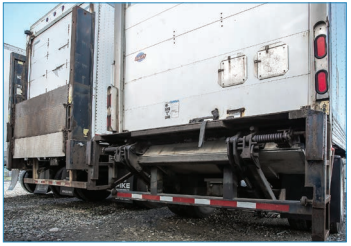
Dock plates and boards, loading dock levellers and hydraulic lift tailgates
These are ways you can bridge the space between the loading area and the rear of the trailer:
• Hydraulic lift tailgates are used on some trailers and many straight trucks to lower cargo to the ground or to lift it up from the ground.
• Walking ramps may be used in conjunction with a hand truck to load/unload smaller items from the back of a truck or trailer.
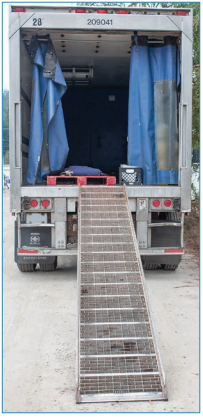
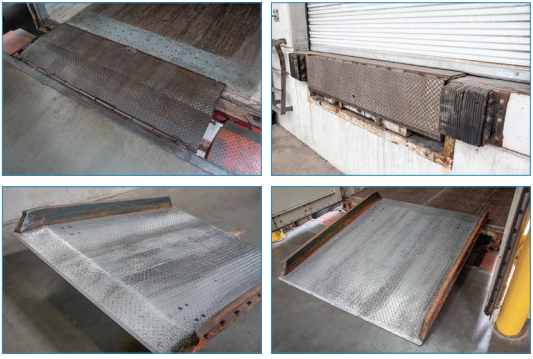
• Slanted dock plates on which forklifts are driven onto the rear of the truck are used when loading dock levellers aren’t available.
• Dock boards are used between the rear of the truck and the dock for light loads usually carried on hand trucks.
• Make sure dock plates/boards are secure before travelling into the trailer. They should be level with the trailer and dock before you use them.
Hand truck
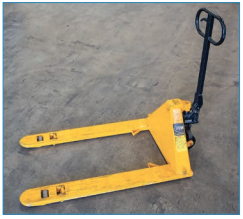
This is the most widely used type of cargo handling equipment. Hand trucks are used to load items, such as as household appliances, large cartons or several smaller cartons at one time. There are also special two-wheel trucks available to handle barrels and drums, known as drum trucks. Always use a specialized hand truck to load barrels or drums.
Take care when using hand trucks and don’t overload them. Use a strap to hold the cargo if necessary.
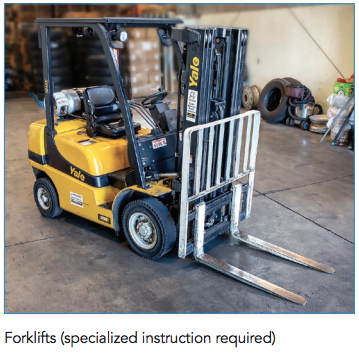
Forklift operation
Regulations require that you receive specialized training and have demonstrated competency to operate a forklift. Make sure you’re familiar with the operating instructions of any forklift that you operate.
Forklift operators should follow these general guidelines:
• Always wear your seatbelt.
• Always lift the load clear off the ground so that it can’t catch or snag.
• Use good visual scanning techniques. Look in the direction of travel, check overhead and side clearances and if the load blocks your view, travel in reverse.
• Brake to a complete stop before reversing.
• Operate at a reasonable speed.
• Warn pedestrians and others with the horn.
• Drive smoothly, avoiding sharp turns or sudden jerks.
• Watch out for sideways swing during sharp turns that can occur because of the rear steering.
• Don’t drive over small objects. This could bring the vehicle to a stop and cause the steering wheel to spin. Failing to avoid small objects in your path could result in serious injury
• Carry the load properly. Keep the forks low from 10−15 cm (four to six in) off the ground and when travelling, cradle the load by tilting the mast back slightly.
• When travelling up or down a grade, the load must be facing uphill.
• If you’re working with a forklift, make sure that your trailer is secure. Many loading docks have locks to achieve this purpose. If a dock doesn’t have a lock, then you should chock the trailer wheels, put the tractor in gear and apply the parking brake while loading or unloading.
Drivers should learn to communicate effectively with forklift operators, follow the dock procedures and monitor their own safety and that of the forklift operator. Stay out of the pinch points and always agree on hand signals with the operator.
Inspect cargo carrying space
The first thing a driver should do is always inspect the cargo carrying space before the loading occurs.
Van trailers:
• Make sure there’s no damage to the sides or roof which would allow water to leak on the cargo. Inspect the floor for holes or damage and ensure it’s adequate to support the weight of the cargo.
• Check for potential cargo damaging conditions such as protruding nails, bolts, metal edges, holes or leaks. Workers loading a van trailer could be injured by some of these damaging situations.
• Sweep out the trailer if it wasn’t done by the last person who used it.
Flatbed trailers:
• Make sure the deck and flooring are adequate, free from damage and strong enough for the cargo.
• Make sure any holes are patched.
Flatbed trailers with removable sides:
• Make sure all sideboards are in place and properly attached to stakes.
• Ensure stakes are properly seated to prevent cargo leakage onto the highway and to protect the cargo from getting wet.
Inspect packing
Inspect the packing before accepting a shipment. Things to watch out for include:
• Damaged cargo
• Cargo that will damage other cargo
• Wet or leaking cargo
• Improperly packed cargo
Improperly packaged or crated cargo can be damaged en route or cause
damage to other cargo or the vehicle. Check containers carefully to make sure they meet the following criteria:
• Containers are adequate for the cargo (for example, items aren’t too heavy).
• Containers are properly sealed so cargo can’t break out in transit.
• Containers are packed tightly ensuring loose cargo doesn’t cause damage en route and your load doesn’t become unstable.
If the cargo is damaged in any way, follow your company’s policy for actions to take. In some cases, a driver must refuse the cargo or note problems on the shipping papers to avoid liability.
Weight distribution
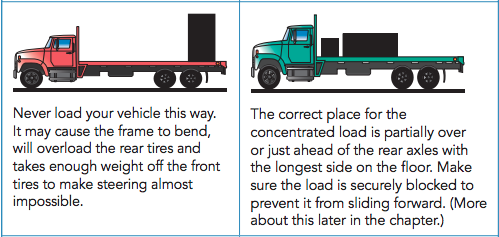
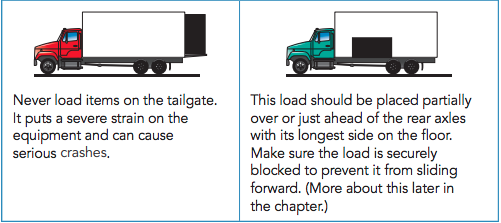
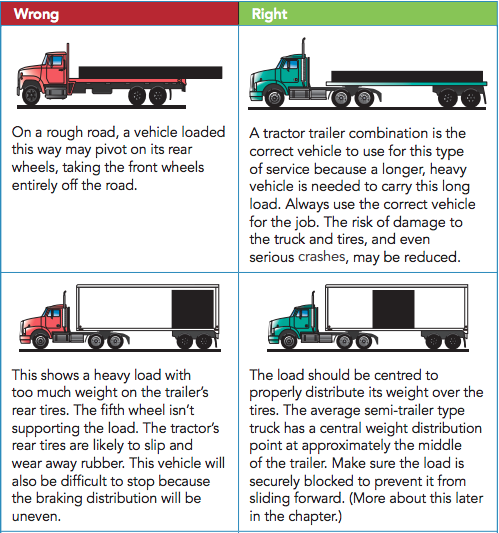
For proper handling of the truck, it’s important that the cargo weight is correctly distributed. Apart from affecting vehicle handing, improper cargo weight distribution may also be illegal and cause you to get a ticket and be delayed
while your truck is reloaded. When the weight of a tractor-trailer is balanced, it reduces the possibility of rollover.
It’s your responsibility as a professional truck driver to ensure that each load is balanced and the weight is distributed evenly between the tractor’s drive axles and the trailer’s rear axles prior to transporting the cargo.
Trailer weight can be adjusted by sliding the rear axles of the trailer (if it’s adjustable):
• When the axle is moved forward, more weight is shifted to the trailer axle and shifted off of the tractor.
• When the trailer axle is moved backward, more weight is shifted onto the tractor.
Don’t overload
Enforcement officers keep a close watch on highways for overloaded vehicles that violate regulations for maximum gross weight and individual axle weight.
Provinces, territories and states have regulations governing the length, width and height of loads. The highway weight restrictions are designed to protect the road surface from excessive deterioration.
You must have a permit for any oversized or overloaded cargo and drivers caught violating load regulations are subject to heavy fines costing you both time and money. Each vehicle type has a maximum weight rating that’s designed to fit the vehicle’s steering and braking systems. Overloading your rig creates unacceptable safety hazards.
Note: Overweight/oversize and other permits can be obtained online at CVSE.ca.
For more information on vehicle weights and dimensions, see chapter 11 — Documents and regulatory requirements.
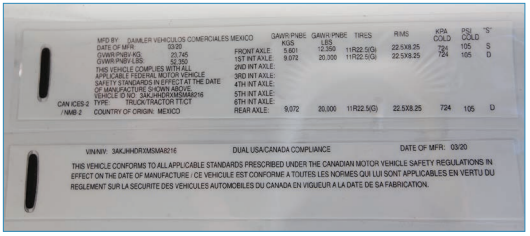
Each manufacturer determines the maximum capacity limits for each vehicle by considering the combined values of the strongest weight bearing components (the axles) and the weaker components (vehicle body, frame, suspension and tires). When these factors have been rated, the manufacturer sets the vehicle’s Gross Vehicle Weight Rating (GVWR) in accordance with the standards set by Transport Canada. Vehicle modifications may be illegal and may affect this rating.
The easiest way to figure out how much weight your vehicle is designed to carry is to subtract the net weight of the vehicle (found in your owner’s manual, insurance papers or scale ticket) from the GVWR (found on the driver’s door post). The remaining number is the maximum weight your vehicle can safely carry. This value includes the weight of passengers, fuel and cargo.
GVWR – Net weight of vehicle = Weight vehicle is designed to carry
Example:
23,600 kg – 9,500 kg = 14,100 kg
Therefore, the vehicle can carry 14,100 kg weight without being overloaded.
GAWR – Gross Axle Weight Rating = Maximum load weight that can be placed on the axle.
Note: The placement of the load on the tractor can’t be concentrated in only one area. Each axle has a maximum weight rating and when crossing scales, the weight on each axle must not exceed the gross axle weight rating.
Example:
• Tractor front axle weight rating (GAWR) … 5,450 kg
• Tractor intermediate axle weight rating (GAWR) … 9,075 kg
• Tractor rear axle weight rating (GAWR) … 9,075 kg
• Tractor total weight rating (GVWR) … 23,600 kg
Aftermarket accessories or equipment will increase the net weight of the vehicle. The extra weight must be added to the net weight listed in your owner’s manual. If you want to check the net weight of your vehicle, weigh your unloaded vehicle.

Increasing a vehicle’s GVWR is possible. However, modification to a vehicle’s rating can only be done at facilities that are recognized by Transport Canada, since GVWR standards are set and enforced by Transport Canada.
The vehicle must also be licensed and insured for the proper gross vehicle weight which includes any trailers and their load when attached. If coverage isn’t correct, insurance claims may be denied. You need to have the correct size tires installed as well to meet the legal axle loadings that are permitted by the jurisdiction in which you’re operating. The legally allowable axle weights may be less than the GAWR of your vehicle.
Regulations aren’t the only reason for monitoring your cargo. The way that cargo is secured will also affect the vehicle handling, safety and fuel efficiency of the vehicle combination. Overloading your tractor-trailer vehicle combination can cause:
• Problems with braking, handling, steering and speed control that may lead to crashes and increase your stopping distance
• A high centre of gravity — this may cause a vehicle to roll over
• Danger on curves or if you have to swerve to avoid a hazard
• Lost or damaged cargo or vehicle damage
• Danger to other drivers if they’re hit by loose cargo objects
• Increased fuel consumption
• Legal and safety penalties
• Vehicles to be placed out of service if the vehicle components fail inspections due to load securement infractions
• Lost money and time if it’s necessary to reload or shift the cargo to another vehicle
• Damage to road surfaces
In addition to following the regulations, consider the driving conditions when you’re loading or securing cargo. You’ll recall from Chapter 12 — Trip planning, that some B.C. roads may be restricted as part of the seasonal strength loss program that identifies and imposes load restrictions on roads or portions of roads that have been weakened by excess water in the road base. Remember that full loads may be too much for spring road restrictions. You also want to distribute the weight on the vehicle in a fashion that will provide for the best vehicle handling and traction. Keep in mind how your load will change if you have multiple drops.
National Safety Code (NSC) Standard 10 — Cargo Securement and MVAR Division 35 use terms such as “immobilize”, “contain” and “restrain” to define how cargo might be secured on or within a vehicle. These terms are simply describing different ways of making cargo secure.
Immobilize
This means not moving or incapable of being moved. Cargo that’s immobile would be the most secure. Unfortunately, testing has shown that it’s almost impossible to immobilize cargo so that absolutely no movement occurs. There will almost always be spaces between cargo, other cargo and restraining devices, so slight shifting will always occur.
Restrain
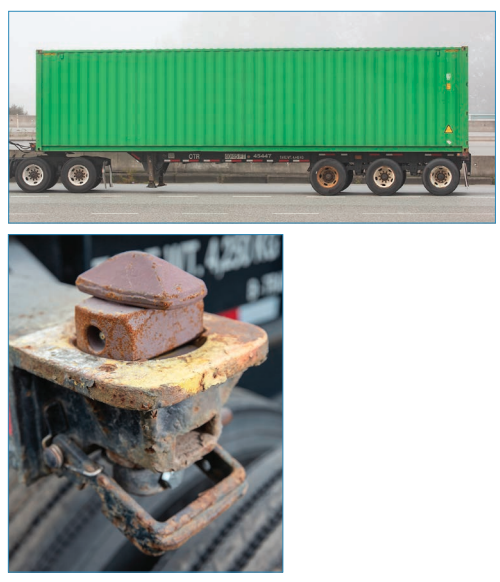
The most common way to secure cargo is to restrain it. Restraining cargo means to limit or hold back any movement in any direction, usually by the vehicle frame, body and tie-downs. Restrained cargo will still move to a certain extent, so it’s not the same as immobilizing it. Even though it may be able to move, cargo will be secure when it’s restrained in a way that it can’t be lost from the vehicle.
Contain
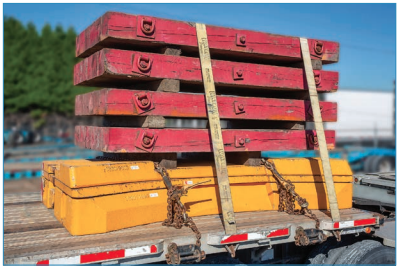
Containing cargo may involve packaging, vehicle structures and body panels, other cargo and shipping containers of various types. Cargo that’s contained is generally able to move freely inside a space or zone, but it can’t leave that space. Contained cargo could move around inside the container. Therefore, the container itself must be able to withstand the cargo’s movement, and in some cases, the cargo may need to be restrained or immobilized within the container
Lateral forces on cargo
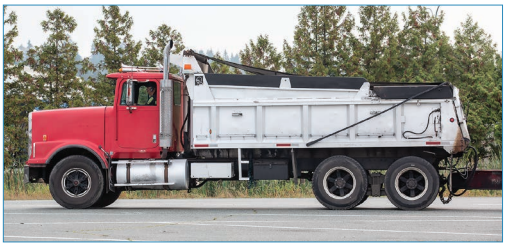
You must understand the lateral forces that develop while driving a vehicle, particularly when the vehicle is heavy and carrying cargo. Cargo tends to move laterally (sideways and forward or backward) from the forces of stopping, starting and manoeuvring around curves and turns. Just as important are how these forces develop and their effect on the vehicle and the cargo.
The cargo securement standard is designed to ensure that cargo remains secure despite the forces that will occur during normal driving. In fact, there’s enough of a safety factor in these performance standards that most vehicles will never experience the maximum forces during driving. It’s only in certain sudden emergency manoeuvres that forces will come close to reaching maximum values.
Improperly restrained cargo will slide when lateral force is high enough. Sliding cargo also causes the vehicle’s centre of gravity to shift which increases the tendency to roll over. A vehicle travelling at a speed of 70 km/h (43 mph) on a ramp posted for 40 km/h (25 mph) can produce lateral force up to about 0.50 g (five times the normal weight).
The forces affecting your load during normal driving are lower than your securement method must withstand. Normal driving occasionally includes making emergency manoeuvres and your method of securing the cargo must withstand the forces that are created.
A cargo securement system combines the use of one or a combination of the following components:
1. Vehicle structure — including floors, walls, decks, tie-down anchor points, headboards, bulkheads, stakes, and posts. You must ensure that all these vehicle elements are in good working condition.
2. Securing devices — these are devices that are specifically designed and manufactured for cargo securement to a vehicle or a trailer:
• Webbing
• Chain
• Wire rope
• Manila rope
• Synthetic rope
• Steel strapping
• Clamps and latches
• Blocking
• Front-end structure
• Grab hooks
• Binders
• Shackles
• Winches
• Stake pockets
• D-rings
• Pocket
• Webbing ratchet
• Bracing
• Friction mat
3. Blocking and bracing equipment — structure, device or article placed against or around cargo to prevent horizontal movement or tipping. To withstand splitting or crushing by the cargo, the materials used for blocking or bracing must be strong. When wood is used, it must be a hardwood that has been properly seasoned and is free from rot, knots and splits.
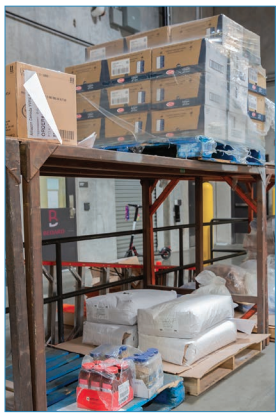
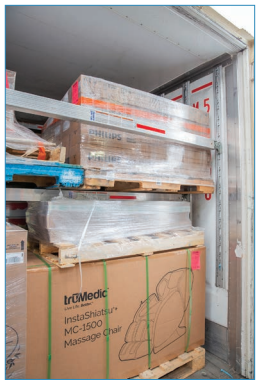
4. Dunnage — filler material used in the empty spaces between cargo. Dunnage keeps the cargo from shifting. Wood, cardboard, airbags, extra pallets, bubble wrap and plastic are types of material used as dunnage.
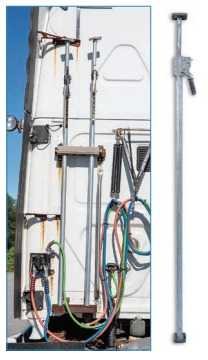
5. Load locking bars — used vertically or horizontally, these bars have rubber feet that are placed against the vehicle walls or ceiling and floor. The bars are placed snugly against the cargo and then tightened with a jacking device until they’re tightly wedged in place against the cargo. Jack bars no longer have a weight rating for securing cargo and need to be supplemented with other securement devices as required to meet the regulations.
6. Tarps — if you carry freight in an open cargo area, you may need to use a tarp. Tarps prevent loose material like sand, peat moss, gravel, wood chips and salt from blowing or falling out of a vehicle. They can also be used to protect cargo from the weather. If you use a tarp, ensure that it fully covers your load and is secured at all securing points. While travelling, check your mirrors frequently to make sure the tarp hasn’t become loose, causing a hazard for you and other road users. Loose tarps can also create a distraction for the driver.
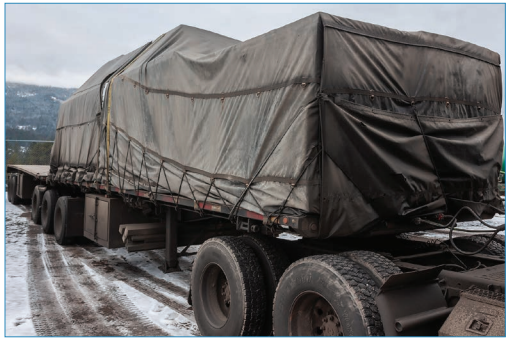
According to Part 1, Division 2 of NSC Standard 10, General Performance Criteria, all vehicle structures, systems and parts used to secure cargo must:
• Be in proper working order and fit for the purpose for which they are used
• Be used on the correct type of cargo
• Not have knots, damage, cracks, cuts or weakened parts that may negatively affect on performance
• Be secured in a way that ensures they won’t come unfastened while the vehicle operates on a highway
• Be able to withstand a specified amount of force in the forward (0.8 g deceleration), rearward (0.5 g deceleration), sideways (0.5 g acceleration) and downward directions.
Friction mats
Friction mats help to restrain cargo by increasing the level of friction between an article of cargo and the deck of the vehicle. A variety of friction mats are available made primarily from recycled rubber and composite material specifically designed to restrain cargo.
Friction mats are suitable for cargo that has a flat and relatively smooth bottom surface with a large enough area to rest on the mat itself. They’re not useful for a heavy article that rests on legs or feet with a small contact area. For a friction mat to be effective, an article should be placed on it so that at least 50 percent of the bottom surface area rests directly on the mat. The friction mat must protrude beyond the cargo in the direction it’s meant to restrain. Leaving a portion of the mat showing outside the footprint of the cargo in all directions will help you confirm it’s there and correctly positioned.
Tie downs
When you carry freight on open vehicles, such as flat decks, tie downs are almost always required, but you may also need to use tie downs for certain freight in closed vehicles. You must understand their correct use and be familiar with the regulations that apply to them as the tie down method used depends on the vehicle and the cargo’s shape, size, weight and stability.
You may use tie downs to produce only downward force, provide restraint in a single direction or provide restraint in several directions at the same time.
Cargo tie downs may be any of the following or they may be assemblies that include more than one of these elements:
• Chain
• Web straps or synthetic webbing
• Natural or synthetic rope
• Wire rope or cable
• Steel strapping
A tie down must be designed, constructed and maintained in a way that the
driver can tighten it.
Tie downs must not be used for cargo securement if:
• The chain has cracked welds or links
• The chain has bent, twisted, stretched or collapsed links
• Chain links are weakened by gouges, nicks or pits
• The chain is incorrectly repaired
• Chain links are obviously worn or showing other evidence of loss of strength
• There are knots in any portion of chain, wire rope or webbing
• There are spread or disturbed grab hooks
• Nylon webbing has cuts, nicks or splits
• Wire cable has missing strands or wraps
• An anchor point is weakened or shows loss of strength due to cracks, breaks or distortion
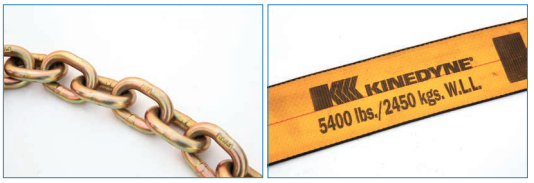
Tie downs and other securement devices must be strong enough to properly secure a load. Manufacturers test these devices to determine how much force can be applied to them before they will break.
The “working load limit” (WLL) of a securement device refers to the maximum load that may be applied to that device during normal service. The “aggregate (combined) working load limit” is the sum of the working load limits of all devices that are used to secure an article on a vehicle.
To calculate aggregate (combined) working load limits:
• For tie downs that go from one anchor point to another on the vehicle, add the WLLs of each tie down to get the aggregate WLL of the load.
• For tie downs that go from one anchor point on the vehicle to an attachment point on the cargo itself, add together: 50 percent of the WLL of each end section of a tie down that’s attached to the cargo.
The total working load limit of any cargo securement system must be at least half of the weight of the load being secured.
Current standards forbid the use of unmarked tie downs. Tie downs must be marked by the manufacturer with respect to their WLL. This ensures that all drivers use the proper equipment for securing a load.
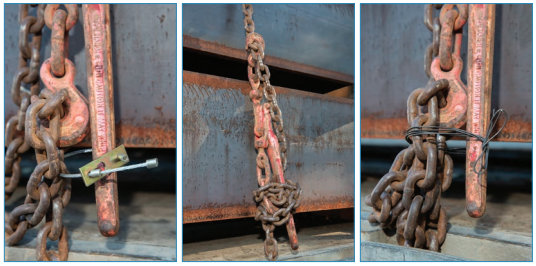
How to properly use a tie down
Ensure that each tie down is secured so that it doesn’t come loose or unfastened and doesn’t open or release while the vehicle is moving. This means you must be able to securely tighten a tie down before transporting cargo on a highway.
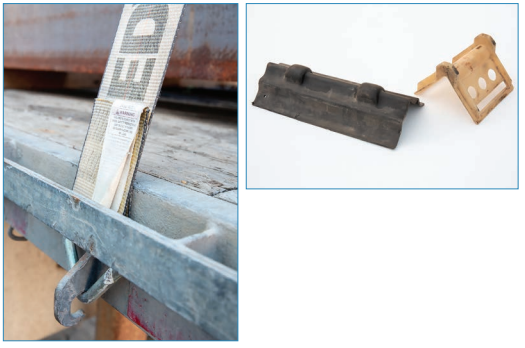
All tie downs and other parts of a cargo securement system must be located inside any rub rails whenever practical. Edge protection must also be used whenever a tie down would be subject to wear or cutting at the point where it touches an article of cargo. The edge protection must resist wear, cutting and crushing.
Some tie downs are passed over or through the cargo. When properly used, a downward force is created to increase the friction between the cargo and the vehicle’s deck. The friction created restrains the cargo.
Note: Before a securement system is selected, you must ensure that it’s appropriate for the cargo size, shape, strength and characteristics.
Strapping
When securing flatbed loads with strapping, make sure that the type of strapping used is strong enough to secure your load. The strapping must conform to load securement laws.
Apply sufficient tension to the strapping so that it’s snug to the load.
Winch, ratchet and wrench drive strap assemblies are among those used to tighten and lock web strapping securely to the load.
Nylon web strapping doesn’t deteriorate due to moisture, but it can rot when exposed to long periods of sunlight, so it’s always stored out of the light when it’s not in use. Because it can be chafed or weakened by items with sharp edges, it’s used in conjunction with edge protectors.
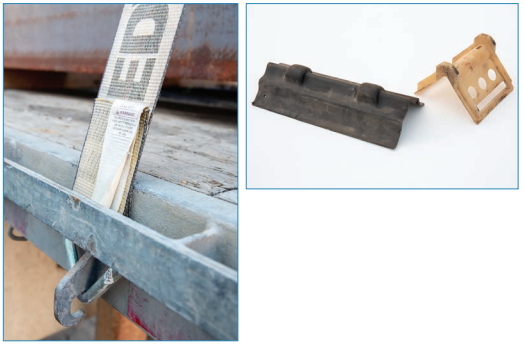
Winch type
• A J-hook or D-ring at the end of the strap is anchored to the vehicle after you’ve tossed the loose end of the strap over the load.
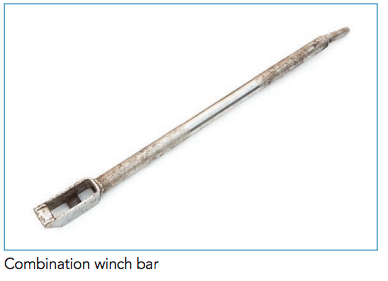
• Once all belts are thrown, you feed the loose end of the belt through a winch mounted on the side of the vehicle and tighten them up with a winch bar. Straps should be taut when securing cargo. Be careful not to damage your cargo by over tightening your securement devices.
Cargo, such as heavy loads of lumber, might be secured with this type of strapping. To use it, first pull the webbing to eliminate any slack. Then, use a winch bar to tighten it until proper tension is achieved. When it’s time to unload, you’ll need to use the winch bar again to release the tension.
Webbing is easier to use, cheaper than chains and can be used on a variety of load sizes and weights, but it’s subject to chafing and isn’t as durable as chain. It can’t be used to secure machinery and certain other metal products because of the possibility of its being sliced by sharp edges and releasing the load.
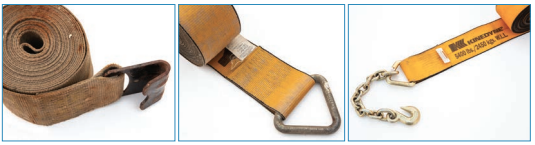
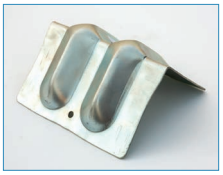
Typical edge protectors that are used with nylon strapping include old rubber tire sections, old pieces of web strap or commercially available corners used on cargo edges. These edge protectors are also used to protect cargo from damage caused by chains.
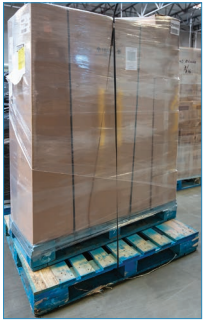
Steel strapping is used to reinforce cartons and secure cargo to pallets, but it isn’t strong enough to secure loads to a flatbed. Vibration has a tendency to tear steel strapping so when using it, ensure that it’s protected from sharp edges and chafing.

There are other drawbacks to using steel strapping. Strapping must be joined properly and if it’s at least 2.5 cm (1 in) wide, it must have two pairs of crimps for each join. End overlap joints must have two seals. Steel strapping will come loose easily if its crimps and seals aren’t installed correctly.
Chains
Chain links are the strongest type of securement for flatbed loads. The working load limit of a chain is determined by its type, grade and size. Chains are available in a range of sizes and with different shapes of links (shorter links are stronger) and you must know how to select the proper chain for a given load.
Chains aren’t suitable for some loads. For example, fragile cartons would be severely damaged by chains.
Chains have a Safe Working Load Limit (SWLL), which is established by the manufacturer and printed in the manufacturer’s rating charts. Don’t rely on the SWLL alone. Chains should be checked for deformation, twists, bends, cracks, wear or other flaws that could make them weaker than their rated SWLL.
For example, you wouldn’t use this chain as it’s broken.

Hooks
When a hook is used with a chain, it must have an SWLL which is no less than the SWLL of the chain. Check hooks for defects such as gouges, nicks, cuts or cracks.
Types of hooks include:
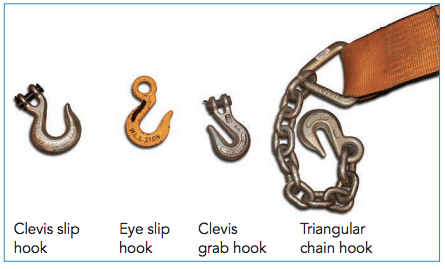
Defective hooks or chains must not be used for tie downs. A defective hook should be tagged out of service and sent for recycling.

Chain binders
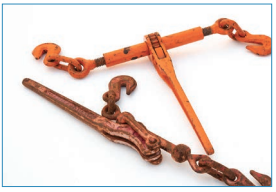
Chain binders are used to tension the chain over the load and lock it in place. The chain binder handle is manipulated slowly, when it overcenters and tightens the chain, the handle is carefully secured in place to ensure the load won’t be accidentally released in transit. The ratchet binder uses a ratcheting system to tension rather then a lever action. The ratchet binders are a safer tensioning tool.
The requirements for chaining down a load (for example, the number of tie downs required on a flatbed) are covered in Motor Vehicle Act Regulations Division 35 — Cargo Securement. The weakest link, whether it’s the chain, hook or binder, will determine the allowable SWLL.
Chaining down an item
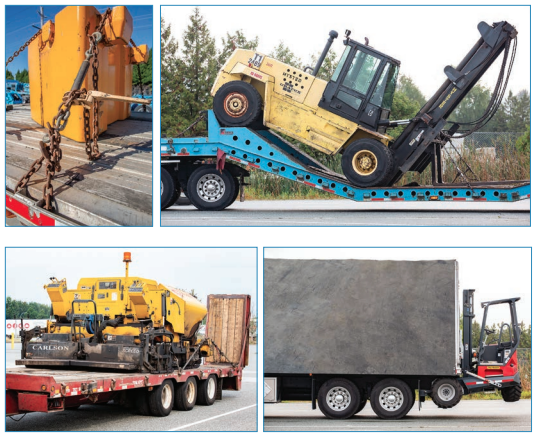
There are different methods you can use to chain down an item on a flatbed.
Check your load to ensure that the most appropriate one has been used. If the item isn’t secure, it could be lost in transit and cause an accident, a serious injury or even someone’s death. Before you leave, determine how many chains you’ll need and where they must be placed to ensure that the cargo can’t move.

For example, to prevent a large item from moving to one side, you would attach the tie downs so that they pull the cargo towards the opposite side of a flatbed. To prevent an item from moving upwards, off the deck, you would attach tie downs to opposite sides of the cargo and pull down with them.
Securing freight in vans
This is accomplished in various ways.
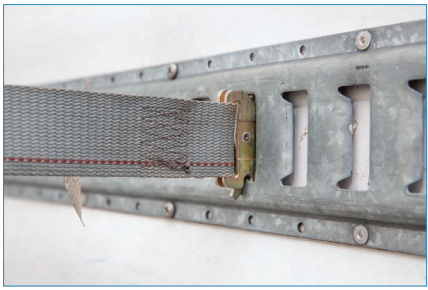
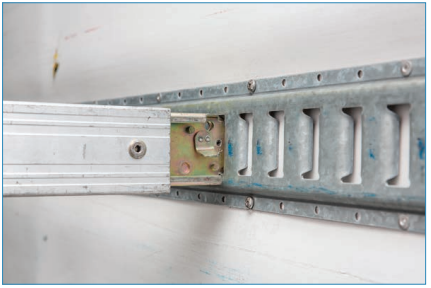
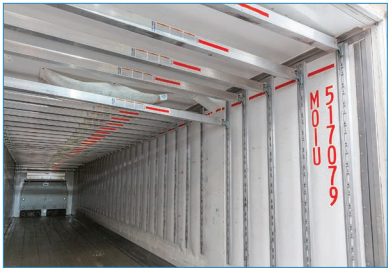
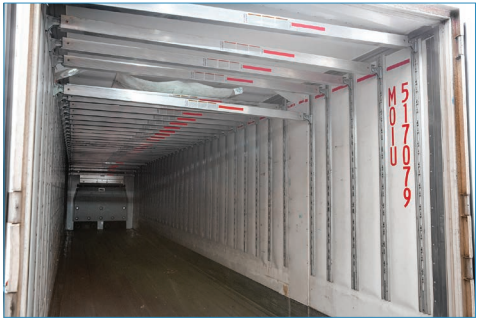
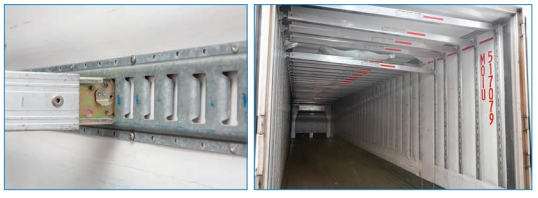
• Most van trailers have either vertical or horizontal E-track rails built into the van trailer walls. Special attachments on each end of a locking bar can be clipped into position in the E-track rail to keep freight from moving.
• E-track straps may also be used to secure freight from moving inside van trailers.
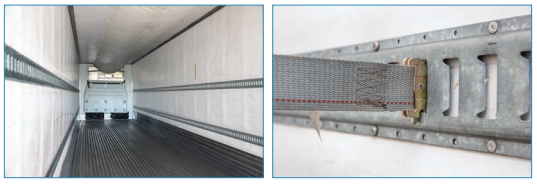
• Dunnage can be used to block the load; sometimes dunnage is nailed to the floor.
• Special friction mats designed for awkwardly shaped cargo, such as rolls of paper, create resistance to horizontal movement and are rated for different loads.
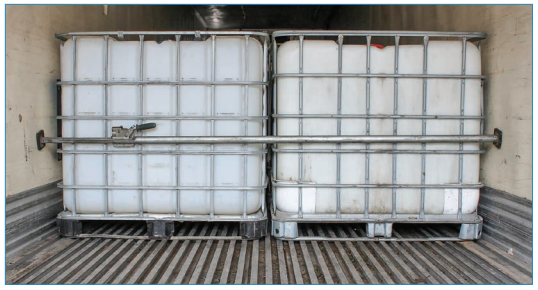
• Rubber feet are placed against the truck walls and a jack is operated until the bar is wedged tightly in place. Jack bars no longer have a weight rating for securing cargo and need to be supplemented with other securement devices as required to meet the regulations.
Minimum number of tie downs
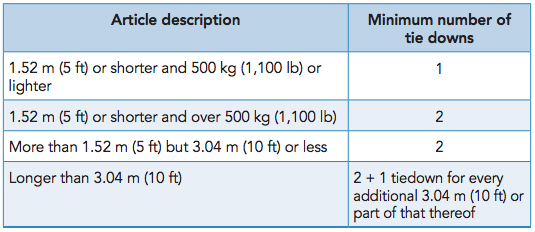
The following table shows the minimum number of tie downs required if an article of cargo on or in a vehicle isn’t prevented from moving forward by a front end structure, tie down, other cargo or a device like the drop on a step deck trailer.
As a rough guide, use two tie downs for the first 3.04 m (10 ft) of a load and one tie down for every 3.04 m (10 ft) after that. Machinery or fabricated structural items that need special securement because of their size, design, shape or weight are exempted from these requirements.
When cargo is prevented from moving forward, the minimum number of tie downs required is one tie down for every 3.04 m (10 ft) of length.
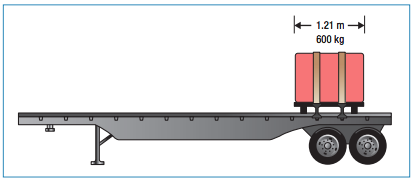
This article is 1.21 m (4 ft) long and weighs 600 kg (1,323 lb). The article isn’t prevented from moving forward. Use two, equally-spaced tie downs.
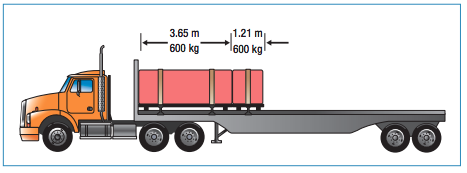
Here, two articles are arranged on a flat deck. Since the first article is butted against a bulkhead or front end structure, use only two tie downs. Since the second article is butted against the first article, use only one tie down.
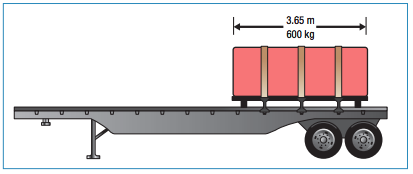
This article is 3.65 m (12 ft) long and weighs 600 kg (1,323 lb). Since the article isn’t prevented from moving forward, use three, equally-spaced tie downs.
The total working load limit of any cargo securement system must be at least half of the weight of the load being secured.
Some vehicles transport cargo that’s in contact with the front-end structure of the vehicle. A “front-end” structure, according to NSC Standard 10, is a vertical barrier that’s placed across the front of a deck that prevents cargo from moving forward. It’s important to note that a cab shield is not a front-end structure or part of the cargo system. Front end structures must meet the following requirements:
Height and width
The height of the front end structure of a vehicle can’t be shorter than:
a) The height at which it prevents cargo from moving forward
b) 1.22 m (48 in) above the deck
The width of the front-end structure of a vehicle can’t be narrower than:
a) The width of the vehicle
b) The width at which it prevents cargo from moving forward
Strength
The front-end structure of a vehicle must be able to withstand a horizontal forward static load equal to 50 percent of the total weight of the cargo where:
a) The height of the front end structure is shorter than 1.83 m (6 ft)
b) The cargo is uniformly distributed over all of the front-end structure
The front-end structure of a vehicle must be able to withstand a horizontal forward static load equal to 40 percent of the total weight of the cargo where:
a) The height of the front end structure is 1.83 m (6 ft) or higher
b) The cargo is uniformly distributed over all of the front-end structure
Penetration resistance
The front-end structure of a vehicle must be able to resist penetration by an article of cargo that contacts it when the vehicle decelerates at a rate of 6.1 m (20 ft) per second per second. The front-end structure of the vehicle cannot have an opening or gap that is big enough to allow an article of cargo to pass through it.
Depending on the industry you work in, you may haul various types of commodities that have unique load securement requirements under NSC Standard 10 — Cargo Securement and MVAR Division 35. Information found here is an overview only. You should receive training through your company on the specifics of loading and securing cargo you carry.
The following cargo require additional securement considerations:
• Logs
• Dressed lumber
• Metal coils
• Paper rolls
• Concrete pipe
• Intermodal containers
• Vehicles (small, large, crushed)
• Roll-on/roll-off or hook lift containers
• Boulders
Logs
There are many rules for the transportation of logs. A carrier must have a vehicle that was built specifically for hauling logs, but must also secure those logs according to the requirements in NSC Standard 10.
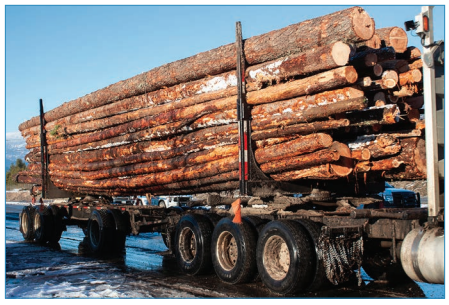
The rules for the transportation of logs apply to the transportation of almost all logs except:
• Loads of no more than four logs
• Firewood, stumps, log debris or logs that are transported in a vehicle or container that’s enclosed on all sides and strong enough to contain them
In only the examples above, logs may be transported using the general cargo securement rules.
Dressed lumber
Dressed lumber is lumber that has been surfaced or planed smooth on four sides. Special rules for the securement of dressed lumber apply to:
• Bundles of dressed lumber and packaged lumber
• Building products including plywood, gypsum board or other materials of similar shape
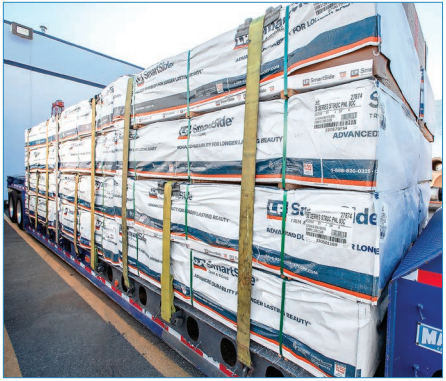
These items must be secured according to the requirements in NSC Standard 10.
Lumber or building products that aren’t bundled or packaged must be treated as loose items and transported using the general cargo securement rules.
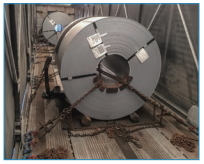
Metal coils
Special rules for the transportation of metal coils apply to a vehicle that’s transporting one or more metal coils that, individually or grouped together, have a total weight of 2,268 kg (5,000 lb) or more. These coils must be secured according to the requirements in NSC Standard 10. Shipments of metal coils that weigh less than 2,268 kg (5,000 lb) may be secured using the general cargo securement rules.
Paper rolls
Special rules for the transportation of paper rolls apply to a vehicle that’s transporting one or more paper rolls that, individually or grouped together, have a total weight of 2,268 kg (5,000 lb) or more. These rolls must be secured according to the requirements in the NSC Standard 10. Shipments of paper rolls that weigh less than 2,268 kg (5,000 lb) may be secured using the general cargo securement rules.
Concrete pipe
Special rules may apply to vehicles, flatbed trailers and lowboy trailers that are transporting concrete pipe. The pipe being transported must be secured according to the requirements in NSC Standard 10. Concrete pipe that’s bundled tightly together into a single rigid piece with no tendency to roll and concrete pipe loaded into a sided container must be secured using the general cargo securement rules.
Intermodal container
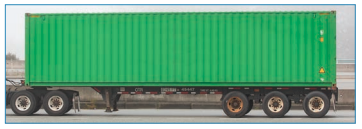
Intermodal containers are freight containers that are designed to be transported in more than one way (for example, by road, rail or sea). These containers must either be transported on a chassis vehicle or must be secured on a different vehicle according to the requirements in NSC Standard 10. Cargo that’s inside an intermodal container may be secured using the general cargo securement rules unless another commodity specific rule applies.
Vehicles
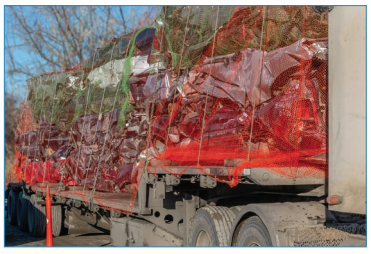
Special rules apply to the transportation of light vehicles, heavy vehicles and flattened or crushed light vehicles. These vehicles must be secured according to the requirements in NSC Standard 10. Light vehicles weigh 4,500 kg (9,921 lb) or less, while heavy vehicles weigh more than 4,500 kg (9,921 lb).
Roll-on/roll-off and hook lift containers
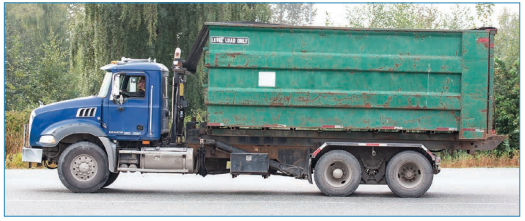
Special rules apply to the transportation of roll-on/roll-off containers and hook lift containers. Hook lift containers are primarily used to transport materials in the waste, recycling, construction, demolition and scrap industries. These containers are handled by specialized vehicles in which the container is loaded and unloaded onto a tilt frame body by a moveable hook arm. These containers must be secured according to the requirements in NSC Standard 10.
Large boulders
Special rules apply to the transportation of:
• Boulders on a flatbed vehicle
• Boulders in a vehicle that isn’t designed to contain them
• A piece of natural, irregularly shaped rock that weighs more than 100 kg (220 lb) but less than 5,000 kg (11,023 lb)
• A piece of natural, irregularly shaped rock of any size that may be contained within a vehicle that’s designed to carry it
• A piece of rock of any size that’s artificially formed or cut into shape and has a stable base for securement
These boulders must be transported according to the requirements in NSC Standard 10. Some exemptions may apply to boulders that may be secured using the
general securement rules.
For the complete requirements for these specific commodities, see NSC Standard 10. A carrier must secure each of these commodities according to the rules found in the standard. You should receive training by your employer on the specifics of loading and securing these items.
The following cargo types can shift or have a high centre of gravity. Be careful and slow down early in turns.
Dry bulk tanks and liquid tankers that transport food products, chemical products and building materials require special care, because they often have a high centre of gravity and the load can shift.
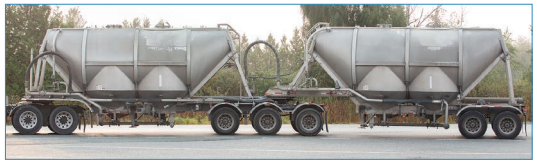
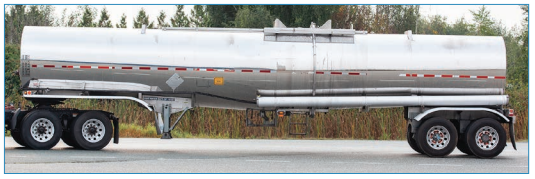
Hanging meat (suspended beef, pork and lamb) in a refrigerated truck can be a very unstable load with a high centre of gravity.
Livestock can move around in a trailer causing unsafe handling. With less than a full load, use false bulkheads to keep livestock bunched together. Even when bunched together, special care is necessary because livestock can lean on curves.
Over-length, over-width and/or overweight loads require special permits and may be limited to certain times and specific routes. Special equipment may be necessary, such as “wide load” signs, flashing lights, flags and so on. Such loads may require pilot vehicles bearing warning signs and/or flashing lights.
Dangerous goods constitute a special form of cargo. Drivers must receive dangerous goods training by the employer and qualify for a Transportation of Dangerous Goods Certificate before hauling dangerous goods. Transportation of dangerous goods training is not included in the B.C. Class 1 mandatory entry-level training course.
Dangerous goods are identified by:
• Classification
• Safety markings (placards)
• Documentation
Provincial and federal transportation of dangerous goods regulations must be strictly followed. Before drivers accept a shipment of dangerous goods, the shipper has several responsibilities when preparing the shipment. The shipper must be trained and certified to handle the goods and before offering dangerous goods for transport, the shipper must:
• Know the classification of the goods
• Label and mark packages or small containers
• Provide placards
• Complete a shipping document
Drivers must ensure that the shipper has done these things before the dangerous goods are loaded on their vehicle.
There are two main reasons for covering cargo:
1. Spill protection (to protect the public).
2. Cargo protection (to protect the cargo).
Spill protection
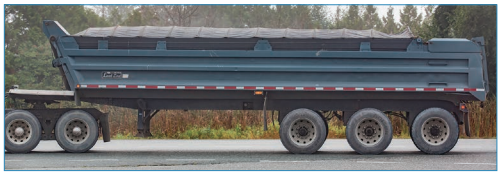
Most laws require that sand, gravel, aggregate and small loads be covered. It’s the driver’s responsibility to know and comply with laws, ensure that the cover is secured properly and monitor the covering while driving. It’s very important that drivers protect the public and meet all legal requirements of spill protection.
Cargo protection — tarps
Cargo can be ruined if it’s not protected from the weather, so you must cover it to help prevent corrosion or other weather damage. When a tarp is required to protect cargo, it’s your responsibility to ensure that it doesn’t leak and is tied properly. A company will be liable for damaged cargo.
To ensure cargo isn’t damaged, avoid sudden stops and starts and handle curves and on ramps carefully.
Tarps are typically used on flatbeds and open top trucks/trailers for hauling bulk commodities, such as gravel or wood chips. You must check the cargo covering for damages before using it. If a tarp is damaged, it must be patched by a professional.
To put a tarp on a flat deck load:
1. Slip the tarp on from front to back (if two tarps are used, install the rear tarp first)
2. Pull it back so the nose fits snugly, and centre it so it hangs evenly
3. Tie it securely with rubber straps or rope
4. Protect the cargo covering from any sharp edges of the cargo
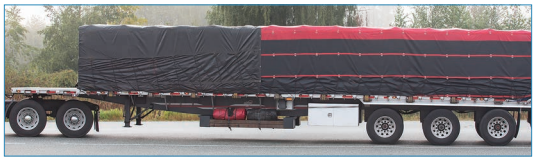
Monitor the tarp for problems while driving. A flapping tarp is caused when a tarp has been improperly secured or a tarp grommet has ripped out. This will damage the tarp, expose the cargo and prevent you from seeing the rear end of the load. You must also be cautious of wind getting under the tarp and causing a ballooning effect.
Tarps used on open top trucks and trailers are typically opened and closed by mechanical means.
Cargo security is an important part of a professional driver’s job and every year, millions of dollars in cargo and equipment are stolen. According to the Insurance Bureau of Canada (IBC), there’s estimated to be approximately $5 billion worth of cargo theft in Canada every year. Only a fraction of the stolen goods are ever recovered.
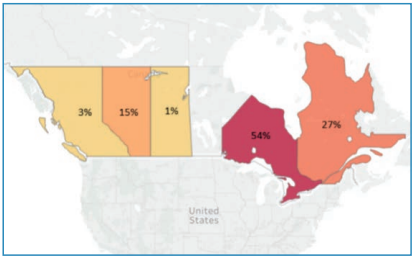
Where’s cargo being stolen from? Cargo thieves operate across Canada, but these cargo theft rates rely on cases reported. With an increase in cases reported in recent years, numbers are becoming more aligned with the reality of cargo theft in each province.
The following map indicates the distribution of reported cargo theft in Canada. While cargo can be stolen across the nation, the highest concentration of reported cargo theft is in Ontario with 54 percent of reported thefts.
Tips to prevent cargo theft
To prevent arriving at your destination only to find that somewhere along the road you were robbed, here are six tips to deter cargo theft.
1. Understand how cargo theft happens — Cargo at rest is cargo at risk. Anytime you park your truck, your cargo is at risk. There are things you can do to protect cargo when you’re stopped. The second factor to consider is to know what’s most likely to be stolen. For example, goods such as pharmaceuticals, food and electronics have more value when resold. That means thieves are looking for these things. If someone asks you what you’re hauling, it’s none of their business. Instead, tell them it’s something less desirable, such as bales of pulp, rolls of paper or empty bottles.
2. Make sure your employer provides training and education — Employers should provide you training for how to prevent cargo theft and ensure you know how to respond if you’re a victim of stolen freight. There should be a security culture in your company and all employees should be aware of cargo theft and hijacking.
3. Pay attention to your surroundings — There are certain areas where you’re more likely to be robbed than others. Some parts of the country have a higher rate of cargo theft than others, so knowing where those hot spots are is important. For example, busy roads with a lot of truck traffic are more targeted.
4. Keep your freight moving — Cargo will more likely be stolen when the truck is stopped rather than moving, but drivers do need to take breaks. Companies and drivers should work together to define time limits for how long a trailer can be stopped and unattended for different circumstances. Staying with your trailer when possible, even when stopped, can help prevent cargo theft. If you need to leave the truck unattended, be sure you’re stopped in a well-lit area and try to back up against a wall or other obstacle that would make it difficult to open the trailer’s doors.
5. Do some research and plan — Before you set out on your route, do some research on the areas you’ll be traveling through. You can plan stops that are in safer areas and plan to drive straight through the areas with high rates of cargo theft. The more you know, the better decisions you’ll be able to make.
6. Use technology and other safety measures — As pricing has become more reasonable, GPS tracking devices and security seals are becoming more common. These devices can be placed on the vehicle as well as the goods inside. When GPS devices are used, often you won’t take a full loss and you may be able to work with law enforcement to recover some or all of the items stolen. It’s also important to communicate with other drivers, company security or other personnel in the company when cargo will be left unattended for a period of time.
Anchor point — Part of the structure, fitting or attachment on a vehicle and cargo to which a tie down is attached.
Banding — A strip of material that may be used to unitize articles and is tensioned and clamped or crimped back upon itself (Same as “strapping”).
Binder — A device used to tension a chain tie down or combination of tie downs.
Blocking — A structure, device or another substantial article placed against or around an article to prevent horizontal movement of the article.
Bolster — A transverse load bearing structural component, particularly a part of a log bunk.
Bracing — A structure, device or another substantial article placed against an article to prevent it from tipping that may also prevent it from shifting.
Bulkhead — A vertical barrier across a vehicle to prevent forward movement of cargo.
Bunk — A horizontal bolster fitted with a stake at each end that supports and contains a stack of logs and is installed transversely.
Cab shield — A vertical barrier placed directly behind the cab of a tractortrailer which is capable of protecting the driver in case cargo moves forward.
Chock — A tapered or wedge-shaped piece used to secure round articles against rolling.
Cleat — A short piece of material, usually wood, nailed to the deck to reinforce blocking.
Coil bunk — A device, used in conjunction with timbers, that keeps metal coils in place during transport.
Cradle — A device or structure that holds a circular article to prevent it from rolling.
Crown — The rounded profile of the top of a stack of logs, when viewed from the ends of the stack.
Deck — The floor of a vehicle onto which the cargo is loaded.
Dunnage — loose materials used to support, protect and keep cargo in position.
Flatbed vehicle — A vehicle with a deck but no permanent sides.
Frame vehicle — A vehicle with a skeletal structure fitted with one or more bunk units for transporting logs. A bunk unit consists of a front bunk and a rear bunk that together cradle logs. The bunks are welded, gusseted or otherwise firmly fastened to the vehicle’s main beams and are an integral part of the vehicle.
Friction mat — A device placed between the deck of a vehicle and cargo or between articles of cargo, intended to provide greater friction than exists naturally between these surfaces.
Gross vehicle weight (GVW) — means the number of kilograms derived by adding the weights on all the axles of a commercial vehicle. It includes the net weight of a vehicle and the weight of its load. For commercial vehicles, the GVW for any given trip cannot exceed the licensed GVW.Gross vehicle weight rating — means the value specified by the vehicle manufacturer as the loaded weight of a single vehicle.
Gross weight, all axles — means the sum of the individual axle weights of all the axles of a vehicle or combination of vehicles.
Gross weight, group of axles — means the sum of the gross axle weights of all the axles comprising the group of axles.
Gross weight, single axle — means the gross weight carried by a single axle and transmitted to the road by the wheels of that axle.
Headboard — A vertical barrier across the front of the deck of a vehicle to prevent forward movement of cargo.
Licensed gross vehicle weight (GVW) — means the GVW for which a vehicle is licensed. The maximum licensed GVW of a vehicle or combination of vehicles must not exceed 63,500 kg under B.C.’s Commercial Transport Regulations.
The licensed GVW is not calculated for commercial trailers, as GVW of the commercial trailer is included in the licensed GVW calculation of the towing vehicle. In B.C., for commercial vehicles designed to carry a load, the licensed GVW is required to be a minimum 1.5 times the net vehicle weight.
Load capacity — The weight of cargo that a vehicle can carry when loaded to its allowable gross vehicle weight in a particular jurisdiction.
Load securement device — means a tie down, binder, lock, chain, cable, belt, rope, winch, cinch, hook or covering, or a door handle, door lock, door hinge or bunk cable guide required under Division 35 of the Motor Vehicle Act Regulations.
Net weight — means the weight of a vehicle that is empty except for the maximum capacity of fuel, oil and coolant necessary for its operation.
Pallet or Skid — A platform or tray on which cargo is placed so that it can be handled as an article.
Rail vehicle — A vehicle whose skeletal structure is fitted with stakes at the front and rear to contain logs loaded crosswise.
Rub rail — A rail along the side of a vehicle that protects the side of the vehicle from impact.
Shackle — A U-shaped metal coupling link closed by a bolt.
Shoring bar — A structural section placed transversely between the walls of a vehicle to prevent cargo from tipping or shifting.
Sided vehicle — A vehicle whose cargo compartment is enclosed on all four sides by walls of sufficient strength to contain cargo. The walls may include latched openings for loading and unloading and includes vans and dump bodies and a sided intermodal container carried by a vehicle.
Strapping — A strip of material that may be used to unitize articles and is tensioned and clamped or crimped back upon itself (same as “banding”).
Tare weight — also known as unladen weight, is the weight of a container when it’s empty. Some jurisdictions and industry documents may use “tare” as the net weight of the vehicle, while referring to “net” as the weight of the load only. This guide reflects the usage of the term “net weight” of a vehicle as defined in Division 1 of the B.C. Motor Vehicle Act Regulations.
Tarp — A waterproof sheet used to cover and protect cargo and tied down with rope, webbing or elastic hooks.
Twist lock — A device designed to support and fasten one corner of an intermodal container to a container chassis vehicle.
Void filler — Material used to fill a void between articles of cargo and the structure of the vehicle that has sufficient strength to prevent movement of the articles of cargo. May be used interchangeably with the term “dunnage”.
Wedge — A tapered piece of material, thick at one end and thin at the other.
Well — The depression formed between two cylindrical articles when they’re laid with their eyes horizontal and parallel against each other.
Winch — A device for tensioning a webbing or wire rope tiedown that’s fitted with means to lock the initial tension.
Working load limit (WLL) — The maximum load that may be applied to a component of a cargo securement system during normal service, usually assigned by the manufacturer of the component.
A driver may be exempt from filling out daily logs if they operate a commercial vehicle within a radius of 160 km of the home terminal, and the driver returns to the home terminal each day to begin a minimum of 8 consecutive hours of off-duty time. The carrier must maintain accurate and legible records showing for each day:
• the driver’s duty status and elected cycle
• the hour that each duty status begins and ends
• the total number of hours spent in each status, and
• the carrier must keep these records for a minimum of 6 months
Drivers must still follow all other hours of service rules and vehicle inspection requirements.
During a ferry crossing in B.C., as long as the driver is not doing any work for any carrier, the time during the crossing can be recorded as off-duty if the crossing is fewer than 5 hours in length.
A driver travelling by a ferry crossing that takes more than five hours isn’t required to take the mandatory eight consecutive hours of off-duty time if:
• The time spent resting in a sleeper berth while waiting at the terminal to board the ferry, in rest accommodations on the ferry and at a rest stop
that’s no more than 25 km from the point of disembarkation from the ferry combine to total a minimum of eight hours.
• The hours are recorded in the daily log as off-duty time spent in a sleeper berth.
• The driver retains, as a supporting document, the receipt for the crossing and rest accommodation fees. The supporting document must coincide with the daily log entries.
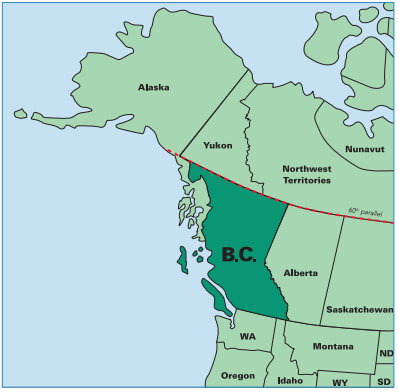
If you operate commercial vehicles north of latitude 60, such as in the Yukon, Northwest Territories or Nunavut, some of the hours of service requirements are extended, and fall under federal requirements in the Commercial Vehicle
Drivers Hours of Service Regulations. The longer hours are to accommodate short summers with longer days and ice roads in the winter. You’ll need to pace yourself and not do too many of these longer days in a row.
• You may drive a maximum of 15 hours.
• You may not drive after 18 hours of on-duty time.
• You must take at least eight consecutive hours of off-duty time before starting the next work cycle.
Drivers may choose one of two cycles:
• Cycle 1 — 80 hours of on-duty time in 7 days.
• Cycle 2 — 120 hours of on-duty time in 14 days and after accumulating 80 hours of on-duty time, you must take 24 consecutive hours off-duty.
Although the rules in most jurisdictions are similar, there are some exceptions.
Before entering another jurisdiction, be sure you know the local requirements.
Driving into the U.S. is common for many Canadian drivers and they must obey all U.S. regulations while operating there.
The following table summarizes the HOS regulations for commercial truck drivers in the U.S. If you are a Canadian commercial truck driver travelling to or from the U.S., you must follow the U.S. HOS regulations while you are in that country. Note: U.S. HOS regulations for passenger carrying vehicles differ from what is below.
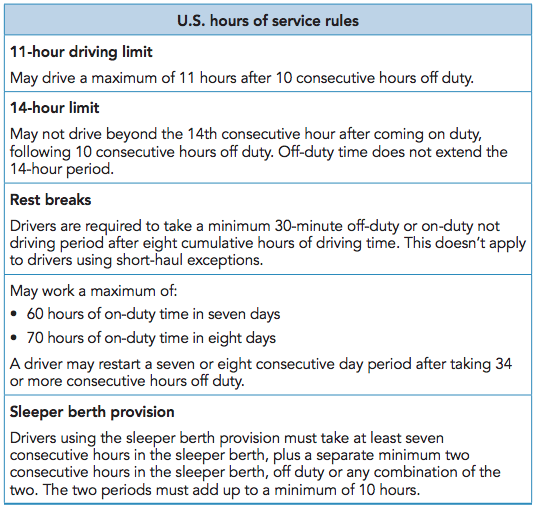
While the hours of service regulations are different in Canada and the U.S., the requirements for keeping a log book are similar. You’re responsible for learning and complying with the laws of each jurisdiction you travel through.
More information on driving into the U.S. may be found at www.fmcsa.dot.gov.
B.C. and Canadian federal regulations take into consideration situations where adverse conditions may inhibit drivers from adhering to driving time limits.
Adverse driving conditions include snow, sleet, fog or other adverse weather or road conditions, including a highway covered with snow or ice, and unusual adverse road driving conditions. These adverse driving conditions must not have been known by a driver or dispatcher before the driver began driving.
A driver who encounters adverse driving conditions may extend the permitted 13 hours of driving time and reduce the two hours of daily off-duty time by the amount of time needed to complete the trip if:
• The driving, on-duty and elapsed time in the elected cycle are not extended more than 2 hours
• The driver still takes the required 8 consecutive hours of off-duty time
• The trip could have been completed under normal driving conditions without the reduction
Note: A driver who extends their driving, on-duty or elapsed time because of an emergency or adverse driving conditions must record the reason for doing so in the “Remarks” section of the daily log.
Carriers must ensure their drivers are following hours of service requirements.
Carriers must:
• Evaluate all drivers to ensure they’re complying with the regulations
• Record the date(s) in which any violation(s) occurred
• Record the date of issuance to the driver of a notice of non-compliance
• Record any actions taken with the driver
Monitoring activities involve the review of their driver’s log books, supporting documents (such as fuel and lodging receipts) and any other relevant information. Carriers must document their findings to support any corrective or disciplinary action taken against a non-compliant driver.
It’s recommended that carriers check their driver’s logs as frequently as possible. Carriers should consider reviewing their driver’s logs on a monthly basis, at a minimum.
The number of drivers and logs checked by a carrier every month may vary according to the size of the company. A small company may choose to monitor all drivers’ logs every month, while a large company may choose only to monitor a portion of their drivers each month. Although a carrier has the option to monitor a percentage of their drivers each month, every driver should be checked at least once each year.
The objective of internal monitoring is to ensure all drivers are fully compliant every day — not just to document each driver’s performance. It’s recommended that carriers closely monitor new drivers or drivers with a history of noncompliance until they can demonstrate that they understand and are able to comply with the provincial and federal hours of service regulatory requirements.