
[ultimatemember form_id=3702]
5.Driving techniques
Operating a tractor-trailer is very different from operating your personal vehicle. Everything about operating a tractor-trailer requires a new set of knowledge and skills. You’ll need to pay much greater attention to how you manage your vehicle efficiently using the various systems available to you. Your secret to success will come with planning your next move well in advance, so you have the required time to execute the task successfully. Plan your work and work your plan. This unit will address basic driving techniques and correct tractor-trailer operations.
This unit will help you learn to:
• Demonstrate and explain the importance of proper start up and warm up procedures
• Enter and exit the cab and cargo area safely
• Adjust the driver’s seat and seatbelt to the correct position for comfort, safety and control
• Set up mirrors to minimize the vehicle’s blind spots
• Monitor the engine, instrument panel and warning lights
• Avoid unnecessary idling
• Take care when crossing railway tracks
• Use effective observation skills
• Communicate effectively with other road users
• Manage space and speed
• Operate vehicle controls smoothly
• Pay attention to traffic, the vehicle, driving conditions and other road users
• Drive safely through curves
• Drive safely on uphill and downhill grades, including mountain driving
• Change lanes safely on both urban streets and higher speed roads
• Cross and turn at intersections safely
• Enter and exit a highway/freeway safely
• Make efficient and courteous use of passing lanes
• Use auxiliary brakes legally and effectively
• Use cruise control safely and appropriately
• Maintain vehicle speeds appropriate for conditions and legal requirements
Your first responsibility is to ensure that everything is in order regarding the vehicle and yourself before driving. It’s important to be fully alert and not impaired by anything that may affect your ability. Whenever approaching your truck, do an overall visual inspection, noting damage, fluid leaks and general appearance, stance and surrounding area.
Entering and exiting the cab
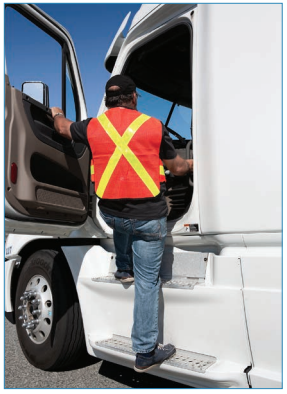
To prevent fall and injury, it’s important to maintain a three-point contact when entering and exiting the cab. This means that three of your four limbs remain in contact with the vehicle at all times.
These are some additional do’s and don’ts to keep in mind when exiting and entering trucks.
Do:
• Wear shoes with appropriate support and traction.
• Check steps and handles for grease, mud and ice. Keep steps clean to eliminate slipping and injury.
• Enter and exit facing the cab.
• Climb up and down slowly.
• Mount and dismount only when equipment is stopped.
• Look for obstacles on the ground before exiting the vehicle.
• Break three-point contact only when you reach the ground, cab or platform.
• Take extra care in wet, snowy or icy weather.
• Avoid wearing loose or torn clothing that can catch on equipment.
• Before leaving the driver’s seat or exiting the cab, ensure the vehicle is secured in neutral with the parking brake on.
Don’t:
• Jump off a truck. Doing so exerts 12 times your body weight on your joints when you land.
• Climb down with something in your free hand. Put it on the vehicle floor and reach up for it when you get down on the ground.
• Move side-to-side as this can affect your balance.
• Use tires or wheel hubs as a stepping surface.
• Use the door frame or door edge as a handhold.
Seat adjustment
Correct seat adjustment is critical for vehicle control and driver comfort.
• Adjust the height so that your feet can rest flat on the floor. There shouldn’t be any pressure on the underside of your leg.
• Adjust the forward placement of the seat so that your left foot can push the clutch pedal to the floor without having to stretch.
• The back of the seat should be straight up, then leaned back slightly and locked into the first setting that allows for some bend in your elbow when your hand is on the steering wheel. Ensure the seat is holding you up.
• Alter the lumbar adjustment to allow for lower back support, if equipped. If the seat provides no lower back support, use a small cushion.
• Adjust the tilt and telescopic steering wheel assembly, if equipped, to provide for a comfortable hand position and a good view of the dash.
Engine start and warm up
• Read the manufacturer’s guide for proper start-up procedures.
• Turn the Battery Master Switch on (if applicable).
• For automated transmission vehicles, just turn the key.
• For manual transmission vehicles, ensure that the parking brake is applied, the vehicle is in neutral and the clutch is depressed.
• Turn the key to the ON position. Allow needles to sweep and warning lights to cycle on then off.
• If the unit is equipped with glow plugs, turn the key part way and wait for the light to go out before starting the engine.
• Start the engine, confirm the oil pressure and ensure no warning lights are on and gauges are reading correctly.
• If the engine doesn’t start, only crank for a maximum of 30 seconds then wait two minutes to try again.
• Once the engine is running, proceed with the interior and exterior portion of the pre-trip inspection. See the Vehicle Inspection unit for detailed pretrip inspection information.
• Engine warm up prepares the engine to do its job by circulating oil, lubricating parts and building pressure to proper levels. Idle to warm up the engine. Avoid excessive idling as it wastes fuel and can result in unnecessary wear and tear on the engine.
• Some components (the transmission, axles and other parts of the drivetrain) will not warm up with the tractor sitting still. Even if you left the engine on fast idle for an hour, the gauges would show little or no charge from start up. Start out gently to allow the oil in other components to warm up and circulate as you begin to drive especially in cold weather.
Observe gauges
When the key is turned to the ON position, the warning indicators should illuminate. Make sure they’re all working.
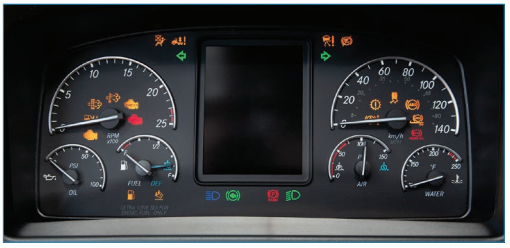
The following are gauges you must watch after starting the engine, ordered by importance:
1. Observe the oil pressure gauge. If it slowly rises, the lubrication system is working. If it doesn’t climb within three to five seconds, turn the engine off. Repeat again. If the oil pressure doesn’t rise, you’ll have to troubleshoot or call maintenance.
2. Observe the air pressure gauge or gauges. Like the oil pressure gauge, they should slowly rise. If not, check that all reservoir valves have been closed. Remember that air pressure must build from 50–90 p.s.i. in less than three minutes at fast engine idle speed. The air pressure warning device must stay on until pressure reaches 60 p.s.i. or greater.
3. The ammeter gauge should confirm normal charging rates. The voltmeter should read 12.5–14 volts.
4. Check the tachometer and make certain it’s operating.
5. Fuel gauges should show proper fuel levels.
6. Check the air filter restriction gauge. It should remain within the green area or at 0 p.s.i.
Engine shut down
Set the parking brakes. If the vehicle has just come in and the engine has worked hard, let it idle until the water temperature is below 200 degrees and the pyrometer (if equipped) is below 300 degrees. Then, turn off the engine to save fuel, reduce wear on the engine and reduce noise levels.
Hand position
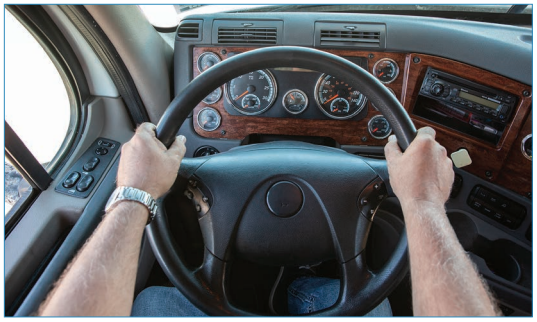
To maintain the greatest control while driving, keep both hands on the steering wheel. If you think of the steering wheel as a clock, hands are best placed anywhere from nine and three o’clock to 10 and two o’clock. You want a bend in your elbows and relaxed shoulders.
In the city and on rough roads, hold the steering wheel firmly to keep it from being pulled out of your grip. This can happen if the wheels hit something hard or drop into a pothole. Keep your thumbs outside the spokes of the steering wheel. If the steering wheel spins and your thumbs are inside, injury will result.
On the open highway, relax your grip. Small adjustments are all that are required to keep the tractor on the road. Adjust your grip to suit the speed of your vehicle and the conditions of the road.
Seatbelts
There’s no question — seatbelts save lives. Transport Canada estimates that wearing seatbelts has saved an estimated 2,400 lives and prevented 55,000 injuries in the past 10 years. Wearing your seatbelt is also the law.
During a crash, seatbelt systems reduce the risk of occupants striking the interior of the vehicle, colliding with other passengers or being ejected. If you’re belted in, you’re much less likely to become injured or knocked out in a crash. If a 68 kg (150 lb) adult is in a 50 km/h head-on crash and not wearing a seatbelt, the adult could collide with other occupants, strike the inside of the vehicle or get thrown from the car with the same force as the weight of a 3,175 kg (3.5 ton) truck. An unrestrained 11 kg (25 lb) child will be thrown forward with the same force as the weight of a 544 kg (1,200 lb) baby elephant.
Staying conscious gives you a better chance of getting out of your vehicle quickly if it catches fire or lands in water. Even during normal driving conditions, a seatbelt can help you maintain better control on rough roads or during crash-avoidance manoeuvres.
Many people think they can protect themselves in a crash. You can’t hold yourself back during a crash no matter how strong you are. Thousands of kilograms of force work against unbelted persons during the rapid deceleration that takes place during a crash.
Adjust your seatbelt correctly by:
• Placing the lap belt low over the pelvis, not over the soft stomach area, ensuring that it’s snug.
• Ensuring the shoulder strap is snug across the chest.
• Never placing the shoulder strap under the arm or behind the back removing all slack.
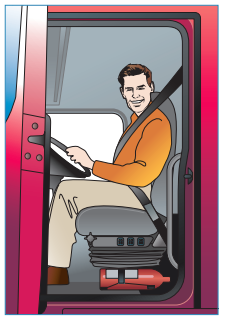
Some shoulder belts can be adjusted for height on the door post to better fit the height of the driver.
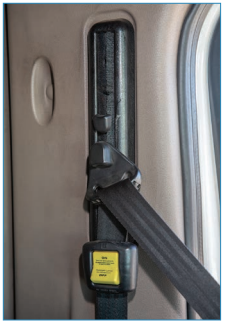
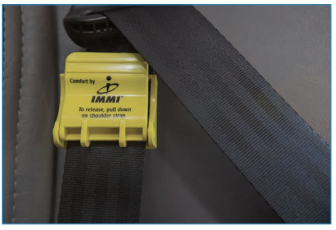
• Use the seatbelt slack adjuster (if equipped) so the belt isn’t tight across your chest all shift long.
Airbags and head restraints
If your vehicle is equipped with driver and passenger airbags, you must still wear your seatbelt. Airbags can seriously injure unbelted occupants. You must allow at least 25 cm (10 in) between your breastbone and the airbag unit in the steering wheel. This distance will minimize the risk of injury if the bag deploys.
If your vehicle has head restraints, it’s important that you adjust them to fit correctly. This will reduce the risk of neck and back injuries during a rear-end crash. By simply making sure the top of the head restraint is at least as high as the top of your head and it’s less than 10 cm (4 in) from the back of your head, you can help prevent neck injuries.
Mirror adjustment
Correct mirror adjustments are essential for the safe operation of a commercial vehicle. After adjusting the seat, adjust the left and right mirrors for optimum vision.
Mirrors should allow you to better view your blind spots and danger zone.
• There are blind spots immediately below and behind each mirror, directly in front of the vehicle and directly in back of the rear bumper.
• The danger zone is an area around the tractor-trailer where pedestrians and other objects are at the most immediate risk. The no-zone refers to the blind spot areas around large commercial vehicles or the areas where cars are so close to the tractor-trailer that the driver’s ability to stop or manoeuvre safely is restricted.
Review the types of mirrors and how to set them up.
Flat mirrors
These mirrors are mounted on the left and right at the front of the windshield.
They’re used to monitor traffic and check clearance on the sides and to the rear of the vehicle.
Ensure that the left mirror is properly adjusted so you can see:
• Sixty metres or four vehicle lengths behind the vehicle
• The top of the trailer
• The inside edge, which should pick up the left side of the trailer
• The rear trailer tires touching the ground
Ensure that the right mirror is properly adjusted so you can see:
• The inside edge, which should pick up the right side of the trailer
• The horizon line 3/4 of the way up the mirror
Convex mirrors
These mirrors are located below the outside flat mirrors. They’re used to monitor the left and right sides at a wide angle. They provide a view of traffic and clearance at the lower sides of the vehicle.
These mirrors present a view of people and objects that doesn’t accurately reflect their size, distance and position from the vehicle — objects will appear smaller and farther away than they actually are. You should position the mirrors to see:
• A small portion of the entire side of the vehicle up to the mirror mounts
• Where the rear truck tires touch the ground
• At least one traffic lane on either side of the vehicle
Inside rearview mirror
Adjust the inside mirror to see through the rearview window of the vehicle, if applicable.
Using wheel chocks
Wheel chocks are used to block the wheels and should be used in addition to the parking brake to ensure the vehicle remains in position when the driver isn’t in control at the steering wheel. The bottom surface is sometimes coated in rubber to enhance grip with the ground.
When using a wheel chock, follow these guidelines:
• Always ensure the chock is centred and squared with the tire. Position it snugly against the tire with about 2.5 cm (1 in) of the chock extending from the edge of the tire.
• Always use wheel chocks in pairs.
• On a downhill grade, position the chocks in front of the drive wheels.
• On an uphill grade, position the chocks behind the drive wheels.
• On a level grade, position the chocks on the front and back of a drive
wheel.
Here are some conditions that must also be considered when using wheel chocks:
• Smaller tires require smaller chocks, while larger tires require larger chocks.
• Heavier vehicles require larger chocks than lighter vehicles.
• Chocks need to be positioned in different ways depending on if the ground is level or not.
• Ensure that the chock configuration is correct based on surface grade.
• Radial tires may wrap around the wheel chock, which reduces the chock’s effectiveness. To combat this, vehicles with radial tires should be chocked with larger wheel chocks.
• Improperly inflated tires can lead to chocking failures.
• Condition of the ground, whether it’s firm, soft, wet, dry, icy or frozen, is a key determination in the type of chock to use. For frozen or icy terrain, choose a chock with a cleated bottom. For severely wet or muddy terrain, multiple chocks may be necessary to ensure safe chocking.
Moving off
To prevent roll back when you start out with a manual transmission vehicle, engage the clutch to the friction point then release your right foot off the brake and smoothly engage the clutch. The engine shouldn’t stall as the computer will feed fuel to allow it to maintain its idle speed. If the vehicle stalls, you may be starting in too high of a gear or engaging the clutch too quickly. Starting up in a vehicle with an automated transmission is very similar to a car, but you may have an automatic hill start system that will take a second to release before the truck will move.
Accelerate smoothly and gradually to the next shift point of your transmission.
Accelerate gradually when traction is poor, as in rain or snow. If you use too much power, the drive wheels may spin and you could lose traction. If the drive wheels begin to spin, ease up on the accelerator to see if you can regain traction. If the vehicle won’t move, you may need to chain up.
Braking
When applying the brakes, press down on the pedal using an even pressure and then ease off the pedal as the vehicle slows down. Just before the stop, ease up to avoid a sudden jerk or rebound. Then, apply pressure to the brake pedal again to hold the vehicle while it’s stopped.
Don’t pump (alternately applying and then releasing) the air brakes as this will result in a loss of air pressure. It’s better to make one steady application of the brakes. Braking systems are designed to stop or slow a vehicle down for a downshift. They were never intended to hold a vehicle back when descending mountains and hills. It’s critical to select the right gear and use auxiliary braking systems (road conditions permitting) to control the speed of your vehicle going down hills. Keeping your foundation brakes cold in case an emergency stop is needed is important. You can descend a hill thousands of times too slow, but only once too fast!
Before going down a hill, do an en route inspection to confirm your brakes are still in adjustment, your air system is operating correctly along with lights, tire and cargo is secured. Before starting down the hill, test your trailer service brakes with the trailer hand valve to prove they’re working and double check that your fifth wheel is locked.
Remember that the brakes, tires and suspension of a combination vehicle work best when the vehicle is legally loaded and the load is properly distributed among axles. When the cargo area is empty and there’s no ABS, the vehicle’s wheels may bounce and lock up. This can make braking more difficult and increase your stopping distance. In this situation, you’ll need to increase your following distance and possibly travel at slower speeds.
Speed management
Heavy commercial vehicles take more time and more distance to slow and stop than smaller vehicles. More braking force is needed to overcome their weight and forward motion.
Proper speed management means operating at the appropriate speed for all road conditions. That includes taking into account the condition of the road,
visibility and traffic speed and flow.
Stopping time and distance
Total stopping time is the distance your vehicle will travel from the moment you:
• See a hazard.
• Think and decide to stop.
• Do place your foot on the brake pedal until you stop.
This can be broken down into perception, reaction, brake lag time and braking time and distance.
1. Perception time is how long it takes a person to realize they need to stop (see and think). Average perception time is about 3/4 of a second. Perception time can increase if a person isn’t paying attention, impaired or not feeling well physically or mentally. Perception distance is how far a vehicle travels during this time.
2. Driver reaction time is the time it takes between deciding to stop and actually applying the brakes (do). Normal driver reaction time is about 3/4 of a second. Reaction time will be slower if the driver is tired or has been drinking alcohol or using drugs. Reaction distance is how far a vehicle travels during this time.
• Covering the brake (resting your foot on the brake pedal) when anything starts to change will save you time.
3. Lag time is the amount of time it takes for the air brake system to respond after the driver has applied pressure on the brake pedal. Air brakes do not respond immediately because it takes time for the compressed air to flow through the system and apply the brakes which takes about 4/10 of a second. Lag time distance is how far a vehicle travels during this time.
• Lightly applying the brakes in anticipation of needing them will save you time.
4. Braking time is the time it takes for the vehicle to come to a complete stop after the brakes have been applied. Braking time depends on:
• The force with which the brakes are applied.
• The condition of the brake linings and drums or brake pads and rotors.
• The traction of the tires on the road surface. Traction is the friction between the road surface and the tire contact patch. The amount of traction a vehicle has depends on several factors: the condition of the road, how much tire contact there is with the road surface, vehicle weight and tire condition and inflation.
• The vehicle weight and speed.
Braking distance is how far a vehicle travels during this time.
Another factor involved in stopping distances is the slope or grade of the road. A vehicle travelling downhill will need a longer stopping distance than a vehicle travelling at the same speed on a level surface because of the effect of gravity. A vehicle travelling up a hill will stop in a shorter distance than a vehicle travelling the same speed on a level surface, again because of the effect of the grade.
Following distance
It’s very important to allow enough distance when following other vehicles.
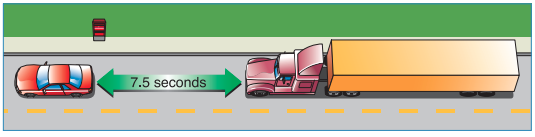
Drivers of buses, trucks and other large heavy vehicles should never be less than one second for every 3 m (10 ft) of overall vehicle length and a minimum of five seconds behind the vehicle ahead under ideal driving conditions. When conditions are less than ideal, increase the number of seconds and adjust your following distance.
To measure following distance, watch the vehicle ahead of you as the back bumper passes a stationary object (such as a power pole) and count to yourself:
• One thousand and one
• One thousand and two
• One thousand and three
• One thousand and four
• One thousand and five
When your front bumper reaches the object, stop counting. This will give you the number of seconds between you and the vehicle you’re following. If you pass the same object before you finish counting, you’re following too close.
Slow down a bit and increase your following distance.
Repeat the count process until you’re at least five seconds behind the vehicle ahead and farther if your vehicle is more than 15 m long, as in the image below:
Speed and weight facts
Speed and weight affect the stopping power required to stop any vehicle and how far it will travel before it stops. You need more stopping power whenever the speed you’re travelling and/or the weight of your vehicle increases:
• 2 X vehicle speed requires 4 X the stopping power
• 2 X vehicle weight requires 2 X the stopping power
• 2 X vehicle speed and 2 X vehicle weight requires 8 X the stopping power
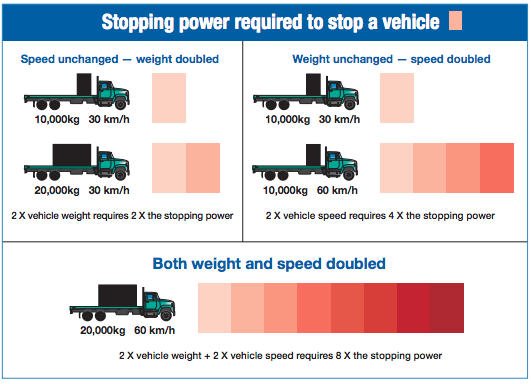
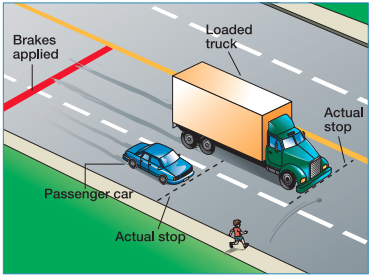
A typical compact car weighs about 1,000 kg (2,200 lb). The truck in the illustration below may weigh 25,000 kg (55,000 lb) when fully loaded — over 25 times heavier than a car — and heavy tractor-trailer combinations can weigh up to 63,500 kg (140,000 lb).
There’s only so much stopping power available and the faster the vehicle is travelling, the more power it needs to stop. This is why it’s so important to drive at a safe speed, at a safe following distance and within the vehicle’s stopping capability.
Consequences of speeding
Speed limits are based, in part, on the principles of good speed management.
They take into account several issues including sight distance limitation, road conditions and traffic volume. There are many reasons why you shouldn’t speed.
• The greater the speed the vehicle is traveling when a crash occurs, the greater the chance of fatalities.
• A driver’s ability to steer safely around curves or objects in the roadways can be reduced by speeding. Tractor-trailer rollover crashes happen when the driver of the truck doesn’t adjust their speed to navigate curves and the slope of the road, such as on and off ramps.
• Speeding can result in fines (from $138–$483), three points on your driving record and can ultimately end up prohibiting you from driving.
• Higher speeds can affect maintenance costs. Tires and brakes wear out faster at higher speeds.
• The power and fuel required to increase speed multiplies substantially at higher speeds.
Driving faster than the flow
Driving faster than the traffic flow can create a variety of problems for you:
• You won’t be able to maintain a safe following distance, which means you
will be unable to stop quickly and safely.
• You increase your chance of making a wrong decision.
• Driving faster than the traffic around you requires more lane changes. Each lane change represents a problem that requires quick decision-making. The more decisions you make, the greater the chance you’ll make a wrong one.
• You’ll tire more quickly. Driving faster than the traffic flow creates tension and causes mental and physical fatigue.
Maintaining a steady speed, within legal limits, at a safe following distance will help give you the time needed to react in an emergency situation. Driving at a steady speed also saves money and helps the environment by reducing the amount of fuel your vehicle burns.
Driving slower than the flow
If you drive slower than the traffic flow, you increase your chance of a crash with vehicles travelling behind or beside you. Other drivers will become impatient and follow too closely or try to overtake your vehicle. After passing, they may cut in leaving you with little or no room for a quick stop. Large vehicles tend to accelerate and travel more slowly than small vehicles. When you’re unable to keep up with the traffic flow, you must travel in the right lane.
Using cruise control
Using cruise control on big trucks can help maintain a consistent and appropriate speed, saving fuel, and allowing for a less stressful, more relaxed trip. It allows the driver to concentrate more on what’s going on around the truck and other aspects of driving. Here are some tips:
• Set the cruise control at or just slightly under the speed limit. This will help ensure you have ample space in front of your vehicle.
• Only use the cruise control on completely dry road conditions.
• If road conditions or weather change for the worse, turn off the cruise control using the cruise control switch, not by tapping the brake pedal.
Slow and steady speed can help you avoid incidents and save you and your company a lot of money and time in the long run.
Shifting gears
In the past, the majority of tractors on the road were equipped with manual transmissions. Now, automatic or automated transmission-equipped trucks are becoming more prominent.
Type of transmissions
Here is an overview of the different types:
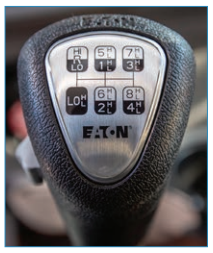
• Manual shift (non-synchronized) transmissions — Full driver control of clutching and gear selection.
A high degree of skill is required to judge and execute proper shifting. Familiarize yourself with the gear pattern by checking the chart on the gear shift lever or the dash.
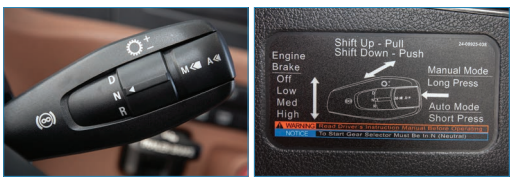
• Automated manual transmissions — Use an onboard computer, sensors and shifter motors to communicate with the engine and complete the shifts.
Some models still have a clutch pedal which is only used to start and stop the vehicle moving. Fully automated models don’t require the driver to use a clutch so only a throttle and brake pedal are present in the cab. The clutch is engaged centrifugally when the driver starts to accelerate. The benefits of these transmissions are that driver fatigue is reduced, drivers require less experience and there’s less stress and wear on the driveline. It’s important to get the driver handbook for the model of transmission you have and read it carefully to properly understand the available options, such as the hill start feature, that may be included in your vehicle. Manuals are available on the manufacturer’s websites.
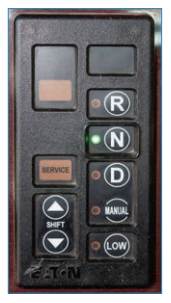
• Fully automatic transmissions — Typically found in vehicles that are used in urban environments, such as garbage trucks, fire trucks and municipal dump trucks. The transmission works the same as the one in your personal vehicle except it doesn’t have a “Park “ position. The transmission is left in neutral when the vehicle is parked, so the parking brake must be applied.
Getting the most out of your engine
You must learn how to select the appropriate gear to maintain control and
ensure smooth operation of the vehicle.
Engines function best in the low to medium revolutions per minute (RPM) range, where they produce peak torque or power. Pushing for a higher RPM doesn’t produce a proportionally higher amount of torque. For the sake of fuel efficiency and to reduce wear on the engine, the tractor should always be in the highest gear in which the engine can still maintain the desired speed. At cruising speeds, this is usually well below the engine-governed RPM and in the middle of the peak torque range.
Typical large displacement diesel engines today have a maximum operating RPM of 2,100 and idle in the 600–700 RPM range. As with most modern engines that are computer controlled (1990’s onwards), you’ll find your peak torque starts at 1,000–1,200 RPM and is a flat line to 1,500 RPM. Most engines have their peak horsepower (HP) rating at 1,800 RPM, but when you look at the HP curve, you reach 95 percent of your peak by 1,600 RPM. To get the most efficient operation of your engine, use the transmission instead of your brake pedal to keep the RPM lower to achieve maximum power and save fuel.
You must learn shifting techniques that can be applied to various driving scenarios. For example, when climbing a grade, select a gear ratio that will allow the engine to pull back to (or just below) peak torque as it crests the hill. Letting the engine pull back in RPM in this manner actually uses the peak torque potential designed in the engine. It also has the advantage of delivering near-maximum fuel economy.
By learning and practicing the correct procedures for shifting, accelerating and
decelerating, a professional driver can save countless dollars on the wear and
tear of an engine and clutch.
Smart tips for smooth shifts
• Always choose a starting gear that will provide sufficient reduction for the terrain and load.
• Anticipate and plan gear shifts in relation to changes in terrain and traffic.
• Use double clutching techniques whenever making shifts with the gear shift lever. Don’t ride the clutch pedal.
• Shifting gears requires finesse not strength. Forcing the transmission into gear will damage it.
• Match road speed and RPM to gear ratios. Never downshift when RPM is too high; never upshift when RPM is too low.
• Avoid accelerating to maximum RPM for gear shifts.
• Use skip shifting when appropriate.
• Prolong the life of the tractor and trailer brakes by downshifting when slowing down and using auxiliary braking systems when appropriate.
• Save fuel by using a gear ratio that achieves maximum fuel economy for the cruising speed.
• Always be aware of the gear you’re in, the maximum engine RPM and the safe top speed of the tractor and trailer.
Progressive shifting techniques
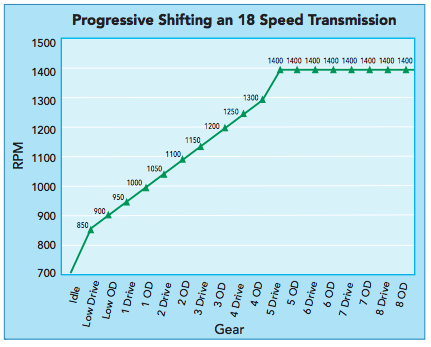
Progressive shifting is shifting to the next highest gear at the lowest possible RPM that will allow the tractor and trailer to continue accelerating. This makes the shifts easier, gets the most work out of the engine, increases fuel mileage and allows the tractor and trailer to reach highway speeds quicker.
The following chart shows a sample of the RPM requirements for progressive shifting techniques, which provide quicker acceleration, easier shifting and less wear on the engine.
Clutch and clutch brake operation
Proper use of a clutch is critical in shifting a non-synchronized transmission smoothly. The clutch pedal has five different positions:
1. Free play — the highest position where the pedal moves easily under the weight of your foot.
• With a mechanical clutch, there should be 2 to 5 cm (0.75−2 in) of free play before you meet resistance. If there’s less than this, the clutch needs to be adjusted.
• Many newer trucks have hydraulically-actuated clutch pedals (reservoir on the fire wall of the engine compartment) with very little free play. Hydraulically-actuated clutch pedals are usually self-adjusting.
2. Friction point — the point where the clutch plates start to come together and begin to grab.
• If you’re holding the vehicle on a level road or slight grade with the foot brake, once you are at the friction point, you can simply release the foot brake and continue to smoothly release the clutch pedal. This should engage the clutch completely and get you moving.
Damage can occur to the clutch by overheating it during start up by:
• starting in a gear that’s too high, creating excessive slippage of the clutch plates.
• adding unneeded RPM which creates additional torque that the clutch has to absorb.
• taking too long to go through the friction point.
Damage can also occur by going through the friction point too quickly.
This creates stress on the springs inside the clutch and also stresses the tractor suspension, which loads up with energy and then unloads again, causing the tractor to hop.
3. Shifting depth — the clutch is disengaged beyond the friction point.
4. Stopping depth — the distance to push the clutch pedal in when bringing your vehicle to a stop.
• Depress the clutch pedal past the friction point, but not all the way to the floor.
• Leave the transmission in gear as you stop. This will stop all the gears inside the transmission from moving and allow you to easily select a start-up gear.
5. Clutch brake — pedal to the floor. After you start your engine and the transmission is in neutral, all of the gears on the input side of the transmission start to rotate while the gears on the output shaft side (connected to the drive axles) are stationary. To select a start-up gear, you need to stop the input shaft from rotating otherwise the gears will grind as you’re attempting to engage them. This is done with the clutch brake. The vehicle must be stationary, held by either the parking brake or the foot brake because if it rolls while the clutch brake is engaged, you can easily damage the clutch brake.
• Depress the clutch pedal all the way to the floor, holding it for three seconds to allow all the gears in the transmission to stop turning. If the clutch brake doesn’t stop the gears from turning, it requires adjustment or replacement and needs to be checked by a technician.
• Place the shifter into your start-up gear, usually low or first gear, depending on your load or if you’re starting on a hill.
• Attempt to put the transmission into gear. If it won’t go in, then the gears will have stopped in a place where they can’t engage properly.
To remedy this, continue to hold the shifter against the gear that you want and simultaneously start to release the clutch pedal slowly. As you begin to release the clutch brake, the input shaft will begin to rotate slowly allowing the shifter to slide into gear.
Shifting non-synchronized transmissions
On non-synchronized transmissions, double-clutching makes shifting gears smoother because it allows you to co-ordinate the engine speed (input shaft) and the road speed (output shaft), aligning the gears for easier shifting. Follow this procedure for smoother shifts.
Upshifting by double-clutching:
• Take up the free play on a mechanical clutch, or put positive pressure on the clutch pedal for hydraulic clutches.
• Depress the clutch pedal just beyond the friction point and ease up on the accelerator simultaneously.
• Move the gearshift lever into neutral.
• Lift the clutch pedal to the point of free play — allowing the engine RPM to drop slightly.
• Again, depress the clutch pedal just beyond the friction point and shift to the next higher gear.
• Release the clutch pedal completely and accelerate at the same time.
Downshifting by double-clutching:
• Take up the free play/positive pressure.
• Depress clutch pedal just beyond the friction point.
• Move the gearshift lever into neutral.
• Lift the clutch pedal to the point where you still have the free play.
• Increase the engine RPM until it allows the next gear to synchronize with road speed (input shaft with output shaft).
• Depress the clutch pedal just beyond the friction point and move the gearshift lever to the next lower gear position while maintaining your engine RPM.
• Release the clutch pedal completely and continue accelerating or decelerating as needed.
Skip shifting
In some situations, a driver can skip some of the gear ratios. This would only be done if the road conditions and the load allow. Don’t attempt skip shifting until you’ve mastered the basic shifting technique and are familiar with the vehicle you’re operating.
Automatic/automated transmissions
Some vehicles have automatic or automated transmissions. You can select a “hold” or “manual” mode to get greater engine braking when going down grades. The lower ranges prevent the transmission from shifting up beyond the selected gear (unless the governor RPM is exceeded). It’s very important to use this braking technique when going down grades.
Special conditions where you should downshift
• Before starting down a hill, slow down and shift down to a gear that lets
you control the speed of your vehicle without using the brakes. Otherwise, the brakes can overheat and lose their braking power, potentially causing a runaway. When you are descending a hill or grade, make sure you’re in a low enough gear to allow your engine brake to hold you back without the use of the service brake. This is usually the gear lower than what is required to climb a hill of the same grade you are descending.
• Before entering a curve, slow down to a safe speed and downshift to the right gear. This lets you use some power through the curve to pull the trailer and help the vehicle be more stable while turning. It also allows you to
speed up as soon as you’re out of the curve.
• It’s important to understand that unlike a passenger vehicle, professional drivers use the vehicle’s auxiliary braking system to slow down for downshifts, not the service brakes. Recognizing the need to reduce speed by looking well ahead when driving along and reading the warning signs, gives you the time needed to release the throttle pedal, activate the engine brake and allow the accumulated momentum to dissipate so you can downshift.
Depending on how much speed reduction is required, you may need to make several downshifts to slow down enough. Heavily loaded tractor-trailer units need more time to accelerate and decelerate for turns, stops and on hills. You may delay traffic slightly to make these manoeuvres safely. Ensure you manage your vehicle properly and avoid rushing to attempt to not hold up traffic, which could just get you into an unsafe situation.
Vehicle components to monitor while you drive
In addition to pre-trip and post-trip inspections, using all of your senses to monitor your vehicle’s behaviour while driving will help prevent dangerous and costly mechanical issues. The following are vehicle components to continually monitor as you drive.
Brakes
• The vehicle should not pull to the left or right when braking.
• Brakes should not grab, lock up or make excessive noise.
• Excessive pedal pressure required or unusual braking behaviour should also be noted.
• Monitor the gauge to ensure that adequate air pressure is maintained.
Transmission
• When the transmission is engaged in either the reverse or forward gears, the tractor-trailer should start out smoothly in response to depressing the accelerator and the transmission shouldn’t produce any odd mechanical noises.
• Any mechanical difficulty in shifting gears should be noted.
Clutch
• The clutch should engage easily and smoothly without jerking, slipping excessively or “chattering”.
• A properly adjusted (mechanical) clutch should have some free play (refer to manufacturer’s recommendations) when the pedal is fully released. Hydraulically-actuated clutches have very little free play in the pedal which is normal.
• When changing gears, carefully control the speed of the engine so that the shift may be completed without jerking or excessive slippage.
• Erratic or careless shifting of gears wears out the clutch and reduces its service life.
Engine
• Be aware of any unusual engine noise, vibrations or lack of normal response.
• Increase speed slowly so that all parts may be properly lubricated. In colder weather, the tractor should idle for about 10 minutes to warm up before first starting out on your route.
Steering
• Does the tractor-trailer steer easily? Does it go precisely where you steer it?
• Does there appear to be excessive play or jerking?
• Is the power steering quiet?
• Does steering feel steady in turning and over bumps?
Suspension
• Is there excessive bounce or does the tractor-trailer bottom out when going over bumps or potholes?
• Is there a constant pull to the left or right when steering? If this occurs, it may be due to a suspension defect.
• Does it weave or sway excessively when turning corners or curves? If this occurs, it may be due to broken springs or faulty shock absorbers.
Tractor bobtailing
Bobtailing is operating a tractor without a trailer. Tractor drive axles are designed to carry weight and removing the trailer significantly reduces the traction of the drive axles. A brake application causes weight to transfer to the steering axle, further reducing drive axle traction. Strong engine power and braking, with very little traction, can cause a loss of vehicle stability.
Drivers should exercise caution even during safe road conditions.
Older tractors with bobtail proportioning valves reduce the application pressure to the rear brakes by as much as 75 percent to prevent skidding. In this situation, you’ll need to apply additional force to the brake pedal to get the tractor to stop as you’ll be using the front brakes only.
To safely operate a bobtail tractor:
• Avoid excessive acceleration and heavy brake applications.
• Reduce vehicle speed when road surfaces are slippery.
• Use auxiliary retarders at reduced settings.
• Leave an appropriate following distance from the vehicle ahead.
Exercise more caution when bobtailing in poor weather than you might with a loaded vehicle.
Entering traffic or merging
Merging is done when two roadways join into one and the traffic on the main roadway must cooperate to allow enough space for vehicles to enter from the merging lane.
Merging is a shared responsibility between the vehicles joining the roadway and the vehicles already on the roadway. Avoid reducing your speed abruptly or stopping when merging. The merging lane is designed to allow you to bring your vehicle up to the speed of the traffic on the roadway onto which you’re merging, while remaining within the speed limit. The drivers behind you are expecting you to continue moving ahead. If you slow or stop, your vehicle may be hit from behind. A loaded commercial vehicle won’t likely be able to match speed with the traffic it’s merging with as many acceleration lanes are fairly short.
Here are some tips on merging safely:
• Merging requires that you plan and time your approach to blend smoothly
with traffic without stopping or abruptly reducing your speed.
• Check the traffic flow on the highway as soon as you can see the lane where
you’ll be merging.
• Choose your gap in the traffic and begin adjusting your speed, if required. Keep glancing at the gap you chose to ensure you’re making the speed and timing adjustments necessary to safely merge without affecting traffic.
• Use your signal light as early as possible to warn other road users that you need space to move over.
• Accelerate to the speed of the traffic on the main road, if possible.
• Keep checking your mirrors (flat and convex) to view the gap and for vehicles following you.
• When it’s safe and legal, move into the gap after you’re past the solid white line of the acceleration lane. Adjust your speed to get your proper following distance.
• Ensure your signal light is turned off once you’ve completed the merge.
When entering traffic from the curb or loading zone, signal your intent with at least four flashes of your turn signal in advance, check mirrors and look directly out the windows to ensure the path is clear before starting to move. Stay in the lane nearest the curb until reaching appropriate speed. When entering traffic from an alley, side street, driveway or terminal, come to a stop before entering a sidewalk or cross street and proceed with extreme caution.
Exiting a major roadway
Tips on how to exit a major roadway or highway safely:
• Plan ahead. Be in the proper lane well before you reach your exit.
• Use your turn signal well in advance of the exit to alert the drivers behind you.
• Move into the deceleration lane as soon as space is available, if there is one.
• If possible, do most of the slowing in the deceleration lane. Some deceleration lanes are short; you may need to start reducing your speed while still on the highway.
• Verify your speed with your speedometer to ensure you’re slow enough for any turns after exiting.
• When you have exited, ensure your signal light is turned off.
• If you miss your exit, don’t stop. Continue to the next exit and make plans to return to your route. Don’t stop and reverse on the highway, the emergency stopping lane or shoulder.
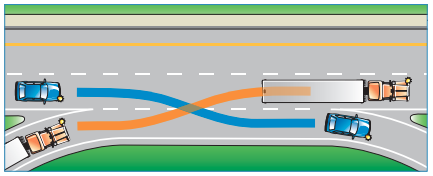
Weave zones
On some roadway interchanges, there are places where the highway entrance and exit use the same lane. The entrance and exit can be close together.
These areas require caution and cooperation, because vehicles share the same lane to slow as they exit the highway while others are using it to increase speed to enter the highway. The area that these vehicles share is called a weave zone.
In weave zones, control your speed and the timing of your lane change to merge with other traffic. This requires skilful use of time and space. Use caution in these zones to ensure safe highway exiting and entering for all vehicles.
Zipper merge
When two lanes merge into one or when a lane is closed due to an obstruction, many drivers will take the first opportunity to change into the necessary lane. This is typical and requires care when traffic is congested. Making a sudden lane change can be dangerous when it’s unexpected by other drivers. Making lane changes when vehicles are traveling at different rates of speed is also more difficult and risky. This can trigger reactions that lead to crashes and road rage.
The best way to merge when traffic is backing up and you need to move over is to stay in your current lane up to the point of the merge. Then take turns with other drivers to alternately allow a vehicle from each lane to proceed and smoothly ease into the remaining lane. This is called a zipper merge.
The advantage of a zipper merge technique is that the traffic speed in the adjacent lanes tends to be about the same. Lane changes can be made safer at the merge point rather than having drivers try to get into spaces that may not be large enough. A zipper merge requires drivers to cooperate and to provide space in front of their vehicle at the merge point.
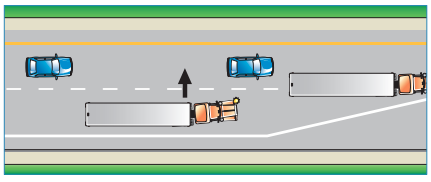
Selecting the proper lane, positioning yourself within the centre of the lane and then making adjustments to your position to suit the current circumstances is a skill that requires a great deal of practice. As you continue to practice, you’ll improve your ability to maintain adequate separation distance between your truck and other vehicles and pedestrians. On a multi-lane highway, it’s recommended that trucks should position themselves in the right lane or the lane closest to the shoulder of the road. This will leave you an out, to the right, if you need one to avoid a crash.
Lane changes
Lane changing poses additional hazards — only change lanes when necessary.
Always check for clearance by looking out of the windows and using both flat and convex mirrors to be sure that there are no vehicles beside or behind the truck.
Give special consideration for the speed vehicles are travelling behind you to ensure they won’t overtake you once the lane change has begun. Always signal intent with at least four flashes of the turn signal before beginning the lane change. If the lane change involves passing another vehicle, when on a multiple lane highway, always maintain your minimum following distance.
Once you’re in the desired lane, cancel the turn signal after completion.
Traffic check — Monitor the surrounding traffic in front, beside and through the vehicle mirrors.
• Identify where and when the lane change should be made. The decision will be based on present conditions and anticipated conditions that will either make the lane change easier or more difficult. In dense traffic, motorists travelling beside a commercial vehicle will need time to adjust their positions in traffic in order to create adequate space for the larger vehicle to move into.
• Consider likely changes in the adjacent traffic and vehicles further away that may change position.
• Observe signs, pavement markings and any anticipated changes in the road markings.
• Check mirrors for vehicles traveling alongside, passing or approaching from the rear and any vehicle that may already be in — or may enter — a blind spot.
Signal — Signal to indicate your intention to change lanes. Signals must be initiated a reasonable amount of time before the lane change, depending on the conditions, but never provide less than four flashes of your turn signal in advance. Early use of turn signals can also help get other drivers to provide the necessary space.
Vehicle space — Maintain safe following distance within the current lane while preparing to make the lane change.
Move over — Make the lane change at a point of the roadway where road conditions and pavement markings indicate the lane change can be made. Lane changes should never be made in intersections, near pedestrian crossings, railway crossings and where solid lane markings indicate it’s not permitted. Make a deliberate, smooth and steady lane change. Taking too much time allows the traffic patterns to change; hesitating may cause other motorists to change speed or position. Steer smoothly into the centre of the target lane, adjusting speed as necessary to establish safe distances from other vehicles. Avoid sudden movements of the steering wheel as this may result in your trailer whipping and possibly cause a roll over. Cancel turn signals as soon as the vehicle is fully in the new lane position.
Resume driving — Adjust your speed and distance relative to other vehicles.
Passing
Drivers often become frustrated when a commercial vehicle holds them up as it passes another commercial vehicle that’s driving at almost the same speed.
If the passing truck occupies the fast lane when it isn’t absolutely necessary, traffic may become congested.
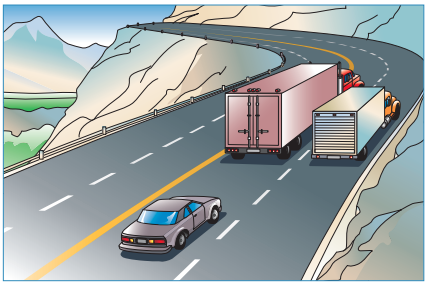
Before passing a vehicle, check for forward clearance. There must be time and space for you to manoeuvre in the event of an emergency. Avoid overtaking a vehicle when you are to the right of it. Most drivers don’t expect to be passed on the right and the noise of the vehicle may cause them to react by pulling quickly to the right and into your vehicle.
When you can see that there’s sufficient passing distance in the left lane, follow these steps:
• Check the rearview mirrors and blind spots.
• Turn the left indicator lights on.
• Accelerate and move smoothly into the left lane.
• Overtake the vehicle and complete the pass as quickly as possible. Be especially cautious when in the blind spot where the driver is unable to see your vehicle.
• Check the right rearview mirror for clearance to make certain the vehicle is behind the trailer and allow at least a two-second gap before returning to the driving lane.
• Turn the right turn signal ON.
• Return smoothly to the right lane when safe to do so.
• Turn the right turn signal OFF.
Use extra caution when passing under these conditions:
• The lead vehicle’s vision to the rear is obstructed.
• There’s the chance that the lead vehicle might pull out unexpectedly to pass.
• The driver of the lead vehicle appears inattentive or distracted.
Don’t pass if the lead vehicle is doing any of the following:
• Signaling or otherwise indicating a left turn.
• Changing lanes and getting ready to pass another vehicle.
• Weaving and wandering near or across the centre line.
• Decelerating suddenly.
• Passing pedestrians, cyclists or animals.
• Being passed by another vehicle.
Passing or being passed by a heavy vehicle is very different from a passenger car. Large vehicles travelling at high speeds create air turbulence that can be hazardous to smaller vehicles. The larger your vehicle, the more wind turbulence. A car, bicycle or other road user travelling directly in front of a truck, alongside the cab, by the back area of the trailer or at the immediate rear of the trailer is in an area of air turbulence. For cyclists, the air turbulence from your vehicle can cause them to lose control.
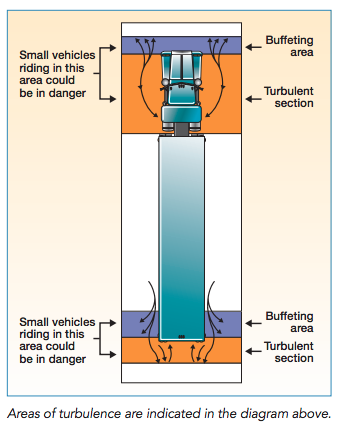
Be alert for road users who drive in these areas. They may be forced off a narrow roadway or drawn into the side of your vehicle. If a smaller vehicle continues to drive in your area of turbulence, slow down until it’s out.
Passing a stalled vehicle
When passing a stalled vehicle, treat it the same as passing a moving one.
When approaching, look for any sign that the vehicle may move or discharge passengers. When possible, and as a courtesy, attempt to move over one lane to provide a safety cushion. Check clearance and determine if it’s safe to change lanes, signal at least four flashes and change lanes. If changing lanes isn’t possible, slow down and keep the brake covered, while carefully watching for any movement such as wheels turning out, lights coming on or exhaust coming out of the vehicle. After passing the danger, centre the vehicle back in the lane or pull back into the original lane.
Being passed
Part of our responsibility as professional drivers is to help other traffic to interact safely with us. It can be frustrating dealing with less knowledgeable drivers but it’s important that everyone gets home safely at the end of the day. If you’re being passed by another vehicle, it’s important to keep track of their progress and the available space that they have to safely complete their manoeuvre.
If you’re being passed on a multi-lane highway, there generally isn’t too much to worry about.
If you’re being passed on a regular highway in a passing lane that’s going to end soon, then the situation will require more attention. When a passing lane is ending, there are warning signs on both sides of the highway showing the lane ending in 200 m (656 ft).
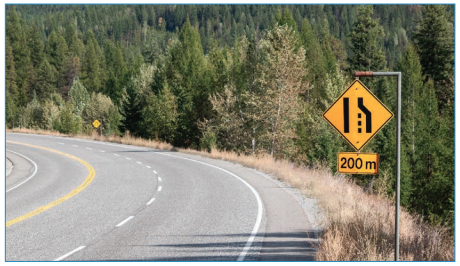
If the vehicle passing you is beside your trailer, they won’t be able to see signs on the right side of the roadway. If there are large vehicles traveling in the opposite direction at the time, they may not see signs posted on the left side of the road and may be unaware that the passing lane is ending, for example. Activate your left turn signal as you approach the “lane ends in 200 m” sign.
It can serve as a warning to the vehicle passing you that they need to either complete their pass or back off and allow you to move over. You’ll need to be prepared to adjust your speed to allow them to complete their pass safely, although it may be frustrating to lose some of your momentum, it’s important to keep everyone safe.
If you’re being passed on a two-lane roadway and a driver has crossed into the oncoming lane to pass you, it is again important to monitor the situation. Many drivers don’t take your vehicle’s length into consideration when calculating how long it’s going to take them to safely pass you. Be prepared to reduce your speed to allow the passing vehicle to complete their manoeuvre. If they’ve miscalculated the required space, a head-on crash is possible with an oncoming vehicle. Your decision to change your speed needs to be carefully considered, because if the vehicle passing you decides to abort their passing manoeuvre when they see an oncoming vehicle and you slow down substantially, they may not be able to get back into your lane. If you’re absolutely sure that the vehicle beside you is going to continue passing and there are vehicles approaching, then reduce your speed and, if safe to do so, move onto the paved shoulder of the road to allow more room.
Operating a tractor-trailer is considerably different than driving a standard size automobile. It requires a lot more room to perform the same types of manoeuvres.
Before making a turn, make certain you signal check traffic to the front, sides and rear of the tractor-trailer by using the proper observation technique of left flat mirror/convex mirror/look ahead/and right flat mirror/convex mirror/look ahead and that you’re in the correct lane for the turn. Plan ahead for the turn — you may need to borrow a portion of another lane in order to complete the turn. Reduce your speed and downshift to the proper gear at least a vehicle length before the turn.
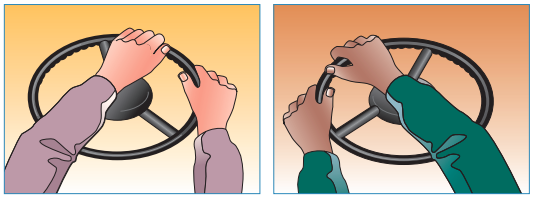
Use either the push-pull steering method or the hand-over-hand steering method.
The push-pull method — Each hand remains on its own side of the steering wheel with one hand pushing the wheel to the top where the other hand meets it and then pulls the wheel down.
The hand-over-hand method — One hand pushes the steering wheel up, across and down, while the other hand reaches up to the top of the wheel and pulls down. This action is repeated grasping the wheel at the top again.
Whichever method you use, the key is to ensure that the tractor-trailer is under control at all times.
Off-tracking
Larger vehicles need additional room to manoeuvre and articulated vehicles, such as tractor-trailers, need even more space. One reason for this is the vehicle’s dimensions. This is especially true when considering off-tracking.
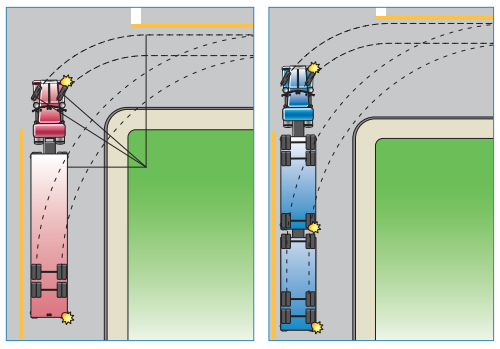
Off-tracking refers to the path of travel that wheels on the tractor and the trailer take, which differ in a turn. The rear wheels on a trailer take a different, shorter path than the front wheels on the tractor when the vehicle is turning or cornering. The greater the distance (wheelbase) between the front wheels and the rear wheels, the greater the amount of off-track. The off-track path of the rear wheels is a shorter radius than the path of the front wheels.
Vehicles that have a significant amount of off-track require drivers to adjust their turning arc. Failure to do so runs the risk of the rear wheels of the trailer running over curbs, running over the centre line, mounting sidewalks and striking fixed object hazards, such as power poles, light standards near the intersection and signposts.
Before making a turn, you must prepare for it by positioning the vehicle correctly. During this positioning, which may require entering adjacent lanes temporarily, you must check your immediate surroundings to ensure that you don’t interfere with other vehicles and it’s safe to do so.
There are two types of off-tracking:
• Low speed off-tracking is common when driving in a city. In low or moderate speed turns, the rear tires are pulled inward of the steering path. The longer the wheelbase of the vehicle or trailer or the tighter the turn, the more off-tracking that occurs.
• High-speed off-tracking is the effect of inertia. It’s seen when a vehicle travels at higher speeds and the rear tires pull outward from the steering path during a turn. When you’re driving a large vehicle, use a moderate speed when entering curves on open highways. Otherwise, you may encounter serious high-speed off-tracking that may result in a roll over.
Left and right turns
When planning to make a turn:
1. Mirror check and signal (approximately 30 m/100 ft from the turn in urban areas or approximately 100 m/330 ft in rural areas) to move into the proper position for the turn.
2. Reduce speed and downshift to the proper gear needed to execute the turn. The speed required should be achieved 20 m (65 ft) prior to the manoeuvre. You should slow the vehicle down to the necessary speed and then idle through the turn. This is especially important on wet, muddy, icy, snow-covered or gravel road surfaces as braking in a turn can lead to a jackknife situation.
3. Check for clear right-of-way by looking for potential conflict with other traffic, cyclists or pedestrians. Remember the off-tracking tendencies of the large vehicle. If you have to borrow space from other lanes, ensure it’s safe to do so, otherwise stop and wait until it’s safe to continue.
4. Be aware of other road users who may want to squeeze into an open space.
5. Check for traffic signals or signs that are directed at you and be aware of signs or signals applying to cross-traffic.
6. Execute the turn, checking both mirrors repeatedly through the turn and cancel the signal when complete.
Left turns
1. If not in the legal turning lane, mirror and shoulder check left, signal at least one-half block back and, when safe, enter the proper turning lane (in an urban area). This is the lane just to the right of the centre line or the left curb on one-way streets or as indicated by directional signs. Where two or more lanes are allowed to turn left, you should always position yourself in the outside (right) lane. This will give you the required space for your offtrack and keep other vehicles that are turning visible in your left mirror, not on your blindside.
2. Reduce your speed one half-block back, if necessary.
3. Ensure that you shift into a proper gear for the turn if the turn can be done without stopping. (Lugging the engine should be avoided.)
4. From the proper lane, signal left at least one-third of a block from the intersection.
5. Scan the intersection for traffic control devices and comply as required.
6. Check left, centre, right and left again for traffic and pedestrians.
7. Travel straight into the intersection to within approximately 3 m (10 ft), or one lane’s width, of the intended lane (except on one-way streets.)
8. Keep front wheels straight and yield to approaching traffic and/or pedestrians in the crosswalk to the left. Keeping the wheels pointed straight ahead will ensure that you won’t be pushed into oncoming traffic if struck from behind.
9. Look well along the intended lane of travel, accelerate and begin the turn when safe to do so. Use the push-pull or hand-over-hand steering method. Remember to constantly check the left mirror. You should also check the right-hand mirror to ensure the nose swing of the trailer doesn’t interfere with any obstacles, such as parked cars or poles and light standards.
10. Stay only as far to the right side as necessary to avoid the rear wheels running over obstacles or other vehicles. Amount of off-tracking must always be considered.
11. Start to recover steering by using the push-pull or hand-over-hand method and return into the proper lane.
12. Accelerate, cancel the turn signal and look well down your intended path of travel (at least 12 seconds or one block ahead.)
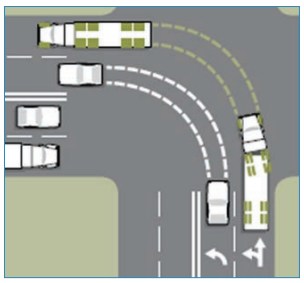
Left turns from a one-way to two-way
When turning left from a one-way street with no signs or lights indicating two or more turning lanes, the left turn should be made from the far left lane. An “S” turn could be used to block off any traffic that may attempt to pass on your left. Position your truck and trailer to the far right of the lane you are turning from and turning into. Continue checking trailer position throughout the turn.
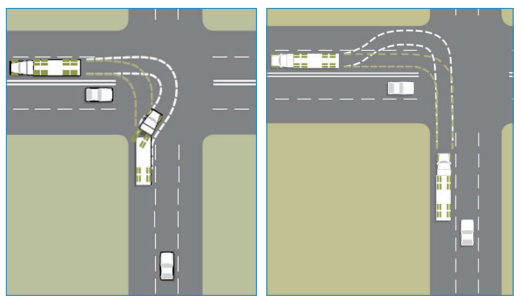
Right turns
1. Take the right-most lane available. Be aware that for every turn of the steering wheel, the rear wheels will follow a shorter path than the front wheels. Allow for this low speed off-tracking on every turn.
2. Signal to the right.
3. Scan the intersection for traffic control devices and comply as required.
4. Check the left mirror for vehicles attempting to pass or that could otherwise interfere with the turning procedure.
5. Check the right mirror to ensure that smaller vehicles, motorcycles, cyclists or pedestrians aren’t attempting to proceed in or around the right side of the tractor-trailer unit. Yield, if necessary
6. Check if the intended lane of travel is free of obstructions, such as parked vehicles. If there’s a parked vehicle within one block, then the left side of the vehicle is to be used as an extension of the curb.
7. Check left, centre, right for traffic and pedestrians. Check left again.
8. Proceed with the turning procedure using the push-pull or hand-over-hand steering method while constantly scanning the front and right side of the vehicle. (Watch for vehicles attempting to pass on the right.)
9. Be aware that you might need to go over the centre line of the street you’re entering or into the second traffic lane.
10. Return to the curb lane immediately after the rear trailer wheels clear the curb.
11. Maintain a safe and controlled speed at all times.
12. Look well down the driving path, at least one block, continue recovering the steering wheel using the push-pull or hand-over-hand method.
13. Accelerate as necessary and ensure the turn signal has been cancelled.
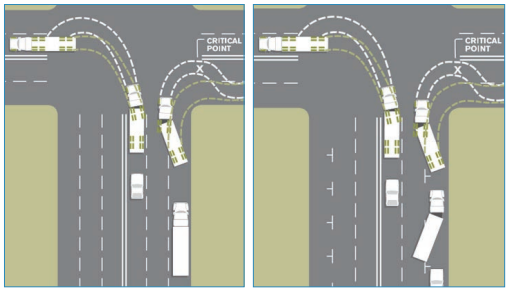
Negotiating Intersections
Know — Expect the unexpected. Decide in advance what you need to know at intersections. Your indecision can confuse other drivers and cause a crash.
Be prepared to yield at all times.
Show — Signal your intentions well in advance and be in the proper lane.
Slow — Slow down gradually. An intersection isn’t a place for speed.
Remember that at 25 km/h (15 mph), you cover more than 7 m (23 ft) per second and may travel 5 m (16 ft) just moving your foot from the accelerator to the brake.
Go — Proceed through the intersection without hesitation when safe. It’s important to understand that uncontrolled side-streets, driveways and alleyways are also considered intersections. The distraction from pedestrians,
cyclists and animals are additional hazards.
Best practices at all intersections:
• Never assume the other driver will yield to you when required. Approach each intersection with your foot off the accelerator and covering the brake.
• As you approach the intersection, look left, then right. Prior to going through the intersection, check left again, then right. If objects, like parts of your vehicle or your mirrors, block your vision, check carefully around them before you proceed.
• Proceed only when safe to do so, even if you have the right of way. You can’t count on the other driver always obeying the rules.
• When changing lanes prior to turning at an intersection, ensure you drive the vehicle to the required lane at least 15 m (50 ft) before reaching the intersection.
• Never pass a vehicle that’s stopped at an intersection until you’re sure it’s not stopped and waiting for a pedestrian to cross. Never assume a vehicle stopped at the intersection and signalling left is only waiting for oncoming traffic to clear. There may be a pedestrian crossing as well.
• It’s illegal to pass a vehicle that has stopped to allow a pedestrian within a crosswalk (marked or unmarked) to cross the road.
Traffic circles and roundabouts
These are found in some areas to help ensure safe passage of traffic through an intersection without having to stop the flow of traffic. Roundabouts, while generally larger than traffic circles, work the same way:
• Slow down as you approach the circle.
• Yield to any traffic in the circle.
• If another vehicle arrives at the traffic circle at the same time as you do, yield to a vehicle on your right.
• Go around the traffic circle to the right (counter-clockwise).
Traffic circles
Traffic circles are designed for use in residential streets where trucks and buses don’t usually travel. If you’re driving a large truck or bus through a traffic circle, encroaching onto the median is okay to get through providing it’s safe to do so.
Turn right to enter a traffic circle and turn right again to leave it. Yield to vehicles that are already in the traffic circle. If another vehicle arrives at the traffic circle at the same time as you do, yield to the vehicle on your right.
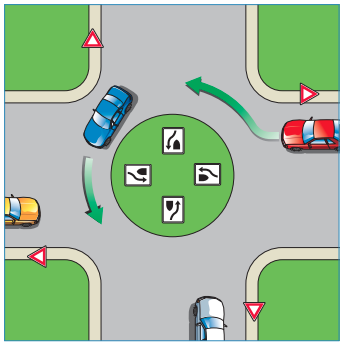
Roundabouts
Some roundabouts have more than one lane. Lane use signs and markings may be displayed at the approaches to indicate where you can go in each lane when you’re in the roundabout.
Make sure you know where you want to go and are in the proper lane to get there before you enter.
Traffic circles and roundabouts often have a truck apron around the edge of the island in the middle. Large vehicles may need to drive over the apron in order to drive through the traffic circle or roundabout.
Slow down when approaching a roundabout and yield to traffic already in it. Take care when driving a large commercial vehicle. Due to your vehicle’s off-track, you may need to take up more than one lane to get through the roundabout. Make sure there are no vehicles in the lane beside you.
When exiting, signal “right” in advance of your exit location.
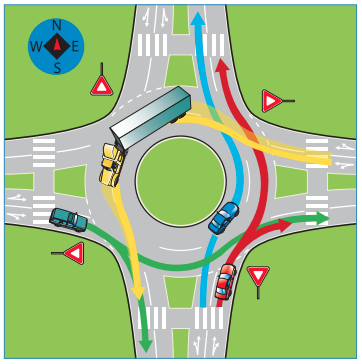
In the example above, the red car has entered the roundabout from the south in the right lane after first yielding to vehicles in the roundabout. The driver may either turn right at the east exit or continue straight and take the north exit.
The blue car entered from the south in the left lane and merged into the left lane in the roundabout. Because the blue car entered from the left lane, the driver can’t immediately turn right at the first exit (east), but can take either the north or west exit.
The tractor-trailer combination entered the roundabout from the east in the left lane and the driver is going to take the south exit. The trailer is partially in the right lane due to the length of the combination. The driver of the green car must yield to the tractor-trailer already in the roundabout.
Crossing intersections
Crossing intersections can be complicated. You need to watch for traffic approaching from the left and right and look out for oncoming traffic that may be turning. This can be very demanding, particularly if the road that you’re crossing is busy and the traffic is travelling quickly.
From a stationary (stand-still) position, it takes at least 12 seconds to cross a typical intersection on a two-way road in a tractor-trailer. This means that you need at least a 15-second gap between your commercial vehicle and vehicles approaching in order to cross safely. You’ll also need to allow for a much larger gap as the speed zone you’re entering increases to allow you to cross the intersection safely and not cause the cross-traffic to brake or swerve to avoid your vehicle.
You may need less time to cross the intersection if your vehicle is already moving. This may be the case when you’re approaching an intersection and can proceed across without stopping. However, you must still take care. It’s difficult to judge your speed and that of other traffic from the left and right. If in doubt, stop and only cross the intersection when you’re sure the gap is big enough.
You’ll need to build your gap selection skills so you know what a safe gap looks like when you’re crossing an intersection.
In urban areas, following the steps below will help you travel safely through intersections.
1. Depending on visibility, take your foot off the accelerator and cover the brake if needed.
2. Check mirrors and be aware of traffic following you. Prior to entering the intersection, check left then right for traffic indicators and controls, pedestrians and other vehicles. Make certain no vehicle approaching is about to turn left in front of you. If clear, check to the left and right once more and proceed through the intersection when safe.
3. Scan the area to determine the point-of-no-return. This is the point at which you’ll no longer be able to stop if the lights turn amber. There’s no exact point, but there’s an area or range a short distance before the intersection where the driver must decide if it’s possible to stop safely before the crosswalk or intersection when the lights turn amber. Deciding factors include: speed of the vehicle, road conditions, traffic volume to the front, rear and side and visibility. The point-of-no-return requires good judgment and experience when making the decision to stop or proceed.
4. Between intersections, watch for traffic changing lanes or entering your
lane from alleys or driveways.
5. Once past the intersection check mirrors again for any change in traffic patterns behind you. If you plan to turn at the next intersection, position yourself so you’re ready to turn. Look for pedestrians that may be crossing ahead.
When approaching any intersection, if your visibility is obstructed for any reason, you may be required to stop before proceeding.
When large vehicles enter a curve, the rear wheels don’t follow the same path as the front, because they don’t pivot, so they’ll off track closer to the curb or the center line depending on the direction you are traveling in the curve, as shown in the diagram below. To mitigate this off-tracking, you must lead your turning arc of the front wheels according to how sharp the curve is and the vehicle’s off-track. Mirrors can also be used to help you monitor off-tracking.
What’s the best way to negotiate a curve?
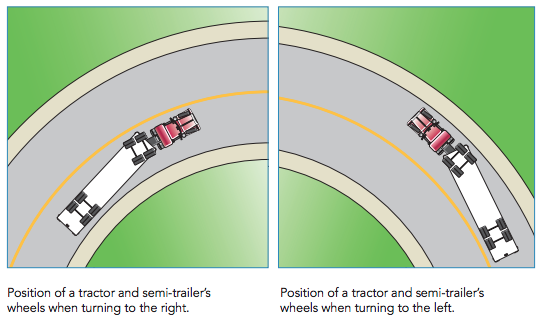
When approaching a curve, estimate a safe speed of travel (if not posted on a sign) from the degree of curvature and banking.
• On right curves, keep the front of the vehicle closer to the centre of the road so the trailer wheels don’t roll over the curb or drop off the pavement on the right, while watching the right mirror for the position of the rear of your vehicle.
• On left curves, keep the front of the vehicle closer to the outside of the curve (right side of road), so the trailer wheels don’t cut into the other lane of traffic on the left, while watching the left mirror.
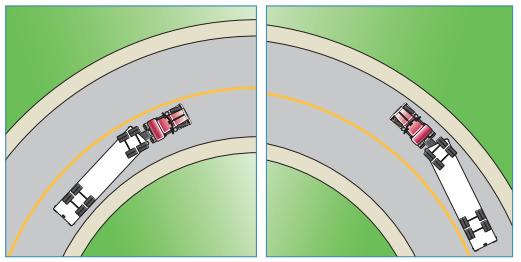
• Hugging the outside of a curve increases the risk of hitting a soft shoulder when it’s a left curve. Hugging the inside increases the risk of putting your mirrors into the path of oncoming vehicles. Manage the space you have and pay attention to tail swing and off-tracking.
• Slow down shortly before the curve and then gently apply power to the wheels after entering the curve.
When you apply power to the wheels, you introduce a force in a different direction from the inertia (this force acts on your wheels by trying to keep it going in a straight line when negotiating a curve). The result is greater control.
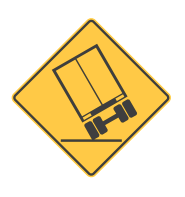
When driving in the mountains or on hills, gravity plays a major role on how your vehicle behaves. Controlling your vehicle becomes much more challenging and you need to adapt your decision-making to suit the prevailing situation. When traveling uphill, your vehicle will slow down and you’ll require lower gears to continue your ascent. Every time you take the transmission out of gear to make a downshift, the truck will slow further changing how the shift needs to be completed. When travelling downhill, it’s important to select the correct gear before you start your descent so that you can travel safely to the bottom of the hill without the use of service brakes. Ensuring all your vehicle systems are in top condition before beginning your trip is more important when travelling in the mountains.
Uphill grades
The force of gravity causes all vehicles to slow down on upgrades, making it difficult to maintain a constant speed. The steepness of the grade, as well as the weight of the load on the vehicle, all play a part in which gear you’ll need to travel up a hill. The steeper the grade and the heavier the load, the lower the gear you’ll need. Remember, different trucks will have different engine ratings and transmissions, as well as different axle ratios, so some will go up a hill faster than others with the same load.
Stay to the right and use your four-way flashers to warn vehicles if you’re travelling substantially below the posted speed limit. When your engine RPM starts to fall and shifting becomes necessary, select a lower gear that will keep you pulling in your peak torque range. Keep an eye on the operating temperatures of your coolant and the oil in your engine, transmission and differentials, if equipped with gauges. If their readings get too high, you’ll need to drop to a lower gear, so you can reduce the load on the vehicle’s drivetrain allowing them to cool down. This is especially important on a hot summer day. Never pass a vehicle on an upgrade unless you’re travelling substantially faster than them and it can be completed safely.
Uphill shifting — You’ll have to change the timing of your shift to complete them smoothly. When you upshift, you’ll have to pause longer in neutral because the vehicle (output shaft) slows during the shift and the pause will give the input shaft a chance to slow down enough to match the output shaft. If the grade is too steep, the deceleration rate of the vehicle could be too great to allow you to complete the upshift, so you’ll need to stay in that gear until the grade lessens. Avoid clashing the gears, as this will cause damage to the transmission. All shifts should be smooth to prolong the life of the transmission and the driveline components.
When you downshift while climbing a hill, you’ll have to change gears more quickly than usual, because the vehicle slows while the transmission is in neutral. There’s less RPM differential between gears when compared to level ground shifts. It takes practice to master this skill as the RPM differential will vary depending on the percentage of grade, weight of the vehicle, how long you stay in neutral and which gears you’re shifting between. If you miss this shift, you should be prepared to immediately recover the next lower gear.
Continue to downshift until you reach a gear in which you can maintain the RPM in the torque range. Whether you’re shifting up or down on a grade, you’ll have greater success if you plan your shifts ahead of time.
Driving uphill in adverse conditions — When driving uphill in adverse conditions, traction between the tires and the road surface may be reduced. Your ability to keep moving will depend on the condition of your tires and the condition of the road surface.
You may need to install your tire chains in order to climb the hill. If possible, do this prior to starting up the grade. Waiting until you spin out to install your chains can put you in a dangerous position, possibly blocking traffic while you do the installation. If you do have to start up from a stop on the grade after installing your chains, it’s recommended that you stay in the gear that you started out in until the grade lessens — attempting to shift will likely result in damage to the chains. Actuate the inter-axle differential lock and, if equipped, your driver controlled differential lock(s). Operating the engine at higher than normal RPM will reduce torque to the drive wheels which will help to prevent spin out.
Shifting on a grade
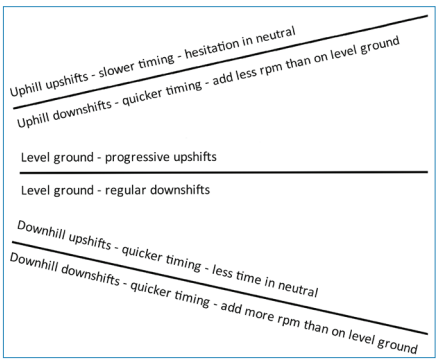
Downhill grades
Almost all brake failures and downhill runaway crashes are caused by overdriving the ability of the brakes to deal with heat. In other words, poor speed control and driver error. You’ll need a consistent strategy to plan your descent.
Remember: There are mandatory brake check areas before significant grades on many of B.C.’s highways. You must pull over, stop and check that your brakes are properly adjusted and that the overall air brake system is in good condition before you descend the grade. Failure to do so is an offence and may result in a fine.
Select gear before beginning descent — Choosing the correct gear to use when driving down a long, steep grade requires experience and familiarity with your equipment and load. If you’re unsure, start down the hill in a lower gear than you think you need as it’s easier to upshift than downshift on a steep hill. Once you have driven for some time, you’ll be able to determine more quickly which gear will hold you back to safely descend a given grade. When you have chosen the right gear, the engine won’t race. Never shift into neutral and coast — this is very dangerous and illegal.
Save your service brakes for an emergency — Note that your service brakes are designed to stop you, not to hold you back while descending grades.
Control your speed primarily through gear selection not by applying the brakes. Choose a gear that will allow you to descend without any use of the service brakes, so you have the service braking function ready in the event of an emergency.
If you descend a grade in too high a gear and need to use your brakes, they’ll start to heat up. The heat will continue to build up with excessive hard braking until it exceeds the capability of the brake components to absorb and dissipate the heat. As brake drums heat up, they expand away from the brake linings. Too much heat can result in brake fade, brake damage and even worse, brake failure that could cause a serious crash. Brake components or tires may actually catch fire.
Whether in town or on a highway, you’ll need to descend hills slower than other traffic in order to be safe and maintain control of your vehicle. Turn on your four-way flashers to warn traffic approaching from behind.
Engine brakes or retarders — Engine brakes or retarders help slow a vehicle down and are used to hold back a vehicle as it descends a hill. There are four basic types of retarders: exhaust, engine, hydraulic and electric with the engine brake being most common.
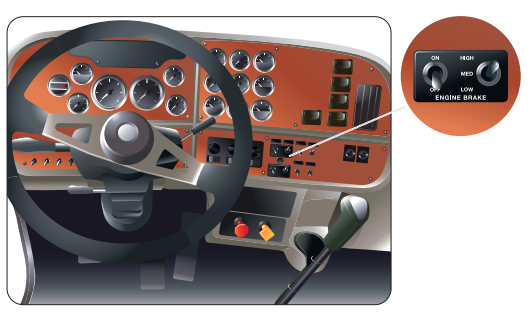
To activate the retarder, there is an on/off switch and a switch to vary the amount of holdback. If the switch is turned on and you release the pressure on the throttle pedal and clutch, the retarding device will activate.
How powerful the holdback is depends on the displacement of the engine in your truck. Larger displacement engines generally have more holdback than smaller ones, so some vehicles can descend a grade more quickly than another with the same load.
Traction also plays an important role in how effective the engine brake is as all of the holdback is generated between the drive tires and road surface. If there isn’t enough traction, the drive axles could lock up and skid which could result in a jackknife. If you needed tire chains to climb the other side of the mountain, leave them on while descending the grade as well.
Note: Never use your driver-controlled differential locks (DCDL) to descend a grade as it could result in the loss of steering control. When unlocking your DCDL, it may take several kilometres before they actually unlock. Be sure they’re unlocked (indicator light is out) before you start down a hill.
Engine brakes are most efficient at a high RPM (2,000–2,100), but check your owner’s manual to see what RPM is appropriate for your truck. All modern trucks are manufactured to meet safety standards, including noise levels. A well-engineered truck with an engine retarder and a properly maintained muffler system shouldn’t be noisy.
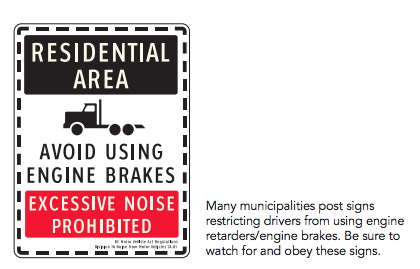
Gear selection — It takes a lot of experience to know what gear to use when you start down a hill. The gear required is determined by how steep the hill is, how heavy your load is and how much holdback your engine brake generates.
Generally, the gear you select to descend the hill is usually the same one you would need to climb it. Downshifting when going downhill takes a lot of skill and practice because the risk of missing a shift and losing control is very real.
The best practice is to downshift before you start downhill so you’re already in the correct gear. If you’re not sure which is the correct gear, then use a lower gear to start out as it’s easier to upshift than downshift on a grade.
Use the engine retarder — Ensure your retarder is set on high and monitor your tachometer, while checking what RPM your engine is holding back at. If you’re holding back between 1,700 and 2,100 RPM, then you’re in the correct gear and can just keep monitoring the gauges and the traffic around you.
If the RPM starts to climb past 2,100, you’re in too high a gear and damage to the engine can result if you allow the RPM to keep climbing. At this point, you’ll need to downshift.
Downshifting — If you find yourself in too high of a gear and need to downshift, begin by slowing the vehicle down substantially (to 1000 RPM or less) and once you’re ready, shift the same way you would on level ground, but increase your RPM more than you would for a regular shift.
How much extra RPM you need will depend on how steep the grade is, the vehicle weight, how long you stay in neutral (the less time the better), and which gears you’re shifting between — the lower the gear, the bigger the RPM differential. These shifts need to be carefully planned, precise, and smooth.
Always remember, if you miss a shift to immediately recover the next highest gear to maintain control of your vehicle. To become an expert at shifting on grades requires a lot of practice.
If you haven’t been trained how to make a downshift when going downhill, then make one brake application and bring your vehicle to a stop, select the lower gear, and continue down the hill safely.
Upshifting — If your vehicle is holding back at 1,600 RPM or less on the steepest part of the hill, then you could go down the hill one gear higher. If you’ve been trained how to make an upshift on a steep hill, then proceed with that. If you haven’t, then stay in the gear you’ve selected and enjoy the ride safely to the bottom.
When you upshift when going downhill, the vehicle will accelerate as you take the transmission out of gear (output shaft speeds up), so the input shaft doesn’t have to slow down as much for you to complete the shift smoothly. This means the shift needs to be quicker with less of a pause in neutral. How much quicker will depend on how steep the grade is, the vehicle weight, and what gears you’re shifting between. If you’re too slow with the shift it may not go into gear, and you’ll need to recover the next highest gear to regain control of the vehicle. Never use your service brakes while the transmission is in neutral as you could lose control if the vehicle begins to skid.
Automated transmissions on downgrades
If you’re driving an automatic or automated transmission, you’ll need to use the “hold” or “manual” mode and select the gear you want to descend the hill in just like you would with a manual transmission. The decision-making process is the same as with a manual transmission even to the point of braking down to 1,000 RPM or less before you attempt a downshift. Remember: arriving safely at the bottom of the hill is the goal even if it takes a few minutes longer.
Plan your descent
Inspect your vehicle — Before you descend a long, steep grade, conduct an en route inspection, checking your vehicle for proper brake adjustment in particular, but also ensuring that your load is secure and that your vehicle is in good working order.
• Perform a hand valve tug test to ensure trailer service brakes are working.
• Check that the compressor is maintaining full reservoir pressure.
• Make sure slack adjustment is correct.
• Verify that glad hands and all air lines are secure with no audible air leaks.
• Check that brake drums are cool.
Plan ahead — Pre-plan your descent. Be sure to note any signage related to the slope you’re about to drive down. Take into account the following factors:
• How steep and long is the grade?
• Are there switchbacks or tight turns?
• Are there runaway lanes?
• What are the road conditions?
• What’s the weight of your load?
• How much auxiliary holdback power do you have available through, for example, engine brakes or retarders?
• What are your skills and training in downshifting on a downgrade?
• If the road conditions require it (for example, icy, snowy, wet) and it’s legal to do so in the jurisdiction you’re in, apply chains to your tires before
descending. If the conditions are extreme, you may choose to stay at the top of the hill until they improve.
Information displayed on highway signs can help you plan your descent.
This includes information about the severity of the grade, the recommended speed to negotiate sharp curves, and upcoming runaway lanes. In B.C., signs
providing information for heavy truck operators may be displayed with or without dashed borders. In either case, you must comply with them.
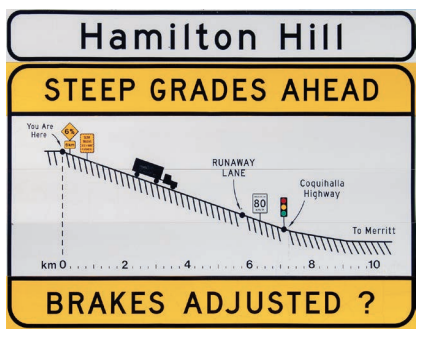
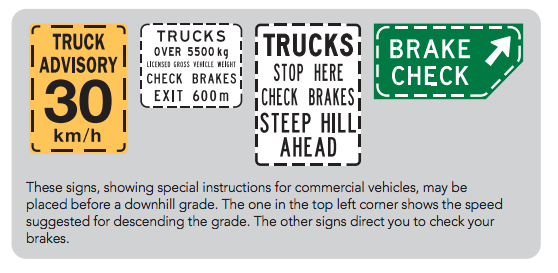
Runaway lanes — Runaway lanes are usually found in locations where other drivers have had problems. There are various types including incline ramps, gravel beds, restraint systems and water barrels. Whatever the design, a runaway lane will stop most runaways without major damage. If you lose control of your vehicle during a descent, use the runaway lane. Don’t hesitate, the situation will not improve. See the Handling emergencies chapter for more information.
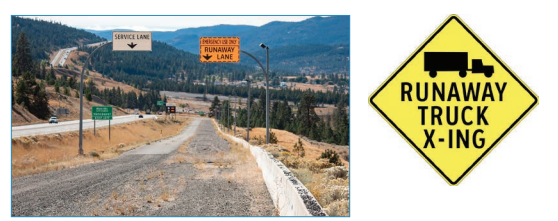
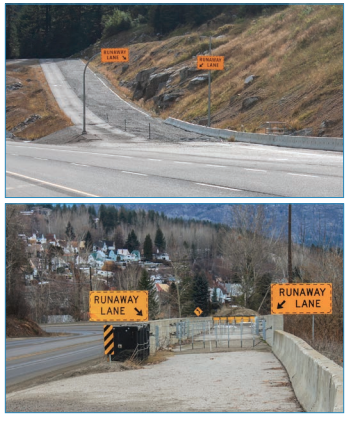
Take great care when the road intersects with railway tracks. As trains are long and heavy, they can take more than a kilometre to come to a complete stop.
Never allow traffic conditions to trap you in a position where you have to stop on the tracks. Be sure you can get all the way across the tracks before you start across. When approaching crossings with multiple sets of tracks, look in both directions for each set.
Crossing railway tracks can be especially hazardous for drivers of large vehicles because of the following:
• Longer vehicles need to travel further and will need more time to clear a crossing.
• Heavier vehicles take more time and need more room to stop before a crossing.
• Larger vehicles are more likely to derail a train if there’s a crash.
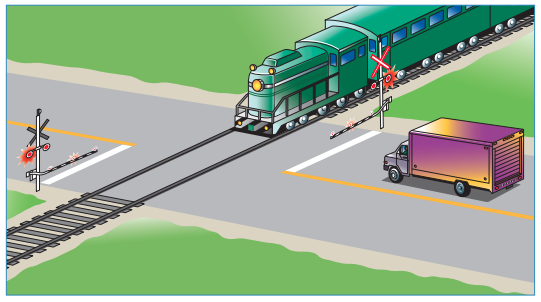
Controlled crossing — A controlled crossing is one with a flag person, stop sign, crossing gate or an electric or mechanical signalling device. All vehicles are required to stop at controlled railway crossings if signalled to do so.
Regardless of whether the railway crossing is controlled or not, always check for trains. Just because the crossing is controlled, it doesn’t mean that the lights and gates will work. Power outages and extreme weather conditions can cause them to malfunction. Developing a habit of checking every railway crossing could save your life.
Uncontrolled crossing — Some vehicles are required by law to stop at all uncontrolled railway crossings. These vehicles are:
• School buses or buses carrying passengers for compensation
• Vehicles carrying explosives or poisonous/flammable substances as a cargo or part of their cargo
• Vehicles designated for carrying flammable liquids or gas, whether the vehicle is loaded or empty
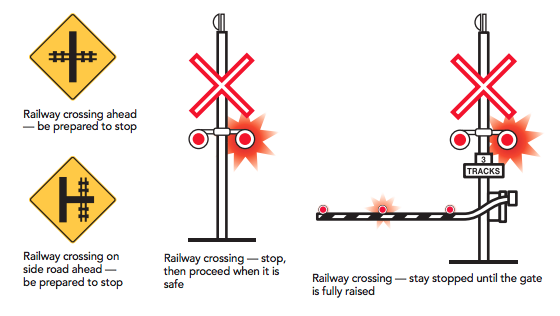
Railroad crossing procedure
• Slow down, shift to a lower gear if you have a manual transmission and test your brakes.
• If you were required to stop at the tracks, shift only before or after crossing the tracks.
• Obey the traffic signs, signals, gates and flag person.
• Check for traffic behind you.
• Listen for warning bells and whistles. Turn off, or down, distracting fans, heaters and radios. Opening the window helps you hear.
• Stop behind any gates or stop lines — no closer than 5 m (about 16 ft) and no further than 15 m (about 49 ft) from the nearest rail.
• When stopped, put your vehicle in neutral and use your emergency or service brake and wait for the train to pass.
Note: Never stop with any part of your vehicle on or over the tracks.
Note: Never drive a vehicle through, around or under a crossing gate or barrier at a railway crossing while the gate or barrier is closed or is being opened or closed.
• Before resuming travel, make sure there’s enough room on the other side of the track for the whole unit to clear, including the vehicle’s overhang. Be aware that a train will be a metre (about 3 ft) wider than the rails on both sides.
• Proceed without shifting while your vehicle is on the tracks.
• Check the crossing signals one more time before proceeding.
• If the crossing lights begin to flash after starting, keep going. It’s safer to continue than to back up.
• If there’s more than one track, there may be more than one train. Don’t assume the train you see is the only one.
• Don’t attempt to cross the tracks unless you can see far enough in both directions to be sure that no train is approaching. Be especially careful at crossings without gates, flashing lights or bells. Even if there are active warning signals and they don’t indicate that a train is approaching, you should still look and listen to be sure it’s safe to proceed.
• Watch for no stopping zones near the tracks.
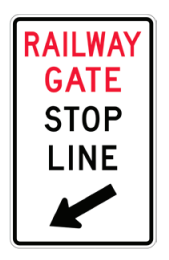
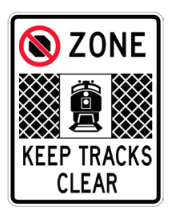
Vehicle stalled or stuck on the tracks — If your vehicle stalls or gets stuck on a crossing, get out of the vehicle immediately. If a train is coming, move away from the track in the direction of the approaching train. This will reduce the chances of being struck by flying debris if the train hits the vehicle as the momentum of the train striking the vehicle will sweep the debris forward.
Contact the railway company if its emergency number is posted or call 911.
Rural crossings
Be cautious when approaching an uncontrolled rural railway crossing at night.
A train may be crossing in front of you. The presence of a train may appear like a black, dark object against the background of a dark road. Many railway crashes involve a vehicle driving into the side of the train.
Pay extra attention when you cross railway tracks in rural areas because:
• Approach grades may be steeper.
• Snow banks may be higher.
• Brush and trees may be more common.
• There tend to be fewer automated warning systems.
• The grade crossing may be rough or uneven.
Common driver errors at crossings
• Due to its size, it’s easy to misjudge the speed and distance of an approaching train.
• Never try to beat a train to the crossing. Many vehicles have been hit by the train or have run into the side of it when trying to get across the tracks ahead of the visibly approaching train.
• Familiarity breeds complacency. Always remember the saying, “anytime is train time.” When approaching a familiar crossing that normally never has a train on it, the driver should still be alert for a train since their schedules can change from day to day.
• You should reduce speed and be especially observant if weather conditions or sight observations limit visibility of the rail.
• Some tracks may have curves and be hidden behind trees or hills which would make a train approaching at high-speed difficult to see and react to ahead of time.
• Always use extreme caution and take your time. Be 100 percent sure it’s safe before crossing any railway track whether signalized or not.