
[ultimatemember form_id=3702]
15. Hours of service (HOS)
As a professional truck driver, you’re responsible for the safety of one of the largest and heaviest vehicles travelling the highway. It’s a job that requires you to be constantly alert and able to respond quickly to whatever comes your way.
It’s extremely difficult to work safely when you’re tired. That’s why there are regulations that limit when and how long truck drivers are permitted to drive and work. These are informally referred to in the industry as hours of service regulations. They’re similar to regulations intended to prevent fatigue in airline pilots. Fatigue slows reaction times, decreases awareness, increases aggressiveness and impairs judgement enough to cause a crash. For more information about fatigue, refer to the unit on health and safety.
National Safety Code standard 9 — Hours of Services sets out recommended hours of service criteria for Canadian provinces and territories. B.C. has adopted this standard and has set out hours of service in Part 3 of Division 37 — Hours of Service in the Motor Vehicle Act Regulations. If you work for a federally regulated carrier, you’ll follow the federal regulations: Commercial Vehicle Drivers Hours of Service Regulations. The B.C. Ministry of Transportation and Infrastructure’s Carrier Safety Guide, available at www.cvse.ca provides additional information on B.C. hours of service requirements.
This unit will help you learn to:
• Understand the reasons behind the hours of service (HOS) regulations.
• Define and provide examples of driving time, off-duty time, and on-dutynot-driving time.
• Explain daily hour limits and cycles.
• Explain hour exemptions, such as personal use and adverse conditions.
• Provide examples of different HOS rules for north of 60 degrees latitude and driving in the United States.
• Explain different methods for recording HOS and what information should be included.
• Complete a daily HOS log.
On-duty time is when you begin to work or when a carrier requires you to be ready to start work. On-duty time ends when you stop work.
You’re on duty whenever you drive or when you’re:
• Inspecting, servicing, repairing, conditioning or starting a commercial vehicle.
• Travelling as one of two drivers when you’re not resting in the sleeper berth.
• Participating in the loading or unloading of a commercial vehicle.
• Inspecting or checking the load.
• Waiting for the vehicle or load to be inspected.
• Waiting along the route because of a crash or other unanticipated event.
• Travelling as a passenger to a destination where you’ll start driving — this qualifies as on-duty time when two conditions apply:
– The carrier requests you make the trip.
– You didn’t have eight consecutive hours of off-duty time immediately before you began your driving time.
• Performing any other work as a carrier or while employed by a carrier.
• Waiting for a commercial vehicle to be serviced, loaded or unloaded when a carrier, who employs or otherwise engages you, asks you to do so.
During a ferry crossing, as long as the driver is not doing any work for any carrier, the time during the crossing can be recorded as off-duty since the driver is not in control of their vehicle.
It’s important that you get enough rest every day. Off-duty regulations are in place to protect you and everyone else who shares the road with you.
• Off-duty time includes any time you spend in a sleeper berth in a commercial vehicle.
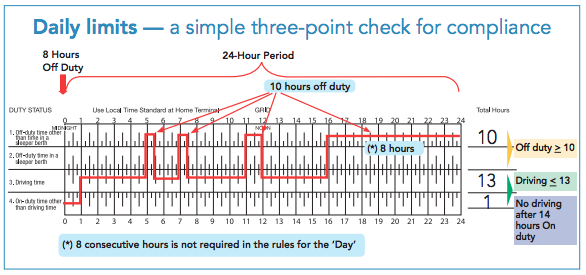
• All drivers must take a minimum of 10 hours off duty every day.
• Off-duty time, other than the mandatory eight consecutive hours, may be distributed throughout the day in blocks of 30 minutes or more.
• The total amount of off-duty time that you take in a day must include at least two hours of off-duty time that doesn’t form part of a period of eight consecutive hours of off-duty time.
• All drivers must have taken 24 consecutive hours off duty in the last 14 days.
A “day” is a 24-hour period that begins at the hour designated by the carrier for the duration of the driver’s cycle. For example, one driver’s day might start at midnight while another driver’s day might start at 2:00 a.m. The driver needs to record the hour at which the day begins on their log book page (for example, midnight or 2:00 a.m.). Each day is independent and there are certain on-duty, off-duty and driving limits for each day:
• A minimum of 10 hours of off-duty time must be taken every day.
• You’re allowed to drive a maximum of 13 hours in a day.
• You’re not allowed to drive after 14 hours on duty in a day.
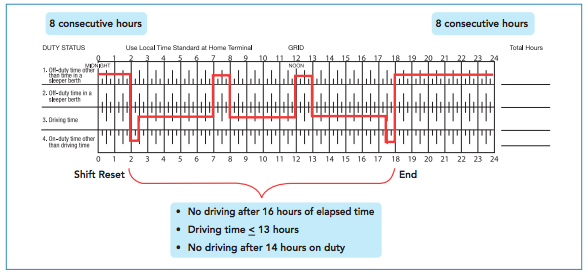
The “work-shift” is not a defined term in Division 37 of the MVAR but it’s commonly referred to in industry. It can be helpful to think of the work-shift as a 16 hour window. A work shift is the elapsed time between two off-duty periods of at least eight consecutive hours. You’re not permitted to drive after 16 hours of elapsed time (your work-shift) until you take at least eight consecutive hours of off-duty time. Every off-duty period consisting of eight consecutive hours or more resets the work shift.
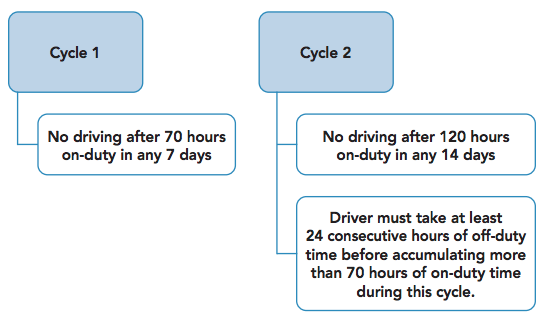
You must keep track of your time using one of two cycles. Each cycle has a maximum number of on-duty hours. You may choose one of two cycles:
Cycle 1 — Drivers working on this cycle must not drive after completing 70 onduty hours in seven days.
Cycle 2 — Drivers working on this cycle must not drive after completing 120 hours in 14 days and must take at least 24 consecutive hours off duty prior to accumulating 70 hours of on-duty time.
The start time of your day (24-hour period) remains the same throughout each cycle. You must reset a cycle to change the start time.
Did you know?
1. You can put in 14 hours of on-duty time without doing any driving at all.
2. You can reset a cycle at any time by taking:
a. 36 consecutive hours off duty to reset cycle 1, or
b. 72 consecutive hours off duty to reset cycle 2.
Cycle Switching
If a driver wants to switch from cycle 1 to cycle 2, they must take at least 36 consecutive hours of off-duty time before beginning to drive again. To switch from cycle 2 to cycle 1, the driver must take at least 72 consecutive hours of offduty time before beginning to drive again. If a driver is using the logging truck or oil-well service vehicle hours, switching between cycle 1 and cycle 2 works differently.
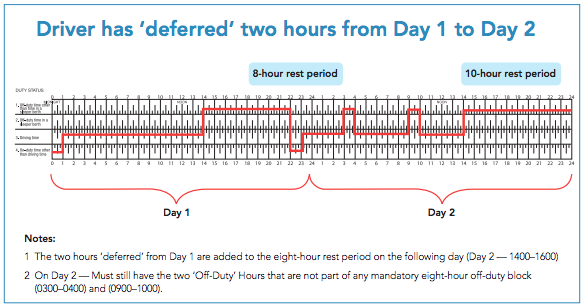
You may reduce your off-duty requirement of 10 hours by up to two hours providing:
• The two hours aren’t part of your eight consecutive off-duty hours.
• The total off-duty time taken in the two days is at least 20 hours.
• The two hours are added to the eight consecutive off-duty hours taken off the next day.
• The total driving time in the two days does not exceed 26 hours.
• You clearly indicate Day 1 and Day 2 on your log book and indicate in the log book remarks section that you are deferring off-duty time under MVAR 37.13.04.
If a commercial vehicle has an approved sleeper berth, a driver can stop and rest whenever they’re tired or during any extended period of waiting.
A driver must record any time spent resting in a sleeper berth as “off-duty time in a sleeper berth” on their daily log.
The same hours of service regulations for driving and on-duty time apply to drivers using sleeper berths.
A sleeper berth doesn’t include the back seat of a bus or a reclining seat.
Single driver
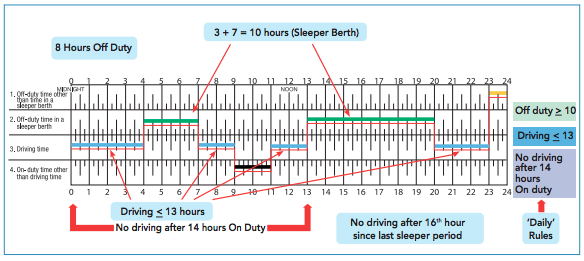
According to Division 37 of the MVAR, a driver can split the required 10 hours of daily off-duty time into two sleeper berth periods if:
• Neither period is less than two hours
• The total of the two sleeper periods is at least 10 hours
• The off-duty time is spent resting in the sleeper berth
• The total off-duty time in the day is at least 10 hours
• The total of the driving time in the periods immediately before and after each of the periods of off-duty time doesn’t exceed 13 hours
• None of the daily off-duty time is deferred to the next day.
• The total of the on-duty time in the periods immediately before and after each of the two periods of off-duty time does not include any driving time after the 14th hour.
• The elapsed time before and after each sleeper period doesn’t include any driving time after the 16th hour after the driver comes on duty.
The 16th hour is calculated by excluding any period spent in the sleeper berth that’s two hours or more in duration and that, when added to a subsequent period in the sleeper berth, totals at least 10 hours and including:
• All on-duty time
• All off-duty time not spent in the sleeper berth
• All periods of fewer than two hours spent in the sleeper berth
• Any other period spent in the sleeper berth that doesn’t qualify as counting towards meeting the requirements of the regulations
A log book example for a single driver using a sleeper berth is shown here.
Team drivers
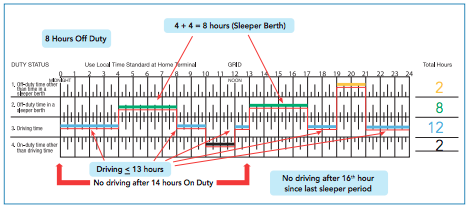
Team drivers can split the required 10 hours of daily off-duty time into two sleeper berth periods if:
• Neither period is less than four hours and the total of the two sleeper periods is at least eight hours
• The off-duty time is spent resting in the sleeper berth
• None of the daily off-duty time is deferred to the next day
• The total driving time before and after each sleeper period doesn’t exceed 13 hours
• The total of the on-duty time before and after each sleeper period doesn’t include any driving time after the 14th hour
• The elapsed time before and after each sleeper period doesn’t include any driving time after the 16th hour after the driver comes on duty The 16th hour is calculated by excluding any period spent in the sleeper berth that’s four hours or more in duration and that, when added to a subsequent period in the sleeper berth, totals at least eight hours and including:
• All on-duty time
• All off-duty time not spent in the sleeper berth
• All periods of fewer than 4 hours spent in the sleeper berth
• Any other period spent in the sleeper berth that doesn’t qualify as counting towards meeting the requirements of the regulations
Team drivers have the freedom to split the 10 hours of daily off-duty time in an way that the drivers want as long as each sleeper berth period is at least four hours and the total for two sleeper berth periods equals at least eight hours.
Team drivers must maintain their own daily logs and meet the daily and work shift limits on their own. When one driver is driving, the other must be resting in the sleeper berth for it to be counted as off-duty.
Only time actually spent in the sleeper berth counts towards the sleeper berth period. This means that any other off-duty time, such as sitting in the passenger seat, doesn’t count towards the sleeper berth period.
A log book example for a team driver using a sleeper berth is shown here.
Driving a commercial vehicle for personal use isn’t considered to be on-duty time if:
• The vehicle’s unloaded
• The vehicle’s not towing a trailer
• The vehicle’s driven a maximum of 75 km a day for personal use
• The odometer readings are recorded at the beginning and end of personal use
• You’re not subject to an out-of-service declaration
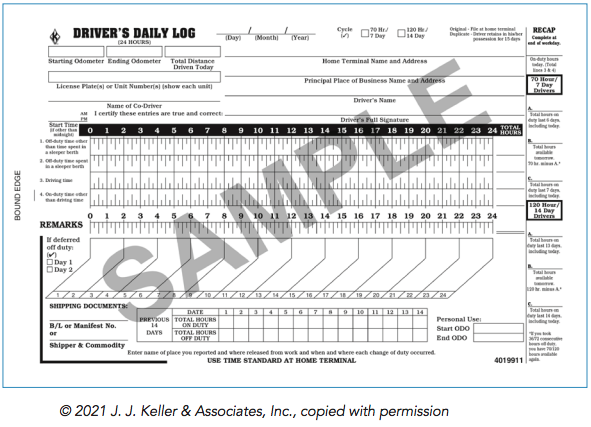
Drivers are required to maintain a complete, legible and accurate log in electronic or written format. The log must have the capability to record activities that occur 24 hours a day, seven days of the week. Your log book is recorded in the local time of your home terminal and is used to record your hours of on-duty, driving and off-duty time. Log book data must be completed on a graph grid so that each piece of required information may be recorded accurately. The grid is filled out in a way that ensures all of the driver’s hours are accounted for in each of the four duty statuses, shown on the left side of the sample logbook above. Drivers may only have one log page per day even if they work for more than one carrier on that day.
Log books must contain:
• The date
• Start time, if different from midnight
• Name of driver in printed letters
• Driver’s signature (at end of day)
• Name of the team driver, if applicable
• Odometer reading at the beginning and end of the day
• Total distance driven by the driver during the day
• Commercial vehicle licence plate number or vehicle unit number
• Cycle the driver is following
• Name of every carrier the driver worked with or for during the day
• Address of the home terminal and the principal place of business of each carrier the driver worked with or for during the day
• Total number of hours spent in each duty status — on-duty time, off-duty time, driving time and off-duty sleeper berth time — these totals must equal 24 hours
• Total amount of time spent in one location doing on-duty work other than driving (this must be shown as a continuous line on the log)
• Continuous line made by drawing through each time noted on the log page (the times noted must include every time the driver’s duty status changed)
• Name of the municipality or location on a highway, including the name of the jurisdiction (province, territory or state), where each change in duty status took place
• Declaration in the “Remarks” section of deferral of off-duty time under MVAR 37.13.04, indicating Day 1 or Day 2
• Odometer reading at the beginning and end of personal use
• In the “Remarks” section, if applicable, note when the driving time is extended due to emergencies and adverse driving conditions.
Note: if you were not required to keep a daily log immediately before the
beginning of the day, then you must record the number of off-duty time and on-duty time hours that you accumulated in the last 14 days in the “Remarks” section of the log book.
You must keep in your possession:
• A daily log for the current day that’s updated to your last change in duty status
• Copies of your daily log for the previous 14 days
• Copies of your team driver’s logs for the last 14 days if they’re no longer riding with you
• Any supporting documents you’ve been issued during your trip You must submit your original log book pages and all supporting documents to your home terminal (the carrier’s place of business where you normally report for work) within 20 days of completing a daily log.
Officers, including police, commercial transport inspectors and motor vehicle inspectors, may ask to see your log book, which you must always present along with any supporting documents when asked. The documents may include:
• Bills of lading
• Shipping documents
• Fuel and accommodation receipts for expenses incurred along the route
Sample log book
In B.C., a driver operating within the province is permitted to use an Electronic Logging Device (ELD) instead of filling out a log book.
As of June 12, 2021, all commercial vehicles operated under federal requirements will require an ELD, whether in Canada or the U.S. ELDs will replace paper logs used to record hours of service in this case.
An ELD is hardware (a tablet) that connects directly to the engine control module (ECM) to automatically record driver compliance with hours of service requirements. It collects vehicle data including date, time, location information, distance driven and engine hours. It also generates alerts for vehicle movement with no logged in driver as “unassigned driving time”.
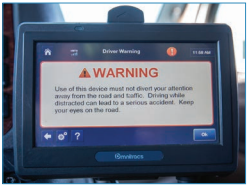
This information is used to monitor the status of vehicles and drivers and is stored in a standard format that allows companies or enforcement officials to collect and review. The information contained in the device must be the same as the information that would’ve been recorded in paper format.
The ELD must be capable of displaying:
• The driving time and other on-duty time for each day that the device is used
• The total on-duty time remaining and the total on-duty time accumulated in the cycle being followed by the driver
• The changes in duty status and the time at which each change occurred for each day the device is used
• The times and dates on which the device has been disconnected and reconnected
When requested by an enforcement official, you must be able to immediately provide the information for the previous 14 days by producing it on a digital display screen of the electronic recording device, in handwritten form or on a printout.
This means that drivers must have blank daily log forms in the commercial vehicle. Any printed copy of the daily log that’s generated from the information stored in the device must be signed on each page by the driver to confirm its accuracy.
It’s against the law to tamper with a daily log. Tampering may include any of the following activities:
• Driver keeps more than one daily log for any day.
• Driver records inaccurate information in a daily log, whether it’s handwritten or produced using an electronic device.
• Anyone falsifies, mutilates or defaces a daily log or supporting documents.
• Anyone alters or tampers with original daily logs.
A carrier is responsible for ensuring their drivers do not falsify their logs, and must not request or require a driver to alter, falsify, delete or destroy daily log records or supporting documents.
Daily logs must be signed at the end of each day to confirm that all of the information recorded is accurate. If a log contains false information, an enforcement officer can still charge a driver with a violation even if the driver hasn’t signed the daily log. They may also issue an out-of-service declaration for any of the violations listed above.
B.C.’s MVAR section 37.37 lists out the various sections of the provincial hours of service regulations which are offences. Depending on the offence, you could receive a violation ticket fine of up to $598, or if convicted by a court you could face a fine of up to $2000 and/or jail time of up to six months.
For vehicles operating under federal requirements, the Motor Vehicle Transport
Act section 18(1) provides that, anyone who contravenes or fails to comply with any provision of this Act or any regulation or order made under this Act is guilty of an offence punishable on summary conviction. Drivers who are convicted of an offence under this Act are liable to a fine not exceeding $5,000.
Corporations who are convicted of an offence under this Act are liable to a fine not exceeding $25,000.
Enforcement officers can issue an out-of-service declaration to a driver for up to 72 hours, or more if the driver fails to take corrective action, if:
• the driver’s faculties are impaired by fatigue, illness, or mental or physical infirmity to the point that is unsafe for the driver to drive
• driving would jeopardize or be likely to jeopardize the safety or health of the public, the driver or the employees of the carrier
• the driver fails to comply with requirements for driving time and off-duty time
• the driver is unable or refuses to produce their daily log book
• there is evidence that the driver has completed more than one daily log, or has falsified information in the daily log
• the driver has defaced or mutilated their daily log or supporting documents so that the enforcement officer cannot determine whether the driver has complied with driving time or off-duty requirements
If you drive while subject to an out-service declaration, you can receive a violation ticket of $598.
A driver may be exempt from filling out daily logs if they operate a commercial vehicle within a radius of 160 km of the home terminal, and the driver returns to the home terminal each day to begin a minimum of 8 consecutive hours of off-duty time. The carrier must maintain accurate and legible records showing for each day:
• the driver’s duty status and elected cycle
• the hour that each duty status begins and ends
• the total number of hours spent in each status, and
• the carrier must keep these records for a minimum of 6 months
Drivers must still follow all other hours of service rules and vehicle inspection requirements.
During a ferry crossing in B.C., as long as the driver is not doing any work for any carrier, the time during the crossing can be recorded as off-duty if the crossing is fewer than 5 hours in length.
A driver travelling by a ferry crossing that takes more than five hours isn’t required to take the mandatory eight consecutive hours of off-duty time if:
• The time spent resting in a sleeper berth while waiting at the terminal to board the ferry, in rest accommodations on the ferry and at a rest stop
that’s no more than 25 km from the point of disembarkation from the ferry combine to total a minimum of eight hours.
• The hours are recorded in the daily log as off-duty time spent in a sleeper berth.
• The driver retains, as a supporting document, the receipt for the crossing and rest accommodation fees. The supporting document must coincide with the daily log entries.
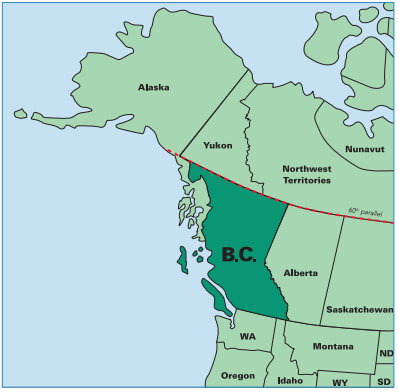
If you operate commercial vehicles north of latitude 60, such as in the Yukon, Northwest Territories or Nunavut, some of the hours of service requirements are extended, and fall under federal requirements in the Commercial Vehicle
Drivers Hours of Service Regulations. The longer hours are to accommodate short summers with longer days and ice roads in the winter. You’ll need to pace yourself and not do too many of these longer days in a row.
• You may drive a maximum of 15 hours.
• You may not drive after 18 hours of on-duty time.
• You must take at least eight consecutive hours of off-duty time before starting the next work cycle.
Drivers may choose one of two cycles:
• Cycle 1 — 80 hours of on-duty time in 7 days.
• Cycle 2 — 120 hours of on-duty time in 14 days and after accumulating 80 hours of on-duty time, you must take 24 consecutive hours off-duty.
Although the rules in most jurisdictions are similar, there are some exceptions.
Before entering another jurisdiction, be sure you know the local requirements.
Driving into the U.S. is common for many Canadian drivers and they must obey all U.S. regulations while operating there.
The following table summarizes the HOS regulations for commercial truck drivers in the U.S. If you are a Canadian commercial truck driver travelling to or from the U.S., you must follow the U.S. HOS regulations while you are in that country. Note: U.S. HOS regulations for passenger carrying vehicles differ from what is below.
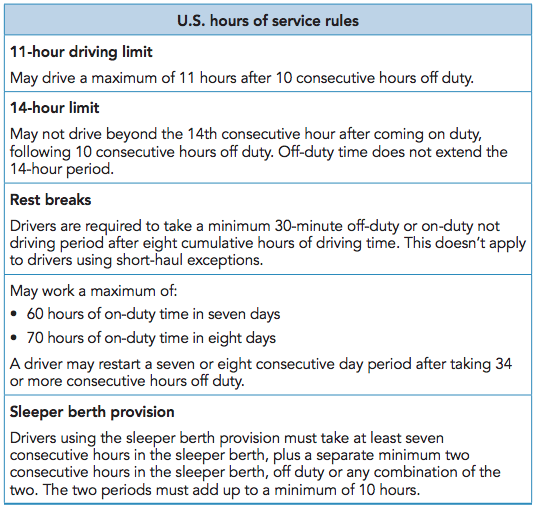
While the hours of service regulations are different in Canada and the U.S., the requirements for keeping a log book are similar. You’re responsible for learning and complying with the laws of each jurisdiction you travel through.
More information on driving into the U.S. may be found at www.fmcsa.dot.gov.
B.C. and Canadian federal regulations take into consideration situations where adverse conditions may inhibit drivers from adhering to driving time limits.
Adverse driving conditions include snow, sleet, fog or other adverse weather or road conditions, including a highway covered with snow or ice, and unusual adverse road driving conditions. These adverse driving conditions must not have been known by a driver or dispatcher before the driver began driving.
A driver who encounters adverse driving conditions may extend the permitted 13 hours of driving time and reduce the two hours of daily off-duty time by the amount of time needed to complete the trip if:
• The driving, on-duty and elapsed time in the elected cycle are not extended more than 2 hours
• The driver still takes the required 8 consecutive hours of off-duty time
• The trip could have been completed under normal driving conditions without the reduction
Note: A driver who extends their driving, on-duty or elapsed time because of an emergency or adverse driving conditions must record the reason for doing so in the “Remarks” section of the daily log.
Carriers must ensure their drivers are following hours of service requirements.
Carriers must:
• Evaluate all drivers to ensure they’re complying with the regulations
• Record the date(s) in which any violation(s) occurred
• Record the date of issuance to the driver of a notice of non-compliance
• Record any actions taken with the driver
Monitoring activities involve the review of their driver’s log books, supporting documents (such as fuel and lodging receipts) and any other relevant information. Carriers must document their findings to support any corrective or disciplinary action taken against a non-compliant driver.
It’s recommended that carriers check their driver’s logs as frequently as possible. Carriers should consider reviewing their driver’s logs on a monthly basis, at a minimum.
The number of drivers and logs checked by a carrier every month may vary according to the size of the company. A small company may choose to monitor all drivers’ logs every month, while a large company may choose only to monitor a portion of their drivers each month. Although a carrier has the option to monitor a percentage of their drivers each month, every driver should be checked at least once each year.
The objective of internal monitoring is to ensure all drivers are fully compliant every day — not just to document each driver’s performance. It’s recommended that carriers closely monitor new drivers or drivers with a history of noncompliance until they can demonstrate that they understand and are able to comply with the provincial and federal hours of service regulatory requirements.