
[ultimatemember form_id=3702]
6.Fuel-efficient driving
This unit focuses on fuel-efficient driving techniques for large commercial vehicles. In an increasingly environmentally conscious world with steadily rising fuel prices, it’s critical that new professional drivers understand this topic.
Learning these techniques can save thousands of dollars per year and reduce greenhouse gas emissions.
This unit will help you learn to:
• Explain the economic and environmental importance of fuel-efficient driving.
• Describe fuel-efficient driving techniques to drive smart and save money.
• Describe vehicle maintenance practices that help conserve fuel.
• Describe commercial vehicle components and features that help make a vehicle more fuel efficient.
• Safely fuel a tractor-trailer.
Your driving habits affect how much fuel you use, how often you need to refuel and vehicle maintenance costs.
Nearly 36 percent of all greenhouse gas emissions in B.C. are produced by the road transportation sector. Heavy-duty vehicles account for 19 percent of this total. Good safe driving habits can reduce fuel consumption by as much as 40 percent, save thousands of dollars a year in fuel and maintenance costs and reduce emissions.
It may surprise you to learn that:
• The cost of fuel has become the single largest expense for operating a heavy-duty truck — more than operator salaries, maintenance costs or the purchase price of the truck.
Tips to reduce fuel consumption
Practicing good driving habits can reduce the amount of fuel you burn. By looking ahead, keeping good space margins and anticipating road hazards, you can avoid sudden stops and changes in speeds. These and other smart driving habits also save on fuel and maintenance costs.
Here are some tips:
Preventive maintenance
Preventive maintenance plays a huge role in the health and efficiency of your vehicle. When your truck is serviced properly, you can run more efficiently and avoid unexpected downtime. Small problems should be fixed before they become bigger and more expensive.
In addition to regularly scheduled maintenance, you should also:
• Ensure your tires are inflated according to the manufacturer’s recommendations. Driving a vehicle with tires under-inflated by eight p.s.i. (56 kPa) can increase fuel consumption by up to four percent. It can also reduce the life of your tires by more than 10,000 kilometres.
• Before you hit the road, make sure you’ve done a pre-trip inspection. Not only is it the law, it can also help you avoid unwelcome breakdowns during your travels.
• Ensure all fluid levels are correct. Under filling and over filling can both damage your vehicle.
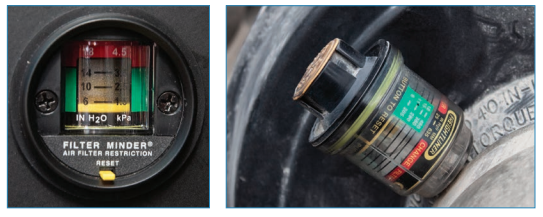
• Monitor your restriction indicator for signs of the air filter becoming plugged or contaminated.
• Continually monitor your vehicle’s condition during the trip:
– Check the gauges on your instrument panel frequently. Conduct en route inspections, including tires and cargo, at least every three hours or 240 km.
– Check for air leaks. They affect the use and effectiveness of the vehicle’s air brakes. They also make the air compressor keep running longer and this reduces fuel efficiency.
• Do a post-trip inspection to spot problems that could delay you next time.
Starting and warmup
Fuel efficiency starts when you turn your engine on. Proper warmup helps lubricate components and seals, which reduces wear and leakage. Starting your truck properly can save money on fuel. Keep the following in mind:
• When starting your vehicle make sure you use zero throttle and are in a gear that doesn’t need any throttle when starting out.
• Don’t pump the throttle of a fuel-injected engine as the amount of fuel required for starting is pre-measured. Similarly, don’t pump the throttle when cranking with older mechanical engines — it wastes fuel and can damage cylinder walls.
• When warming up the engine, don’t increase the engine speed. Five minutes of idling for a warmup is generally adequate and cooldown is provided when pulling in for parking.
• Ensure oil and air pressure are in their normal operating ranges during startup.
• Warm your vehicle up after the initial idle time by driving easily; don’t try to get too much power out of the engine by pushing the throttle down hard.
Reduce speed
Reduce your average speed. Driving fast eats up fuel no matter what vehicle you drive. Keep to the speed limit and save on fuel! Vehicles are most fuel efficient when they’re travelling between 50 and 90 km/h. Above this speed zone, vehicles use increasingly more fuel the faster they go. For example, at 120 km/h, a vehicle uses about 20 percent more fuel than at 100 km/h. On a 25 km trip, this spike in speed — and fuel consumption — would cut just two minutes from your travel time.
Maintain a steady speed. When your speed dips and bursts, you use more fuel and spend more money than you need to. Tests have shown that varying your speed up and down between 75 and 85 km/h every 18 seconds can increase your fuel use by 20 percent.
Accelerate gently. The harder you accelerate the more fuel you use. In the city, you can use less fuel by easing onto the accelerator pedal gently. To be as fuel efficient as possible, take five seconds to accelerate your vehicle up to 20 km/h from a stop. Imagine an open cup of coffee on the dashboard. Don’t spill it!
Did you know?
• At speeds over 90 km/h, each additional 10 km/h increases fuel consumption by approximately 10 percent.
• At $1.45/litre, the cost of fuel for a heavy-duty truck using 45 L/100 km and traveling 150,000 km per year is around $98,000.
• Improving fuel efficiency by just 10 percent would save $9,800 in fuel costs and reduce greenhouse gas emissions by about 14 tonnes per year.
Drive smoothly
• On manual transmissions, change gears smoothly. Shifting professionally will result in about 30 percent improvement in operating costs.
• Practice progressive gear shifting. Shifting to the next highest gear at the lowest possible revolutions per minute (RPM) that will keep the truck accelerating. In low range gears this can be 800 to 1000 RPM. Shifting progressively reduces equipment wear, decreases noise levels, makes it easier to shift and saves fuel.
• Run the engine in the highest gear to keep the RPM low.
• Use your retarder properly and turn it off when you don’t need it — let the terrain work for you.
• Back off the accelerator when going over the top of a hill and let gravity and momentum do the work.
• Use cruise control where appropriate.
• Anticipate traffic lights and pace yourself to avoid stopping and starting where possible.
Reduce idling
Idling a truck engine burns up to four litres of fuel per hour at 900 RPM. Turn off the engine when the vehicle is stopped for any length of time. This will save fuel, reduce maintenance requirements, prolong engine life and prevent unnecessary emissions.
If a 10-truck fleet were to cut idling by an hour a day for 260 days, it would save approximately 10,400 litres of fuel ($15,080 at $1.45/litre). A 100-truck fleet would save $150,800 and a 500-truck fleet $754,000.
Consider this:
• Ten seconds of idling uses more fuel than restarting your engine.
• Engine oil life can be reduced by as much as 75 percent leading to more frequent and expensive oil changes.
• Engine wear is increased. One hour of idling is equivalent to 11 km of driving.
Two ways to manage idle time:
1. Knowing how long the engine should run before and after a trip for correct engine operation and prevention of unnecessary fuel use.
2. Use the vehicle’s computer when available. Some modern engine monitoring systems automatically shut down the engine after a pre-set idling time.
Monitor the weather
Weather conditions affect fuel efficiency. Driving on snow-covered roads can increase fuel consumption by 15 to 20 percent and fuel economy can be significantly affected by heavy winds.
Here are a few ways to minimize the effects of weather:
• Avoid bad weather where possible by changing trip times or routes.
• Adjust speed to suit the conditions. For example, reduce speed when there’s a strong headwind.
• Slow down and maintain safe following conditions in order to better anticipate other vehicles in front of you.
• Do not park your tractor-trailer on an icy grade — getting stuck wastes fuel and time.
Plan your route
Plan your route carefully. The most fuel-efficient route is often one that avoids heavy commuter traffic, busy city driving and hills. Flat routes are more fuel efficient than mountainous routes. Highway driving is more fuel-efficient than driving on congested city streets.
Choosing to drive on a flat multi-lane highway improves fuel efficiency by:
• Four to 11 percent compared to a flat two-lane highway.
• As much as 18 percent compared to a mountainous highway.
• 25 to 35 percent compared to driving on suburban roads.
Equipment and options can make a big difference in fuel consumption.
Consider some of the following equipment options.
Choose the right truck
Choosing the right truck for the job with proper options and specifications can save on fuel and overall operating costs.
Using a truck designed for long-distance highway transportation for city transport costs more than using a truck designed and geared for city use.
If two trucks can each carry the same payload, purchasing the lighter one results in better fuel economy and reduced operating costs.
Look for aerodynamic features
At between 90 and 100 km/h, about 50 percent of the fuel consumed is used to overcome air resistance. Aerodynamic design features have a significant effect on how much fuel is consumed, particularly at highway speeds.
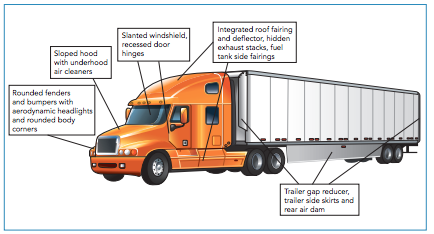
Some of the aerodynamic design features available on new trucks include:
• sloped hood with underhood air cleaners
• rounded bumpers
• rounded fenders with aerodynamic headlights and rounded body corners
• slanted and/or rounded windshield
• recessed door hinges and handles and low-profile side mirrors
• Integrated roof fairings and deflectors, fuel tank side fairings
• Hidden exhaust stacks, and
• Trailer gap reducers.
Trailer aerodynamic features include side skirts and rear trailer or boat tails, which can improve fuel economy by 15 to 20 percent. Many of these features can be added to older trucks and trailers. Aerodynamics should also be considered when loading flatbed trailers and flat deck trucks. Keeping the load low and covering it with a tarp will improve aerodynamics and help reduce fuel consumption. Ensure your tires are inflated according to the manufacturer’s recommendations.
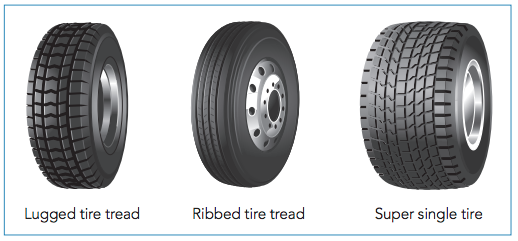
Tires with a rib tread design are more fuel efficient than tires with a lug tread design on drive and steering axles, however they don’t provide as much traction in snow.
Aerodynamic drag is increased if any of the wheels on a tractor-trailer combination aren’t properly aligned and tracking parallel to the direction of travel.
Also consider super single tires rather than dual tires on the drive axles. Super single tires provide low rolling resistance, are lighter and may lower your vehicle’s height. Canadian rules now allow super single tires to carry the same weight as dual tires.
Use accessories designed to improve productivity and fuel efficiency:
• Oil pan heaters and block heaters help with cold starting and ensure the engine oil circulates better when the engine is started.
• Fuel heaters prevent fuel gelling in cold weather.
• Thermostatically controlled engine fans, winter grille covers, battery blankets and in-cab auxiliary heaters conserve engine heat in cold weather.
On-board computers that can monitor fuel consumption are available for new trucks and may be added to older trucks. They can help you drive in the most fuel-efficient way.
Your truck’s fuel tanks are mounted to the frame and are low enough to allow you to fill them while standing beside the truck. Fuel is flammable and it must not be spilled or allowed to leak. Fuel dripping from your truck is a major safety defect.
Fuel tank caps are vented to allow air to get into the tank as the fuel level drops, but must also keep fuel from splashing out. Fuel tank caps have seals to prevent leakage so always check for signs of fuel leaks. A missing fuel tank cap is a minor defect, but if fuel is splashing and dripping it’s a major defect.
Keeping the fuel clean and keeping water out of the fuel are also very important. Dirty or contaminated fuel can cause serious engine damage. You should protect the fuel filler from dirt and water as you fuel up. Fill your tanks to the filler neck, but leave a little air space. Fuel will expand in warm weather.
Employers with dual tank trucks will have a safe work practice for fill ups, based on manufacturer specifications and those for the pump itself.
Always fuel with caution. The average flow rate of a commercial diesel pump is around 100 litres per minute and can go as high as 140. At a flow rate of 100 liters per minute, more than 1.5 litres per second will pour through the spout. That’s a lot of fuel. Spills aren’t only a serious hazard, they can lead to fines.
Fuelling tips
• Don’t add fuel into the tank when the engine is running.
• Don’t repeatedly enter and exit the vehicle while fuelling. Doing so can cause static build-up that can cause a static spark to occur when handling a fuel nozzle.
• Never overfill the fuel tank. Capacity is 95 percent of total volume to allow for expansion on warm days.
• In the event of a major or minor fuel spill, notify the attendant to get it cleaned up immediately using an approved absorbent material.
• Don’t add fuel close to electrical sparks or open flame.
• Don’t smoke while fuelling and be sure no one close by is smoking.
• Don’t use a cell phone while fuelling.
Using propane
Only people with the proper certification or training can refuel a propane vehicle or container. However, if you are around a propane refueling station you should be aware of the following:
• Ensure there’s nothing that could ignite within 3 m (10 ft) of the dispenser or container being filled
• Wear proper protective gloves and clothing, such as long sleeve shirts
• Engine and electrical accessories must be switched off
• Don’t smoke and be sure no one close by is smoking
• Don’t use a cell phone
• Do not allow your vehicle to be fueled while the engine is running, or a radio transmitter is on
Natural gas
A number of Canadian companies have fleets using natural gas as their fuel choice. Using natural gas has many benefits including:
• Reduced greenhouse gas emissions by 17 to 19 percent when compared to diesel.
• Fuel cost savings of 30 to 40 percent per kilometre.
• Quieter vehicles that create less noise in urban settings.
• Lower levels of air pollutants.
Summer fuel
Use the correct fuel for the season. Summer fuel can improve fuel economy by as much as three percent, but can cause engine problems in cold weather.
Think about where you’ll be driving. For example, if you delivered a load to California in the winter and refuelled to return to the B.C. Interior, that fuel may not be appropriate for B.C. winter temperatures.
Biodiesel
Consider using biodiesel fuel. Biodiesel is a diesel fuel substitute used in diesel engines made from renewable materials such as plant oils and animal fats, for example. It provides power similar to conventional diesel fuel, but contributes less carbon dioxide or sulfur to the atmosphere and is low in particulate emissions.