
[ultimatemember form_id=3702]
10. Off-road tasks and manoeuvres
This unit will introduce some theory behind backing a tractor-trailer, coupling and uncoupling a trailer, sliding a fifth wheel, sliding tandem axles and installing tire chains on a tractor-trailer. All of these tasks will be practiced during your practical training.
This unit will help you learn to:
• Perform straight-line backing manoeuvres with a tractor-trailer unit.
• Perform offset backing manoeuvres with a tractor-trailer to the right and to the left.
• Perform alley-dock backing manoeuvres with a tractor-trailer to the right and to the left.
• Demonstrate how to couple and uncouple a tractor-trailer.
• Explain the safety precautions necessary with coupling, uncoupling and backing.
• Slide the fifth wheel and the trailer axles.
• Explain the importance of tire chains and when they’re needed.
• Repair a broken chain.
• Install tire chains on a tractor-trailer.
Backing up a tractor-trailer can be challenging for new truck drivers or drivers in training. The best you can do is practice (a lot). You’ll get more confident as you gain experience backing up and become more comfortable doing it. There isn’t a truck driver anywhere that can perfectly back up every time. Take it slow and don’t let anyone rush you. With practice, you’ll begin to understand which way to turn and what the tractor-trailer will do.
Backing up a single-unit vehicle is done in the same way as backing up a passenger vehicle; the top of the steering wheel moves in the direction your vehicle will go when backing up.
A tractor-trailer combination vehicle handles differently than a single-unit vehicle when backing because it has a pivot point where the trailer connects to the tractor. If you steer to the right, the rear wheels of the tractor move to the right. However, the trailer will pivot to the left. If you continue backing, the tractor and trailer will eventually meet at a sharp angle (90 degrees or more) called a jackknife. Turning a tractor while backing and causing the trailer to assume a jackknife position is called jacking.
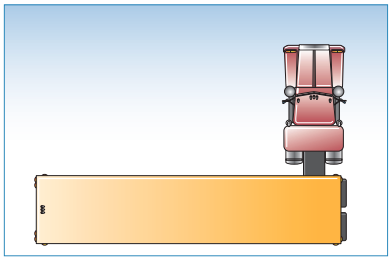
Therefore, to prevent jacking, all of your steering actions need to be reversed.
To move the back of the trailer to the left, steer right. To move the back of the trailer to the right, steer left.
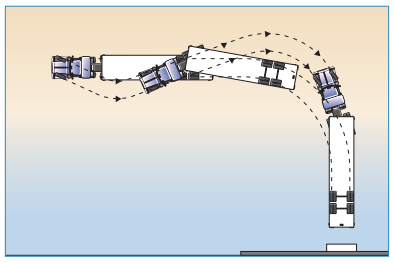
As your trailer begins to turn, your tractor must begin to follow a path that matches the trailer’s path. This is called chasing and, if not done, you risk jackknifing your vehicle. A tractor-trailer combination backing into a normal rightangle turn would follow an S-shaped curve.
General tips for backing
Backing any vehicle is risky and can be dangerous because you can’t see
everything behind your vehicle.
Start in the best position — Always start with a plan. Every backing
manoeuvre starts with getting into a good position while travelling forward. A
critical part of the setup is to get the back of the trailer as close to where you
want it while going forward. The back of the trailer is the most difficult part to
get into position, so always start with it as close to your target as possible. This
position will depend on the type of backing to be done.
Adjust your mirrors — Make sure mirrors are adjusted for optimal viewing
while backing.
Turn on your four-way flashers — Secure the vehicle and activate flashers.
Get out and look (GOAL) — Before backing, get out and walk around the vehicle. Check for obstructions and hazards. Check your clearance to the sides and overhead, as well as in and near the path your vehicle will take. Make note of any reference points that you’ll need to see in the mirrors on either side of your vehicle as you back up. If things change, stop, get out and look again.
Remember: always secure the vehicle by setting your tractor and trailer parking brakes whenever you get out and look.
Silence your audio and roll down the window — This will give you a better view in the mirror and you can listen for any warnings when backing.
Sound horn — Sound the horn twice to start out and then twice for every vehicle length while backing.
Use mirrors on both sides — Check the outside mirrors (flat and convex) on both sides frequently. Get out of the vehicle and check your path if you’re unsure.
Back slowly — Always back as slowly as possible using the lowest reverse gear.
That way you can easily correct any steering errors and stop quickly if necessary.
It’s easier to pull up and restart a backing manoeuvre than it is to try and correct it while reversing. Remember, when you turn the steering wheel to the right, the rear of the trailer goes left and when you turn the steering wheel to the left, the rear of the trailer goes to the right.
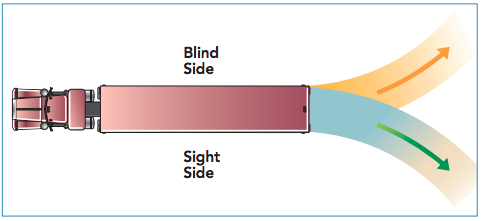
Back and turn toward the driver’s side (Sight-side) — Set yourself up so you’re backing to the sight-side, as it’s much safer than blind-side backing. If you back and turn toward the sight-side, you can watch the rear of your trailer by looking out the side window when the angle between tractor and trailer gets too great to see it in your mirror. Use sight-side backing — even if it means going around the block to put your vehicle in this position — the added safety is worth it.
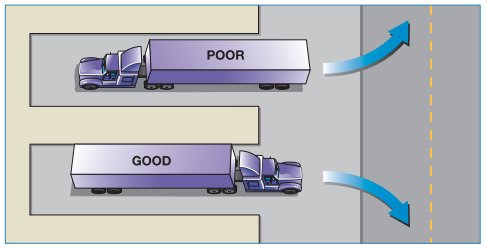
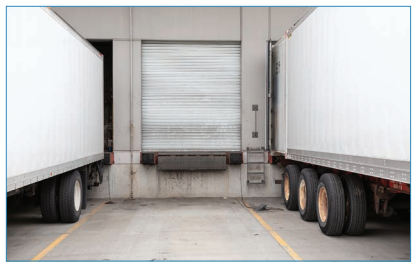
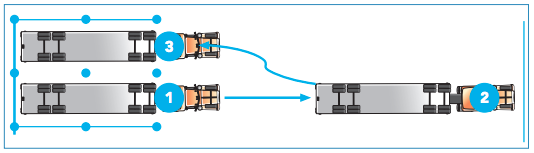
Back out of traffic — It’s easier to back out of traffic than into traffic. In the following image, the driver in the vehicle at the top drove straight into the loading dock and will now have the difficult task of backing into traffic to get back onto the road. The driver in the vehicle at the bottom backed out of traffic into the loading dock and can now easily drive forward to get back onto the road.
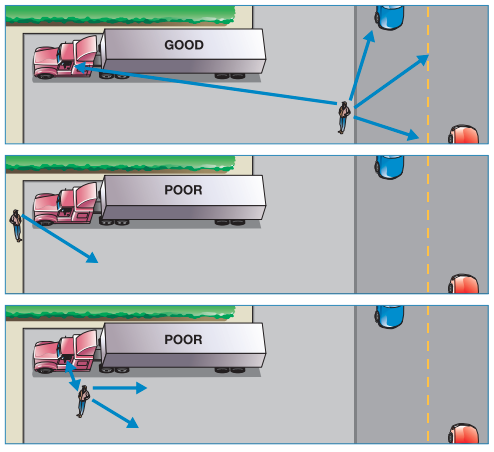
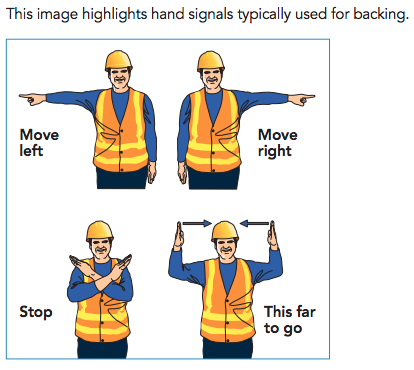
Use a guide — Use a reliable guide whenever one is available. The guide should stand near the back of your vehicle where you can see them in the driver’s side mirror and they can see behind your vehicle. If you can’t see your guide, stop!
Placement of a guide
There are four different backing manoeuvres.
1. Straight back-up
Straight-line backing is the simplest manoeuvre to learn. It’s fundamental in order to learn all other backing manoeuvres. While executing a straight-line backing manoeuvre, the vehicle should be positioned straight and shouldn’t drift to either side.
• The earlier a drift is detected, the less steering input will be needed to correct the drift.
• If drifting can’t be easily corrected, pull ahead, reset and start the manoeuvre over.
• It’s easier to start over than to reposition the vehicle while backing. Selecting reference points behind the trailer will help you recognize if the vehicle is drifting.
• Ensure you’re checking mirrors on both sides of the truck to help stay in a straight line and identify any hazards that may enter your path. Every time you check your flat mirror, you should also check your convex mirrors for hazards that are close to your tractor, such as curbs and concrete barriers.
• If someone or something enters your path, stop and, if necessary, get out and look again. Remember that before you exit the cab of the tractor each and every time, you must set the tractor and trailer parking brakes so the vehicle is secure.
• Remember to honk twice when you start your backing and then again for every vehicle length as you proceed backwards.
• If you’re backing to a loading dock, remember to open the trailer doors before you reach the building.
2. 90-degree alley-dock
Alley-dock backing involves backing while turning into a space that is 90 degrees to the truck. It often occurs at loading docks when the driver must back in from off the street or between two vehicles. The manoeuvre combines sight-side (from the driver’s side) backing and straight-line backing. It requires patience and extreme caution. Continually check your vehicle’s clearance and watch for other vehicles, pedestrians or objects that may move into the path of the vehicle after the start of the manoeuvre.
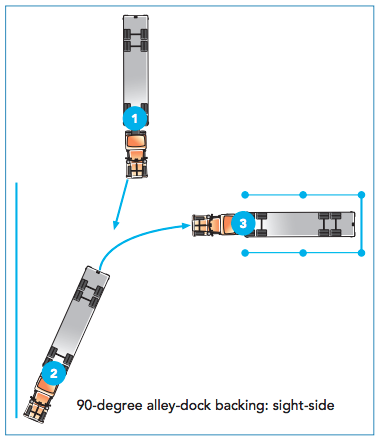
• Pull forward in a straight line near the entrance to the loading dock or parking space. Check your mirrors for obstructions. Pull up and stop with the tractor opposite the space you need the trailer to enter and ensure there are no obstacles (such as pallets or dock plates) that have been left in your way.
• Drive past the mouth of the space and proceed until the trailer landing gear (16-metre/53-foot trailer) is in line with the left side of the space, then turn hard to the right. How far you pull the trailer forward until you start to turn to the right will depend on the wheelbase of your trailer as well as how sharp your tractor turns. The wheelbase of a semi-trailer is the distance from the centre of the kingpin to the geometric centre of the axle group.
• Continue to move forward slowly. When the tractor is positioned at about 12 o’clock, turn to the left and continue to move slowly until the trailer is at a 45-degree angle. When you can see the dock or parking space in your left mirror, straighten your vehicle and stop. This sets up your trailer to head in the direction you need it to go.
• You’ll now need to use a combination of jacking and chasing manoeuvres to back your trailer into the space as required. Keep in mind, you may need to get out and confirm your clearances on the right side of the trailer since you can’t see them from the driver’s seat. You may need to pull up and reset if you’ve jacked too far or not chased soon enough. You must also make sure to activate your 4-way flashers and sound the horn prior to backing.
• If space allows, once the back end of the trailer is partway into the space, pull ahead and reposition the unit to make it easier to complete the move.
Turning the 90-degree dock into a straight-line back is safer as you can see down both sides of the trailer.
• Remember to open your trailer doors prior to finishing your docking unless you have a roll-up door. Always stand out of the way when opening the trailer doors in case the cargo has shifted, which could fall out on top of you.
If your trailer has a seal on the door, you’ll need to have the receiver remove it before you open it.
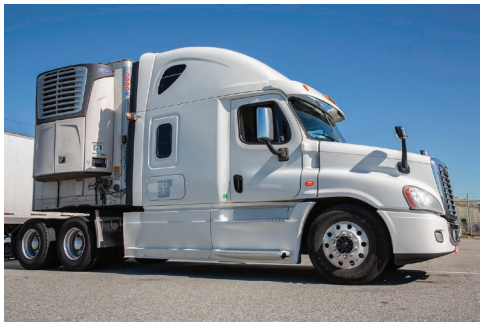
• Occasionally, if space is at a premium, you may have to finish with your tractor in a jackknife position so traffic can get past the front of your truck.
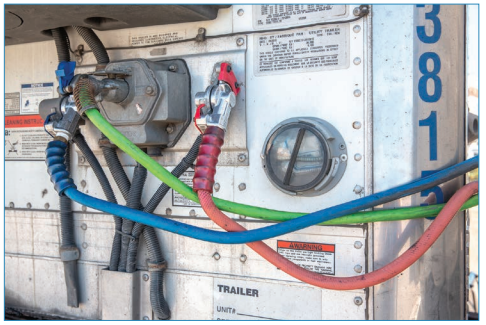
• Be sure to check that your air lines and light cord will stretch far enough prior to finishing the jackknife so you avoid damaging the lines.
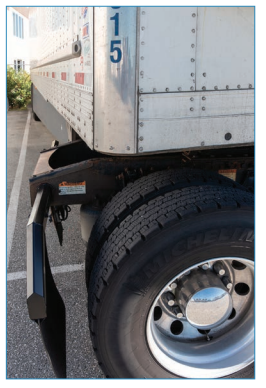
• Be aware that the tail frame of your tractor will likely stick out past the side of your trailer, so make sure there’s enough clearance before you complete your move.
• Blind-side alley-dock parking should be avoided, if possible, as it’s a highrisk manoeuvre. Circle around the block and come back to the dock from the opposite direction, so you’re backing to your sight-side. If you have no choice but to blind-side back, use a guide. This course will teach you to blind-side alley-dock with the help of a guide.
3. Offset backing
Offset backing is used mostly when you need to realign yourself with your target. The need for this is generally due to not setting yourself up perfectly for a straight-line back or when you need to make a small correction.
If you need to realign, you can do that as you pull ahead as well as when you’re backing. The biggest mistake new drivers often make when realigning is that they attempt to move their entire unit too far laterally at once for the amount of space they have. Realignment is done in the shortest distance with the use of an “S” manoeuvre.
If you need to move over 1 m (4 ft) to realign, it may take you two or three moves to complete that task depending on the space you have available. Using the “S” manoeuvre, you may be able to move your unit over 0.3 m (1 ft) as you pull up and then another 0.3 m (1 ft) as you do an offset back. You would then need to repeat the process to have moved over a metre (4 ft). If you have lots of pull up space, then you could complete this in one move.
Less experienced drivers sometimes get themselves into trouble because they attempt a bigger “S” manoeuvre than the space they have will allow them to complete.
There’s no shame in pulling up to reposition. Be sure that every move you make improves your situation, whether it’s moving forward or backward. Getting out and looking will keep your equipment and pedestrians safe and prevent incidents. There’s never a valid reason to hit something when backing — it usually happens when drivers don’t look or are unaware of their surroundings.
Remember to always set your tractor parking brake before leaving the cab.
Sight-side offset backing — Sight-side backing is backing toward the left side of the vehicle. The driver can see the intended trailer path. Sight-side backing is preferred, as the driver has maximum visibility.
Blind-side offset backing — Blind-side backing is backing toward the right side of the vehicle. The driver has limited visibility and can only see in the truck’s rear view mirrors. Blind-side backing is more dangerous than sight-side backing and should be avoided when possible. Stop often and get out of the tractor to check your position. Use a guide for this manoeuvre when possible.
4. Parallel parking
Parallel parking involves backing into a space along a curb or dock. You can also think about this as being a lane change while backing. It’s similar to offset backing, except you’re moving over the full width (3.7 m/12 ft) of a lane.
• Position your vehicle next to the other parked vehicles. Leave about 1 m (4 ft) between the vehicles.
• Pull forward in a straight line near the parking space.
• When the rear tandem axles of the trailer are about 3 m (10 ft) in front of the parking space, stop. Set the tractor and trailer parking brakes, exit the vehicle and do a visual check. Always check vehicle positioning.
• Get back into the vehicle and release the tractor and trailer parking brake, put your 4-way flashers on, and sound the horn twice. Then start backing slowly with the steering wheel turned to the left. The trailer should be entering the space at about a 15-degree angle.
• Turn the steering wheel sharply to the right and continue backing until the
tractor and trailer are in a straight line. The middle of the vehicle should be in the parking space. Continue to back until the front of the trailer is even with the front of the parking space.
• Turn the steering wheel sharply to the right and keep backing until the trailer is parallel in the parking space.
• When the trailer is almost parallel to the packing space, turn the wheel all the way to the left and follow the trailer into the space. Any corrections can be made by pulling forward to straighten out the units.
• Remember that it’s sometimes easier to restart the manoeuvre than it is to try and correct what’s wrong.
• Ideally, you want to be within 30 cm (12 in) of the curb.
Sliding the fifth wheel
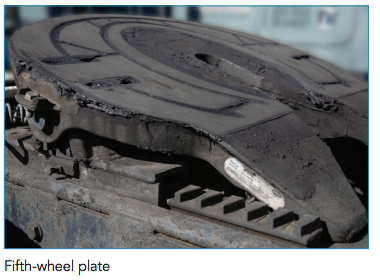
You’ll recall that the fifth wheel coupler, often just referred to as the fifth wheel, is a skid plate mounted on the tractor chassis with a latching mechanism that couples or connects to the trailer kingpin. Most tractors have fifth wheels that can be slid forwards and backwards on a track. You may need to move your fifth wheel to accommodate different trailers or to ensure the correct weight distribution between the drive and steer axles of the tractor.
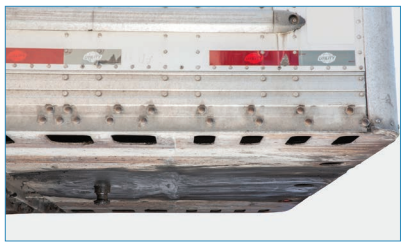
The majority of 16 m (53-ft) trailers today come with a 1 m (3 ft) pin setting — that means the kingpin located 1 m (3 ft) from the front of the trailer as in the image below:
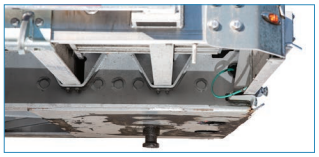
Other trailers could have different pin settings from a shallow 46 cm (18 in) to some older trailers that are up to 1.8 m (6 ft) deep, as shown in the image below:
As part of your coupling, you’ll need to check your trailer’s kingpin setting as well as the location of trailer landing gear. Some pup trailers have landing gear that’s close to the front of the trailer, which could interfere with the tail swing of your tractor. If the mud flaps on the rear of your tractor are removable, you may need to take them off to help with the swing clearance space on some landing gear. Ensure your fifth wheel position will prevent the trailer from striking the back of your cab, as well as the tractor tail frame from contacting the landing gear of the trailer.
Although all of the cargo is carried in the trailer, when you couple to the tractor weight is transferred to the tractor. The position of the fifth wheel plays an important role in tractor weight distribution and generally there’s only one position that will give you the perfect weight distribution between drive and steer axles. Some tractors are dedicated to only one trailer so they may have a stationary fifth wheel, but most are equipped with one that’s adjustable. If you slide the fifth wheel toward the nose of the tractor you will increase the weight on the steer axle and take weight off the drive axles. If you move the fifth wheel toward the rear of the tractor, you will increase the weight on the drive axles and decrease the weight on the steer axle.
You’ll inspect your fifth wheel and attachments as part of your pre-trip inspection as well as anytime you’re coupling to a trailer. There are several different styles of slide tracks in the industry and the newer tractors tend to have ones that are easier to slide as the fifth wheel sits on top of the rail. Before you attempt to slide your fifth wheel, ensure the track is free of dirt and sand as this will prevent the plate from moving. In some extreme cases, you may have to have the mechanism pressure washed to get it to move.
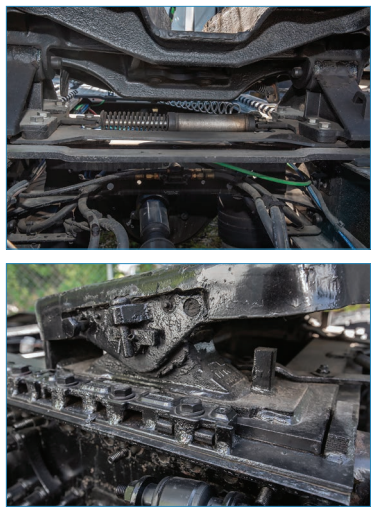
Steps for sliding the fifth wheel:
• Park the vehicle in a straight line on level, stable ground
• Apply the tractor and trailer brakes
• Exit the cab and lower the landing gear until it just touches the ground
• Note with a Holland ILS style slide, you may be able to move the fifth wheel without putting the trailer landing gear down
• Enter the cab and release the tractor brakes
• Set fifth wheel switch to “Unlock”
• Dump air from the tractor suspension, if applicable
• Wait for the suspension pressure gauge to read 0 p.s.i.
• Re-apply the tractor brake
• Exit the cab and visually check to see if the slide mechanism is unlocked
• The fifth wheel will be hanging from the trailer kingpin
• Ensure that the track isn’t packed with debris
• Enter the cab and release the tractor parking brakes/engage the inter-axle differential lock
• Gently pull forward or backward as required to reposition the fifth wheel
• Damage to trailer landing gear could result from being too aggressive with your movements
• Once the fifth wheel is in the desired location, return its switch to the “Lock” position
• Perform a gentle tug test to ensure the fifth wheel is locked
• Refill the suspension, if applicable/disengage the inter-axle differential lock
• Apply the tractor parking brakes, exit the cab and check that the fifth wheel is locked
• Raise the landing gear and secure the handle
Having the knowledge and skills to correctly connect and detach the trailer from the tractor is a major responsibility of every professional driver.
Coupling a tractor-trailer
1. Inspection of the yard prior to coupling
• Walk the area around the trailer and tractor before beginning the coupling procedure.
• Look for anything in the path that could obstruct the tractor and trailer. Make sure it’s clear before beginning the first stages of alignment.
2. Align tractor and trailer
• Enter the tractor, release the tractor parking brakes.
• Turn on four-way flashers, engage your inter-axle lock if on uneven ground or in slippery conditions and sound the horn twice.
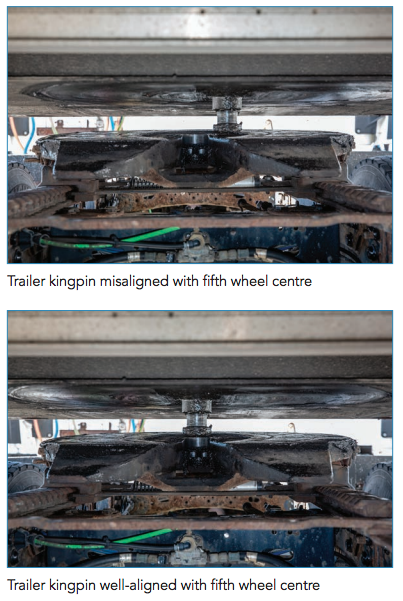
• Back the tractor at a walking pace. Position the tractor so the centre of the fifth wheel is in line with the trailer kingpin. Look in the mirrors or through the rear window (if equipped). As you get closer to the trailer, you’ll need to rely on your convex mirrors.
• Stop just before the fifth wheel makes contact with the trailer apron.
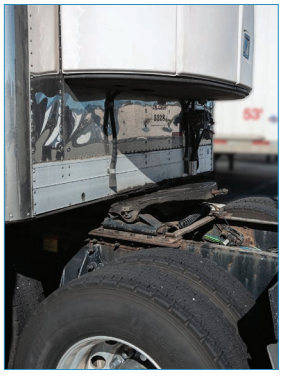
• Know the width of the tractor compared to the trailer. Typically, trailers are 2.6 m (8.6 ft) wide and the outside edges of your drive axle tires are 2.4 m (8 ft) wide, so you need 7.6 cm (3 in) of trailer overhanging each side of your tires. Remember that the centre of the fifth wheel is always in the centre of the tractor frame and the kingpin is always in the centre of the front of the trailer.
• If you need to adjust to the trailer height, deflate the tractor air suspension. Set the tractor parking brake and get out to check the alignment of the fifth wheel with the kingpin. It’s much easier to spot any extreme offset from the ground than it is from the tractor.
3. Inspection of the tractor
• The fifth wheel is tilted back and the fifth wheel locking jaws are in the unlocked/open position.
• There’s enough grease on the face of the fifth wheel plate.
• The fifth wheel slide is locked into place, free of damage and securely mounted.
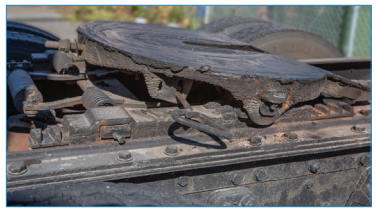
• Air and electrical lines aren’t damaged and are properly secured.
4. Inspect the trailer
• Check that the trailer spring brakes are applied, or if no spring brakes, that the wheels are chocked. You’ll need to connect your air lines to the trailer, charge it with air and, if there are no spring brakes, use your hand valve to stop it from rolling as you couple.
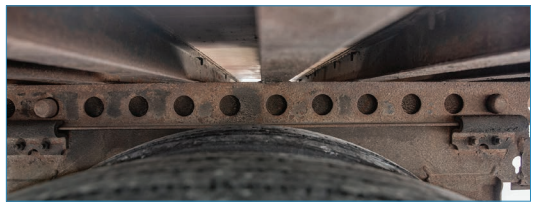
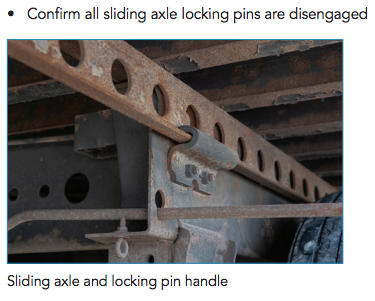
• Check that axle slide pins are locked as shown in the image below:
• Check the condition of the trailer kingpin and apron, including the collar, and remove any kingpin locking devices. Check for excessive wear or cracks.
• Check the location of the kingpin and landing gear relative to the front of the trailer to ensure your tractor fifth wheel setting will work. Remove your mud flaps for extra clearance on the landing gear, if required.
• Check the height of the fifth wheel relative to the trailer apron. Ensure it will go underneath the trailer without touching and raise the trailer with the landing gear as required to accommodate.
5. Connect the trailer
• Re-enter the tractor and shift to reverse gear and release the tractor parking brakes.
• Reverse the tractor until the fifth wheel is fully under the front of the trailer, but still ahead of the kingpin. It can be helpful to note the location of the fifth wheel relative to your drive tires so you have an idea of how far to back up to get the fifth wheel under the trailer.
• Restore the tractor air suspension to its normal height.
• Apply the tractor parking brake, exit the cab and visually check that there’s no air space between the face of the fifth wheel and the bottom of the trailer apron.
• Re-enter the tractor and shift to reverse gear and release the tractor parking brake.
• Watch the trailer in your mirrors as you back up slowly and smoothly to make the connection.
• Have your window open so you can hear the click; you should also feel the fifth wheel lock into place.
• Set the tractor parking brakes and exit the cab. Raise the landing gear until it’s 5 cm (2 in) off the ground to ensure you won’t damage it from any lateral movement as you lock into the fifth wheel.
6. Tug test
• Release the tractor parking brakes. Select low gear and attempt to move the tractor forward.
• The tug test must be firm enough to overcome the friction between the fifth wheel and the trailer’s upper coupler plate. This should be done at least twice to verify the fifth wheel has locked around the kingpin.
7. Confirm fifth wheel is locked, raise the landing gear and connect air lines
• Set the tractor parking brakes and exit the cab. Visually check that the nut and washer (if equipped) are flush with the front of the fifth wheel, the release handle has retracted and is slack and there’s no air space between the top of the fifth wheel and the trailer upper coupler plate.
• Go under the trailer, and using a flashlight, visually confirm the lock jaws are closed around the kingpin, or the lock bar is across the pin depending on the brand of fifth wheel.
• Fully raise the landing gear, then release slightly to prevent sticking during cold weather. Stow the landing gear handle into its retainer.
– Never drive with the landing gear partway up.
• Inspect and connect air and electrical lines:
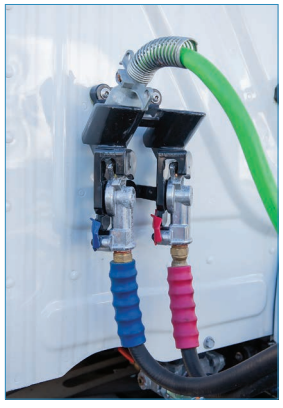
– Lines are usually coloured red for supply and blue for service.
– Check the seals and secure each air supply line to the appropriate trailer connection.
– If the air lines are crossed, supply air will be sent to the service line instead of the trailer air tanks. This will not allow the release of the trailer parking brakes.
– Check the condition of the trailer and tractor electrical connectors.
Ensure the electrical cord is secured properly by the lock on the flap.
8. Supply air check
– Re-enter the vehicle and supply air to the trailer with the trailer supply valve.
– Re-charge the trailer air suspension (if applicable).
– Complete your pre-trip inspection.
Uncoupling a tractor-trailer
1. Location inspection
– Ensure that the selected location and ground condition are level and strong enough to support the trailer landing gear, particularly if the trailer is loaded.
2. Position the tractor and trailer in a straight line.
3. Set the trailer parking brakes and ensure the tractor parking brakes are released.
4. Adjust suspension
• Dump the trailer suspension, if equipped with a manual air ride.
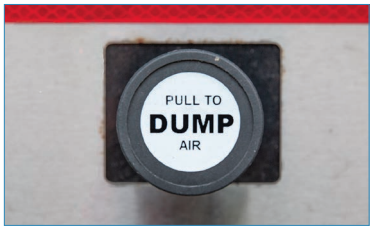
• Confirm that the suspension has deflated if equipped with an auto-dump.
5. Reverse gently to relieve kingpin pressure on fifth wheel locking jaws.
• Apply the tractor parking brakes and exit the cab.
6. Lower landing gear and block trailer wheels
• Block trailer wheels, if applicable, and place supports under the landing gear, if required.
• Lower the trailer landing gear until it touches the ground and ensure both legs touch at the same time.
• Crank until most of the trailer weight is on the dollies and not the tractor.
This will be identified when airbag suspension begins to auto-deflate as weight is removed from the tractor.
• After the landing gear is lowered, place the crank handle into its travel position.
7. Remove connections
• Disconnect electrical connection and air lines.
• Hook glad hands to dead end couplers on the tractor.
• Stow electrical connection in the holder on the back of the tractor.
8. Unlock and disengage the fifth wheel
• Unlock the fifth wheel using a puller bar. If the lock mechanism is stuck, you may have to release the tractor brakes and gently back the tractor against the trailer kingpin to release the tension and then reapply the tractor park brakes. This should allow you to unlock it.
• Re-enter the cab and release the tractor parking brakes and drive the tractor ahead 15 to 25 cm (6 to 10 in) off of the pin. Apply the tractor parking brakes and lower the tractor air suspension. Set the tractor parking brakes and get out and ensure the weight of the trailer has been transferred to the trailer landing legs — there should be a large air space above the fifth wheel.
9. Confirm stability of trailer
Check again that the ground and the landing gear are supporting the trailer.
10. Clear trailer
• Re-enter the tractor, release the tractor parking brakes and slowly drive forward until the tractor is clear of the trailer.
• Re-inflate the tractor air suspension, if applicable.
• Re-install mud flaps, if they were removed.
Coupling and uncoupling pintle hitch attachments
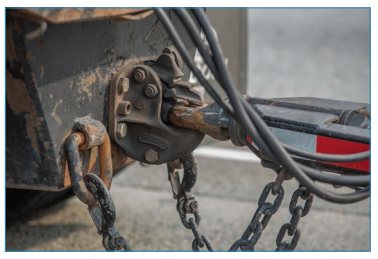
The steps for coupling pintle hitch attachments are:
• Position the towing/power unit in line to receive the pintle eye.
• Stop the towing/power unit before contact is made with the pintle eye.
• Chock the trailer wheels, if not equipped with spring brakes.
• Ensure pintle hook is open to receive pintle eye.
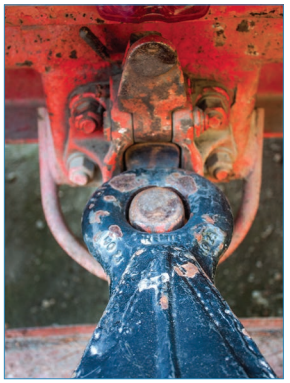
• Ensure pintle hook and eye have no cracks and or signs of excessive wear.
• Ensure pintle eye is the proper height to lower onto the pintle hook, adjusting the drawbar height if necessary.
• Position towing/power unit so the pintle eye can be lowered onto the pintle hook.
• Snap pintle hook shut and ensure safety latch is locked.
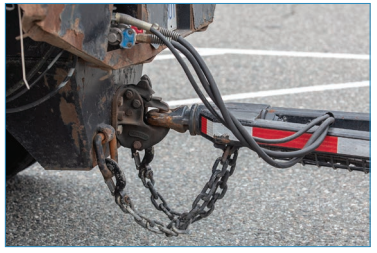
• Properly attach safety cables/chains to the towing/power unit. Fasten safety pin, if applicable.
• Raise any drawbar support legs and connect air and electrical cords as required.
• Double check that the “no-slack” air ram is functional.
Steps for uncoupling pintle hitch attachments are:
• Park the towing/power unit and trailer in a straight line.
• Set the parking brakes of the towing/power unit and trailer.
• Chock the trailer wheels, if not equipped with spring brakes.
• Disconnect air lines, electrical line and other associated hoses, if applicable.
• Disconnect safety cables/chains from the towing/power unit.
• Disconnect the safety pin, if equipped.
• Release the pintle hook locking (safety latch) mechanism.
• Lower landing leg, if equipped; otherwise, block the drawbar when required.
• Move the towing/power unit ahead slowly until the pintle eye completely clears the pintle hook.
• Stop and visually check that the pintle eye is free of the pintle hook.
Double trailer combination types
When adding a second trailer to the rear of a lead trailer, an additional fifth wheel is needed. Sometimes we need a converter dolly (converts a semi-trailer to a full trailer) and sometimes the fifth wheel is a permanent extension of the lead trailer. There are three different types of double trailer combinations.
A-train
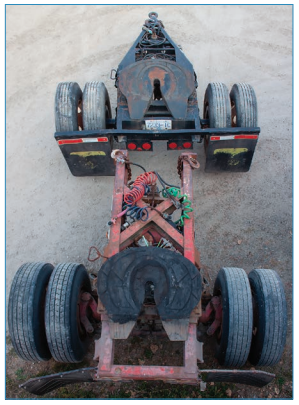
This converter dolly has an A-shaped drawbar that joins into a single pintle hitch point on the lead trailer. Due to its ‘A’ shape, it’s often called an A-dolly. When two trailers are joined together using the A-dolly, the whole unit is called an A-train. These converters provide two points of articulation (joints that allow side-to-side or lateral movement). One of these points is at the pintle and the other is at the fifth wheel.
B-train
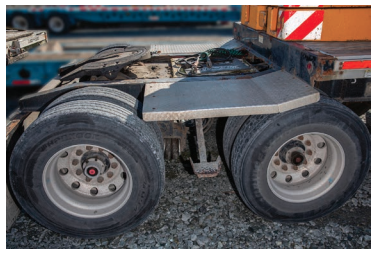
In a B-train, the fifth wheel is mounted to the frame of the lead trailer. Some B-train lead trailers have slide away dollies so they can be backed up to loading docks to be loaded or unloaded or have a power tailgate installed. When you don’t need the fifth wheel, it slides underneath the back of the trailer out of the way. The lock pins for the slide away dollies are air operated and the trailer has a third glad hand on the front, which you supply with air to unlock the pins so you can slide the dollies in or out. Always confirm the lock pins for the slide away dollies are locked back in before driving away or coupling up your B trailer.
C-train
The C-train is like the A-train, in that it uses a separate converter dolly. The difference between the two is that the C-train has two drawbars (shaped like a “C “) and requires two pintle hitches on the back of the front trailer.
Two bars mean there’s only one articulation point. The result is that the second trailer is more stable and moves less from side-to-side. To improve performance even more, some double drawbar converters have a self-steering axle.
When driving a C-train, check that the air pressure on the self-steering axle is within the manufacturer’s standards. If the air pressure falls too low, the wheels will steer too much and the unit will become unstable. Lock your steer axle straight when running on highways particularly at high speeds and unlock it when you’re in low-speed, tight-turning situations in a city or town.
Link-up arrangement
When linking two or more trailers to a towing unit, always hook the heaviest trailer directly to the tractor. The lightest trailer should be the furthest away from the towing unit. This rule applies no matter how long each trailer is. If the trailers are not joined according to weight, the unit will be unstable. The rear trailer will sway and control of the unit could be lost.
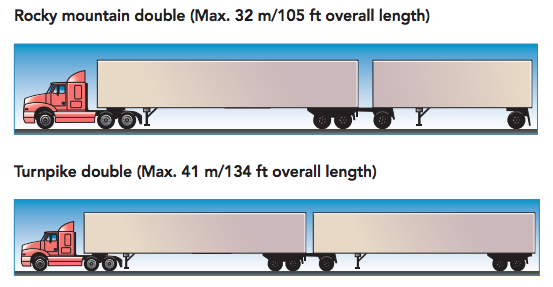
Examples of long combination vehicles (LCVs)
Carriers are required to obtain special operating permits from B.C.’s
Commercial Vehicle Safety Enforcement (CVSE) branch before these vehicles may be operated on designated routes. Drivers of LCVs must have a minimum of 24 months or 150,000 km of experience driving articulated vehicles, and must meet additional training and other requirements before a Carrier may permit them to operate an LCV. They’re not to be operated during adverse weather conditions.
Some trailers have sliding trailer rear axles which assist in transferring weight between the tractor and trailer to achieve proper distribution of weight. For example, when the trailer axles are adjusted toward the rear of the trailer, the amount of weight on the tractor will increase. However, when the trailer axles are adjusted forward, the weight will be shifted off the tractor and onto the trailer axles. If you’re travelling between different jurisdictions, you may also have to slide your axles to meet trailer wheelbase regulations that are different from your home province or territory. Keep in mind that when you’re finished sliding trailer axles (bogies) for weight distribution, the trailer wheelbase and rear overhang must still meet local legal requirements.
Steps for sliding a trailer axle:
• Park vehicle in a straight line on level, stable ground
• Apply tractor and trailer brakes
• Deflate trailer air suspension, if equipped and it’s a type that can be drained
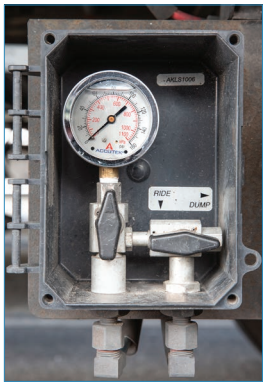
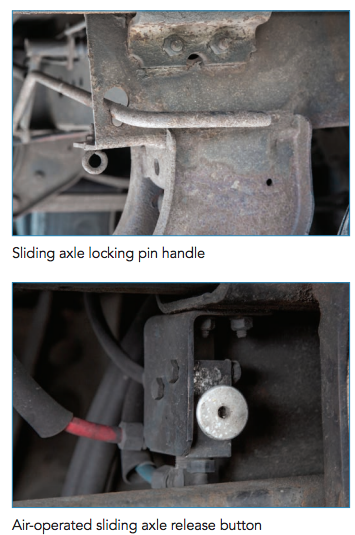
• Pull and lock handle and latch it open or push the air-operated button to release the sliding axle locking pins
• Enter the cab and release the tractor parking brakes only/engage the interaxle differential lock
• Gently pull forward or backward as required (If the pins didn’t unlock, you may have to rock the trailer first to unlock them)
• Once the trailer axles are in the required location, apply the tractor parking brakes and exit the cab
• Release the lock handle or pull out the release button to relock the slide pins
• Enter the cab and release the tractor parking brakes
• Move slowly until you hear/feel pins lock in/rock back and forth to ensure all pins are locked in
• Apply the tractor parking brakes and exit the cab
• Visually check all sliding axle pins are properly set — re-inflate the air suspension in the trailer
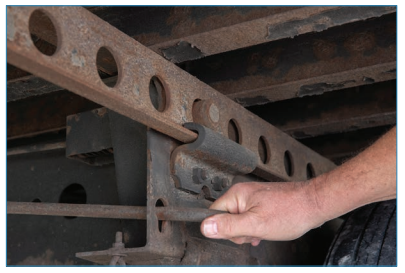
• Visually check for any air lines that are hanging down and secure, if required
• Enter the cab and disengage the inter-axle differential lock
• Perform a tug test to ensure all the sliding axle pins are securely locked
• Check your axle weights on the scale or measure the trailer wheelbase depending on the reason for sliding the axles
Commercial drivers who travel outside the Greater Vancouver and Greater
Victoria areas in the winter are required to carry chains, or other acceptable traction devices, and comply with all signage and regulations. While it is a requirement to carry chains at specific times and locations during the year, the best practice is to keep chains on board at all times. It is your responsibility to know how to install them.
Rapid changes in elevation and weather can make B.C. highway conditions unpredictable during winter months. Drivers may start a trip in sunshine but face stretches of slush, ice, heavy snowfall or compact snow along the way.
It’s the responsibility for the driver of a vehicle to understand the conditions on the roads they travel and prepare their vehicle for those conditions. Drivers must obey winter tire and chain signs throughout the province from October 1 to April 30. For select highways not located through mountain passes and/or high snowfall areas, tire and chain requirements end March 31.
The B.C. Ministry of Transportation and Infrastructure will have signs posted:
“Must carry tire chains, October 1 – April 30.” Any vehicle found crossing that point without proper tires is subject to a fine. Professional drivers only need to carry, not install, chains at this point. However, when encountering a sign or flashing amber lights with a message that indicates vehicles over a certain posted gross vehicle weight must use chains, then the chains must be installed to meet the minimum government requirements in B.C.
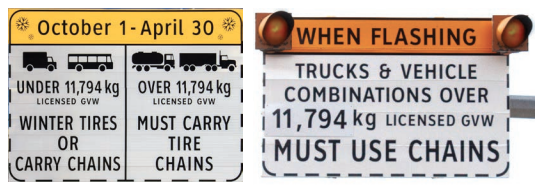
Commercial trucks weighing between 5,000 and 11,794 kg (11,000 and 26,000 lb) licensed gross vehicle weight (GVW) must carry chains or acceptable traction devices, unless the vehicle is equipped with winter-rated tires that have the three-peaked mountain and snowflake symbols or the M & S symbol.
Commercial vehicles that weigh 11,794 kg (26,000 lb) licensed GVW and greater, such as tractor-trailers, are required to carry steel chains on most major highways.
Chain configurations
Depending on the licensed GVW, vehicle type and configuration of commercial vehicle, the requirements vary for type, number and placement of chains or acceptable traction devices.
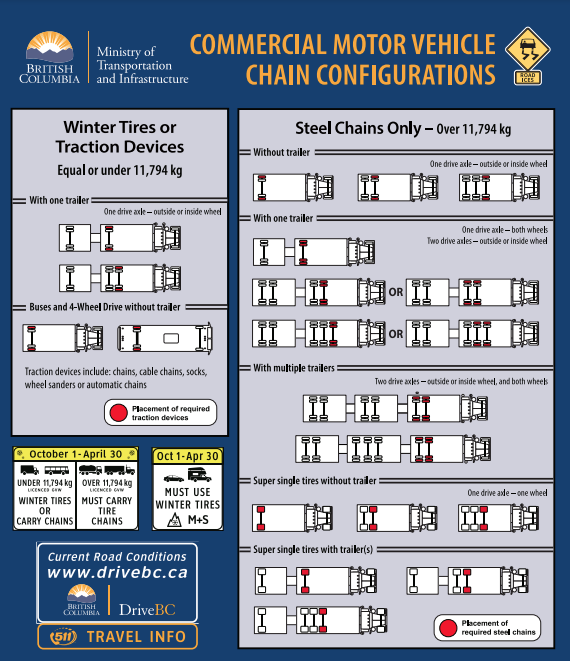
*Note: The chained tires highlighted are examples and can vary; however, they must be in the same grouping pictured.
Chain requirements
Chains required for vehicles 11,794 kg (26,000 lb) licensed GVW or greater:
Steel chains — It’s a requirement that commercial vehicles with a licensed GVW of 11,794 kg (26,000 lb) or greater use steel-link chains. For larger vehicle configurations, they have been proven to provide superior traction and prevent lateral slippage.
Chain and traction device options for vehicles 5,000-11,794 kg (11,000- 26,000 lb) licensed GVW
Cable chains — Cable-style chains are lighter and due to their lower profile, don’t provide the same level of traction as steel-link chains.
Automatic tire chains — Automatic tire chains are activated and retracted from the safety of the driver’s seat, eliminating the need for manual installation of chains.
Wheel sander — On demand, a wheel sander system delivers grit in front of the tire to increase traction.
Textile tire cover — Textile “socks” placed over tires improve traction. They work best on snow and ice and at low speeds. They degrade quickly when used on asphalt and at speeds higher than the manufacturer’s specifications.
Tire chain drawbacks
While tire chains are useful and legally required in specific circumstances, they also have limitations and in some Canadian and US jurisdictions may not be legally permitted. Know the rules of the jurisdiction you travel in.
• Driving with chains reduces fuel efficiency and the allowable speed of the vehicle drops significantly to only 50 km/h.
• Tire chains can be very harmful to developed roads and should be kept off of any dry/barren surfaces.
• Chains must be secured tightly on the tire and periodically checked. Most owner’s manuals recommend that you re-check the tightness of the tire chain from time-to-time, as they can loosen on their own while the vehicle is being driven.
• Use caution when operating with tire chains. If the tire chains come loose and slide off or break, they can cause damage to the tractor, as well as the trailer. They can even wrap around the axle, damaging it and severing air lines. However, if used properly, they can make the difference between you arriving safely and delivering your load on time, or not.
Common causes of tire chain failure:
• Driving too fast with chains.
• Driving on dry roads with chains for extended periods of time; this will rapidly wear the chains.
• Not securing the chains tightly enough.
• Accelerating too rapidly causing tire spin and stress on chains.
• Attempting to lift a loaded vehicle off on a hill without enough tire chains installed.
Stricter chain-up rules in B.C.
In the winter of 2018, unprepared commercial trucks caused 41 highway closures in B.C. because they were either poorly equipped or unequipped with chains. In some cases, this was due to the driver’s inability to install the chains properly. Loss of traction in winter conditions leads to crashes and commercial vehicles spinning out on hills and blocking all lanes until they can be towed.
New laws were introduced as a result.
Commercial vehicles are now restricted from using the left lane northbound on the Coquihalla between Box Canyon and Zopkios. This is to prevent multiple spinouts from closing the highway. In the event of severe weather, Commercial Vehicle Safety and Enforcement (CVSE) and traffic control will be directing commercial drivers to chain up at the newly expanded Box Canyon chain-up area.
Carrying chains isn’t helpful unless you know how to install them. Be sure you have the knowledge and ability to follow the new chain-up regulations. Your employer is required to ensure you’re properly trained so ask for help if you’re not confident in chaining up your truck.
See B.C. Ministry of Transportation and Infrastructure’s YouTube video: “How to Put Tire Chains on a Commercial Vehicle”.
How to install chains
Pre-season tire chain inspection
• Prior to your first trip out in October, inspect your tire chains for issues and install them on your tires for sizing.
• Replace any worn, cracked or broken components.
• Ensure your chains are racked/stowed correctly so they’re easy to install when needed.
• Make sure your tire chain bungees are in good condition and your cam lock tools fit the tire chains you have.
• Replace or update supplies as needed, such as spare cross links, quick links and chain pliers.
• The middle of a snow storm on the side of a mountain isn’t the time you want to be untangling your chains or discovering they’re too short to fit your tires.
• Just because the bag the chains came in say they’re the right size, this isn’t always the case.
Prior to installing chains
• Ensure the vehicle is in a safe location away from traffic.
• Check that the vehicle is parked ideally, in a straight line on a stable and level surface.
• Apply both the tractor and trailer parking brakes.
• Use caution when walking around the vehicle, as the ground may be slippery from snow and ice.
• Wear gloves and high-visibility clothing and dress for the weather conditions.
• Gather your needed equipment: cam-lock tool, chains and bungees.
• Which axles to chain up and how many tire chains you should install will vary depending on your circumstances. In severe situations, you may need to also place a chain on the left rear trailer tire to help stabilize the trailer on the highway.
• If you feel road conditions would require a drag chain on your trailer, it may be safer to wait until road conditions improve to continue your journey.
• If you’re pulling a single trailer and are lightly loaded, then installing tire chains over four tires should be adequate.
• If you’re pulling multiple trailers or a heavily-loaded single trailer, you should install chains on all eight tires of your tractor’s drive axles.
• If you’ve spun out on a hill and need to lift your load off of the hill, then all eight tires should be chained up to spread the load throughout your drive train and give you the best chance to get moving again.
• When lifting on a steep hill, use your lowest gear and start out as smoothly as possible. Stay in the same gear until the grade lessens enough to allow you to make a smooth up shift. If you attempt an up shift on too steep of a grade, the torque generated will likely break your chains and leave you stranded on the hill with a very expensive bill to replace your chains and possibly for a tow truck.
• Good quality tire chains are expensive ($300 plus per set of triples) and need to be used carefully. Destroying a couple of sets of chains can take all of the profit out of an entire week’s work.
Installing chains
• Decide whether you’ll be rolling forward or backward onto your chains and ensure there’s enough room behind your trailer to back up, if that makes the most sense.
• Drape chains over the top of each tire with the tail chains just touching the ground on the side of the tire that you’re going to drive towards.
• With triple chains, place them over the outside tire using the centre rail. Once positioned correctly, unfold the chain on to the inside tire as well.
• Release the tractor and trailer parking brakes and move the vehicle in the direction you determined to roll the chains onto the tires.
• Stop when the hooks are approximately half to three quarters of the way up the tire.
• Re-apply the parking brakes to secure the vehicle.
• Connect the side rails together using the hooks or boomers, depending on the style of chain you have.
• Single chains: do up the inside rail and then outside rail of the tire chain.
• Triple chains: do up the centre rail, then the inside rail and lastly the outside rail of tire chain.
• Tighten chains using the cam-locks, if equipped. If cam-locks are on both outer rails, then tighten the inside ones first.
• Make sure all the chain tails are secure so they don’t beat against the trailer or tractor components as you’re driving along.
• Installing bungee cords helps take any additional slack out of the chains, especially as they will loosen up as you drive.
• If you’re installing chains just to get out of a parking spot and back onto bare roads, the chains don’t need to be super tight, as you should only be driving at low speeds.
• If you’ll be travelling very far on your chains, stop and retighten them after you’ve travelled a couple of kilometres. Find a safe place off of the highway to do this.
Note: The tighter the chains are installed, the less wear and tear will occur on the chains and tires.
Removing tire chains
• Remove your tire chains in the opposite order to how you installed them.
• Remove bungees, loosen cam-locks, release outside hook or boomer, inside hook or boomer and finally the centre hook.
• Lay the chains flat on the ground so you don’t damage them as you drive off of them.
• Before you hang your chains up, inspect them for damage.
• If you have spare parts and chain pliers with you, repair the chains before hanging them up.
• If you can’t repair them, always hang the damaged chains to the outside of the hangers so they’re easy to access for repairs when you return to the yard.
• Triple chains should be picked up by the centre rail so they fold in on themselves to be hung up.
• Taking the time to hang your chains correctly makes installing them next time much faster.
• Double check that you’ve put all your tools and equipment away before continuing your journey.
Chain repairs
Changing cross links
• Spread the chain to be repaired out on a solid surface with the cross links face up.
• Gather enough cross links of the same type and length that need replacing.
• Lay the replacement cross link out flat beside the broken one and ensure there are no twists in it.
• Use your chain pliers to spread out the hooks on each end of the broken cross link.
• Remove the hooks from the side rails and replace them with the new cross link.
• Be sure to put the new crosslink in the same spot as the old one to keep your spacing correct on the chain.
• Use the opposite side of your chain pliers to squeeze the hook ends closed.
• Once all repairs are made, fold the chain over on itself (triple) and pick it up by the centre rail to hang back on the truck. With a single chain, just pick it up and hang on the truck.
Repairing side rails
• Generally, if your side rail breaks it’s time for a new tire chain, but emergency repairs can be made to get you off of the road and back to civilization.
• Remove the chain from the tire and lay on a solid flat surface.
• Untangle the chain and ensure that there are no twists in the side rail.
• Use a quick link to repair the break in the side rail.
• If there are several breaks, you may need more than one quick link.
• If the rest of the tire chain is in good shape, you may be able to change the side rail out with one from another damaged chain once you’re back in the yard.
• Always hang the damaged chain to the outside of the rack so it can be easily removed for further repairs back at your terminal.