
[ultimatemember form_id=3702]
12. Trip planning
In this unit, you’ll learn about everything that’s involved in planning a safe and efficient trip. A carefully planned trip will help you reduce your fuel usage, reduce wear and maintenance on the vehicle and most importantly, keep you safe.
You’ll learn about selecting the best route and rest stops, and things that may require a change to your plans. Finally, you’ll learn about planning tools, such as maps and computer programs that will help you plan a successful trip.
This unit will help you learn to:
• Identify personal safety gear, documents, permits and licenses required for your trip.
• Describe the need to carry emergency equipment and an emergency contact list.
• Plan ahead and anticipate problems.
• Explain the risk of travelling to an unfamiliar location without first confirming facilities and preferred routes.
• Identify some special requirements relating to a vehicle, load, routing or commodity.
• Identify sources of reliable information about weather and road conditions.
• Access sources of maps and electronic route information.
• Access sources of information about commercial vehicle routes, road construction, road closures, height clearances, weight restrictions, permit requirements and more.
• Prepare a route plan that considers vehicle size and weight.
• Calculate route and trip distances, including fuel and rest stops.
• Calculate fuel use, including converting between imperial and metric volumes and distances.
• Calculate trip durations to determine arrival times and plan departure times.
• Estimate expenses that might be incurred.
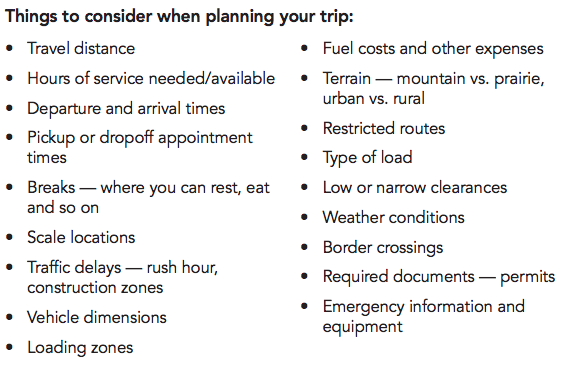
Trip planning steps
1. Ensure that documentation is current and correct
2. Plan the route considering restrictions, traffic and weather
3. Estimate travel time and plan for food and rest stops, considering hours of service requirements and where you may need to reset your hours
4. Estimate need for fuel and plan fuel stops on route
5. Estimate travel expenses
6. Confirm pick-up and delivery times
Trip documents
Next to driving, documentation is probably the largest task a driver deals with on a daily basis. Make sure you have all the necessary documentation and that it’s accurate before you depart. Generally, documentation falls under three categories:
1. Driver
2. Cargo
3. Vehicle
Driver documentation
Driver’s licence — You’re required to have a valid driver’s licence and must carry it when driving.
Log book/electronic log — The following must be available for inspection while you’re on duty. For more information, see the Hours of service unit.
• A daily log that’s updated to your last change in duty status
• Copies of your daily log for today and the previous 14 days.
• Any supporting documents you’ve been issued during your trip
Cargo documentation
Shipping documents must be in order before you begin your trip. This ensures the safe and accurate delivery of goods to the appropriate party. For more information, see the Documents and regulatory requirements and Cargo securement chapters.
Types of shipping documents include:
• Bills of lading
• Waybills
• Dangerous goods shipping documents
• Weigh slips
• Cargo packaging information
• Delivery instructions
Vehicle documentation
Paperwork related to the vehicle includes:
• Insurance documents, including vehicle licensing and registration
• International fuel tax agreement
• Required permits if your load is oversize
• Vehicle inspection report
• Trip report
Confirm pickup and delivery times
It’s the driver’s responsibility to confirm pickup and delivery times with shippers and receivers. It’s especially important to make sure you have the correct time for your receiving appointments. Remember to account for different time zones when planning your arrival time. Find out if there are any delivery restrictions, such as non-acceptance on weekends or the need for an appointment that could cause costly stops or layovers.
Drivers must also keep in touch with their dispatcher on a regular basis throughout a trip. The dispatcher must be informed whenever a change to the planned route or a delay in the planned arrival time is required.
You may be given a designated route to follow, and you may even be given designated fuel stops, but ultimately it’s the driver’s responsibility to plan the trip.
This is because the driver may discover a more efficient route than the dispatcher knows or the driver may be aware of changes that need to be made to designated routes. Drivers, therefore, need to be aware of the many types of roadways and highways, all of which can be located on a map or through GPS technology.
If you’re going to use any type of GPS technology you must be sure to set your vehicle specifications in the settings. It’s critical to use systems that will allow you to specify the height, length, width and weight of your vehicle. This prevents getting stuck somewhere that’s designed for car traffic only. It’s also a good idea to double check your route with a map book or other sources since navigation systems can make mistakes.
Canadian and U.S. interstate highways — Provincial and U.S. interstate highways or freeways separate opposing traffic, have limited access and bypass small communities. Using these highways is more fuel efficient than using two lane highways. Even though these tend to be the safest types of highway for drivers, they can become busy if there’s construction, bad weather, a major crash, or especially in urban areas, traffic congestion. Drivers should be prepared to take alternate routes if any of these problems occur on a highway.
To avoid traffic congestion, drivers should plan to drive through congested city (urban) areas during non-rush hour traffic.
Some highways have truck only designated lanes.
Watch for signs; often you won’t know what routes are designated or restricted until you get to where you’re going.
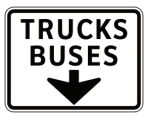
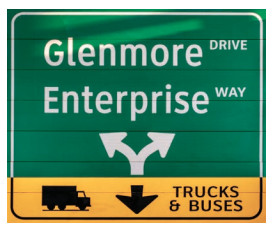
Toll roads — Toll roads require drivers to pay a fee to use them. An example of a toll road in Canada is the 407 Express Toll Route in Toronto, Ontario. In B.C., there are currently no toll highways or bridges. Many American cities have toll roads and bridges. Deciding whether the additional cost is worth incurring depends on several things:
1. How much longer the trip will take if a non-toll road is used
2. Whether the terrain is easier to drive on the toll road
3. What the traffic and conditions are on the non-toll road
4. If using the toll road will allow the driver to avoid poor road conditions, busy areas and stop-and-go driving
5. If the toll road will avoid wear and tear on the truck’s equipment
6. If driving the toll road will reduce fuel usage
After considering all these things, you may determine that a toll road route may be the most economical route to take.
Secondary routes — Secondary routes are major through routes. Even though these secondary routes have lower speed limits, are narrower, and are often more hazardous than highways, they may be good alternatives in case of delays on the multi-lane highways.
Other streets and highways — Other streets and highways must be used to reach loading or unloading points. Local streets aren’t always designed for truck traffic, so you must avoid streets with low clearances and local truck restrictions.
It’s also wise to avoid streets with unsafe railroad crossings, poor road surfaces and sharp turns.
Local truck routes — Many cities and towns have designated truck routes; you need to know what these are in advance because they’re not always marked well, and deviating from these routes could result in a fine or, much worse, an incident.
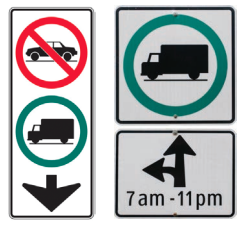
Posted bridges — Many bridges have special weight and height restrictions.
If you cross a bridge while carrying more weight in your vehicle than what is permitted, it could result in fines, permit implications, and worse, bridge collapse.
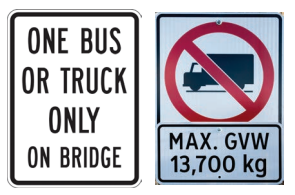
Roads are monitored and controlled by governments to ensure safety and minimize inconvenience to the traveling public and residents in urban centres. Using restricted routes can result in a fine but can also result in facing a hazardous condition or being unable to avoid an incident. It’s the driver’s job to find out which city (urban) routes cannot be used by trucks. Some restrictions may be for specific days of the week or times of the day. It’s important to immediately recognize and respond to any unexpected situation where you find that your vehicle weight or height limit is greater than what’s permitted on a particular roadway.
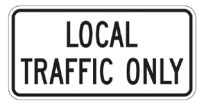
Find out the general weight and size restrictions of the regions you’ll be travelling through. You’ll need knowledge of the permits required, road restrictions and local bylaws regarding loading and unloading cargo. From time-to-time, roads are restricted because of construction, maintenance or seasonal conditions.
Commercial drivers who travel outside the Greater Vancouver and Greater Victoria areas in the winter are required to carry chains and comply with all signage and regulations. See Chapter 10 — Off-road tasks and manoeuvres, for more information on chains.
Seasonal strength loss program
During spring runoff, heavy vehicles travelling on B.C. highways can cause serious damage to some roadways, due to excess water under the road bed. To protect the roadway, the B.C. Ministry of Transportation and Infrastructure has in place a seasonal strength loss program. This program identifies and imposes load restrictions on roads or portions of roads that have been weakened by excess water in the road base. Once excess water has been removed from the road base, and the road has been determined to be structurally sound, load restrictions can be lifted.
Why are load restrictions needed?
In the spring, thawing of a road begins from the surface and moves downward.
As the thaw progresses, the water may not efficiently drain out of the soil as the surrounding soil can remain frozen and impermeable. As the thawing continues, the soil then becomes temporarily saturated with water, which reduces the pavement structure’s effective strength (bearing capacity) to carry traffic. If surplus water is present in the granular base material of a paved road, the majority of damage will occur in the asphalt layer. If the frost has extended down deep into the base layers of a road, damage may occur in the entire road structure.
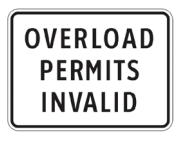
All overload permits on restricted routes are invalid for the duration of these load restriction periods.
Operators that violate a posted road restriction can be fined $345 under B.C.’s Transportation Act, section 79(1)(c) and can be made to reduce weights to posted restriction immediately on site or re-route depending on location and potential for road damage.
Load restriction notifications are available through email subscription on the Ministry of Transportation and Infrastructure website:
www.th.gov.bc.ca/bchighways/loadrestrictions.
Ports of entry are locations where a person may legally enter a country and include international airports, land border crossings, as with the U.S., and maritime ports, such as the Vancouver port. Cargo and vehicle inspections and weighing may take place at a port of entry. It is the responsibility of the carrier and the driver to ensure they have the required documents and clearance to transport goods across a port of entry.
The Canadian Border Services Agency (CBSA) manages and has enforcement responsibility over the flow of trade and travellers at Canadian borders. Carriers entering Canada by land must register with CBSA by obtaining a Carrier Code, which is used to identify the carrier in all CBSA programs, and to meet all other requirements for crossing the border.
Crossing the border into the United States
The U.S. Customs and Border Protection manages international travel and trade at U.S. borders. It is the responsibility of a Canadian carrier and driver to comply with the various driver, vehicle and cargo status requirements before transporting goods into the U.S. The following are some examples of the requirements that must be met before travelling across a U.S. port of entry:
Driver:
• Must be eligible to legally enter the United States
• Must be minimum 21 years of age to drive commercially in the United States
• Carry proof of citizenship — passport, free and secure trade (FAST) card and visa, if required
• Participate in a controlled substance testing program
• B.C. driver’s licence must NOT have a “W” on it for as a result of a medical condition of profound hearing impairment or epilepsy.
Vehicle:
• Vehicle registration
• US Department of Transportation (DOT) number and operating authority
• US Border Crossing Permit or submit border crossing fee
Cargo:
• Pre-arrival notification under Automated Commercial Environment (ACE) • Depending on the cargo type, other government department approval or pre-notification may be required. For example, the Federal Agriculture Agency for agriculture shipments.
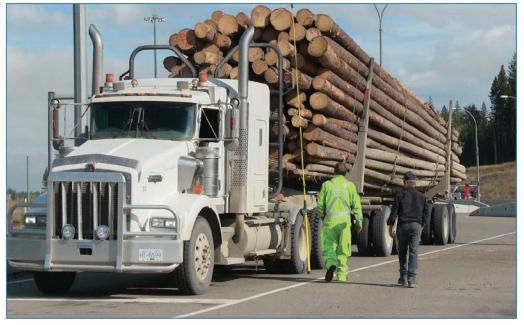
Roadside safety inspections can be conducted at weigh stations, ports of entry, special safety inspection facilities or a suitably safe area. The driver must produce their driver’s licence, driver’s logs and cargo documentation. Cargo may be inspected even if sealed. Inspectors will provide a new seal and drivers should document both the old and new seal numbers. In the United States, you’ll also require a medical certificate. Currently, your valid B.C. commercial driver’s licence also acts as your medical certificate for travel to the United States.
Even though your trip is carefully planned, detours, emergencies and unexpected delays can happen any time. That’s why at least one alternate route should also be planned. When things require you to change your route, you must contact your dispatcher immediately.
There are many ways to find out about your route and weather conditions before and during your trip:
• Talk to other truck drivers about restricted access.
• Use your cell phone or computer/GPS for route information and suggestions.
• Ask the shipper or receiver for the best local route to get to your destination.
• Listen to local radio for updates about traffic, incidents and weather. In the Vancouver area, AM 730 reports lower mainland B.C. traffic conditions 24 hours a day, including border crossing and ferry waits.
• In rural areas, signs will show a radio station to tune to for local road conditions, construction and so on.
Road reports
To check road conditions, go to DriveBC.ca or
call 1-800-550-4997 (toll free).
Check the highway cameras several times to look for weather trends, incidents and construction. This is especially important in winter before heading into the mountains.
Overhead electronic signage is not always up-to-date.
Get the DriveBC app for your phone or call *511 hands-free in B.C.
The DriveBC.ca website has helpful tools such as:
• Highway cameras
• Road restrictions
• Height clearance tool
• Major events
• Road construction
• Border delays
BCFerries.com provides ferry schedules and other travel information.

Weather reports
Environment Canada provides weather information by phone and online. For Vancouver, Howe Sound, Whistler and the Lower Fraser Valley:
• From Greater Vancouver: 604-664-9010
• For more information, talk directly to a forecaster: 1-900-565-5555 (charges apply)
• For local, national and international weather information: weather.gc.ca
The following formulas are often used to calculate distance, average speed and
trip time:
Distance = speed multiplied by time: 80 km/h x 9 hours = 720 km
Average speed = distance divided by time: 720 km/9 hours = 80 km/h
Trip time = distance divided by average speed: 720 km/80 km/h = 9 hours
Drivers must also calculate how much time rest, meal and fuel stops will take when determining their arrival time. One way to calculate total trip time is to allow 2.5 hours for every 150 km you’ll travel; experience has shown this to be reasonable for calculating driving time, meals, fuel and rest stops.
Example: distance 810 km/150 km = 5.4 x 2.5 hours =13.5 hours.
Drivers must also consider the following when calculating travel time:
• Stops, including weigh scale stops, ports of entry stops and possible roadside safety inspections
• Layovers
• Compliance with hours of service regulations
• Varying speed limits
• Load weights
• Route taken
• Ferry schedules
• Time of day
• Volume of traffic
• Personal endurance ability
Since crossing borders at ports of entry can cause delays, drivers must allow extra time for customs and immigration clearance. Drivers who cross borders regularly should apply for the FAST Express card that will allow them to:
• Use dedicated lanes in Canada and the United States as long as their carrier and the shipper are also FAST approved.
• Cross the border with faster customs and immigration processing.
• Transport eligible goods for approved carriers and importers.
Fuel consumption estimates are needed to plan fuel stops and to make sure drivers carry enough cash or have enough credit to cover their fuel expenses. Most employers will issue their drivers one or more card lock cards to purchase fuel for their trucks. Download the app for each of these fuel suppliers on your phone to help you plan your fuel stops.
When planning your trip, remember that fuel usage is based on highway driving time, city (urban) driving time and unexpected slowdowns. As discussed in Chapter six: Fuel-efficient driving, many factors can increase fuel usage, for example:
• Driving too fast
• Prolonged idling
• Operating at too high an RPM
• Stop and go driving
• Poor highway conditions
• Mountainous terrain
• Headwinds/tailwinds (reduce speed by 10 km/h when driving into strong headwinds).
• Condition of the vehicle: low tire pressure or defects in the engine or fuel line.
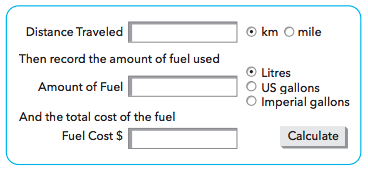
Fuel calculators are available online. When travelling between Canada and the United States, you’ll need to convert imperial and metric quantities.
Drivers should consider personal needs when trip planning and keep receipts or other documentation to prove expenses. Each carrier will have their own policies and procedures for reimbursement. Be sure to know who is responsible for what expenses.
Drivers should consider:
• Meals
• Layover/lodging
• Fuel
• En route repairs
• Towing
• Tolls
• Permits
• Special fees