[ultimatemember form_id=3702]
13. Trip planning
Section 1 — Single unit
This section will help you learn to:
– Identify the components of an air brake system
– Explain how an S-cam foundation brake works
– Describe what happens when one or more air brake system components fail
Air brake systems:
• Use a much greater force to apply the brakes than hydraulic braking systems do, which is needed to cope with the heavy loads of commercial vehicles.
• Are more tolerant to small leaks, which in a hydraulic system could result in brake failure (an air brake system includes a compressor to generate more compressed air as needed).
• Are capable of stopping heavy vehicles safely
Air can be compressed (squeezed) into a much smaller space than it would normally occupy. For example, the tires on a vehicle are filled with compressed air to support the weight of a vehicle.
Squeezing air into a smaller space increases the air’s resistance, which creates pressure that can be converted into mechanical force to apply the brakes.
If a constant supply of compressed air were directed through a pipe that’s one square inch (see previous diagram), and if a one square-inch plug were placed in the pipe, the compressed air would push against it. Holding a scale against the plug would register how much force the air was exerting against the plug.
Pressure is measured in pounds per square inch (p.s.i.) or kilopascals (kPa).
One p.s.i. is equal to 6.89 kPa.
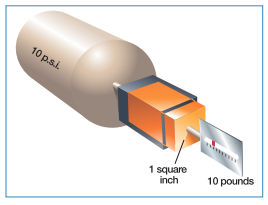
If the scale registered 10 p.s.i. (68.9 kPa), for example, then it could be said that the force was 10 lb on the one square-inch surface of the plug.
The more the air is compressed (that is, the greater the air pressure), the greater the force that would be exerted on the face of the plug.
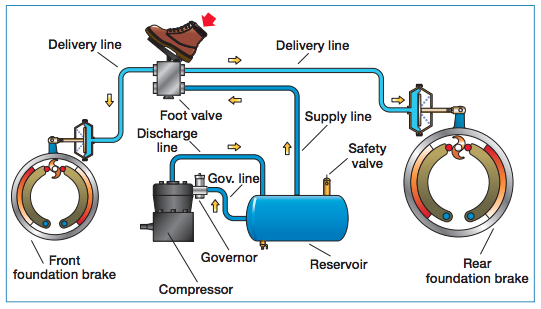
In this simplified diagram, air at full system pressure is indicated by the dark shading in the line connecting the supply reservoir to the foot valve. The driver is making a brake application. This can be seen by the light shading in the air lines connecting the foot valve to the air chambers. Arrows show the direction of air flow. The air chambers are pressurized and the brake linings (in red) have contacted the brake drums, slowing the vehicle.
This diagram, showing the brakes applied, highlights the components that are used to make the simplest possible air brake system:
• A compressor to pump air with a governor to control the compressor.
• Air lines to allow the pressurized air to flow between the air brake system components.
• A reservoir to store the compressed air.
• A brake pedal (usually called a foot valve) to apply the brakes by directing compressed air from the reservoir to the brakes.
• Foundation brakes, including brake chambers, slack adjusters, brake linings and drums or rotors, transfer the force generated by the compressed air through a mechanical linkage to apply the brakes.
The force generated at the wheel to stop is a lot more than the force you apply when pushing down on the brake pedal.
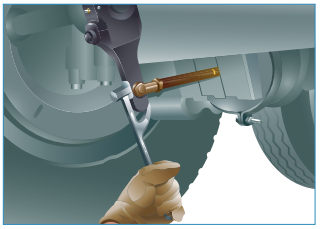
In the diagram, the driver is pulling on an air brake slack adjuster to measure if the brake is within adjustment tolerance.
The slack adjuster, besides adjusting for brake wear, acts as a lever. Leverage is a form of force multiplication.
Trucks and buses are much heavier than cars, so they need more mechanical advantage in order to safely and effectively stop the vehicle.
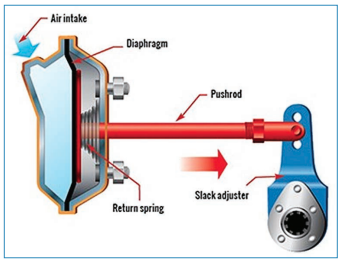
This diagram shows the most common device used to apply air brakes: the air brake chamber. It converts the force of compressed air into a strong mechanical force through the pushrod and slack adjuster.
The air brake chamber consists of a flexible diaphragm clamped between two steel housings. The diaphragm construction is similar to a tire sidewall consisting of a reinforced fabric core with a rubber coating. The other main parts are the pushrod and plate assembly and a return spring.
Leverage and air pressure
Air chambers are made in a number of sizes ranging from Type 9 (nine square inches of effective diaphragm area) to Type 36 (36 square inches of effective diaphragm area). The range of sizes allows for matching air chamber force with axle capacity so that no axle is under- or over-braked.
Air chambers are very powerful. A typical Type 30 chamber, if applied with air pressure at 100 p.s.i. (690 kPa), develops a pushrod force of 3000 lb (1,360 kg).
This force is then applied to move the lever (the slack adjuster) to apply the brakes.
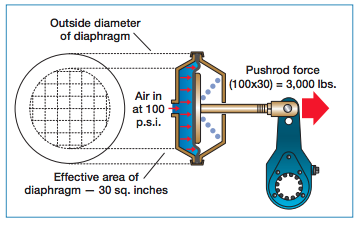
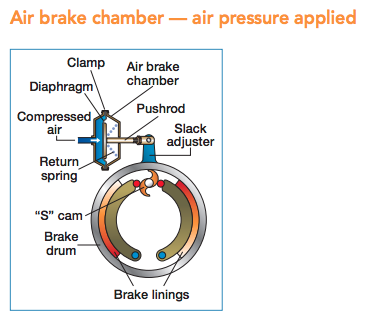
This diagram shows how air under pressure comes in one side of the diaphragm causing it to inflate. As it inflates, it pushes against the pushrod, plate assembly and the return spring causing them to move. Note the position of the slack adjuster — it’s now at about a 90-degree angle to the pushrod.
The amount of pushrod force is governed by the air pressure (in pounds per square inch) and the effective surface area of the diaphragm (in square inches).
The pushrod force is exerted against the brake mechanism causing the brakes to apply.
The most common size air chamber used on a truck drive axle is a Type 30 clamp type chamber with 30 square inches of effective diaphragm area.
Even though air brake system pressures are 100 p.s.i. (690 kPa) and above, much lower air application pressure, usually less than 20 p.s.i. (138 kPa), is all that’s required when making normal stops.
Foundation brakes: S-cam type
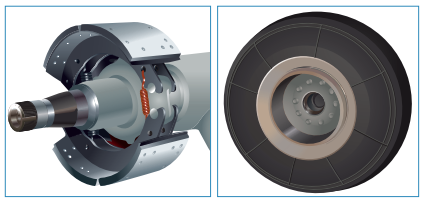
The brake assembly at each wheel is generally called the foundation brake. It consists of the brake parts around the wheel that are operated by the air brake system, including the brake chamber. The most popular type of foundation brake is the S-cam drum brake.
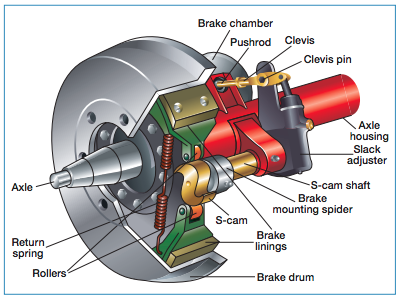
This diagram shows the main components used in the S-cam drum foundation brake. The air brake chamber pushrod is connected to a lever arm called a slack adjuster, which is attached to a camshaft with an S-shaped head called an S-cam. Air pressure applied to the chamber causes the pushrod to move forward causing the slack adjuster to rotate the S-cam. This causes the brake linings to press against the brake drum causing friction, which causes the wheel to decelerate stopping the vehicle. The slack adjuster is also the way to adjust the brakes to compensate for brake lining and brake drum wear. Brake shoe return springs pull the brake linings away from the drum when the air pressure is released from the air chamber
Brake adjustment
There are two methods of checking for correct adjustment of your brakes, but the measurements to indicate the need for brake adjustment are different. The applied stroke method is that used by roadside inspectors, and is also a method recommended by commercial fleet maintenance supervisors. Unless you have a device to apply and hold the service brakes on, this method requires two people — one to apply the brakes and one to measure travel.
The second method is the pry method of free stroke measurement (pry method), and requires you to use a brake tool (shown in the force multipliers section above) to measure brake chamber pushrod travel. New air brake chamber pushrods have markings (usually in red) to indicate when brake adjustment must be done immediately. If the pushrod travel becomes too excessive, the marking will show. Don’t wait until the red marking is exposed before adjusting the brakes.
All commercial trucks and trailers with air brakes have been manufactured with automatic slack adjusters since 1996. While automatic slack adjusters adjust themselves during normal brake applications made in day-to-day driving, it is required that you still check the pushrod travel as part of your daily trip inspection. The acceptable measurement limit of pushrod travel depends on the size of the brake chamber. In general, for an automatic slack adjuster when using the pry method, there should be 19 mm (0.75 in) or less of free-play or pushrod travel. If an automatic slack adjuster strokes beyond the maximum allowed, it is usually an indication there are other brake problems that need to be repaired by a qualified mechanic. It is dangerous to manually adjust an automatic slack adjuster — they should only be adjusted or repaired by a qualified mechanic.
While most commercial trucks and trailers operating within the industry are equipped with automatic slack adjusters, there are still older vehicles in operation that are equipped with manual slack adjusters. Generally, the acceptable pushrod travel for a manual slack adjuster is 13 mm (0.5 in) to 19 mm (0.75 mm) when using the pry method. Unlike automatic slack adjusters, if the pushrod travel of a manual slack adjuster exceeds 20 mm using the pry method or 45 mm using the applied stroke method, you must adjust the brakes.
Brake adjustment is important and is more fully covered in the ICBC Driving Commercial Vehicles guide (MV2677) in Chapter 9 — Air brake adjustment.
The first requirement of an air brake system is a way to compress air and store it in reservoirs (tanks) so that it’s available for instant use.
The source of the compressed air is the compressor, which takes in air from the atmosphere and compresses (pressurizes) it. The compressed air is then pumped through an air line to a supply reservoir.
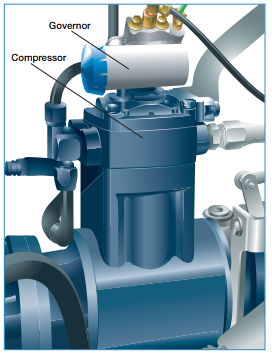
The compressor is usually mounted on the engine of an air brake-equipped vehicle — on most, it’s mounted on the side of the engine and driven by gears. A belt, like a fan belt, drives some compressors on older and smaller vehicles. As long as the engine is running, the compressor will be running. The compressor must be able to build air pressure from 50 p.s.i. (350 kPa) to 90 p.s.i. (620 kPa) in under 3 minutes.
Although the compressor is capable of compressing air to over 500 p.s.i. (3,448 kPa), this is far higher than is needed to operate an air brake system. Most current air brake systems operate with a maximum pressure of 135 p.s.i. (931 kPa).
There needs to be a way to stop compressing air once a certain air pressure has been reached. And, if the air pressure in the tanks drops below a certain level (such as after a series of brake applications), there needs to be a way to start compressing air again.
This is the job of the governor. When enough pressure has been built up, the governor causes the compressor to go into an “unloading” stage.
Governors are usually set to unload the compressor (stop the compressor from pumping air) when the air pressure reaches about 125 p.s.i. (862 kPa). Although the maximum pressure on different vehicles may vary between 105 p.s.i. and 135 p.s.i. (724 kPa and 931 kPa), the range between minimum and maximum pressure should be approximately 20 p.s.i. (138 kPa).
For example, if the maximum air pressure was 135 p.s.i. (931 kPa), the governor would put the compressor in the loading stage if air pressure in the reservoirs dropped to 115 p.s.i. (793 kPa). Applying the brakes several times would likely cause the air pressure to drop to this level. The governor must put the compressor in the loading stage if the air pressure drops below 80 p.s.i. (552 kPa).
Tanks (known as reservoirs) are used to store the compressed air from the compressor
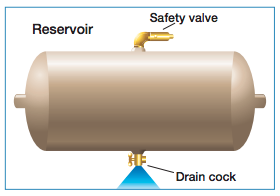
A safety valve on the first reservoir protects the reservoirs from being overpressurized and bursting if the governor fails to unload the compressor. The safety valve consists of a spring-loaded ball to allow reservoir air to exhaust into the atmosphere. The valve’s pressure setting is determined by the force of the spring. Safety valves are normally set to vent the excess pressure at approximately 150 p.s.i. (1,034 kPa).
If the safety valve has to relieve the pressure, the governor needs service or repair. Only a qualified mechanic should do this.
The air that’s delivered from the compressor usually contains some water vapour that condenses into liquid. This is why the supply reservoir is often called the wet tank. Most compressors also pass a small amount of oil and carbon particles. The oil and any other contaminants mix with the water and make a grey sludge.
If allowed to accumulate, this sludge can enter other components of the braking system. Too much water in the system causes trouble with valves and other parts. In winter, water in the system may freeze causing malfunction of valves or brake chambers.
To prevent this sludge from contaminating the air valves in the system, drain
valves (also known as drain cocks) are installed in all reservoirs. Draining the reservoirs can prevent this sludge buildup and most manufacturers recommend you drain them daily.
Pressing on the brake pedal (called the foot valve treadle) applies the air brakes, just like stepping on the brake pedal applies the brakes in a car.
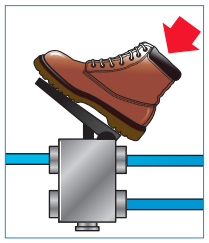
The treadle (pedal) of a foot valve has a springy feel that’s quite different from the feel of a hydraulic brake pedal of a car. It’s possible to push the pedal all the way to the floor which will give you your maximum brake application pressure.
You’re not creating the force with your foot, you’re simply opening a valve that allows the stored compressed air to travel to the brakes. If the foot valve is held in one position, the air pressure delivered to the brake system will remain constant.
Releasing the foot valve allows the application air to be exhausted through the assembly’s exhaust ports, releasing the brakes. It’s important to remember that the maximum brake application you can make is limited to the amount of air pressure available in the reservoir. For example, if the reservoir air pressure is 80 p.s.i. (552 kPa), this is the maximum air pressure available for a brake application.
A unique feature of a foot control valve is the ability to maintain the application pressure that you’ve chosen, even if there are small leaks downstream from the foot valve. You need only to maintain the treadle position and the foot valve will momentarily open, replenish any air that has been lost and then close — all automatically.
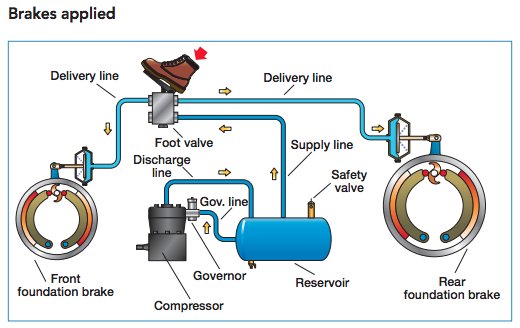
In this simplified diagram, air at full system pressure is indicated by the dark shading in the line connecting the supply reservoir to the foot valve.
The driver is applying the brakes, which is indicated by the light blue shading in the air lines connecting the foot valve to the air chambers with arrows that show the direction of air flow.
The air chambers are pressurized and the brake linings have contacted the brake drums, slowing the vehicle.
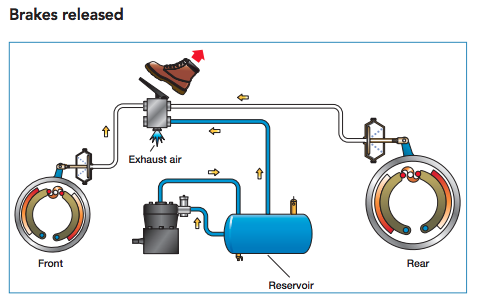
In this simplified diagram, the driver’s foot is off the brake pedal allowing the brakes to release. This has caused an exhaust port in the bottom of the foot valve to open, so the air that was applied to the brake chambers can escape. Note the burst of exhaust air below the foot valve.
The return springs in the air chambers have returned the pushrod assembly to the released position and the slack adjusters and S-cams have rotated to their released position.
Brake shoe return springs (not shown) have also retracted the brake linings away from the brake drums.
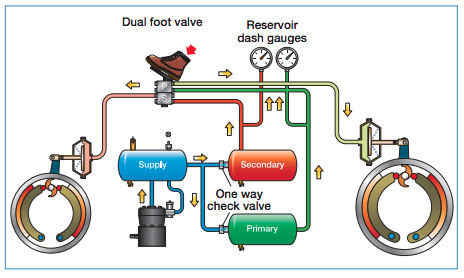
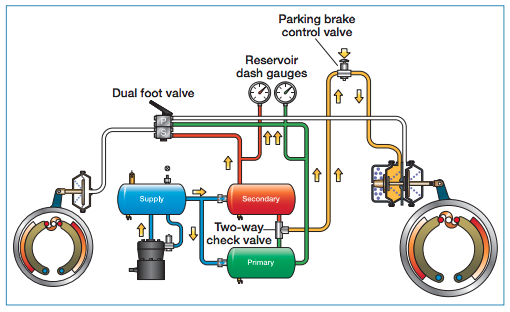
Dual air brake systems have been in use since the mid-1970s.
The device that made dual systems possible is the dual foot valve. It’s actually two control valves operated by a single pedal. This allows the brake system to be divided into two completely independent sections. Each section has its own supply, delivery and exhaust ports.
The two sections of the dual foot valve are the primary and secondary. The primary section is located closest to the pedal and in many systems operates the drive axle brakes. The secondary usually operates the steering axle brakes.
When the driver applies the brakes, both sections of the dual foot valve are activated. Air from the primary tank is applied to the rear axle brakes and air from the secondary tank is applied to the front axle brakes.
Most dual systems use three reservoirs: a supply reservoir and two service reservoirs, one for each section of the dual system. Each service reservoir is filled through a one-way check valve and each has its own pressure gauges. Even if the primary or secondary system totally fails, the driver is able to make a controlled stop using only the foot valve, although maximum braking power will be reduced.
There are other ways of splitting a dual air brake system. However it’s divided, if one of the systems fails, the driver is still able to make a controlled stop.
Note the change in terminology for the reservoirs. The first reservoir (wet tank) is called the supply reservoir, while the two service reservoirs are called the primary and secondary to indicate the section of the dual foot valve that they supply.
Supply, primary and secondary reservoirs
The compressed air from the compressor contains several contaminants including water vapour, oil mist and carbon particles. Most contaminants settle in the supply reservoir. Primary and secondary reservoirs have been added so that all the air brake components, with the exception of the governor valve, are supplied with cleaner air.
One-way check valve
One-way check valves allow air to flow from the supply reservoir to the primary and secondary reservoirs. As the name implies, a one-way check valve allows air to flow in one direction only.
This is so the air supply in the primary and secondary reservoirs is protected if there’s a failure in the air compressor, compressor discharge line or supply reservoir.
Reservoir pressure gauges
All air brake-equipped vehicles have at least one gauge on the instrument panel to indicate the air pressure in the service reservoir system.
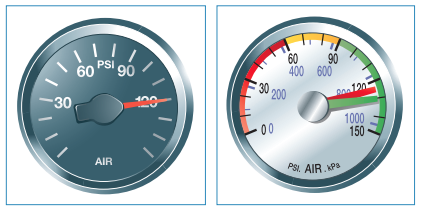
Rather than having two separate reservoir gauges, many vehicles have a single gauge with two needles, indicating the pressure in the primary and secondary reservoirs.
Many vehicles also have a gauge to indicate how much air pressure is being applied when the foot valve is depressed.
The reservoir pressure gauge is mounted in the dashboard so you can monitor the status of the air brake system while driving and during a pre-trip inspection.
Low air warning device
All vehicles equipped with air brakes must have a warning device to indicate if the air pressure in the system drops to a dangerous level. This could occur if there’s an air leak or if you apply the brakes repeatedly and have used up the air supply more rapidly than the compressor can replenish it.
The low air warning device should come on when air pressure drops below 60 p.s.i. (414 kPa).
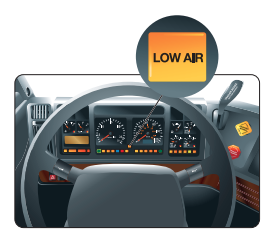
A typical low air warning device is a warning light on the dashboard. There may also be a buzzer.
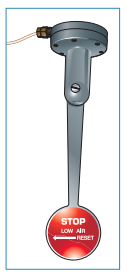
Some older vehicles are equipped with a low air warning device near the top of the windshield that drops into the driver’s view when air pressure drops below approximately 60 p.s.i. (414 kPa). It’s known as a wig-wag.
Some wig-wags automatically retract when air pressure rises above the warning level of 60 p.s.i. (414 kPa), while others need to be manually pushed up to the “out of view” position after the air pressure has risen above the warning level.
When a low air warning device activates, stop the vehicle and find the cause of the air loss. The air pressure remaining in the system (approximately 60 p.s.i./414 kPa) will be enough to stop the vehicle if you act promptly.
While air pressure does an excellent job in helping to stop a vehicle by applying the foundation brakes, it’s totally unreliable (and illegal) for use when parking.
If you park a vehicle using only the air brakes, any leaks in the system or any failure in a hose, diaphragm or air valve would result in loss of air pressure and a possible rollaway crash.
Regulations for parking brakes require that the parking force must be maintained by mechanical means and be unaffected by loss of air pressure.
The most common type of parking brake in an air brake system is the spring parking brake. The second type is known as a safety actuator and is usually found only on some highway coaches and intercity buses.
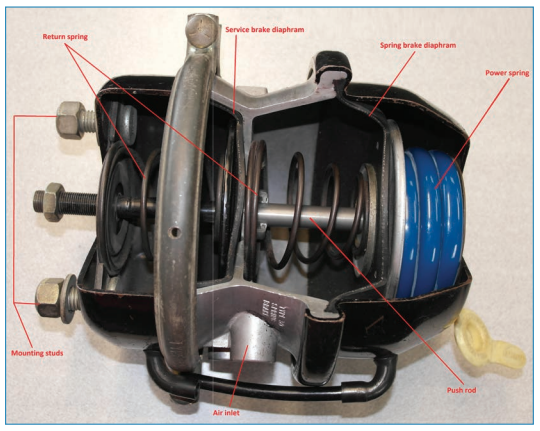
This diagram shows the main components of a typical combination spring and service brake chamber.
Spring parking brakes are mounted on the rear axles only — not on steering axles. The spring parking brake section is mounted behind the service brake chamber, which contains the normal pushrod, diaphragm and return spring.
These brakes are applied and remain applied by mechanical spring pressure, not by air pressure.
The coil spring in most spring parking brake chambers can exert a force of between 1,500 and 2,000 lb. Keep away from a spring parking brake chamber that shows any sign of damage in the housing, such as cracks or dents. The spring in a spring parking brake chamber is under extreme pressure and could cause serious injury if tampered with. Spring parking brakes should only be serviced by a qualified mechanic.
Applying and releasing spring parking brakes
There are several ways to apply and release spring brakes.
• Normally, they’re applied and released by using the parking brake control valve on the dashboard.
• If the air pressure in the system falls below approximately 60 p.s.i. (414 kPa), the spring brakes may begin to drag and at 20 p.s.i. to 45 p.s.i. (138 kPa to 310 kPa) may fully apply automatically.
• Caging the brakes: involves manually releasing an applied spring parking brake. If all air’s lost and the vehicle has to be towed, spring parking brakes can be released by caging them. For safety reasons, this should only be done by a qualified mechanic when making a repair or in an emergency.
Always ensure the wheels are blocked before spring parking brakes are caged — there will be no parking brake force at the wheel that is caged.
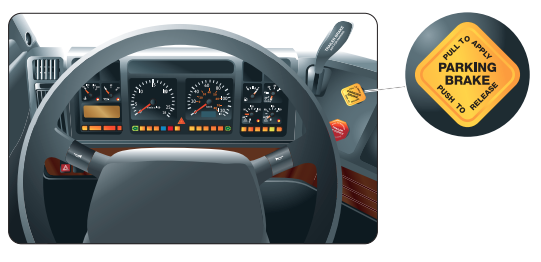
A parking brake control valve (usually a yellow button) is mounted on the dashboard. In most cases, pushing this valve in allows air pressure to flow to the spring parking brake chambers causing these spring parking brakes to release (a minimum 90 p.s.i./620 kPa is required). Essentially, air at reservoir pressure has been supplied to the spring parking brake causing the parking brake diaphragm to inflate, compressing the main spring.
Pulling the parking brake control valve out to the “park” position, exhausts the air pressure against the spring parking brake chamber causing these brakes to apply. Instructions are usually printed on the button.
While the push-pull parking brake control is the most common, some systems may use a switch instead. Usually, flipping it in one direction applies the spring parking brakes and flipping it in the other direction releases them.
Driver alert — compounding of brakes
Always be sure that you have released the spring parking brakes before making heavy service brake applications, like during a pre-trip inspection.
When spring parking brakes are applied, there’s up to 907 kg (2,000 lb) of force applied to all of the brake components. If a heavy service brake application is made, the force of the air application is added to the spring force. This could add a further 1,600 kg (3,000 lb) for a total of 2,268 kg (5,000 lb). This is known as compounding and can damage slack adjusters, S-cams, brake chamber mounting bolts, brake shoe rollers, shoes and brake drums.
Lighter brake applications of less than 30 p.s.i. to 40 p.s.i. (207 kPa to 276 kPa), to prevent a vehicle from rolling while the spring parking brakes are being released or applied, will not compound the brakes.
Spring parking brakes in dual air brake systems
This installation takes advantage of the primary and secondary reservoirs to supply the parking brake dash control with air from the tank that has the highest pressure.
This is accomplished by the use of a two-way check valve. The air that’s delivered from the two-way check valve is called blended air.
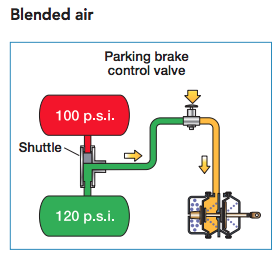
The two-way check valve protects the primary circuit from the secondary circuit and allows the reservoir with the higher pressure to be supplied to the parking brake control.
This also ensures that the spring parking brakes will not automatically apply if there’s a total loss of air pressure in either reservoir.
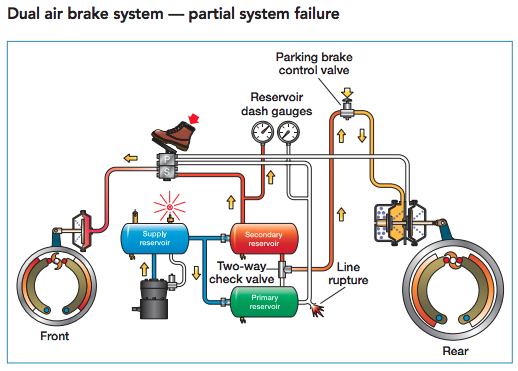
This diagram shows the benefit of the blended air supply for the parking brake system. There has been a loss of air from the primary reservoir. The two-way check valve shuttle has moved so that secondary reservoir pressure supplies the parking brake control valve.
The result is that the spring parking brakes don’t apply automatically. The low air warning system has alerted the driver to the air loss, allowing them to make a controlled stop using the front axle brakes.
Some vehicles with dual air systems are equipped with an optional device called a spring brake modulator. This device senses a loss of pressure in the primary system, and when the driver applies the service brakes, causes air to be exhausted from the spring parking brakes in direct proportion to the brake application. By simply applying the foot valve normally, the driver controls the amount of spring force used to assist the front brakes to bring the vehicle to a controlled stop.
All vehicles must meet Canadian Motor Vehicle Safety Standards for emergency stopping, so regardless of how the dual system is arranged, the vehicle will have adequate braking force even with a partially failed air system.
With all systems, after stopping, you can securely park the vehicle by manually applying the parking brake control valve.
The common types of foundation brakes found on air brake-equipped vehicles are:
• Wedge brakes
• Air disc brakes
• Long stroke and regular stroke air brakes
• Air-over-hydraulic brakes
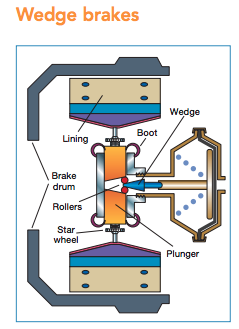
This type of brake uses one or two small air chambers with wedge-shaped pushrods. Wedge brakes are usually found only on steering axles.
When the brakes are applied, air pressure in the brake chamber pushes the wedge part of the pushrod between two rollers, forcing the brake linings out to contact the brake drum.
Most wedge brakes have internal automatic adjusters. Checking proper adjustment requires that inspection hole covers in the backing plate be removed so that brake lining movement can be checked while the brakes are applied and released. If either linings move more than 1.5 mm (1/16 inch) or a total of 3 mm (1/8 inch) for both linings, the automatic adjusters have failed.
Unlike conventional S-cam braking systems, you can’t easily check the wedge brake adjustment of a wedge brake.
Adjustment and repairs to wedge brakes should only be done by a qualified mechanic.
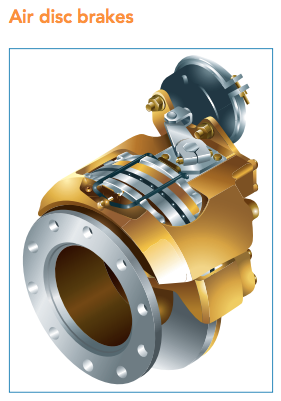
This type of brake uses a rotor, or disc, that’s mounted to the wheel hub and rotates with the wheel. Two brake pads are located on either side of the rotor.
When they’re applied, the brake pads press against the rotor. This action is similar to that of a large “C” clamp.
There are a number of different linkages used between the air chamber and the operating mechanism. This illustration only shows one type, but the principle of the others is similar.
Most air disc brakes feature an internal automatic brake adjustment mechanism to adjust for brake pad wear.
Unlike conventional S-cam braking systems, you can’t check the adjustment of an air disc brake.
Make sure adjustment and repairs to air disc brakes are only done by a qualified mechanic.
Long stroke and regular stroke brake chambers
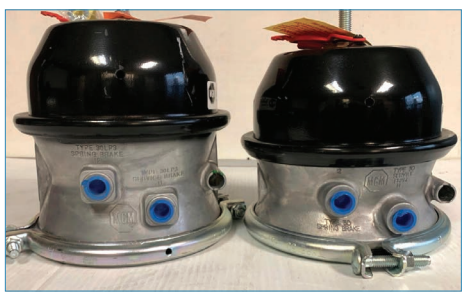
Many new air brake systems are equipped with long stroke brake chambers. As the name implies, it has a longer pushrod stroke than the pushrod of a standard brake chamber.
Long stroke brake chambers can be identified by their square-shaped inlet ports and/or trapezoid-shaped name tag on a clamp bolt.
Air-over-hydraulic brakes
Air-over-hydraulic brakes are sometimes found on middleweight trucks and buses. This type of braking system combines the features of an air brake system and a hydraulic braking system.
Hydraulic foundation brakes offer several advantages on commercial vehicles of this size, including light weight, compact size and proven automatic adjusting mechanisms. Most middleweight commercial vehicles were once powered by gasoline engines, which supplied a source of engine vacuum so that vacuum boosters for the hydraulic brakes could be used. The now-common diesel engine doesn’t supply a usable vacuum, so a partial air brake system has been adopted.
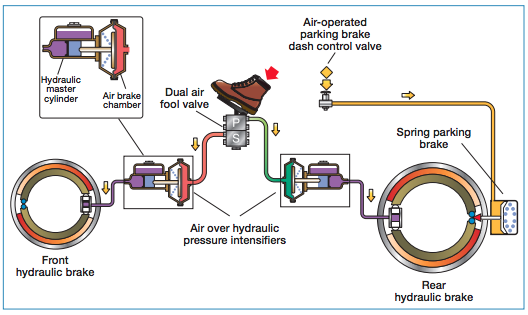
As shown in the diagram above, an air-over-hydraulic braking system consists of a compressor, governor, air storage tanks, foot valve and two air-over-hydraulic pressure intensifiers. The system may also include spring parking brakes. Like a full air brake system, typical air-over-hydraulic braking systems use a standard air pressure of around 125 p.s.i. (862 kPa).
A standard dual air foot valve is also used. Pressing on the foot valve directs air pressure to the air-actuated side of the hydraulic pressure intensifiers causing the hydraulic-actuated side of the intensifiers to direct hydraulic pressure to the foundation brakes. In other words, air pressure actuates the braking action, but hydraulic pressure delivers the braking force to the foundation brakes to stop the vehicle.
To provide a parking brake, many air-over-hydraulic braking systems have a parking brake chamber attached to the foundation brake.
The parking brake is controlled by the same dashboard-mounted parking brake control valve used on vehicles with full air brake systems. Applying the parking brake control valve on the dashboard applies the spring in the parking brake chamber, which forces a wedge between the brake shoes to apply the brakes.
Releasing the parking brake control valve directs air pressure to the parking brake chamber to contract the wedge and spring.
Like a full air brake system, if there were a serious air leak in an air-overhydraulic system, eventually the brakes would stop functioning properly. For
this reason, you need to know and understand how the system works and check air pressure gauges frequently.
Air dryers
Air dryers are commonly installed in the compressor discharge line between the compressor and the first reservoir. They’re designed to remove any water vapour, oil mist and carbon particles from the air before it’s delivered to the supply reservoir.
The warm, moist air from the compressor enters the dryer where a certain amount of the water vapour condenses on cool metallic surfaces. The air then passes through a filter that removes any oil and through another filter that removes the remaining water vapour. From there, the clean air passes through an internal one-way check valve and onto the supply reservoir.
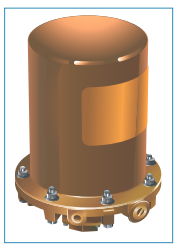
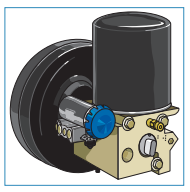
When the system has come up to full pressure, a purge port in the bottom of the air dryer will open. The collected contaminants are ejected along with a sudden burst of air.
At the same time, a certain amount of clean air is allowed to flow back through the filters. This reverse flush effect cleans both filters in readiness for the next compression cycle. The purge port remains open until the compressor resumes pumping.
Some air dryers are equipped with an electric heating element to prevent freezing in cold weather.
Check the air dryer operation by periodically looking for water in the reservoirs.
More than a few drops may indicate that the air dryer or compressor needs servicing.
There’s also an integrated air dryer system, which combines the spin-on filter, dryer and governor into one unit. It also includes a purge reservoir that provides the air volume to purge all moisture and contaminants from the dryer cartridge each time the air compressor unloads. The former “wet” or “supply” reservoir isn’t needed in this system. A unique feature is that air pressure builds in one service reservoir first and when pressure reaches approximately 100 p.s.i. (689 kPa), the other reservoir will begin to fill. Pressure in both service reservoirs and the air accessories circuit will then build to full pressure. Maximum pressure may be up to 135 p.s.i. (931 kPa).
Alcohol evaporators and alcohol injectors
Alcohol evaporators and alcohol injectors are optional devices that introduce a small amount of alcohol vapour into the air system. The alcohol vapour combines with any moisture that may be present. The alcohol acts as an anti-freeze, lowering the freezing point of any moisture that’s collected in the air system. These systems are designed to use pure methyl hydrate to provide the alcohol. Be sure to use only methyl hydrate specifically formulated for use in alcohol evaporators or alcohol injectors.
Automatic drain valves
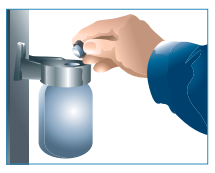
Automatic drain valves, sometimes called spitter valves, are optional devices installed on some or all of the reservoirs on some air brake systems. They intermittently expel any contamination that’s collected.
Most are self-contained and open briefly each time reservoir pressure lowers two or three p.s.i. (13.8 kPa or 20.7 kPa), but some are connected to the compressor governor and open briefly each time that the compressor cycles.
The manual drains should be opened periodically to check for the presence of water in reservoirs. If you find contaminants or more than a few drops of water, the compressor or air dryer may need servicing or the automatic drain valve may not be functioning correctly.
Front wheel limiting systems
Some vehicles may have an optional system to reduce the possibility of steering axle brake lockup and loss of steering control on slippery surfaces.
There are two types of front wheel limiting systems:
• Automatic front wheel limiting systems
• Manual front wheel limiting systems
Automatic front wheel limiting systems
These consist of a limiting valve, sometimes called a ratio valve, mounted near the steering axle. There’s no dashboard control.
At very low application pressures, no air pressure is delivered to the steering axle brakes. As application pressure exceeds the holdback point (five p.s.i. to 15 p.s.i./34.5 kPa to 103 kPa), limited application pressure is delivered to the steering axle brakes. At brake application pressures below 40 p.s.i. (276 kPa), the steering axle brake pressure is approximately 50 percent of drive axle pressure.
At application pressures above 40 p.s.i. (276 kPa), the percentage gradually rises until it reaches an application pressure that may be used during an emergency stop (60 p.s.i. to 70 p.s.i./414 kPa to 483 kPa) and steering axle and drive axle brakes receive equal pressure. A built-in quick release function helps to speed up the release of the steering axle brakes.
Manual front wheel limiting systems
These are no longer installed on new vehicles.
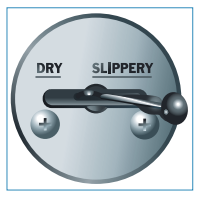
They consist of a limiting quick-release valve mounted near the steering axle brakes and a dash-mounted control valve. The control valve may be a “flip” type switch, as shown, or a push-pull type.
With the control valve in the “dry” position, the steering axle brakes are applied with the same pressure as the drive axle brakes.
The “slippery” position limits the application pressure to the steering axle brakes to 50 percent of drive axle brake application.
Commercial vehicle safety standards allow reduced braking on steering axle brakes only when weather and road surface conditions make such operation essential for safety. Tests have shown that front wheel skids aren’t as dangerous as the drive axles locking up.
The limiting quick-release valve also acts as a normal quick-release valve helping to speed up the release of the steering axle brakes.
Pressure-protection valves
Pressure-protection valves are often installed between the service brake reservoirs and any non-essential air-operated accessories, such as air seats, air horns, air windshield wipers, air suspensions, fifth wheel sliders and air shifts.
Some air brake systems integrate the air dryer with the supply reservoir — these also use pressure-protection valves.
They’re designed to cut off the air supply to these systems if a failed accessory causes the service reservoir pressure to drop below a preset pressure. This ensures that sufficient pressure is maintained in the service system so that a safe stop can be made.
Shutoff pressures vary between 60 p.s.i. and 90 p.s.i. (414 kPa and 620 kPa), depending on the manufacturer’s specifications.
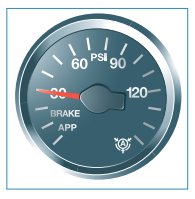
Application pressure gauges
Some vehicles are equipped with one or more optional gauges that indicate the actual pressure being delivered to the service brakes.
There may be a single gauge or separate gauges for tractor and trailer brake application.
Tractors may have a single gauge that indicates application pressure if either the foot valve or trailer hand control valve is applied.
Anti-lock braking systems (ABS) are typically made up of three main sections: speed sensing, decision-making and brake releasing or modulation.
If the brakes are applied too hard for road conditions and a wheel lockup occurs, the Electronic Control Unit (ECU) senses the sudden drop in wheel speed and will signal valves to release air pressure from the brake chambers at the affected wheels.
As the brakes begin to release, the wheels will begin to turn and the ECU will allow the brakes to re-apply. If the lockup re-occurs, the apply-and-release cycle will repeat as often as necessary. Most systems are capable of cycling the brakes up to five times per second.
To achieve the shortest possible stopping distance on extremely slippery surfaces, you simply have to apply and maintain firm continuous pressure on the brake pedal. The ABS will rapidly apply and release the brakes as often as necessary. There may be some noise and vibration. ABS prevents the axle brakes from locking up allowing you to retain complete steering control.
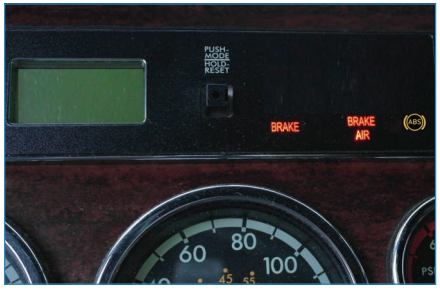
Vehicles are equipped with a dash-mounted failure warning light that monitors the ABS. When the ignition switch is first turned on, the ABS performs a selfchecking sequence. Depending on the system, the warning light may turn on, flash briefly, then stay lit until vehicle speed reaches seven kilometres an hour to 11 km/h or light briefly then turn off.
If the warning light doesn’t go out or comes on during vehicle operation, it’s telling you that there’s been a failure in the ABS. Normal braking is still operational and only the anti-lock feature is disabled. The vehicle may be driven to a service depot for repairs.
Section two — Tractor-trailer air brake systems
Section two — Tractor-trailer air brake systems
This section will help you learn to:
– Explain how trailer brakes are applied
– Safely park the trailer
– Connect the trailer to the tractor
– Understand the ABS for the trailer
Section one — Single unit covered an air brake system for a single unit vehicle such as a straight-truck or bus. Section two looks at components and systems needed to be able to pull air brake-equipped trailers.
Section two — Tractor-trailer air brake systems
To create a tractor-trailer vehicle combination, we must first convert the truck to a tractor. This is completed by adding the following main components: a trailer supply valve on the dash (red button) and a tractor protection valve. The tractor protection valve will prevent total air loss in the event there’s a separation of the trailer from the tractor.
We’ll need to add two air lines from the tractor to the trailer, commonly referred to as the service line and the supply line. In some tractors, a hand valve that controls the trailer service brakes is added. Because tractors and trailers need to be disconnected and reconnected from time-to-time, the air lines are equipped with quick coupling devices called glad hands. Glad hands are often colour-coded — a blue line or blue colouring indicates the service line and a red line is used to indicate the supply line.
• The supply line (red) may also be called the emergency line.
• The service line (blue) may also be called the control line.
• Glad hands allow easy and quick connection between the tractor and trailer.
• Seals are used to ensure the glad hand connection doesn’t leak air.
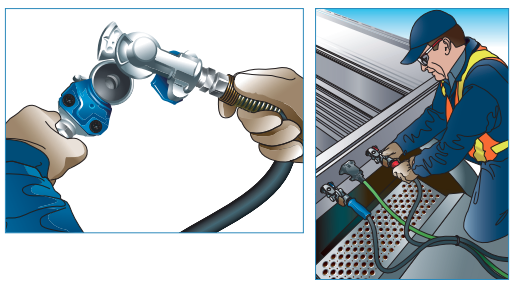
If the mechanical connection between the tractor and trailer fails, causing the trailer to separate from the tractor, the supply and service air lines will disconnect. Air pressure from the tractor system rushes out through the broken supply line and if the brake is applied, air pressure would rush out through the broken service line.
To prevent the tractor air from being depleted to an unsafe level, tractors are equipped with a tractor protection system.
A tractor protection system consists of a trailer air supply valve, located in the tractor dash, and a tractor protection valve, usually located behind the tractor cab. All of the supply and control air delivered to the trailer passes through the tractor protection valve.
If the trailer breaks away, the tractor protection system will automatically shut off air loss from the tractor, preserving enough pressure to make a safe stop.
Some tractor protection systems will shut off immediately in a breakaway, but some will allow tractor pressure to drop to as low as 20 p.s.i. (138 kPa) before shutting off.
Proper operation of the tractor protection system should be checked as part of the daily pre-trip inspection.
Trailer air supply valve
Once the air supply line is connected to the trailer, there needs to be a way of directing air pressure to the trailer.
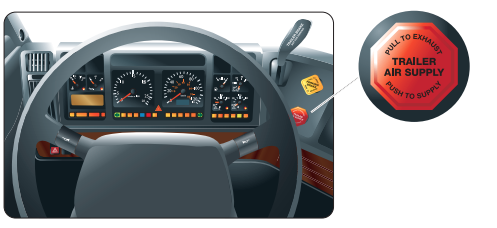
For this, you use the dash-mounted trailer air supply valve, which senses air pressure in the supply line that carries air to the trailer system. Most trailer air supply valves are an octagon-shaped red button.
Hand valve
Applying the foot valve directs approximately the same application pressure to both the tractor and trailer brakes. For example, if you make a 20 p.s.i. (138 kPa) foot valve application, this application pressure will be applied to both the tractor and trailer brakes.
There are times when you want to apply only the trailer service brakes without applying the tractor brakes such as when coupling the tractor to a trailer.
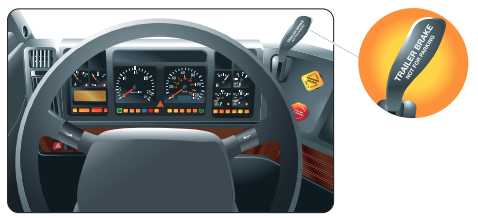
For this you use the hand valve. When the trailer air brake system is fully connected to the tractor, the hand valve allows you to apply the trailer service brakes independently of the tractor.
Most hand valves are spring-loaded, just like the foot valve, so that when you release it, it will return to the released position (the hand valve is not used for parking the vehicle). Hand valves are commonly used to check brake lights as well as to tug test the trailer service brakes.
The hand valve should not be used in normal or emergency situations.
Two-way check valve
The two-way check valve allows you to apply the trailer brakes independently.
This valve is identical in construction to the one used in spring parking brake installations, except that it allows the highest application pressure from the hand or foot valve to be directed to the trailer brakes.
Trailer with spring parking brakes — charging
There are two basic types of trailer air systems: those that use spring parking brakes and those that don’t. Although most current trailers use spring parking brakes, some older trailers and converter dollies aren’t equipped with them.
In any case, all trailer systems must have an emergency stopping system that will fully apply the trailer brakes if the trailer separates from the tractor. Trailers that aren’t equipped with spring parking brakes use a device called a relay emergency valve. If this valve senses the trailer has broken away from the tractor, it applies the trailer service brakes with full trailer reservoir pressure. This action is called dynamiting the trailer brakes. Trailers with spring parking brakes use the spring force to “dynamite” the trailer brakes if the trailer brakes away from the tractor.
This diagram shows a typical trailer system that uses spring parking brakes for parking and for emergency (breakaway) stopping.
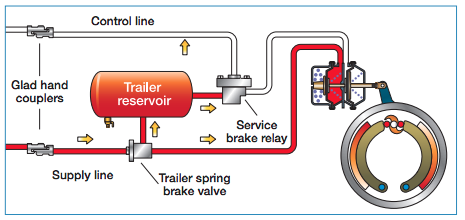
The system shown uses one reservoir and two air valves, a relay valve for the service brakes and a trailer spring brake valve that fills the reservoir and controls the spring parking brakes.
Other systems may be equipped with one, two or three air valves and multiple reservoirs. Using more or fewer air valves or additional reservoirs doesn’t alter the basic operation of the system.
The tractor is delivering air through the supply line to the trailer spring brake valve. The spring parking brake valve directs air to fill the reservoir(s) and release the spring parking brakes.
In the two types of systems:
• One fills the reservoir(s) before releasing the spring parking brakes.
• The other releases the spring parking brakes first, then fills the reservoir(s).
Always perform a tug test after coupling the tractor to the trailer. Follow the coupling procedures as shown in Chapter 10: Off-road tasks and manoeuvres.
Trailer with spring parking brakes — service brake application
In this diagram, a control signal from the tractor has been sent through the control line to the trailer’s relay valve. The relay valve has drawn air from the trailer reservoir and delivered it to the trailer service brake chambers at approximately the same pressure as the control signal.
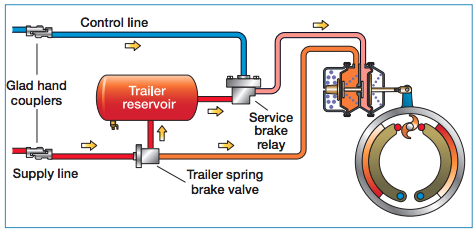
Trailer with spring parking brakes — dynamited
This diagram shows a broken supply line. The trailer spring brake valve has sensed the loss of pressure in the supply line and has exhausted the air pressure from the spring parking brake chambers causing the spring parking brakes to apply. Note the burst of air from the exhaust port of the trailer spring brake valve.
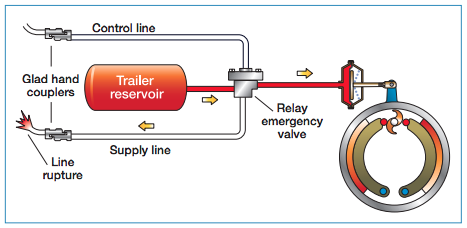
This is called dynamiting of the trailer brakes. The trailer brakes will also be dynamited each time the glad hands are disconnected or when the trailer supply valve that’s located on the tractor dashboard is closed.
Driving a tractor without a trailer attached is called bobtailing.
A bobtail tractor has very little weight over the rear drive axles, so it’s very easy to lock up the rear brakes even with a light brake application.
To help prevent this unwanted lockup and to increase control, some older tractors not equipped with ABS use a bobtail proportioning system, which consists of two special valves: one that controls the steering axle brakes and another to control the drive axle brakes.
When the tractor is being driven with a trailer attached, the tractor brakes operate normally. However, when bobtailing, the braking pressure to the drive axle brakes is reduced by as much as 75 percent, preventing the rear brakes from locking. The steering axle brakes receive full application pressure.
A tractor with a bobtail proportioning system will stop in a shorter distance and control will be increased, especially on wet or slippery road surfaces. Because the steering axle brakes are doing most of the braking, a higher than normal pedal pressure is required.
Dual air tractor-trailer system — foot valve applied
This diagram shows only the two service reservoirs, the dual foot valve and the components that are added to a tractor with a dual air system, so that it can safely tow a trailer with air brakes.
The components added are a trailer air supply valve, tractor protection valve, hand control valve and a pair of two-way check valves.
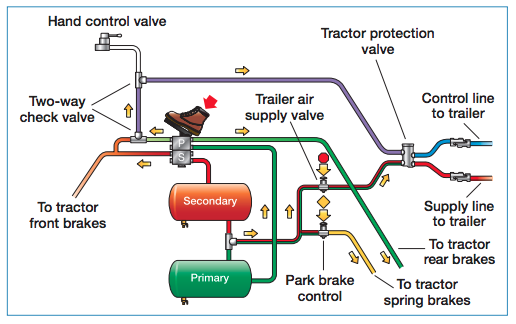
Two-way check valves are installed so that whichever brake is applied — foot valve or hand valve — a control signal will be sent to the trailer.
In this diagram, the driver is making a foot valve application. The tractor front and rear brakes are being applied and a control signal is being sent to the trailer through both of the two-way check valves.
Note that in most dual systems, the parking brake control valve (yellow button) is interlocked with the trailer supply valve (red button), so that applying the parking brake control valve causes all of the parking brakes on both the tractor and trailer to apply.
Dual air tractor-trailer system — primary air system failure
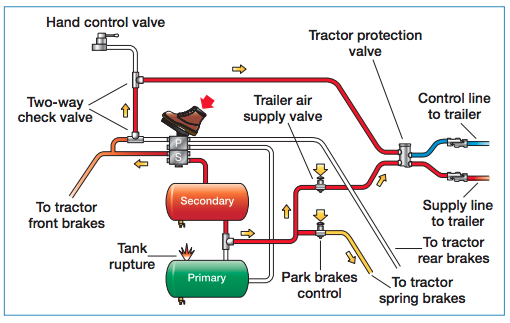
This diagram shows a tractor with a dual air system where there has been a failure in the primary air system on the tractor. The low air warning would have alerted the driver to the problem and a glance at the reservoir gauges would confirm that only one part of the dual air system had been lost.
The driver is making a foot valve application, causing the tractor front brakes to apply. Application air from the secondary foot valve is also passing through both of the two-way check valves to the trailer control line, signaling the trailer brakes to apply.
If the secondary system had failed, a foot valve application would apply the rear tractor brakes directing air through both of the two-way check valves to signal the trailer brakes to apply.
The same motor vehicle safety standards that require automatic shutoff of the air supply to the trailer — in the event that the pressure in the tractor air system is lowered to no less than between 20 p.s.i. and 45 p.s.i. (138 kPa and 310 kPa) — apply equally to tractors with dual air systems.
Because the trailer supply valve is now supplied with “blended air” from a twoway check valve, the automatic shutoff will not occur until the service reservoir with the highest pressure is lowered to between 20 p.s.i. and 45 p.s.i. (138 kPa and 310 kPa).
The automatic shutoff requirement should be checked as part of a pre-trip inspection. If it doesn’t function properly, the vehicle must be placed out of service until it’s repaired.
Dual air tractor-trailer system — trailer breakaway
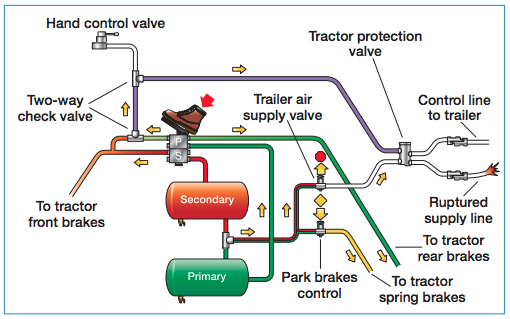
This diagram shows how the tractor protection valve and trailer air supply valve act together to protect the tractor air supply from being depleted to an unsafe level if the trailer separates causing the connecting lines to rupture. The sudden loss of air through the broken trailer supply line has caused the trailer air supply valve to shut off automatically.
The driver is making a foot valve application causing the tractor service brakes to apply. The application pressure is also passing through both of the two-way check valves to the tractor protection valve.
Because there’s no pressure in the supply line to the trailer, the tractor protection valve has closed the passage to the trailer control line. No application air can be wasted through that broken line.
If only the control line separates, nothing will happen until the trailer brakes are applied. When that happens, the tractor protection system will activate to protect the tractor air supply.
When a trailer isn’t connected, the trailer air supply valve will be in the closed position. This allows the tractor to be driven bobtail so that no air will be lost through the disconnected glad hand couplers.
Trailer ABS systems use similar components as those on trucks and tractors.
The ECU may be powered from the stop lamp circuit or may have a dedicated power source through the electrical connector.
Trailers with ABS air brakes will also have an indicator visible in the tractor’s mirror to indicate if the system’s not functioning properly. This warning light may be mounted on the front left side of the trailer or on the rear left side of the trailer.
On some air brake systems, there may be a trailer ABS warning indicator on the dashboard of the tractor.