
[ultimatemember form_id=3702]
8. Defensive and cooperative driving
The purpose of this unit is to help new professional drivers learn about proactive and defensive driving and to help them learn to drive safely regardless of the driving conditions or the actions of others.
This unit will help you learn to:
• Use defensive driving techniques
• Identify hazards and conflicts
• Communicate effectively with other road users
• Understand how driving conditions affect safety
• Appreciate how the size and weight of a tractor-trailer affects other road users
• Recognize common situations that lead to crashes
• Explain strategies to avoid crashes
• Understand that personal attitudes and defensive driving habits are key to preventing crashes
• Understand the challenges of driving in adverse conditions
There can be many contributing factors to crashes and incidents, but the biggest and most important one — and the one you have control over — is you. It’s your skills, knowledge, habits, attitudes and physical and mental condition that often determine whether you’re involved in a crash or if you’ve avoided one.
Defensive driving means driving safely despite the conditions around you and the actions of others. This means using strategies that minimize risk, like anticipating potential conflicts and taking action early to eliminate the hazard.
Cooperative driving involves analyzing how you’re affecting others rather than just how others are affecting you and driving in a way that assists the safe flow of traffic and use of the roadway.
Driving conditions
Driving conditions are categorized into six areas:
1. Driver — condition, ability, attitude
2. Road — conditions and type
3. Weather conditions
4. Traffic — volume, type of traffic and other drivers’ behaviours
5. Light — daylight, darkness, glare
6. Vehicle — condition and capability
Pay attention to how these six conditions are impacting your current driving situation and adjust accordingly. Normally, your number one adjustment will be to slow down and increase your following distance, but in extreme cases it may mean parking your vehicle and waiting for conditions to improve.
A professional driver is patient and accommodates for the mistakes of others.
Always take steps to avoid situations that might cause anger, hostility or danger.
There isn’t a load that’s worth your life and everyone needs to get home at the end of the day.
Zone of awareness
Many drivers are content to limit their awareness to the things they can observe through the windshield, with an occasional glance in their mirrors. A proactive driver, however, realizes a hazard can come from any angle and that their zone of awareness must include a full 360-degree area around the vehicle as well as above and below.
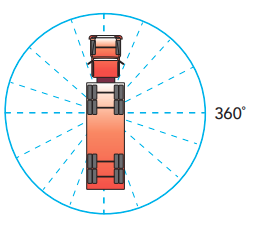
While most hazards will appear from the front, rear or side of the vehicle, many drivers have lost control by not being aware of the road conditions under their truck. Similarly, drivers have lost the tops of their trucks or trailers in underpasses by not paying attention to hazards above the vehicle.
Overhanging eaves, wires or tree limbs may also be a crash point if the driver is unaware.
The earlier a potential hazard is detected, the more time you have to avoid any problem that develops. Your zone of awareness should be as wide as possible for the circumstances. It contains clues to detect potential hazards and we can do this by engaging our senses: seeing, hearing, feeling and smelling.
See-think-do: a hazard detection system
Use your eyes to see and your mind to analyze what you see for potential dangers. A system that works well is see-think-do.
See:
• Scan and identify any real or potential hazards or conflicts
Think:
• Predict likely outcomes
• Decide which course of action will lead to the desired outcome
Do:
• Execute your decision and put your plan into action
• Scan mirrors, the road ahead and behind, paying attention to blind spots
• There is a “danger zone” approximately three metres (10 feet) around the tractor-trailer where pedestrians or other vehicles may be present and you don’t notice
Developing good visual habits
Continuously scanning your surroundings on and off the road leads to good visual habits. As well as looking ahead, you should be scanning to the sides and behind your vehicle. Watch road signs and check your vehicle’s instruments.
Your eyes should be continually moving from far to near, as well as left to right.
To do this well, you must avoid distractions while driving, such as using the phone and radio, or eating. Being visually distracted by events like traffic incidents and cargo securement issues can not only cause you to miss key visual information but is also dangerous.
There are two interesting facts related to vision that you should be aware of:
• Speed — As your speed increases, there’s a corresponding reduction in your peripheral vision. At highway speeds, this range of vision is reduced so the effect becomes somewhat like driving through a tunnel where you still see straight ahead but your peripheral vision is limited.
• Steering — We tend to steer toward whatever we look at. Not looking far enough ahead or looking off to the side of the road can cause us to wander or go wide in a curve. For this reason, keep your eyes moving and focused on where you want to go.
Here’s how to use your eyes:
Eyes up — Look up as far as you can see. The further you can see, the more time you’ll have to react to real or potential hazards. This would be about 20 seconds ahead at highway speeds and about 12 seconds ahead at lower speeds in town.
Sweep — Move your eyes left and right to identify hazards on and off the road.
This can be especially important at marked/unmarked intersections, crosswalks, or areas with wildlife activity.
Fill in the gaps
• Drop your eyes from the “eyes up” position to about 12 seconds ahead of you at higher speeds and about six seconds ahead at urban speeds. Note that at different speeds, this will affect the amount of distance, but the seconds for you to reach where you’re looking will remain the same. This is your reference-down point. You’re looking for road signs, as well as potential, developing and immediate hazards or situations.
• Then, fill in the space between your reference-down point (six or 12 seconds ahead) to the front of your vehicle. Here’s where you look for road signs, road surface, debris, potholes and anything that may cause you to adjust your position on the road.
Mirrors — By checking your flat and convex mirrors every five to eight seconds, you’re making sure you’re aware of your surroundings and escape routes. Use your mirrors to check:
• Space immediately behind and beside the vehicle
• Vehicles approaching from behind
• Cargo securement and covering
• Condition of your vehicle (engine exhaust, tires and other components)
It’s especially important to check mirrors on both sides before turning, changing lanes or changing directions. Getting used to using your convex mirror is a challenge for many drivers, but it’s a critical skill to master as these mirrors help to fill in the blind spots that you used to cover off with a shoulder check when driving a car. Make certain no vehicle has come between the trailer and the curb. While turning, check the mirrors continuously to look for vehicles sneaking up beside you.
Good visual habits:
• At night when meeting oncoming vehicles with bright headlights or headlights on “high beam”, shift your gaze well ahead and to the right edge of the road
• Keep your vehicle windows clean inside and out to reduce glare
• Maintain an unobstructed view • Vegetation, buildings, trees, parked vehicles or any roadside obstruction that obscures vision should be treated as a hazard potentially requiring you to stop, if necessary, giving you time to study the situation before proceeding
• Be aware that other vehicles in the adjacent lane may obscure your vision
• Pay attention to traffic ahead possibly stopping for any number of reasons, including a left turn or a pedestrian
• Don’t focus too much attention on gauges that can wait until you’re stopped or on a straight stretch of road. If you need to make a few short glances at the same gauge, ensure you’re not taking your focus and attention off the road for too long
Blind spots
A “blind spot” is an area alongside your vehicle that you can’t see when using any of your mirrors. It’s important to check blind spots to ensure you keep track of all the potential hazards around your vehicle, particularly if you’re going to change lanes. Blind spots can be problematic for a regular sized vehicle, but the bigger the vehicle, the bigger the blind spot!
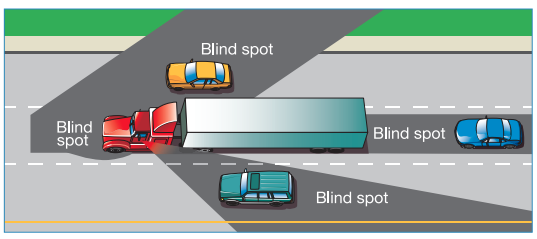
It should make you uncomfortable if you’re driving in other drivers’ blind spots. Virtually all vehicles have blind spots — even motorcycles. Yet, some drivers habitually change lanes without checking for other vehicles. It’s a good idea to adjust your position relative to other traffic, so you stay out of another driver’s blind spot whenever you can.
Eye health
Good vision and good visual habits are essential to safe and defensive driving. Vision can change so gradually that it’s easy to be unaware of a vision problem until it’s too late. Be sure to have regular eye examinations. If you wear corrective lenses, it’s a good idea to take a spare pair with you when on the road.
Engaging your other senses
Hearing
Horns, train whistles, children playing and the sound of other vehicles are all examples of messages we receive through hearing and are indicators of potential hazards. Listening to the sound of your own vehicle can help you identify maintenance problems so you can get them fixed before they cause a breakdown. In the winter, driving with your window open slightly allows you to hear the sound of your tires on the road. A wet road is noisy, but an icy road is very quiet.
To gain the greatest advantage of your hearing, avoid playing the stereo or radio excessively loud and keep other in-vehicle noises at a low level.
Feeling
As we drive, our bodies are in contact with various parts of the vehicle: our hands on the steering wheel, our body in the seat and our feet on the pedals.
As we learn what the vehicle feels like under normal conditions, it becomes easier to identify changes in the driving conditions as well as the overall condition of our truck. Pay attention to what may be causing the change in the ride or behaviour of the truck.
Smelling
Smell may offer an early indication of a possible problem with your vehicle, such as the smell of hot oil, rubber or antifreeze. Early detection of a problem allows you more time to find a safe location to park and have the problem dealt with.
Communicating
Good communication will help other road users be aware of your presence and understand your intentions.
A few tips to help you do it well:
Eye contact — When you’re making a tight turn or moving slowly into an intersection, check the road users around you and make sure they’ve seen your signal and are aware of your intentions. Eye contact is a good way to confirm others have seen you. You can acknowledge them with a wave of the hand or a nod.
When passing — Whenever you’re about to pass a vehicle, pedestrian or cyclist, assume they don’t see you. They could suddenly move in front of you.
Lane changes and turning — Put your turn signal on early especially if there are vehicles in the lane you need to move into. Signalling early allows other drivers time to adjust their speed and open up a spot for your vehicle to fit into.
This technique is especially important before changing lanes. Change lanes slowly and smoothly. This gives a driver you didn’t see a chance to honk their horn or avoid your vehicle.
Slowing Down — Warn drivers behind you when you need to slow down.
Flashing the brake lights should warn following drivers. Use the four-way flashers for times when you’re driving very slowly or stopped. Warn other drivers in any of the following situations:
• Trouble ahead — the size of your vehicle may make it hard for drivers following to see hazards ahead. If you see a hazard that will require slowing down, warn the drivers behind you by flashing your brake lights or using the four-ways.
• Turning — brake early and slow down gradually for tight turns.
• Stopping on the road — truck and bus drivers sometimes stop in the road to unload cargo or passengers or to stop at a railroad crossing. Warn following drivers by flashing your brake lights. Don’t stop suddenly.
• Driving slowly — drivers often don’t realize how fast they’re catching up to a slow-moving vehicle until they’re very close. If you must drive slowly, alert following drivers by turning on your flashers.
When it’s hard to see — If you’re having trouble seeing other vehicles, other drivers will have trouble seeing you. Turn on your headlights and clearance lights at these times.
When backing — Use your four-way flashers any time you’re backing up. If your vehicle doesn’t have a back-up alarm, sound the horn twice and again every vehicle length. Before backing we want to use GOAL: Get Out And Look, walk around your vehicle prior to backing up to ensure the way is clear.
When parked at the side of the road — When you pull off the road and stop, turn on the four-way emergency flashers. This is especially important at night.
If you stop on a road or on the shoulder of any road, you must put out your warning devices 30 m in front and back.
Don’t direct traffic — Some drivers try to help out others by signalling when it’s safe to pass. You shouldn’t do this because it could cause a crash.
One of the most important aspects of proactive and defensive driving is recognizing potential hazards before they become a real hazard. Early recognition and being aware of what you see allows you the time you need to avoid trouble. Hazards appear under a variety of driving conditions. Your ability to adjust to these conditions will increase your chances of avoiding a crash.
Sharing the road
Pedestrians
Always yield to pedestrians and allow them to finish crossing the street before you start moving forward. Don’t crowd them in the crosswalk. Be especially alert to pedestrians stepping from between parked cars, persons getting out of parked cars and children who might dart into the street. Cover the brake and be prepared to stop in all of the above situations. Prior to turning, observe whether there are any pedestrians present on the curb or on the roadway that you may need to consider. Halfway through any turn at an intersection, continually check blind spots, off-track and tail swing areas for pedestrians.
• When pedestrians indicate their intention to cross the street, you must stop your vehicle before the crosswalk and allow them to cross.
• When a pedestrian has entered a marked or unmarked crosswalk, you must yield the right-of-way.
• When stopping for a pedestrian at a crosswalk, stop far enough back (about two to three car lengths) so that traffic in another lane will be able to see the pedestrian and have time to stop.
• Never pass another vehicle when you’re approaching a crosswalk. There’s always a chance that the other vehicle is slowing or stopping for a pedestrian.
• Not all crosswalks are marked, but the rules of pedestrian safety should be followed at all intersections.
• Be considerate of visually-impaired pedestrians. Some may have a white cane or guide dog.
• At night, don’t overdrive your headlights. You should be able to stop your vehicle within the distance you can clearly see.
• When it’s dark, be alert for pedestrians. If they’re wearing dark clothing, they can be difficult to see from a distance.
• Distracted people are hazards. Watch for where they’re looking. If they’re looking elsewhere, they can’t see you, but be alert even when they’re looking at you. Remember, you must exercise care to avoid hitting a pedestrian.
• Pedestrians talking to one another or on their phone may not be paying close attention to the traffic.
Cyclists
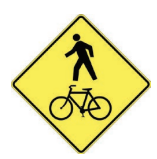
Due to their size, bicycles can easily be hidden in your vehicle’s blind spots and are even quite difficult to spot in a convex mirror. They’re far too often only seen at the last moment. Extra caution needs to be taken around bicycles.
There are large blind spots both behind and to the side of large vehicles. The “right turn squeeze” could occur if a motorcycle or cyclist is positioned between a large vehicle that’s turning right and the curb.
In this position, the driver of the large vehicle may not see the cyclist. Cyclists should ride as close as practical to the right curb. However, they may need to ride further out when avoiding drainage grates, potholes, debris or slippery surfaces.
• Be aware of the roadway conditions that may affect a cyclist.
• When passing a cyclist, change lanes like you would for other vehicles.
• When preparing to turn right, watch for cyclists who may ride alongside your vehicle. Remember to check your blind spots to the right.
• Before moving away from the curb, check for cyclists who may be riding past your vehicle.
• Don’t follow too closely behind cyclists. They don’t have brake lights to warn you when they’re stopping.
• Be alert for children on bicycles. They may lack the necessary knowledge and skills for safe cycling around traffic and may not be aware of all the dangers. Children on oversized bicycles are at risk of losing control.
Motorcycles and smaller vehicles
• Smaller vehicles may become impatient when driving behind a truck. When being passed, slow down to allow the vehicle to move safely and quickly ahead of you.
• Use extra care with motorcycles. They can be more difficult to spot and in the event of a crash, riders are more likely to be injured because they’re less protected.
• Sometimes a motorcycle’s turn signals can be hard to see. Watch the rider for clues. If the rider does a shoulder check, they may be intending to change lanes or turn.
• When turning left, watch for oncoming motorcycles. They can be hard to see, especially in heavy traffic, at night or at dusk. It can be difficult to judge the speed of the motorcycle.
• Be aware that motorcycle riders will often move within their lane to avoid road hazards like potholes and to maintain a space cushion from other vehicles.
• The “right turn squeeze” could occur if a motorcycle or cyclist is positioned between a large vehicle that’s turning right and the curb. In this position, the driver of the large vehicle may not see the cyclist or motorcyclist.
Work zones
According to Work Zone Safety Alliance BC, roadside work is a dangerous job.
Between 2011 and 2020, there were a total of 12 roadside worker deaths and 207 injuries as a result of being hit by a motor vehicle.
Roadside worksites involve hundreds of activities. Some of the occupations at risk include construction workers, tow truck operators, road maintenance crews, telecommunications and utility workers, municipal workers and first responders who work alongside or on roads, in close proximity to traffic. Drivers should be prepared to move over and increase the space between their vehicle and the work zone, if it’s safe to do so.

Flashing amber, red or blue lights — Drivers should be prepared to reduce speed when driving near an official vehicle with flashing amber, red or blue lights.
• If the posted speed limit is 80 km/h or more (50 miles per hour) drivers must slow to 70 km/h (43 mph).
• If the posted speed is less than 80 km/h (50 mph), drivers must slow to 40 km/h (25 mph).
• In both situations, drivers must move over and increase their space between their vehicle and the official vehicle with flashing lights, if it’s safe to do so.
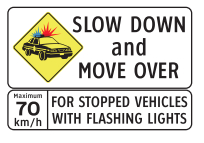
Roadside workers — Roadside workers are depending on drivers to keep control of their vehicle in a construction zone.
Here’s what they want you to do:
Slow down
• Plan your route and allow extra travel time.
• Expect the unexpected and don’t tailgate.
• Stay within posted speed limits and pay attention.
• Allow extra space between your vehicle and the one in front of you.
Keep your eyes (and ears) on the road
• Never use a cell phone or text while driving.
• Follow sign and flag directions.
• Get to know the work zone signs.
Show respect for roadside workers
• Make eye contact.
• Keep your cool and be patient.
• Slow down even if you don’t see anyone working. Hazards such as traffic shifts or lane reductions may appear suddenly.
Wildlife and livestock
Due to crashes caused by wildlife and livestock on roadways, several people are killed and hundreds of motorists are injured each year. According to provincial data, over 24,000 animals are killed each year as a result of being hit by a vehicle, resulting in significant cost to the province for highway clean-up.
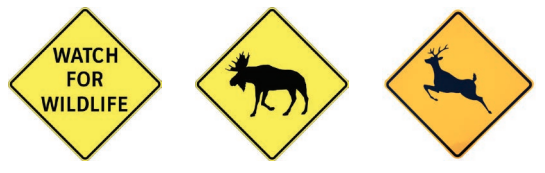
Approximately, 80 percent of wildlife vehicle crashes involve deer. Moose, elk, bears, coyotes and other wildlife make up the remaining 20 percent. Crashes with smaller wildlife are extremely common, but usually go unreported.
Because of their size, moose crashes are often the most serious.
Wild animals tend to be more active from dusk to dawn and they often move in groups. If you see one, there may be more. Be especially careful where creeks intersect roads, where forage is available at roadside, where there’s a water source nearby and on long, wide straight stretches of road. During the winter, animals may wander onto the roads to lick salt off the ground. Open range cattle often forage near the roadside where grass grows and won’t hesitate to suddenly walk across the road.
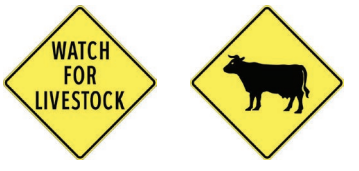
To reduce the chance of a crash with animals:
• Reduce your speed, look well ahead and use caution in areas with wildlife or open range cattle warning signs
• Watch the sides of the road and ditches for animals
• Watch for animal eyes reflecting from your headlights at night
• Honk or flash your headlights to help chase animals away or divert them from crossing the road
• Brake hard if you encounter an animal, but don’t swerve to avoid it
• Leave a wide margin when you drive around an animal (frightened animals may run in any direction)
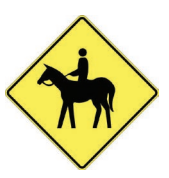
• Be especially cautious when passing a horse and its rider
For more information on wild animal crashes, visit wildlifecollisions.ca.
Driver condition and ability
Driving requires both mental and physical sharpness. You should always ensure you’re fit for driving and not suffering from any impairments, including fatigue or distraction. Poorly trained drivers who may not be aware of the importance of good driver condition, pose a higher risk to themselves and others. Be mindful of your skill level and always seek to improve.
Your mental and physical condition can affect the quality of your work. In terms of driving errors, these can be divided into two broad categories: recognition errors and decision errors.
Recognition errors include:
• Distraction — psychological, environmental, situational
• General inattention
• Inattentional blindness
• Improper visual search patterns — fixation
Decision errors include:
• Speed choice
• Risk taking
• Disregarding traffic control devices and laws
Both of these error types can potentially arise from your diminished mental or physical condition. Recognition errors arise typically from some situation which you’re not fully conscious of or may not take seriously. Decision errors arise when you, whether consciously or unconsciously, dismiss factors or cues you should be attentive to.
Some forms of errors, such as texting and driving, have elements of both categories. Texting and driving is a conscious decision which results in a distracted state that the driver doesn’t acknowledge. It’s also illegal in B.C. and many other parts of Canada and the U.S.
Recognition errors
There are many circumstances that can create the type of stress that diminishes a driver’s capacity to operate a vehicle. These may be on-going personal concerns related to money or family issues or immediate issues related to the task at hand, such as time pressures or distractions from factors inside or outside the vehicle.
Any of these may create a state of mind that can take your attention from the primary task of driving. This can lead to a higher likelihood of infractions and crashes.
Decision errors
Decision errors may arise from inattention to cues and factors in the environment or from a conscious choice to disregard these things. Failing to stop at a stop sign or red light could result from being preoccupied and not noticing the control device — or noticing it and choosing to disobey it.
In unconscious decision errors, crucial information may be missed such as the presence of a small animal or child in the road or a vehicle in the vicinity not behaving as expected. Time concerns frequently create unconscious stresses in the mind of a driver which could lead to poor decision making, such as speeding or clearing intersections too late.
Rules of defensive driving are based upon the principle of making driving, which is inherently a dangerous activity, as safe as possible given the circumstances. Decision errors violate the rules of safe driving and, in both cases, increase the potential for crashes.
Keep your attention where it belongs — on the tasks and functions related to driving. If you decide to get take-out meals, it’s unlikely you can safely drive a semi-truck and trailer and eat while keeping your attention on the road and both hands on the wheel where they belong.
Other drivers
In order to protect yourself and others, you must know when other drivers may do something hazardous. Watch driver body movements for clues. For example, drivers look in the direction they’re going to turn. You may sometimes get a clue from a driver’s head and body movements that they may be going to make a turn, even though the turn signals aren’t on. Drivers making overthe-shoulder checks may be going to change lanes. These clues are most easily seen in motorcyclists and cyclists. Watch other road users and try to tell whether they might do something hazardous. Some clues to these types of hazards are discussed in this section.
Blocked vision. People who can’t see others are a very dangerous hazard. Be alert for drivers whose vision is blocked. Vans, loaded SUVs and cars with the rear window blocked are examples. Rental trucks should be watched carefully.
Their drivers are often not used to the limited vision they have to the sides and rear of the truck or the vehicle’s size. In winter, vehicles with frosted, ice-covered or snow-covered windows are hazards. Vehicles may be partly hidden by blind intersections or alleys. If you only can see the rear or front end of a vehicle but not the driver, then they can’t see you. Be alert because they may back out or enter into your lane. Always be prepared to stop.
Delivery trucks. Packages or vehicle doors often block the driver’s vision.
Drivers of step vans, postal vehicles, and local delivery vehicles often are in a hurry and may suddenly step out of their vehicle or drive their vehicle into the traffic lane.
Parked vehicles. Parked vehicles may be hazards, especially when people open doors to get out of them or if they suddenly start up and pull out. Driving beside parked vehicles is potentially hazardous because your vision is partially obstructed. Hazards often appear when there’s little time or space for evasive action.
Key sources of hazards are:
1. The space between parked vehicles through which pedestrians and animals may suddenly appear and dart into the street
2. Parked vehicles, which may suddenly pull out into your path without warning
3. Occupants of parked vehicles who open their doors without looking first. Positioning your vehicle at least 1.5 metres (five feet) out from a parked vehicle will place it beyond the arc of a door should it suddenly be opened. Watch for movement inside the vehicle or movement of it that indicates people are inside.
4. A stopped bus and passengers that may cross in front of or behind it — they often can’t see you
Usually there are clues a parked vehicle is planning to re-enter a traffic lane:
• Exhaust fumes will indicate the engine is running and that vehicle is possibly ready to go.
• Back-up and brake lights may indicate that a parked vehicle is preparing to enter traffic.
• Front wheels pointing toward traffic may indicate the vehicle is ready to leave the space or manoeuvring in preparation to leave.
• A person behind the steering wheel may indicate a readiness to leave a parking space.
Other commercial vehicles in trouble
When in rural areas, especially if you see another commercial vehicle pulled over and clearly having trouble, consider pulling over to assist if it is safe to do so and you feel personally safe and comfortable to extend help.
Tailgaters. Tailgating is following another vehicle too close to be able to stop in time if they suddenly stop. Drivers of large vehicles must rely on outside mirrors for rear vision, and so cannot see tailgaters who sit in the vehicle’s blind spots. It’s not always possible to prevent a rear-end crash caused by tailgaters, but if stops are gradual the impact may be much less. If you notice someone tailgating you, remain calm and increase the space between you and the vehicle in front if required.
It’s good practice to allow tailgaters to pass. Watch for these drivers by checking your rearview mirror frequently. The easiest thing to do if you have someone tailgating is to pull over and let them pass.
Disabled vehicles. Drivers changing a tire or fixing an engine likely aren’t paying attention to the dangers of the roadway and may be careless. Jackedup wheels or raised hoods are clues that the vehicle may be disabled.
Crashes and incidents. Crashes are particularly hazardous. People involved in the crash may not look for traffic and may dart across the road without looking. Passing drivers tend to slow down or stop suddenly to look at the incident, causing a chain reaction crash.
Confused drivers and tourists. Confused drivers often change direction suddenly or stop without warning. Confusion is common near highway interchanges and major intersections. Tourists unfamiliar with the area can be very hazardous, so watch for rooftop luggage and/or out-of-province licence plates. Unexpected actions (stopping in the middle of a block, changing lanes for no apparent reason, backup lights suddenly going on) are clues of confusion. Hesitation is another clue, including driving very slowly, using brakes often or stopping in the middle of an intersection. You may also see drivers, including taxis, who are looking at street signs, maps, GPS and house numbers.
Slow moving vehicles. Seeing slow moving vehicles early can prevent a crash. Some vehicles are slow by design, such as: mopeds, farm machinery, construction machinery and tractors. Some of these will have the “slow moving vehicle” symbol to warn you. This is a red triangle with an orange centre.
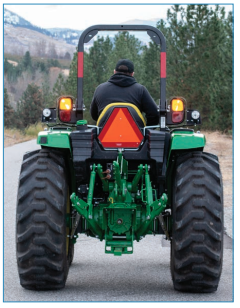
Drivers signalling a turn. Drivers signalling a turn may slow more than expected or stop. If they’re making a tight turn into an alley or driveway, they may go very slowly. If pedestrians or other vehicles block them, they may have to stop on the roadway. Vehicles turning left may have to stop for oncoming vehicles.
Drivers in a hurry. Drivers may feel your commercial vehicle is preventing them from getting where they want to go on time. Such drivers may pass you without a safe gap in the oncoming traffic, cutting too close in front of you. Drivers entering the road may pull in front of you in order to avoid being stuck behind you and causing you to brake. Be aware of this and watch for drivers who are in a hurry — let them go ahead.
Impaired or distracted drivers. Drivers who are sleepy, on drugs, sick, using their cellphone or have had too much to drink are all hazards. Some clues of impaired or distracted drivers include:
• Weaving across the road or drifting from one side to another
• Leaving the road (dropping right wheels onto the shoulder or bumping across a curb in a turn)
• Stopping at the wrong time (stopping at a green light or waiting for too long after a stop)
• Open window in cold weather
• Speeding up or slowing down suddenly or driving too fast or too slow
Visibility issues
Driving at night
In British Columbia, you’re legally required to turn your headlights on 30 minutes after sunset and remain on until 30 minutes before sunrise or whenever visibility is poor. When you’re driving at night or at any time when you can’t see clearly 150 m (500 ft), you must turn your headlights on. Daytime running lights are not bright enough to be used at night. They’re too dim and the taillights and instrument panel lights won’t be on.
• Use your low-beam headlights if there’s oncoming traffic.
• Be sure that your headlights are properly aimed, so they don’t bother or interfere with other drivers.
• Keep your headlights clean.
• Don’t overdrive your headlights at night (unable to stop or respond to a hazard illuminated by your headlights). The average low beam headlights are only capable of illuminating the highway ahead at a distance of approximately 100 m (328 ft).
Glare
Glare from the sun, reflections and the lights of other vehicles can affect your vision in the day or at night. If glare makes it difficult to see the road, reduce your speed. Ensure your vehicle’s windows are properly cleaned inside and outside to improve visibility. Sunglasses and a clean windshield are essential for a professional driver when dealing with sun glare or glare from the snow on a bright winter day. Avoid looking directly at oncoming headlights, so they don’t impair your vision. Look slightly down and to the right edge of your driving lane until the vehicle passes you.
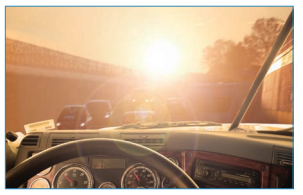
Headlight glare from oncoming and following vehicles can be a problem for every driver on the highway, so be sure to dim your headlights when encountering an oncoming vehicle. If your headlights make it hard for an oncoming driver to see, then you and your rig are also in danger. The human eye takes about seven seconds to recover from headlight glare. That means at 80 km/h (50 mph) a vehicle would travel 156 m (512 ft) in those seven seconds.
To help you see at night, keep your cab as dark as possible. Adjust your instrument panel lights to a low level.
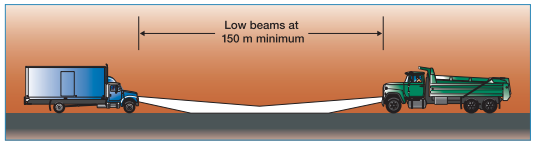
These two vehicles are approaching each other at night in opposite directions with their lights on low beam.
Smoke and fog
Fog can occur at any time and can be extremely dangerous. It’s often unexpected and visibility can deteriorate rapidly. You should watch for foggy conditions and be ready to reduce your speed.
Don’t assume that the fog will thin out after you enter it.
If visibility becomes so poor that it’s no longer safe to continue driving, slow down and move your vehicle well off the side of the road to a safe location.
Turn on your hazard lights and don’t attempt to drive until conditions improve.
If you must drive, consider the following:
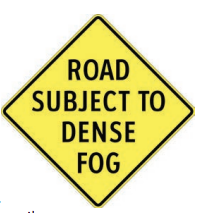
• Obey all fog-related warning signs.
• Slow down before you enter fog.
• Use low beam headlights and fog lights for best visibility even in daytime, as high beams will reflect the light back to you, creating glare. Be alert for other drivers who may have forgotten to turn on their lights.
• Turn on your four-way flashers. This will give vehicles approaching you from behind a quicker opportunity to notice your vehicle.
• Watch for vehicles on the side of the roadway. Seeing tail lights or headlights in front of you may not be a true indication of where the road is ahead of you. The vehicle may not be on the road at all.
• Use roadside highway reflectors and the white fog line as guides to determine how the road may curve ahead of you.
• Listen for traffic you can’t see.
• Avoid passing other vehicles.
• Don’t stop along the edge of the road, unless absolutely necessary.
Smoke and fog
Fog can occur at any time and can be extremely dangerous. It’s often unexpected and visibility can deteriorate rapidly. You should watch for foggy conditions and be ready to reduce your speed.
Don’t assume that the fog will thin out after you enter it.
If visibility becomes so poor that it’s no longer safe to continue driving, slow down and move your vehicle well off the side of the road to a safe location.
Turn on your hazard lights and don’t attempt to drive until conditions improve.
If you must drive, consider the following:
• Obey all fog-related warning signs.
• Slow down before you enter fog.
• Use low beam headlights and fog lights for best visibility even in daytime, as high beams will reflect the light back to you, creating glare. Be alert for other drivers who may have forgotten to turn on their lights.
• Turn on your four-way flashers. This will give vehicles approaching you from behind a quicker opportunity to notice your vehicle.
• Watch for vehicles on the side of the roadway. Seeing tail lights or headlights in front of you may not be a true indication of where the road is ahead of you. The vehicle may not be on the road at all.
• Use roadside highway reflectors and the white fog line as guides to determine how the road may curve ahead of you.
• Listen for traffic you can’t see.
• Avoid passing other vehicles.
• Don’t stop along the edge of the road, unless absolutely necessary.
Driving on slippery surfaces
Drive slowly and smoothly on slippery roads. If it’s very slippery, you shouldn’t drive at all. Start off driving gently and slowly, get the feel of the road and don’t hurry. Check for ice on the road, especially on bridges and overpasses. A lack of spray from other vehicles could indicate that ice has formed on the road. Also, check your mirrors and wiper blades for ice. If they have ice, the road most likely will, too.
Steering control is lost when front tires skid on slippery surfaces. Make turns as gently as possible. Don’t brake any harder than necessary and don’t use the engine brake or retarder as they can cause the driving wheels to skid on slippery surfaces.
Adjust speed to conditions. Don’t pass slower vehicles unless necessary. Go slowly and watch far enough ahead to keep a steady speed and avoid having to slow down or speed up. Take curves at slower speeds and don’t brake while in curves. Be aware that as the temperature rises to the point where ice begins to melt, you should slow down even more as the road may become more slippery.
Adjust space to conditions. Don’t drive alongside other vehicles and keep a longer following distance. When you see a traffic jam ahead, slow down or stop to wait for it to clear. Try hard to anticipate stops early and slow down gradually.
Watch for snowplows, salt and sand trucks and give them plenty of room.
Water on the road
A wet road is a slippery road. It can take twice as long for a vehicle to stop on wet pavement as it does to stop on dry pavement. When the pavement is wet, slow down and increase your following distance. Be especially observant of painted areas, railroad tracks, steel bridges, oil spills and muddy surfaces. A road may be especially slippery just after it has started to rain as oil residue will sit on the surface until it’s washed off.
Visibility is a concern when driving in the rain. Make sure your windshield wipers, washer and defroster are functioning properly. Drive with low beams on — high beams will reflect the light back to you creating glare — and reduce your speed.
Hydroplaning — Hydroplaning occurs when a vehicle drives through large amounts of water on the roadway and a cushion of water builds up under the tires. The result is a loss of traction and control. Hydroplaning is rare for loaded vehicles travelling under 100 km/h (62 mph) because of the weight on the tires.
When bobtailing or hauling an empty trailer, drivers should be aware that their vehicle has less traction than a loaded vehicle and is subject to hydroplaning at lower speeds. The trailer could be floating behind you especially in slushy conditions when it’s empty. If this happens, don’t brake. Release pressure on the accelerator to allow the vehicle to slow. Look and steer where you want the front of the vehicle to go.
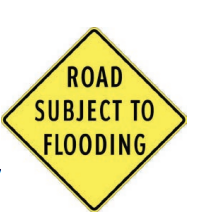
Flooding — Pools of water may hide a deep pothole that could cause damage to the wheel components and vehicle suspension.
Driving through large amounts of water at high speeds will soak the wheel components and when water enters the brake drums, braking efficiency is reduced. If driving through deep water is unavoidable, slow down and lightly apply the brakes.
Test the brakes if you’ve been driving in extremely wet conditions or if you’ve driven through a large amount of water. Place slight pressure on the brake pedal (dragging) until the brake pads and drums have had a chance to dry.
Snow and ice
Like driving on wet pavement, traction and braking ability are greatly reduced on ice and snow. When driving on packed snow, reduce vehicle speed by half.
Slow to a crawl if driving on an icy road.
Be aware that ice and snow are most treacherous around the freezing point, zero degrees Celsius. Traction varies tremendously with temperature changes.
Icy roads will look just the same at -2 or -22 C, but will be far more slippery at the warmer temperature. Ice melts slowly and freezes more rapidly, so be especially aware of shaded spots. Bridges and overpasses are other places that ice may build up. Many drivers relate their experiences of black ice as spots of thin, transparent ice that appear black because the pavement can be seen through them.
To stop on icy roads, use extremely light pressure on the brakes. This will help prevent the wheels from locking up. A slowly revolving wheel on an icy surface will be more effective than a locked wheel skidding on an icy surface. Vehicles equipped with anti-lock brake systems (ABS) may not have wheel lockup, but the road surface has a limited amount of traction and even with ABS, a truck can skid and jackknife.
Requirement to clear snow and ice — Snow and ice on vehicles are dangerous as they can obstruct your view if they’re on your windshield. If they’re on your roof, they can slide off and completely cover your windshield. When loose snow blows off commercial trucks and trailers, there’s often a temporary loss of visibility for other vehicles on the highway. When the accumulated snow melts and freezes, thick chunks of ice may form and if these pieces dislodge when the vehicle is in motion, they can create hazards for other road users.
Before coupling, remove all snow and ice. In below freezing temperatures, the jaws of the coupling device may not lock if the grease is frozen. Double check the locking mechanism and make sure the fifth wheel is lubricated with a wintergrade lubricant.
Snow and ice build-up also increase fuel consumption due to the additional weight and can also damage your trucks and trailers.
Remove snow from the tractor-trailer before beginning a trip and at regular intervals if the snow continues to fall. Regularly clear the lights of snow and ice. Keep everything clean, so you can be seen.
Crosswinds
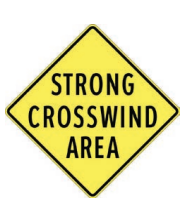
A crosswind is a strong wind blowing in a direction not parallel to your direction of travel. Unexpected crosswinds can result in a loss of control. Expect these conditions in flat, open areas or in locations where trees have been cleared. Heavy tractor-trailer vehicles traveling at high speeds are more prone to rollover in strong crosswinds. Crosswinds can be especially dangerous when the road is slippery and when hauling an empty trailer.
Driving in extreme heat
Driving in extreme heat can cause additional stress on you and your vehicle.
Carry extra water and make sure you stay well hydrated. When conducting pre-trip and en route inspections in hot weather, pay extra attention to the following vehicle components:
• Tire condition and pressure. Low tire pressure will cause tires to overheat faster, causing a blow out.
• Engine oil and coolant. Low engine oil or low coolant will not be able to keep the engine cool in extreme heat. Overheated engines can seize.
• Engine belts and hoses. Heat causes belts and hoses to deteriorate over time. Ensure yours aren’t getting worn out when driving in extreme heat.
Roadway design and surface issues
Pavement drop off
Sometimes the pavement drops off sharply near the edge of the road. Driving too near the edge can tilt your vehicle toward the side of the road, which can cause the top of your vehicle to hit objects, such as signs or tree limbs. Also, it can be hard to steer as you cross the drop off, going off the road or coming back on.
Objects and debris
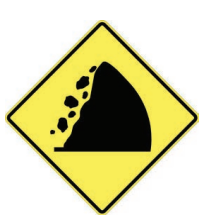
Things that have fallen on the road can be hazards. They can damage tires, wheel rims, electrical and brake lines. They can get caught between dual tires and cause severe damage. Some obstacles that appear to be harmless can be very dangerous. For example, cardboard boxes may be empty, but they may also contain some solid or heavy material capable of causing damage. The same is true of paper and cloth sacks. It’s important to remain alert for objects of all sorts, so you can see them early enough to avoid them without making sudden, unsafe moves. Watch for fallen rocks in mountainous areas.
Road design
Off ramps — Highway exits can be particularly dangerous for commercial vehicles. Off ramps and on ramps often have speed limit signs posted.
Remember, these speeds may be safe for automobiles, but may not be safe for larger vehicles or heavily loaded vehicles. Exits that go downhill and turn at the same time can be especially dangerous. The downgrade makes it difficult to reduce speed. Braking and turning at the same time can be a dangerous practice. Make sure you’re going slowly enough before you get on the curved part of an off ramp or on ramp.
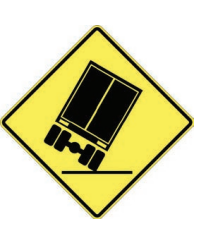
Road crown — At the centre of most roads is a crown. It’s designed to be higher than the outside edges to allow water to run off the road surface rather than pool and remain near the centre. The crown on some roads is abnormally high, which can cause the front end of the tractor to dip when entering a left hand turn.
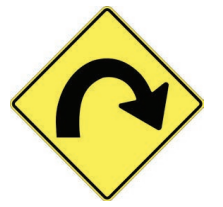
Curves — The curves of modern highways are usually sloped (banked) to compensate for the outward movement (inertia) of the vehicle in a turn.
On improperly designed roads, the degree of bank may be inadequate or could slope in the wrong direction (off camber). This could allow the vehicle to skid out of the turn and off the road.
Narrow bridges and underpasses
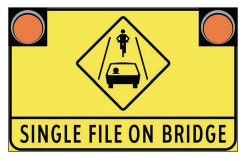
When approaching a narrow bridge or narrow underpass, turn on your hazard lights, slow down and yield to oncoming traffic. Before entering an underpass, check all posted clearance signs and ensure there will be proper clearance for you to safely travel under. When it’s safe to proceed, cross the bridge or go under the narrow underpass.
Turn hazard lights off when the tractor-trailer unit is across the bridge or through the narrow underpass. It is very important to be aware of the height and width of the commercial vehicle you are driving to ensure you can safely clear the top of underpasses when traveling below them, and when traveling along narrow roadways and bridges.
Gravel roads and poor surfaces
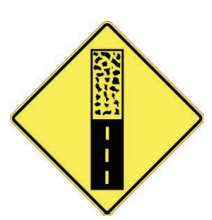
On roads with surface issues such as frost heave, broken pavement or potholes, allow more time for your trip. Increase your following distance, reduce your speed and maintain your space cushion.
Driving on gravel roads requires different skills than driving on paved roads. A vehicle tends to wander on a gravel road. Grasp the wheel firmly and compensate as necessary. Take care not to turn the steering wheel too abruptly as control may be lost.
Reduce speed and increase following distance to 12 seconds in order to maintain visibility from dust clouds created by vehicles ahead and to avoid rock chips from striking and damaging the truck. Slowing down also prevents churning up large amounts of loose gravel, which could become a hazard for other drivers.
Traction is also reduced when driving on loose surfaces. To get a sense of how your vehicle will handle on a gravel road, accelerate slowly and gradually increase your speed. If the vehicle loses traction or starts to slip, slow down.
Gravel roads are usually narrow and intersections and curves aren’t always marked. Portions of the road may have a washboard surface caused by heavy vehicles driving too fast and braking too late. Gravel may be loose and deep which can make it difficult to steer around curves. In wet conditions, the road may be slippery in areas where there’s less gravel and more mud. The surface may be particularly soft and loose along the shoulder.
Getting stuck — When mixed with moisture, the dust and dirt on the surface of gravel roads can become very slippery. Heavy rainfalls may make the ground extremely muddy and cause the vehicle to become stuck. If safe, step out of the cab to check the ground where the road condition is unknown. If the vehicle is stuck and the drive wheels are deeply submerged in mud or the vehicle is leaning to one side, seek assistance to recover the vehicle. Further attempts to drive the vehicle may sink it further or cause damage.
Visibility on gravel roads — A vehicle travelling on a dry gravel road produces a considerable cloud of dust. Stay well behind dust clouds on gravel roads. You never know if you’ll meet slow moving farm implements or road maintenance equipment in the middle. Adjust your road speed before meeting oncoming traffic and turn your headlights on.
It’s more difficult to see railroad crossings, intersections and farm approaches when travelling on gravel roads. Sight distances are shorter, there are more curves, more hills, more intersections and no shoulders. The road you’re travelling on may come to an abrupt end at a T-intersection.
Passing on gravel roads — Take extra care when passing on gravel roads. This manoeuvre should only be done when absolutely necessary. Several factors can increase risks of passing:
• Narrower road.
• Soft shoulders.
• Reduced visibility from dust and debris from vehicles ahead.
Vehicles passing in the other direction may kick up gravel and dust. When oncoming vehicles approach, slow down and move the truck as far to the right as it’s safe to do so. Once the vehicle has passed, gradually re-centre the truck and regain the appropriate speed. Remember — never pass another vehicle near the crest of a hill or when your vision is obstructed.
Back on the pavement — When you transition back to paved roads after driving on gravel, pull over and clean off loose debris/rocks and retighten cinches and belts. Check for rocks between tires. These projectiles can cause a lot of damage to other vehicles when they become loose.
Traffic conditions
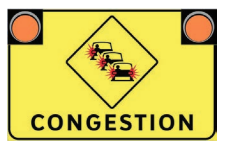
Traffic conditions refer to the other vehicles on the road, their general flow, distribution and speeds. You should be aware of the actions of other drivers and their vehicles and plan ahead to ensure that they aren’t placing themselves at risk of a crash.
Traffic conditions are created by the number of vehicles and pedestrians using that same road or street and by how well the road has been engineered to accommodate the amount of traffic present at a given time. More vehicles mean more conflict in traffic and more chance of a crash. Traffic conditions are influenced by the time of day, day of the week, holiday periods and by the nature of the environment, such as a shopping centre, sports arena, factory or school.
Vehicle conditions
Vehicle conditions such as wear, tear and pre-existing damage, can lead to equipment failure and crashes. Ensure that major defects are addressed prior to operating the vehicle on a public roadway.
By completing the required vehicle pre-trip inspections and vehicle checks throughout your shift, you’ll be able to better identify minor issues before they require major fixes.
Frequent driving on gravel roads can take a toll on a vehicle. Dust and other particles collect in the air filter and radiator, reducing airflow into the engine and causing it to overheat. Particles will also stick to vehicle components that require grease to function. Excessive build-up of particles can increase friction between two moving parts and cause them to overheat or wear down more easily. Ensure air filters are checked and changed frequently.
A vehicle that is not kept in good mechanical condition can pose an extreme road safety hazard to yourself and other road users, and may result in your commercial vehicle being taken out of service by provincial commercial vehicle safety enforcement officers. As the driver, you are responsible to make sure your vehicle meets basic pre-trip inspection requirements and if there is a problem, you need to report it to your employer for repair, or arrange for the repair by a qualified mechanic if you are an owner/operator.
There are only six positions that another vehicle can take in relation to yours prior to a crash. They are:
1. Vehicle ahead — travelling in the same direction
2. Vehicle behind — travelling in the same direction
3. Oncoming vehicle
4. Vehicle approaching an intersection or at an angle
5. Another vehicle passing you
6. You passing another vehicle
By studying these six positions, recognizing the situations and hazards and managing space and speed, you can avoid being in most two-vehicle crashes.
The following section will study those types of crashes as well as crashes with an overhead obstruction, the mystery crash and run-off-the road crashes.
Crashes with the vehicle ahead
Why do crashes with the vehicle ahead occur? There could be a variety of reasons. However, they generally all boil down to following too close. When required to stop, you must always be able to stop before running into the vehicle ahead. When driving a larger, heavier vehicle, it will take longer for you to stop than for the driver in front of you.
In order to defend against this type of crash, stay alert and always keep a safe following distance. Following distance in a commercial vehicle should be a minimum of five seconds in ideal conditions. Larger, loaded combination units should leave at least one second of following distance for every 3 m (10 ft) of overall vehicle length.
There are times when your following distance should be increased, such as when you’re following:
• Oversize vehicles that obscure your vision
• Dangerous goods carriers
• Vehicles that stop frequently, such as delivery vans and school buses
• Motorcycles
• Vehicles being driven erratically
• Emergency vehicles
Also, increase your following distance when travelling in poor road conditions and under conditions that reduce visibility such as fog, rain, snow and smoke. Also, leave more space in areas where traffic intersects, merges or converges.
Few drivers are fully aware of the total stopping distance or time needed to bring a vehicle to a stop. It can be frustrating to leave a safe space in front of you and have automobiles constantly taking up that space. This will happen regularly and you need to be patient and recognize that it’s your duty to be careful with your large vehicle. You will need to re-adjust your speed and space margin if a vehicle moves into the buffer space you created for your commercial vehicle.
Crash with the vehicle behind
Tailgaters can create hazardous situations for you. Be aware of any vehicle following you too close and allow or encourage them to pass, if possible. If you’re already driving at the maximum posted speed limit, slow down a little to see if the tailgater will pass. If the tailgater stays behind you, increase your following distance from the vehicle ahead to give yourself more time to react should you have to stop suddenly. Keep yourself as visible as possible by keeping your lights clean and using your four-way flashers when travelling a lot slower than others.
Crash with an oncoming vehicle
One of the first rules of the road we learn is that you’re to drive on the right side of the road in North America. There are times, such as passing another vehicle, when it’s permissible to venture to the left side, but in specific instances only. If everyone carefully followed this rule of staying to the right, head-on crashes might be less frequent.
Circumstances do arise in which you or an oncoming vehicle will cross the centre line and you may suddenly find yourself in the path of an oncoming vehicle.
Some of these circumstances are driver caused, but some aren’t. Being aware of the reasons why a driver would venture into the wrong lane makes it more likely that you’ll be able to anticipate and avoid a potential head-on crash.
Other than when passing another vehicle, there are four reasons a driver could be on the wrong side of the road:
1. A problem in their lane. Trouble in a driver’s own lane, such as a construction barrier, animal, pedestrian or bicycle may cause a driver to swerve left in order to avoid the problem.
2. Faulty driving manoeuvres. Through an error in judgment, a driver may enter your lane. For example, making a wide right turn (which may be necessary for larger vehicles) or misjudging the distance required to pass a vehicle.
If you drive a vehicle with an extended wheelbase, you may need to take additional space to complete the turn on the street you’re entering.
3. Inertia effect on curves. Inertia acts on your vehicle by trying to keep it going in a straight line when negotiating a curve. If the driver on the inside of the curve is going too fast, loses traction or otherwise misjudges the curve, inertia will push their vehicle across the centre line and a sideswipe or head-on crash could result.
4. Loss of control. Drivers can lose control of their vehicles for many reasons, including:
• The right wheel drops off the pavement edge and the driver overcompensates in making the recovery
• A loss of visibility or centre line is obscured or worn away
• Falling asleep at the wheel, drug or alcohol impairment
• Tire blowout, skidding on a slippery surface
• Poor road conditions, potholes, snow or slush
• Poor judgment
Here’s what you can do to avoid a head-on crash:
• Read the road ahead — Be aware of oncoming traffic and try to anticipate what problems the oncoming driver may encounter causing their vehicle to cross the centre line and enter your lane.
• Ride to the right — Don’t crowd the centre line. If there are two lanes available to you going in the same direction, use the right lane as a matter of preference.
• Reduce speed — When you see a threat developing with an oncoming vehicle, reduce your speed immediately while moving right, if possible. This means slow down right away and if necessary, sound your horn and flash your lights. By quickly slowing down, you give them extra time to get back into the proper lane and avoid a crash.
• Ride right off the road — If you’ve followed the first three steps and the vehicle still keeps moving in your direction, you have only one out left — to ride off the road to the right. This option will, in almost all cases, be better than a head-on crash. If a crash is unavoidable, try to hit the object or vehicle at an angle rather than head-on to lessen the impact. Never try to out-guess the other driver by pulling to the left. If you’re going into the ditch or field, it’s better to steer into it to avoid a rollover.
Intersection or angle crash
About half of all two-vehicle crashes occur at intersections. This is largely due to the traffic conflict that exists at intersections, both vehicular and pedestrian. Be prepared for the unexpected.
Intersection hazards include:
• Stale green light — green lights that have been visible for a block or two may change suddenly to yellow. Also, watch for pedestrian signals that have changed to ‘wait’ as an indication of a green light about to change to yellow.
• Vehicles stuck behind left turners may become impatient and without warning or signal, swing over into the right lane to get by.
• Vehicles that are waiting at a green light or crosswalk may be waiting for other vehicles or pedestrians to clear — never pass these vehicles without slowing enough to check that the way is clear.
• Drivers making turns may signal and move into the intersection and then stop unexpectedly even when no traffic or pedestrians are blocking their path.
• Drivers who misjudge your speed and turn in front of you.
Crashes caused by another vehicle passing you
As a professional truck driver, you’ll quickly become aware that most drivers would rather drive in front of you than behind you. Some of those drivers will take unnecessary risks such as:
• Tailgating — staying too close behind your vehicle and darting out to make a pass with limited visibility
• Following the leader — a series of vehicles passing you at the same time, even though the second and subsequent vehicles have extremely limited visibility
• Passing you on the right
• Racing to merge at the last second at the end of a merge ramp or where two lanes merge into one can result in the following crash types: side-swipes, being cut-off, or being run off the road
As a defensive driver, you can do a lot to reduce the risk of a crash by making it easier for other vehicles to pass:
• Maintain your lane position, either in the centre of the lane or slightly to the right, to allow the passing vehicles extra clearance and vision.
• Maintain or reduce your speed.
• Watch for vehicles merging in front of you with limited space.
• If you need to pull over, turn on your four-way flashers, get as far off the road as safely possible, and put out warning devices, as needed.
• When pulling back onto the road, wait for sufficient space. Leave on the four-ways until you’re up to speed.
Crashes caused by you passing another vehicle
Think about passing before you do it. Every time you find yourself in a position to pass, ask yourself:
• Is it safe and legal?
• What will I gain by passing?
• Is it worth the risk?
• Is the pass necessary?
• Will I have to exceed the speed limit?
By asking yourself these questions, you may find that in most cases you don’t have to pass after all. Passing also increases fuel consumption significantly.
There’s nothing wrong with passing another vehicle, so long as it’s done where and when it’s safe to do so. Remember — never feel pressured to exceed the speed limit and make an unsafe lane change simply because there is an aggressive driver tailgating you.
Sideswipe crash
A sideswipe typically occurs during a lane change while vehicles are passing or between vehicles going in opposite directions and colliding close to the centre line.
Avoiding getting hit by another vehicle in a sideswipe requires you to manage your lane position, carefully execute lane changes and to watch other drivers.
You must also monitor your blind spots and pay attention to how you position your vehicle beside others. Sideswipe prevention involves getting your mirrors properly set up, having adequate convex mirrors and keeping your mirrors clean.
Crash with an overhead object
You need to make a conscious effort to ensure there’s enough clearance overhead at all times. A major cause of damage is hitting overhead objects, so watch out for low-hanging wires, signs and so on. It’s important for you to know the height of the truck you’re driving. Ensure you check out the height of the overhead objects before driving under them. Exit the vehicle, as needed, to check clearances and identify potential obstructions.
While the height of bridges or overpasses is often posted, clearance may be reduced when the road is repaved or there’s snowpack.
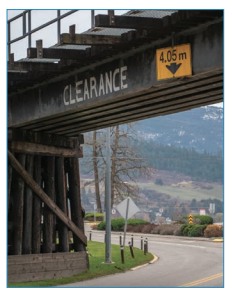
Incident with roadway clearance
Being aware of clearance under your vehicle is very important when crossing railway tracks and when entering or exiting sites with uneven surfaces. Trailers can get stuck (hung up) on the raised roadway area.