
[ultimatemember form_id=3702]
11. Documents and regulatory requirements
Canadian trucking regulations help govern transport across more than one million kilometres of highway that cover Canada. In order to ship items quickly and safely from coast to coast, it’s important to understand the road transport laws and regulations that are in place and ensure you’re abiding by those laws.
As a professional driver, you’ll be expected to know and understand the laws and regulations that affect you and your employer, and that affect how you’ll perform your day-to-day job. Canadian carriers operating in the cross-border movement of goods must adhere to both Canadian and American customs requirements and transport regulations.
The purpose of this unit is to introduce you to the various government laws, regulations and standards, including documentation, that govern the trucking industry. Workers are sometimes expected to rely heavily on their personal knowledge of these regulatory and compliance requirements.
This unit will help you learn to:
• Explain the purpose, structure and basic content of regulations that apply to commercial vehicle operations
• Identify and describe the meaning of messages and symbols on cargo packaging and documents such as waybills, packing lists, delivery documents, instructions and workplace hazard information
• Describe the purpose, importance and proper condition of required vehiclerelated documents
• Access information and reference tables related to vehicle weights and dimensions
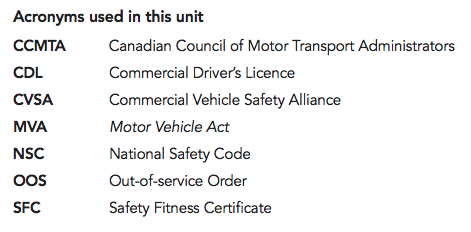
Across Canada, road transportation is a provincial responsibility. Each province and territory in Canada uses the National Safety Code (NSC) standards as guides for drafting their own transportation safety requirements. The NSC is maintained by the Canadian Council of Motor Transport Administrators (CCMTA). The CCMTA coordinates all matters dealing with the administration, regulation and control of motor vehicle transportation and highway safety.
The goal of the NSC is to improve road safety and consistency of regulations across Canada and to help ensure that the transportation industry remains viable and sustainable.
Although the NSC standards aren’t the law, they are considered best practices by Canadian federal, provincial and territorial governments. There are 16 standards overall, but the key standards you need to be aware of as a commercial driver are:
1. Medical standards for drivers — Outlines the medical requirements used to determine if a driver is medically fit to operate a vehicle.
2. Carrier and driver profiles — Assists in identifying the type of information that should be maintained on each carrier and commercial driver profile.
These profiles help review carrier and driver safety performance.
3. Short-term suspension — Identifies the criteria that can be used by Peace Officers to place a driver “out-of-service” on a short term basis, which can include issues related to driver fatigue, alcohol or drug impairment, as well as hours of service violations.
4. Hours of service — Describes the number of hours a commercial driver can be on duty and operate a commercial vehicle.
5. Cargo securement — Describes the safest methods for securing loads to commercial vehicles to ensure that they don’t shift, move or spill onto the roadway.
6. Commercial vehicle maintenance and inspection — Minimum standards for periodic inspection, maintenance and repair of commercial vehicles.
7. CVSA on-road inspections — Contains Commercial Vehicle Safety Alliance on-road inspection information and sets the minimum standards for roadside inspection in Canada, the United States and Mexico.
8. Trip inspection — Contains daily trip inspection requirements and ensures that any vehicles with problems or defects are immediately identified so that their operation may be prevented until all repairs have been made.
9. Safety rating — Establishes the safety rating framework to assess a carrier’s safety performance.
10. Facility audits — Describes the auditing process used to determine a carrier’s level of compliance with safety laws. It also indicates that carriers must maintain records at their principal place of business for review and assessment by an auditor.
11. Commercial truck driver entry level training (Class 1) — A standard designed to ensure that Class 1 commercial truck drivers are properly and consistently trained before they’re licensed. In B.C., this is the Class 1 MELT course you are currently taking.
Safety code regulations in B.C. are found under various divisions of the Motor Vehicle Act Regulations (MVAR). Carriers in B.C. are required to establish, maintain and follow a written safety plan and preventative maintenance program to operate. All commercial drivers have a responsibility to follow the policies and procedures contained in their company’s safety plan and preventative maintenance program and understand their responsibilities. The following motor vehicles are regulated under B.C.’s NSC Program:
• Commercial vehicles licensed with a gross vehicle weight of more than 5,000 kg (11,023 lb)
• A bus — commercial vehicles that have a seating capacity of 10 or more passengers plus the driver
• Vehicles operating under the Passenger Transportation Act
In B.C., the Motor Vehicle Act and its regulations govern the operation of motor vehicles on public roadways. This legislation sets out:
• procedures for obtaining a driver’s licence and endorsements, and provisions for their renewal, expiry and suspension
• permitted uses for each type and class of vehicle, and uses of licence plates
• administration of driver penalty points for driving offences and resulting prohibitions from driving
Traffic laws
In B.C., traffic-related laws are set out in the MVA and its regulations.
Other Canadian jurisdictions have their own versions of laws and individual municipalities in B.C. may also have their own bylaws. It’s your responsibility to be aware of bylaws and the traffic laws in other jurisdictions before traveling in different municipalities and outside the province. Violating traffic laws may result in fines or other penalties.
Criminal Code of Canada — The Criminal Code of Canada is federal legislation which sets out offences that apply across the country. Some of these include:
• Impaired driving:
– regardless of blood alcohol content
– with a blood alcohol concentration (BAC) that is at or over 80 mg of alcohol in 100 mL of blood
– to any degree by alcohol or a drug, or by a combination of alcohol and a drug
– driving with a blood drug concentration (BDC) at or over a prescribed level
– driving with a BAC and BDC at or over prescribed levels.
• Leaving the scene of an accident
• Failure to provide a breath or blood sample
• Impaired driving causing bodily harm or death
• Dangerous driving causing bodily harm or death
• Driving while suspended, prohibited or otherwise disqualified
Convictions under the Criminal Code of Canada vary with the seriousness of the offence and whether it’s your first, second or subsequent offence. Police have the authority to enforce the B.C. law, the Criminal Code of Canada and any municipal bylaws. It’s illegal to refuse a lawful request from a police officer.
Consequences of traffic convictions
Traffic convictions and incidents added to your driving history will appear on your public abstract, as well as your NSC abstract. These may affect the status of your driver’s licence as well as your ability to operate a truck or gain employment.
Consequences of receiving a traffic conviction may include one or a combination of the following:
• Fines — A direct fine for the violation. The dollar amount of the fine varies with the seriousness of the violation. Most offences are ticketed under provincial regulations but some may be ticketed under municipal bylaws.
• Driver penalty points — Some violations have driver penalty points points attached to them. These are recorded against your driving record when you’re convicted of an offence. Each offence carries a different number of points. You’re considered guilty of an offence if:
– You pay the full fine amount, or part of the fine amount
– 30 days have passed since the ticket was served on you, and you have not paid or disputed the ticket
– You dispute the ticket and either attend court and are found guilty, or fail to appear in court
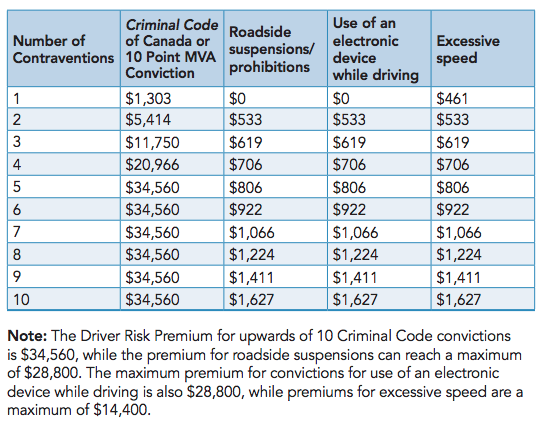
• Driver penalty point (DPP) premium — Each year ICBC looks at the total number of driver penalty points you received during a 12-month period called your “assessment period”. Your assessment period may include driving offences committed during an earlier period for which convictions may have only recently been recorded on your driving record. If you collect more than three points on your driving record during the assessment period, you’ll pay a DPP premium.
• Driver risk premium (DRP) — Each year ICBC also reviews your driving record for offences in the previous three years. You receive only one DRP invoice per year, but each driving offence may impact DRP billings for more than one year, depending on your driving record over the three-year period.
The DRP, like DPP premium, is separate from Autoplan insurance premiums.
They’re billed even if you don’t own or insure a vehicle, however, you will only be billed under one program each year, whichever results in the higher premium. You’ll pay a DRP if you have at least:
– One or more driving-related Criminal Code convictions
– One or more 10 point MVA convictions
– One or more excessive speeding convictions
– Two or more roadside suspensions/prohibitions
– Two or more convictions for using an electronic device while driving
This table shows the DRP amounts a person would have to pay for one or more of the following offences:
• Driver’s licence suspension or prohibition — Driving privileges can be suspended or prohibited for various reasons.
• Jail time — If you’re found guilty of a driving-related offence, you may face time in jail.
• Criminal record — Criminal Code of Canada convictions may affect an individual’s employment status and/or future employment opportunities. Employers may require their drivers or job applicants to disclose criminal record history in order to maintain their jobs or prior to them being hired.
• Insurance cost — Drivers with a history of traffic convictions and incidents may pay more for their personal vehicle insurance.
• Travel restrictions — Individuals with a criminal record may be refused entry into some countries.
• Loss of employment — Individuals may be required to disclose criminal convictions or traffic violations as a condition of their employment. Driving related convictions may result in work suspensions or termination.
This section provides an overview of some of the regulations that govern the operation of commercial vehicles, as well as requirements for commercial drivers. Breaches of regulations under Canada’s Motor Vehicle Transport Act can result in fines of up to $5000 for an individual, and up to $25,000 for a carrier. These regulations apply to commercial vehicles operating across more than one Canadian jurisdiction. In addition to monetary fines, other penalties may apply. While operating in B.C., commercial drivers are subject to the MVAR and the Commercial Transport Regulations (CTR), which fall under the MVA and the Commercial Transport Act (CTA), respectively.
Commercial Transport Regulations
While the CTR covers various topics, you should become familiar with the requirements in Division 7, which regulate the size, weight and configuration of commercial vehicles operated in B.C. The CTR also provides requirements for pilot cars, oversize vehicles and requirements for reporting to weigh scales.
Motor Vehicle Act Regulations
The MVAR sets out requirements for classes of driver’s licences, vehicle equipment standards, as well as hours of service and logbook requirements.
These provincial regulations are aligned with standards in the National Safety Code, and are harmonized with regulatory requirements in other Canadian jurisdictions. As well as the previously mentioned topics, Division 7 of the MVAR covers vehicle equipment standards/requirements. Division 25 of the MVAR addresses vehicle inspection and maintenance requirements. Division 37 of the MVAR covers safety code requirements, including safety certificates, hours of service, pre-trip inspections, facility audits, as well documentation requirements.
Safety certificate
To be insured in B.C., all commercial motor vehicles must have a valid NSC certificate number issued to the business for which the vehicle operates. These businesses are referred to as carriers, and include:
• a person who is the owner of a commercial motor vehicle,
• a person other than the owner, who manages the commercial motor vehicle, and who determines the use of the vehicle,
• the lessee of the commercial motor vehicle (where the lease term is one month or more), or
• a person who holds a licence under the Passenger Transportation Act, authorizing the commercial motor vehicle to be used as a passenger directed vehicle under a “transportation network service” authorization (e.g., Uber).
However, a person is not a carrier simply because they are the driver of the commercial motor vehicle. A carrier must also have an NSC safety certificate issued under Division 37 of the MVAR for their commercial motor vehicle. You will recall that in B.C., a commercial motor vehicle is defined as a:
• commercial motor vehicle with a licensed GVW of more than 5,000 kg (11,023 lb)
• a bus – commercial motor vehicles that have a seating capacity of 10 or more passengers, plus the driver
• vehicles operating under the Passenger Transportation Act
All provincial, territorial and U.S. jurisdictions have the authority and responsibility to regulate all carriers who operate within their borders. When a driver, driving a B.C. plated commercial motor vehicle, leaves B.C., they must follow the federal Commercial Vehicle Drivers Hours of Service Regulations and regulations enacted within the jurisdictions they visit. Similarly, when an out-ofprovince driver and vehicle enter B.C., they become subject to the laws of B.C.
You can find more information at the B.C. Ministry of Transportation and Infrastructure’s Commercial Vehicle Safety and Enforcement website, under NSC Safety Certificate Applications: https://www.cvse.ca/.
Hours of service
Part 3 of the B.C. MVAR Division 37 limits the on-duty hours of drivers of certain commercial motor vehicle types. It also specifies the required number of off-duty hours between shifts. The regulation applies generally to buses and commercial motor vehicles with a gross vehicle weight (GVW) of 11,795 kg (26,000 lb) or more. It is important to know that there is some variation in hoursof service requirements for specific industries, like forestry and the oilwell and natural gas industry. More information on hours of service requirements will be discussed in chapter 15 — Hours of service.
Vehicle inspection and maintenance
Division 25 of the MVAR sets out minimum vehicle inspection and maintenance standards in B.C. Carriers and registered vehicle owners are required to comply with these regulations, and maintain a record of all maintenance and repairs for each vehicle, as part of a preventative maintenance schedule. Under the provincial Commercial Vehicle Inspection Program (CVIP), licensed designated inspection facilities (DIFs) will inspect vehicles either once every 6 months or once a year, depending on the type and weight of the vehicle.
The following motor vehicles are required to comply with vehicle inspection standards:
• commercial motor vehicles, emergency vehicles, and farm logging vehicles with a licensed GVW over 8,200 kg
• commercial trailers or semi-trailers defined under the CTA
• private vehicles with a GVW of 3500 kg and less, registered outside of B.C.
• taxis, buses and limousines operating under the Passenger Transportation Act
• industrial machines (X-plated) with a licensed GVW over 17,300 kg
• school buses, and a bus with a seating capacity of 10 or more passengers, plus the driver
• farm vehicles with a licensed GVW over 17,300 kg
• vehicles issued a Notice and Order for inspection
The Commercial Vehicle Safety and Enforcement (CVSE) branch of the B.C.
Ministry of Transportation and Infrastructure is responsible for maintaining the province’s Vehicle Inspection Manual — which contains detailed inspection standards and requirements used by all licensed DIFs and by CVSE officers to ensure a vehicle meets safety standards.
Whether you work for a carrier or become an owner/operator, you are required to carry out a daily vehicle pre-trip inspection to keep yourself and others safe on the road, and to ensure the commercial vehicle you operate will meet inspection under the CVIP. More information will be covered in Chapter 14 — Vehicle inspection and maintenance.
Bills of lading and condition of carriage
A bill of lading is a document issued by a carrier to a shipper that covers the type, quality, and destination of the goods being carried. All bills of lading and shipping records must be issued in keeping with requirements under Part 7 of Division 37 of the MVAR. It sets out the specific information that must be included on bills of lading, and waybills for certain types of goods being transported, like livestock and household goods. The condition of carriage requirements are an agreement between a carrier and a shipper (customer) for the carriage of goods from Point A to Point B by the carrier against payment of freight by the customer.
More information on bills of lading and condition of carriage requirements are discussed further on in this chapter.
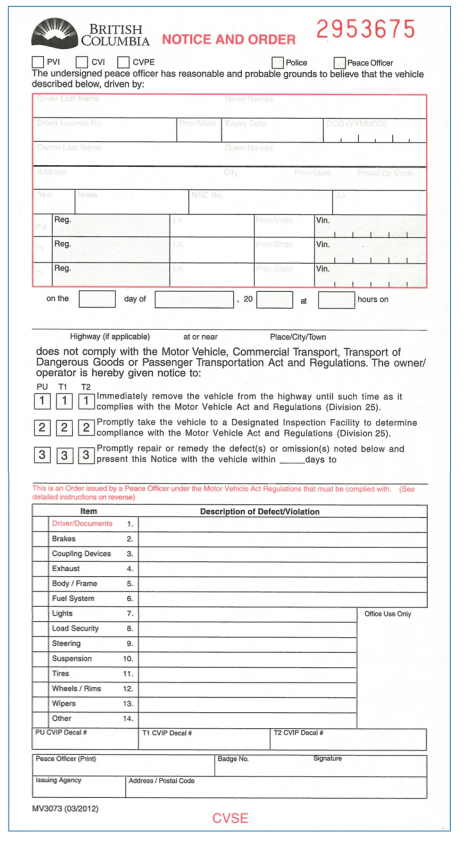
A notice and order (N&O) is a provincial legal document informing the driver or registered owner of a vehicle that the vehicle or its operation doesn’t meet the requirements of a specific act or regulation. Unlike a violation ticket, an N&O doesn’t include a fine or driver penalty points. It may require that identified defects be remedied or repairs made, or require a driver to obtain or produce certain documents or certifications.
Once the corrective actions are completed, it’s often required to report back to the issuing officer or agency, or that the vehicle undergoes a complete mechanical inspection at a designated inspection facility (DIF). If an order isn’t complied with in the time indicated by the issuing officer, there’s potential for the driver or registered owner to be issued a violation ticket. Further enforcement action can also result, up to and including, removing the vehicle from the road until defects are repaired and any required inspections are complete.
Any of the following enforcement officials can issue an N&O:
• Police officers
• Commercial Vehicle Safety and Enforcement (CVSE) officers
• Any Peace Officer authorized to enforce the Motor Vehicle Act, Commercial Transport Act, Passenger Transportation Act or Transport of Dangerous Goods Acts, and their regulations.
What to do if you receive an N&O
There are three levels of notice and order that can be issued. These are noted on the form as Box 1, 2 and 3. Each type or level can be applied to the power unit (PU), trailer 1 (T1) or trailer 2 (T2).
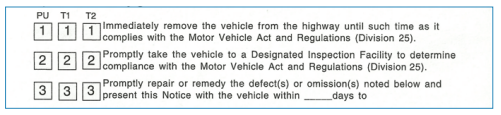
Level 1 (box 1) means:
• The vehicle is immediately removed from the road and cannot be operated on highway until it passes a complete mechanical vehicle inspection at a DIF.
• The enforcement official may specify where the vehicle is to be towed to, for the purpose of inspection and testing.
• Tow costs are at the driver/registered owner expense.
Level 2 (box 2) means:
• The enforcement official has ordered the driver/registered owner to take their vehicle promptly to a DIF, have it repaired immediately and pass a complete mechanical vehicle inspection within 30 days.
• The vehicle is not out of service and may be driven from the location.
• A level 2 order provides a window of 30 days for vehicle repairs to be completed and to obtain a passed inspection at a DIF. It doesn’t mean you can wait 30 days before having the vehicle inspected and repaired. The expectation is it must be done as promptly as possible within that window of time.
• If the level 2 N&O isn’t satisfied within 30 days, the driver operating the vehicle on highway is subject to a fine of $598 and escalated enforcement, such as removing the vehicle from the road.
Level 3 (box 3) means:
• The enforcement officer has given the driver/registered owner specific direction to achieve compliance. This will typically specify vehicle component(s) on the N&O that must be fixed within the timeframe stated by the officer. This is also the section used to describe non-compliant driver behaviour and/or non-compliance to the acts/regulations, other than B.C law.
• This level of N&O doesn’t require a vehicle inspection.
• The vehicle component(s) must be repaired and the driver/registered owner may be required to report back to the enforcement officer or a specific agency or location to confirm the vehicle meets the required safety standards. This same procedure may also apply to a non-compliance issue with any of the other applicable acts/regulations.
• This section may be used by the enforcement officer to indicate a warning to cease a non-compliant situation immediately.
• If an enforcement officer observes the vehicle operating contrary to the order, without the specified component(s) being repaired, the driver/ registered owner may be subject to:
– A fine of $598 for failing to comply with the order and any other violations under the act or regulations
– Escalating enforcement, such as increasing the level (box) of the N&O
Do you have to have the vehicle inspected or repaired?
The registered owner may choose to not have the vehicle inspected or repaired, but wouldn’t be able to operate the vehicle until the repairs have been made and the vehicle has been inspected, which may include passing a mechanical inspection at a DIF. Owners may choose to destroy or dispose of a vehicle instead of repairing.
The registered owner should inform any new owner of the vehicle if there is any outstanding level 1 (box 1) or level 2 (box 2) N&O upon the sale or transfer of the vehicle. If the vehicle hasn’t satisfied the requirements of the order and passed a complete mechanical inspection by a DIF, this will cause an inability to obtain licencing and insurance from ICBC and may prevent the completion of the sale.
Is there a fine?
No. A notice and order isn’t a violation ticket where a driver/registered owner receives a fine. If the N&O isn’t complied with, the driver/registered owner may receive a fine for failing to comply with the order, or be subject to additional violations and fines under the applicable act/regulation that’s being enforced.
Are points added to my driving record?
No. Points don’t get added to the driver’s/registered owner’s licence if issued a notice and order.
Is a record kept of my notice and order?
• Yes. A level 1 (box 1) or level 2 (box 2) N&O is recorded on the Vehicle Information Database, maintained by ICBC.
• A level 3 (box 3) N&O may be maintained on a database within the enforcement officer’s organization.
No violations are listed on the form. Why do I still have to have an inspection?
If the enforcement officer believes the vehicle doesn’t comply and warrants a level 1 (box 1) or level 2 (box 2) N&O, the description of the defect or violation may not be indicated. Completion of this section or any notation in this section is discretionary.
Only brake defects are indicated. Why must I have a full inspection?
When issued a level 1 (box 1) or level 2 (box 2) N&O, a full mechanical vehicle inspection at a DIF is required. There may be more problems or suspected issues with the vehicle in addition to the indicated defect.
How many things actually have to be wrong with my vehicle before I get a notice and order?
• The issuance of a notice and order is determined by the enforcement officer based on the severity of the vehicle defects. It’s not necessarily dependent on the amount or number of defects.
• It’s at the discretion of the enforcement officer to determine if the vehicle condition or a component is unsafe or non-compliant.
The documentation that’s required to be in the vehicle, or to be carried by the driver, can vary by the type or intended use of the vehicle and may differ between carriers. Document requirements can also vary by jurisdiction. When travelling across provincial or national borders, drivers must be aware of the documentation requirements in that jurisdiction.
You may be required to carry and produce the following documents:
Driver’s documents:
• Driver’s licence — A driver must be licenced for the class and type of vehicle they’re operating. A Class 1 driver with an air brakes endorsement may operate semi-trailer trucks and all other motor vehicles or combinations of vehicles, except motorcycles, as set out in Division 30 of the MVAR.
• Your valid B.C. commercial driver’s licence is your proof of medical certification.
• In some cases, a Code W may be placed as an identifier on a commercial driver’s licence. It shows that the driver is prohibited from driving a commercial vehicle in the United States because of profound hearing impairment or epilepsy. The Code W appears as restriction 22 on the back of the driver’s licence, along with a “W” placed on the front of the card at the bottom right hand corner. No medical conditions are displayed on the driver’s licence and law enforcement do not have access to the reason the Code W exists.
• B.C. services card — The B.C. services card is issued to all B.C. residents enrolled in the provincial Medical Services Plan (MSP), and contains your personal health number (PHN). Drivers have the option of combining their B.C. services card with their driver’s licence card, in most cases.
• Valid passport or FAST (free and secure trade) card for border crossings into the United States and Mexico. To apply online for a FAST card, visit the Trusted Traveler Programs (TTP) System operated by United Sates Customs and Border Protection, under the U.S. Department of Homeland Security.
• Log books — Under Division 37 of the MVAR, a driver is required to have in their possession a copy of their daily logs for the previous 14 days, the daily log for the current day, and any supporting documents or other relevant records that the driver received in the course of the current trip. See chapter 15 — Hours of service, for more information. Vehicle and load documents:
• Vehicle registration and insurance documents
• Lease/rental agreements
• Safety certificate
• Operating authority certificate
• Dangerous goods documentation (if applicable)
• Commercial Vehicle Inspection Program (CVIP) inspection certificate
• Permits that may be required by CVSE or other jurisdictional authority (if applicable)
• Trip inspection schedule and report
• Route/passenger information
• Shipping documentation
Vehicle licence, registration and insurance
Carriers must ensure that their vehicles are licensed, registered and insured for the appropriate vehicle type and use (or rate class), along with any other permits or certificates required for operation. Carriers must ensure their vehicles do not operate in excess of the weight they are licensed to carry. As well, if a carrier or owner/operator is paid to transport goods, they must carry cargo insurance.
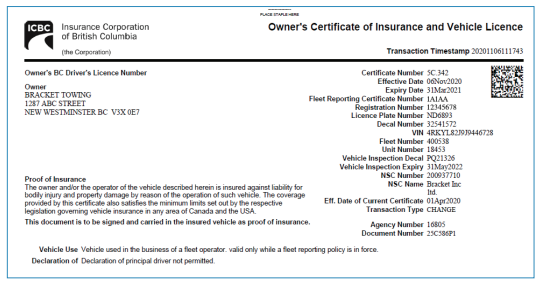
As discussed earlier, B.C. carriers must have an NSC safety certificate before they may licence, register and insure a commercial motor vehicle. As a commercial driver, you should review the information on the owner’s certificate of insurance and vehicle registration to ensure it matches the carrier’s NSC safety certificate number, NSC number and NSC name.
Commercial Vehicle Inspection Program (CVIP)
The goal of the CVIP is to ensure all commercial motor vehicles, which includes trailers and specialized equipment, are subject to a systematic, regular preventative maintenance program. Regular preventative maintenance of equipment ensures small problems can be corrected before they result in crashes or incidents, major repairs, or a vehicle breakdown a long way from a service facility.
Vehicles that have met inspection requirements at a licensed provincial DIF will receive an inspection certificate of approval in the form of a CVIP decal, placed on the outside lower left hand or lower right hand of the vehicle’s windshield, or other outside glazed surface to the right hand of the driver. In the case of a trailer, the CVIP decal is placed on the outside left or right, lower front corner of the trailer. As a commercial driver, you must confirm that both the truck-tractor and the trailer you are hauling have a valid CVIP inspection decal on each unit before you drive or park your vehicle on a highway or other roadway. It is illegal to operate the vehicle without a valid inspection certificate.
It’s generally expected that the maintenance program will follow the recommendations of the vehicle manufacturer for maintenance and repair. The motor carrier must also ensure that each vehicle is repaired in the event of a recall notice being issued by Transport Canada. Proof of repairs and regular service must be kept in the vehicle’s preventative maintenance file, while a copy of the DIF’s inspection report must be carried in the vehicle.
Records of inspection, maintenance and repair must be kept for the last three years of ownership and six months after disposal of the vehicle.
International Registration Plan (IRP)
The International Registration Plan (IRP) is an agreement between the United States and Canada that allows for the sharing of commercial vehicle licensing (road use) fees. This plan was created to encourage the fullest possible use of the highway system between member provinces, territories and states. Federal carriers operating British Columbia-plated vehicles can apply through Prorate Services for vehicle registration in other provinces or states. The British Columbia government will issue a Cab Card for each vehicle the carrier operates.
The Cab Card will specify which member IRP locations a vehicle may operate in. An IRP registration doesn’t:
• Exempt a carrier from paying motor fuel taxes in any province or state
• Exempt a carrier from obtaining an Operating Authority Certificate and/or a Safety Certificate
• Allow a carrier to operate outside of B.C. with a Provincial Operating Status
• Allow a carrier to exceed maximum height, length, width and axle limitations
For more information see the British Columbia IRP Manual available at ICBC.com.
International Fuel Tax Agreement (IFTA)
The International Fuel Tax Agreement (IFTA) is an agreement between the United States and Canada that allows federal carriers to operate in more than one location. This plan was created to make it easier for carriers to register, licence, report and pay taxes for motor fuels. A carrier licensed under IFTA is required to send quarterly fuel tax returns to its base jurisdiction where it’s registered. IFTA reports help determine how much fuel tax is owed in each state or province based on the distance driven in each jurisdiction. If you’ve driven more distance in a jurisdiction than the amount of fuel you purchased, you will owe fuel tax to that state or province. If you purchased more fuel in a jurisdiction
than the distance you drove then they will owe you a refund of fuel tax paid.
Fuel tax reporting is required from all intra-jurisdictional trucking firms that travel in B.C. An IFTA commercial vehicle is a motor vehicle used across jurisdictions or internationally for the commercial transportation of passengers or goods that:
• has two axles and a GVW or registered GVW over 11,800 kg (26,014 lb),
• has three or more axles regardless of weight, or
• is used in combination with a trailer where the weight of the combination is over 11,800 kg (26,014 lb).
Intra-jurisdictional trucking firms must apply for an IFTA licence to report and account for fuel tax payable and distances travelled in each jurisdiction in which they operate.
You must keep a careful record of your fuel receipts, log reports and trip reports.
Daily trip inspection report
Under Part 4 of MVAR Division 37 — Trip Inspection, a carrier must not allow a driver to operate a commercial motor vehicle without either the driver, or other authorized person, completing a daily pre-trip inspection and report of the vehicle. The inspection must occur daily, before the first trip of the day. If a trip lasts more than one day, a trip inspection must be done every day, no later than the first rest stop of the day.
In general, the following vehicles must carry out a daily pre-trip inspection:
taxis, buses, commercial motor vehicles with a licensed GVW over 8,200 kg, vehicles licensed under the Motor Carrier Act, or a trailer/semi-trailer defined under the CTA, as well as vehicles owned or leased by a driver training school, and those under a licence or temporary operating permit under the Passenger Transportation Act.
An inspection schedule lists minor and major defects for each inspection item.
Minor defects must be repaired before the next trip inspection. If a major defect is found, the commercial vehicle cannot be driven until the defect is repaired.
Completed by the driver, owner, carrier or the person authorized by the carrier or the owner, the daily vehicle trip inspection report is intended to serve as the communication tool between the driver, the carrier and the maintenance department.
It’s an offence to drive, or permit a person to drive, a vehicle on a highway if any vehicle part (or equipment) is defective or inoperative. A defect found during an inspection could prevent problems later. If not addressed, defects can cause costly breakdowns or even worse, a crash. It’s much less expensive to complete repairs during normal business hours than arrange for a service call on the road.
For detailed information on trip inspections and reports, see the Vehicle Inspection chapter.
Shipping documents
The documentation that accompanies shipments serves many purposes. Most importantly, it provides an accurate record of the cargo and in some cases it also serves as a contract for transport services. As a professional driver, you must be able to understand the terms and content of the shipping documents and your legal responsibilities.
If you don’t understand how to properly prepare and handle the documentation of the freight you haul, you may:
• Be liable for civil or criminal penalties
• Damage your reputation as a professional driver
• Be fired from your job
In terms of dangerous goods, the shipping documents must be carried within the driver’s reach. When the driver leaves the cab, the shipping documents should be left in an obvious place in the cab — either on the seat or in the pocket in the driver’s door. The driver ensures information is complete and legible according to carrier policy and checks that load and paperwork match.
See Motor Vehicle Act Regulations, Division 37 — Safety Code, Part 7 —
Required Documents.
Types of shipping/cargo documents:
• Bills of lading
• Waybills
• Dangerous goods shipping documents
• Weigh slips
• Delivery instructions
Bills of lading
A bill of lading is one of the most important documents in the shipping industry. The bill of lading is a legally binding document providing the driver and the carrier all the details needed to process the freight shipment and invoice it correctly.
The freight covered by a bill of lading must be in possession or control of the carrier at the time the bill of lading is issued. A bill of lading must cover only goods received from one shipper, picked up at one place and consigned to one consignee at one destination and delivered to one place. The number of pieces in the shipment as well as the correct freight classification for the goods being shipped are indicated. If there are discrepancies (for example, the description of the goods and/or the quantity on the bill of lading doesn’t match the shipment delivered) you’ll need to investigate.
There are three common types of bills of lading:
• Straight bill of lading — Freight delivered straight to the receiver.
• Order bill of lading — The order bill of lading is negotiable. It enables a shipper to collect for the shipment before the shipment reaches its destination.
• Multiple carrier bill of lading — Covers a shipment by more than one transportation company at a fixed rate for the entire service. More than one type of transport company may be used — for example, truck and rail.
A bill of lading must be completed and provided to the shipper when your freight is to be picked up. At least three copies of the bill of lading are issued:
the original, the shipping order and the memorandum copy. The following information must be included:
• Name and address of the shipper
• Date of the shipment
• Originating point of shipment
• Name of originating carrier
• Names of connecting carriers, if any
• Name and address of the receiver of the goods
• Where the shipment is going (if different from address of receiver)
• Weight, description and particulars of the goods in shipment
A bill of lading must also contain the following:
• Space to write whether the goods were received in apparent good order
and condition
• Space to write the declared value of the shipment
• Space to tell whether transportation charges are prepaid or to be collected
at delivery
• Space to note any special agreement between the consignor and the carrier
• A noticeable and clear statement of anything that limits a carrier’s liability
(For example, a term or condition of the carrier’s applicable schedule of
rates, an agreement with the consignor)
• A statement of notice of claim of the specified conditions of carriage
One of the most costly and obvious consequences of not using or filling out a bill of lading accurately is that you won’t get your product to your desired recipient. As well, if the bill of lading indicates that the goods were loaded in good order and condition, but the consignee receives them at the destination in a damaged condition, the consignee will be entitled to make a claim for the damage against the bill of lading carrier. This means if the information isn’t accurate, it will be difficult to get your full freight claim paid as you won’t have the right information to recover the cost of damage; for example, if the bill of lading said there were 100 boxes but only 90 arrived, the consignee will be entitled to make a claim against the bill of lading carrier for the shortage.
Incorrectly using a bill of lading can have severe consequences.
As a driver, it’s your duty to make sure the information listed on the bill of lading is complete and any delivery instructions are followed. The forms themselves may vary in appearance and design, but the information fields are fairly standard.
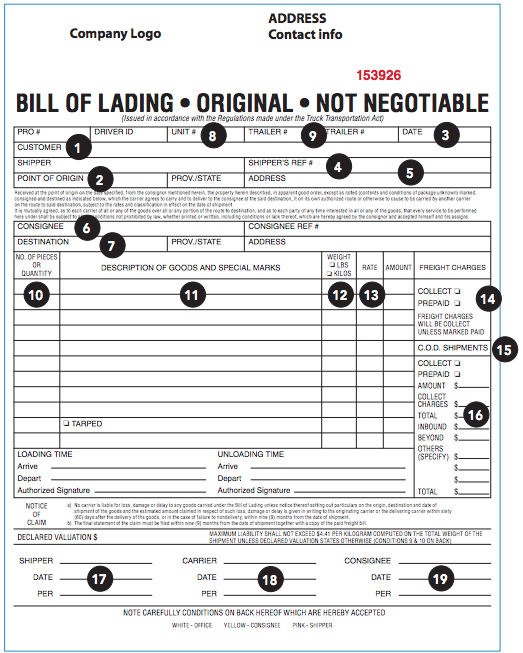
Fields on a bill of lading:
1. Shipper — Name and address
2. Point of origin
3. Date of shipment
4. Shipper’s reference number
5. Carrier — Name and address
6. Consignee — Name and address
7. Destination — Address where the carrier will make delivery to the consignee
8. Unit number
9. Trailer numbers
10. Number of pieces
11. Description of goods
12. Weight
13. Rate
14. Freight charges prepaid or collect
15. C.O.D. shipment — Indication whether charges are prepaid or collect (cash on delivery)
16. Shipment declared value
17. Shipper’s agent — Signature and date sent
18. Carrier’s agent — Signature to take control of the shipment
19. Consignee’s agent — Signature to acknowledge receipt of the shipment
Signing and dating the bill of lading — Signing and dating the bill of lading is extremely important. When you do this, you’re accepting responsibility for the freight. You’re signing as an agent of the company, and acknowledging that the company has accepted the terms of the contract. The bill of lading is not valid without signatures.
Count, inspect and determine that the freight is properly described before you sign the bill of lading. If you’re not satisfied with the amount of the cargo or the condition of the cargo, do not sign. When in doubt, call your dispatcher or supervisor for instructions.
Checking the bill of lading — Mistakes in loading and unloading do occur, and the issue of theft is a problem for drivers. It’s important to check that the freight you’re transporting accurately matches the numbers and descriptions detailed in the bill of lading.
Waybills
Instead of carrying a bill of lading for the goods transported, the company may carry a waybill for the goods issued by the consignor or carrier. A waybill is identified by the numerical code or other means of identification set out on the bill of lading and sets forth at least the following:
• Particulars of the goods carried on the vehicle
• Name and mailing address of the consignor
• Point of origin of the shipment
• Name and mailing address of the consignee
• Destination of the shipment
• Names of connecting carriers, if any
• Whether the charges are prepaid or collect
• Date of the consignment
Miscellaneous documentation
A freight bill is a bill given by the carrier to the consignee for the freight, which contains a description of the freight, the name of the shipper, the point of origin of the shipment, its weight, and the amount of charges. A cargo manifest is a list of all of the goods that make up the freight you are carrying, generally for use by border customs or other officials.
In addition to the bill of lading, the freight bill and the cargo manifest, the driver may encounter several other documents associated with their shipments.
Packing slip — The packing slip is a list of the total parts that are packaged in a shipment. Upon receipt of a shipment, it’s the consignee’s responsibility to check the contents of the shipment against those indicated on the packing slip.
Delivery receipt — The delivery receipt is a paper signed by the consignee or an agent of the consignee. It’s given to the driver when the consignee accepts the shipment. The driver keeps the delivery receipt as proof that the delivery was actually made.
Warehouse receipt — When the shipment goes to a warehouse, the driver may receive a warehouse receipt. The receipt is the driver’s proof that the delivery was actually made at the warehouse.
Transporting dangerous goods
The transporting of dangerous goods in commercial or personal vehicles is subject to both federal and provincial laws and regulations. The federal dangerous goods program focuses on all modes of transportation, as well as movement between jurisdictions. The provincial program harmonizes provincial and federal requirements for transportation of dangerous goods on B.C. highways, including provincial ferry routes, under the Transport of Dangerous Goods Act.
This section provides a brief overview of dangerous goods documents and requirements for general information only and doesn’t constitute dangerous goods training. Dangerous goods are also referred to as hazardous materials (hazmat). Dangerous goods can be solid, liquid or gaseous form, and can harm people, other living organisms, property or the environment.
Training required:
This course provides only a brief introduction to the topic of transportation of dangerous goods. As a new professional driver, it is your responsibility to be able to identify whether the cargo you are intending to haul may be considered a dangerous good based on the placard attached to your trailer, the bill of lading and labels on cargo. If you do not have a valid Transportation of Dangerous Goods (TDG) training certificate, you are not legally allowed to operate a vehicle carrying dangerous goods.
The law states that no one shall handle, offer for transport or transport dangerous goods unless they are trained, or they work in direct contact with someone who is trained.
Carriers are responsible to make sure their employees have the proper training to work safely with dangerous goods. This usually means a formal in-house training program to earn a TDG training certificate. The certificate is valid for three years and is not transferable; a new certificate is required each time a driver changes employment.
Hazard classes and divisions
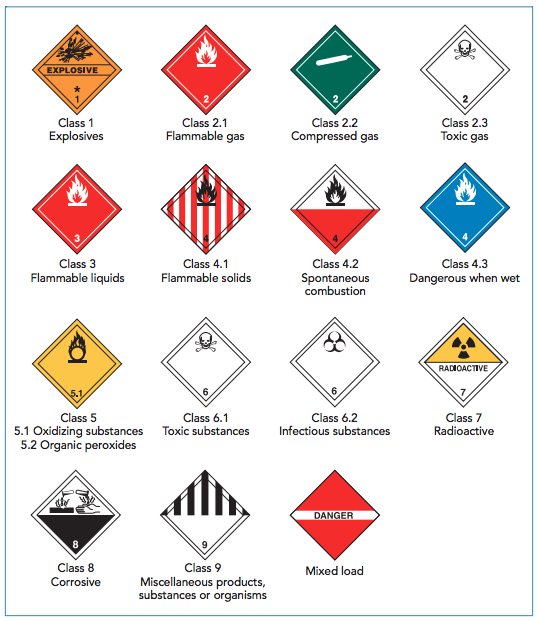
Dangerous goods are divided into nine classes according to the type of danger they present. The following table is meant only to provide a sample of dangerous goods that pose a hazard and is not a complete list.
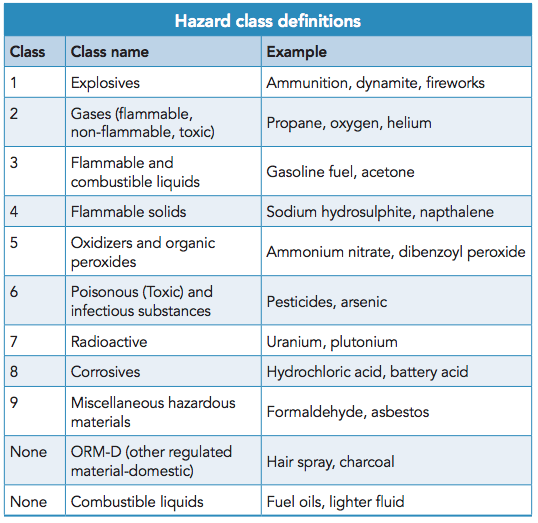
Identification of dangerous goods
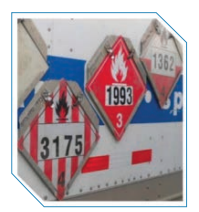
Safety markings and documentation are used to inform people of how to properly handle dangerous goods. Placards are a clear way of telling people that a large container or transport unit contains dangerous goods. When a crash or spill occurs, these placards alert responders to the presence and nature of the dangerous goods. This allows them to take the correct actions.
• The consignor is responsible for providing the placards to the carrier before allowing a carrier to take possession of dangerous goods for transport in a large means of containment on the vehicle.
• It’s a carrier’s responsibility to make sure a vehicle has all the proper placards on it before it’s loaded.
• Drivers must place the placards on each side and each end of the vehicle so anyone looking at the vehicle from any angle will be able to see the signs.
• The carrier must ensure that the placards remain displayed on the vehicle while the dangerous goods are in transport.
Labels are a clear way of telling people that a small container holds dangerous goods. There’s a specific set of labels representing the different hazards defined by the federal Transportation of Dangerous Goods Regulations, which has been adopted by B.C. The labels may be displayed on any side of the outer surface of the container except for the side on which it’s intended to rest or be stacked during transport. The label must also be placed on the shoulder of a cylinder.
In the event of an emergency
In the event of an emergency involving dangerous goods, call CANUTEC at
1-888-CAN-UTEC (226-8832), 613-996-6666 or *666 on a cellular phone.
The following chart lists the dangerous good classes with their corresponding label and placard.
The following are examples of some of the dangerous goods placards that may appear on the sides and each end of the vehicle and its trailer:
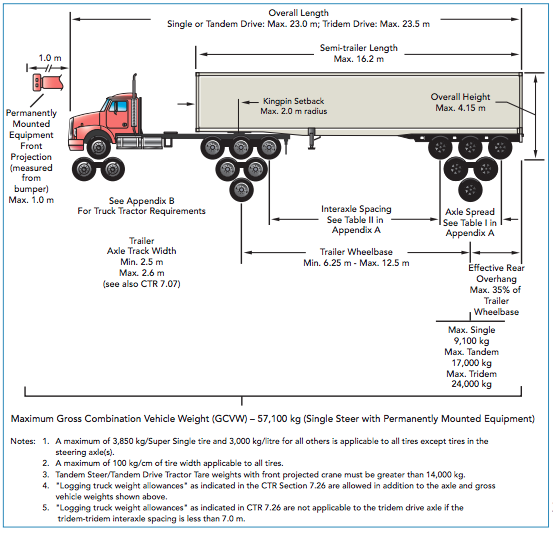
Maximum weight standards have been established by jurisdictions to ensure public safety and to protect infrastructure. In B.C., the type of vehicle, the number of axles, the manufacturer’s rating and the tire size can all impact the legal weight. You will need to become familiar with the maximum vehicle weights permitted based on the type and configuration of your vehicle, as well as its load. See Commercial Transport Regulations — Division 7.
Trailers with sliding axles are capable of changing the way the weight is distributed on the trailer. Sliding the trailer axle to shorten the trailer wheelbase, reduces off-tracking, but also reduces the maximum weight limit. Extending the wheelbase allows the weight capacity to reach the maximum allowed for axles. Never exceed the manufacturer’s gross axle weight rating (GAWR). A carrier must be aware and comply with all weight restrictions that apply to their vehicles — these restrictions may vary between jurisdictions.
When travelling off of provincial or state highways you must be aware of your vehicle’s gross weight in kilograms (and pounds for the United States), as cities, municipalities and U.S. counties may have different weight allowances and dedicated truck routes. If a bridge has a rated capacity of five tons, that’s only 10,000 lb. If the rating is five tonnes, that’s only 5,000 kg and your tractor-trailer when empty weighs more than either of those bridges can support. You’re responsible for understanding and being able to calculate your weights. If you drive on a road, bridge over overpass and exceed the rated capacity, you’ll be responsible for the cost of repair for any damage done. If you become lost, stop in a safe place and contact your dispatcher or safety department for help getting safely back on route before you cause damage.
A commercial vehicle must not be operated on a highway unless the owner of the registered vehicle has correctly decaled the sides of it. Drivers must be aware of weight restrictions that may apply to their vehicles.
The Commercial Transport Regulations set out the maximum dimensions for commercial vehicles and their loads. A driver must be aware of the actual size of their vehicle and load. If a vehicle or its load is too tall or too wide, it may not be able to travel on certain routes. Drivers need to be aware of the truck’s dimensions to avoid conflicts.
The maximum overall length for a vehicle depends on if you are using a truck or truck tractor and what type of trailer you are using. For example, in B.C., a single vehicle cannot, without a permit, exceed 12.5 m (41′), while a logging truck and trailer with one articulation point cannot exceed 23 m (75′ 6″).
General information on the maximum overall length, including what items are not included when determining overall length, can be found in section 7.08 of the Commercial Transport Regulations.
Load projection — the load cannot project more than:
• 1 m (3′ 3″) ahead of the front bumper
• 1.85 m (6′ 8″) behind the back of the vehicle
• 4.5 m (14′ 9″) behind the centre of the last axle
When making turns, be sure to leave enough room to avoid the rear of your tractor-trailer striking the vehicle in the lanes beside you. This is especially important if the trailer axles have been moved in order to transfer weight.
When leaving a curb, be sure that the rear of your tractor-trailer doesn’t pivot onto the sidewalk, as this will be a danger to pedestrians and cyclists or may damage property such as power poles or sign posts.
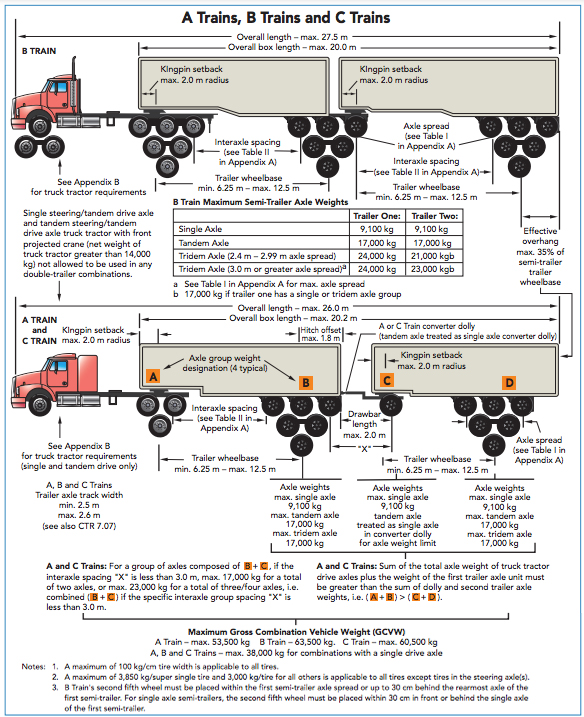
The following two tables show the maximum weights and dimension of the most common commercial vehicle configurations. These diagrams may be found in Appendix D — Tractor Semi-Trailer Combination and Appendix G
— A trains, B trains and C trains, of Division 7 of the Commercial Transport Regulations. Additional diagrams showing maximum weights and dimensions for other vehicle configurations, like trucks and pony trailers, full trailers, or pole trailers, can be also found in the Appendices of Division 7.
Height — Maximum height: 4.15 m (13′ 7″)
Know the height of your tractor-trailer (and load) to be able to calculate if your vehicle is too tall to pass through underpasses, bridges or tunnels. It will also help you to watch for potential hazards of unmarked overhead obstructions such as: canopies, roof overhangs and other building protrusions, signs, utility lines, tree limbs, doorway entries and more. Signs may be posted on these structures to give their overhead clearances. Some areas may have check bars and warning devices installed to warn drivers.
Vehicle height regulation
7.05 (1) A person must not, without a permit, drive or operate a vehicle having a height in excess of 4.15 m.
(2) Despite subsection (1), if a vehicle is equipped at the top with a tarp system with roll-up tarp backstops consisting of short, nonretractable metal straps which extend upwards to secure the rollup tarp, the overall height of the vehicle, including the backstops,
must not exceed 4.3 m, and the overall height of the load must not exceed 4.15 m.
(3) Despite subsections (1) and (2), a person must not, without a permit, drive or operate a vehicle on a highway if the overall height of the vehicle is greater than the height limit indicated on a low clearance warning sign posted on the highway.
[en. B.C. Reg. 95/2006, s. 3.]
Width — Maximum legal width is 2.6 m (8′ 6″)
Know the width of your load and vehicle. There are allowances for your mirrors and other trailer attachments such as lights and ladders to exceed the 2.6 m width law. There’s also an exception for loose hay or straw. Outside of these exceptions, you’ll need to get a permit to haul an over width load.
Vehicle width regulation
7.06 A person must not, without a permit, drive or operate on a highway a vehicle having a total outside width in excess of 2.6 m, but not including the following as part of that width:
(a) loose hay, straw or fodder projecting over the sides of the vehicle to a total outside width not in excess of 3.1 m;
(b) one or more mirrors, fitted for the purpose of conforming to the requirements of the Motor Vehicle Act Regulations, which do not extend more than 30 cm on each side beyond the total width of vehicle and load otherwise permitted by this section;
(c) auxiliary equipment or devices that are not designed or used to carry cargo and do not extend more than 10 cm on each side beyond the total width of vehicle and load otherwise permitted by this section, including, but not limited to, anti-splash and spray devices, load securement devices, ladders, glad hands, air connectors, electrical connectors, hydraulic connectors, clearance lamps and dangerous goods placards;
(d) 445-mm-wide tires, fitted to the steering axles of a truck or truck tractor manufactured before January 1, 2005, that extend up to a maximum of 10 cm on either side of the vehicle beyond the maximum vehicle width of 2.6 m.
[en. B.C. Reg. 95/2006, s. 3; am. B.C. Reg. 128/2008, s. 1.]
Knowing your width is also important because external components such as side mirrors, anti-splash and spray devices, or clearance lights may be easily overlooked and damaged if the tractor-trailer is driven through a structure that’s too narrow. In addition, load components extending beyond the frame of the vehicle must be considered.
Special permits
In B.C., CVSE monitors, controls and issues permits for the movement of all overweight or over-dimensional commercial vehicles traveling on provincial infrastructure. To enhance public safety, conditions are often applied to permits including things like adding extra signage to vehicles which have exceeded the weights and dimensions in regulations.
Permits may be required in multiple jurisdictions in order for a driver to travel in full compliance. For example, a vehicle that exceeds maximum weight or dimension limits may be allowed to operate if the carrier obtains a permit. It’s the driver’s responsibility to follow all conditions of their permit carefully, so be sure to read it carefully before proceeding. If you’re unsure of the requirements get clarification from your carrier, the permit hotline or by calling your local scale.
Some carriers who specialize in hauling over-dimensional loads will have term permits on some of their vehicles that are valid for an entire year. Larger loads may exceed the allowances of the term permit and may only be eligible for a single-trip permit. In some cases, extraordinary load approvals may be required.
Also consider what permits may be required if you are to travel in the United States or are transporting dangerous goods. Contact the appropriate department prior to departure. If a carrier is issued a permit, they must ensure that they and their drivers read and follow all applicable conditions. For information on the maximum dimensions for which a load may be permitted in B.C., see Chapter 4: Commodities Guidelines and Permit, of the B.C. Commercial Transport Procedures Manual, available at the CVSE website below.
Note: Permits can be obtained online at CVSE.ca or by calling the Provincial Permit Centre at 1-800-559-9688.
Over-dimension signs
When a commercial vehicle is operated under the authority of an overdimensional permit, they must meet all relevant safety requirements.
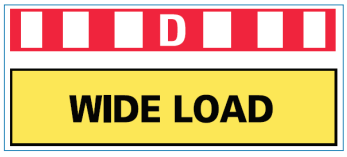
A vehicle that’s required by regulation or permit conditions to be equipped with an oversize load/vehicle sign may use one of the following, as described in Division 8 of the CTR:
Large “D” sign
This sign may be used for over-dimensional vehicles that are long, wide or both long and wide.
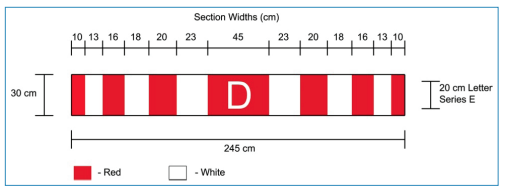
• The sign or rigid area must be 2.45 m by 0.3 m
• The letter “D” must be white in colour and must be 20 centimetres high (Series E)
• The white portions of the sign or rigid area must be white in colour with a good reflective quality
• The red portions of the sign or rigid area must be red in colour and painted with the transparent red paint used for stop signs
Alternate sign for over-dimensional load
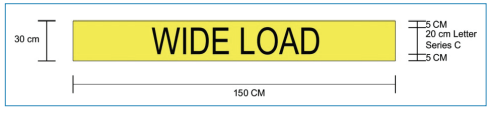
• The panel size must be 1.5 m by 0.3 m
• The lettering must be black on a yellow background
• The lettering “Wide Load” must be 20 cm high (Series C)
• For overlength loads, the words “Long Load” or “Oversize Load” must be 20 cm high
• The panel must have a 9.5 millimetre black border at the panel’s edge
Pilot cars
Depending on what type of oversize load you’re hauling and how wide or long the load is, you may require a pilot car escort. Pilot cars must meet very specific requirements for the type of vehicle as well as lighting and signage installed on them. Some loads require one pilot car, some require two and in extreme cases you may need three pilot cars or even a police escort. Requirements are listed in Division 8 of the CTR, along with the rules for where pilot cars should travel relative to the load they’re escorting. Additional information on pilot car requirements can be found in Chapter 8: Miscellaneous Information, of the B.C. Commercial Transport Procedures Manual available at CVSE.ca.
Generally over-dimensional loads are hauled by drivers who have several years of commercial driving experience. The most important thing to remember is any time you’re travelling under a permit you must always read the entire permit to properly understand what you’re required to do. Permits will sometimes list designated routing, time of day you’re allowed to travel and number of axles you’re required to have under a load if it’s overweight.
Remember that provincial permits only apply to roads under provincial control and you may require an additional municipal permit if you have to travel off of the highway. When operating across national or provincial borders, you’ll require permits for each jurisdiction you must travel through.