
[ultimatemember form_id=3702]
9. Handling emergencies
No matter how safely you operate your tractor-trailer, there’s always a chance for a crash or incident as long as there are variables that you have no control over, such as weather, wildlife and other drivers. Even the best driver may be involved in a crash at some point in their driving career. When the unexpected happens, you need to safely and legally deal with the situation in a calm and responsible manner.
This unit will explain the professional driver’s responsibilities at the scene of a crash and in protecting equipment, cargo and human life. This includes what to do about your truck, how to protect yourself and others, how to prevent a fire or control a fire if one ignites and how to report a crash. This unit also provides information on dealing with a variety of emergency situations.
This unit will help you learn to:
• Handle emergency incidents in a safe and professional manner.
• Explain the importance of following workplace practices, procedures andpolicies regarding crashes, close calls, injuries or other incidents including:
– Engaging emergency support, such as towing, recovery and repair services
– Speaking with police, media or the public
– Obligations and limitations in administering first aid
• Describe typical incidents that must be reported to employers, police and other reporting agencies.
• Explain the need to carry emergency equipment and first aid supplies.
• Describe how and when to use emergency equipment, such as fire extinguishers, warning devices, spill kits and first aid supplies.
• Properly wear and use appropriate personal protective equipment.
• Use warning devices and other emergency equipment safely and in compliance with regulations.
• Explain what to do in emergency situations such as, vehicle malfunctions, fires, medical distress, and vehicle runaway due to brake failure.
Emergency supplies
Approved warning devices Any vehicle is a hazard when it’s parked on the side of a road. Large vehicles present more significant hazards. In most cases, drivers are required to put out approved warning devices when they park their commercial vehicles at the side of the road in an area that isn’t designated for parking.
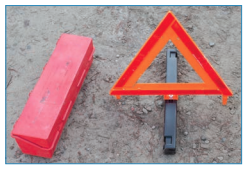
The following commercial vehicles must carry approved warning devices in the driver’s compartment and must be easily accessible:
• All vehicles with a seating capacity of more than 10 passengers.
• All commercial vehicles with an overall width of more than 2.3 m (7.5 ft).
• All commercial vehicles with a load width of more than 2.3 m (7.5 ft).
When parked in the dark, the above commercial vehicles must have a minimum of two warning devices.
During daylight hours, the minimum for approved warning devices is:
• Two red flags that measure at least 30 by 30 cm (12 by 12 in), or
• Two warning devices that have been approved for daylight use, including flares, fuses and reflectors.
At night, you may use flares, fuses, reflectors and red lanterns.
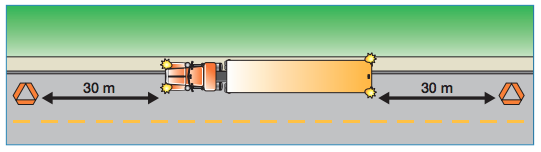
If your vehicle becomes disabled:
• Move it as far off the travelled portion of the highway as possible.
• Place warning devices approximately 30 m (100 ft) ahead and 30 m (100 ft) behind the disabled vehicle.
Note: It’s a good safety practice to place additional warning devices further than 30 m (100 ft) from your vehicle.
A breakdown can be dangerous at any time, but it’s especially dangerous in adverse weather conditions. Exposure to wind and cold can cause frostbite and blowing and drifting snow can be disorienting. If your vehicle breaks down in adverse conditions, put on extra clothing, stay in the cab and stay warm.
First aid supplies
It is strongly advised that all commercial vehicles carry first aid kits that are easily accessible by the driver and that the driver be trained in basic first aid. Truck drivers are often in remote areas, including areas with no cell phone service, so it’s important to be able to help yourself or someone else if there’s an incident.
It’s also important for you to know and follow your workplace policies and procedures regarding providing first aid to others. Know your limitations and
obligations.
Fire extinguishers
Every vehicle registered as a commercial vehicle transporting fuel petroleum products and those registered as public service vehicles (except trailers) must be equipped with a fire extinguisher approved by Underwriters Laboratories (UL).
The extinguisher must be kept charged with a valid expiry date.
Extinguishers must be secured in a quick-release holder in view of and easily accessible to the driver.
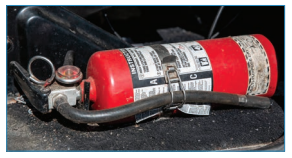
There are two main categories of fire extinguishers: multi-purpose dry chemical extinguishers and carbon dioxide (CO2) extinguishers. The multi-purpose dry chemical extinguishers are easier and safer to use, but the CO2 extinguishers are more effective.
Multi-purpose dry chemical extinguishers are available in two classes. If its cylinder is marked BC, it can be used to put out grease, oil, gasoline and electrical fires. If its cylinder is marked ABC, it will also put out Class A fires, such as paper or cloth.
CO2 extinguishers are extremely effective but should never be used in an enclosed space. You could smother yourself if you use these in a confined space. You could also blister your skin.
How to use a fire extinguisher
• Remove from the bracket.
• Pull the safety pin by breaking the seal.
• Approach the fire from upwind, if possible.
• Hold the extinguisher in an upright position.
• Point the discharge apparatus (hose, horn, nozzle) at the base of the fire, approximately two to three metres (six to eight feet) away.
• Don’t allow the flames to come between you and an exit.
• Squeeze the handle.
• Continue to use until fire is out and extinguisher is fully discharged.
• Never turn your back on a fire as it may re-ignite.
• Ensure all discharged fire extinguishers are replaced with fully charged ones before the vehicle is used again.
Generally, extinguishers will be totally discharged in approximately eight to 10 seconds, so proper technique is extremely important! Even when the fire appears to be out, don’t turn your back on it. Keep watch for flashback until the area has completely cooled.
Remember the word PASS:
P — Pull the pin
A — Aim low
S — Squeeze lever
S — Sweep from side to side
Personal protective equipment (PPE)
A carrier’s safety plan will document PPE requirements and ensure that drivers receive training on requirements such as goggles, hard hats, steel toe boots, breathing apparatus and so on.
Drivers should carry extra warm clothing, hat, gloves, blankets, food, water and any required medication in case of being stranded for a long period of time due to weather or traffic delay. A driver should also carry an emergency contact list.
Other supplies
The following other supplies should be on hand:
• Ice scraper
• Snow brush
• Extra windshield washer fluid, antifreeze and oil
• Extra wiper blades
• Small shovel
• Sand or road salt
• Spare tire chains
• Flashlight and spare batteries
• Jumper cables
• Candles and matches
• Paper towels and bathroom tissue
• Antibacterial/antiviral wipes
• Disposable face coverings
• Bottled water
Vehicle gets stuck
Ideally, by following the guidelines below, you shouldn’t get stuck in the first place. The best way to prevent getting stuck is by avoiding soft shoulders, deep snow, muddy roads and icy/slippery surfaces.
If you do get stuck, stay calm and take the following steps:
1. Avoid spinning the drive wheels and rocking, this will dig the vehicle in deeper. Spinning wheels will warm any ice or snow under the tires, reducing traction even more.
2. Dig out from in front of the wheels. Install all of your tire chains on your drive axles. Scatter sand or gravel in the wheel path if you don’t have chains.
3. When ready to try pulling out, start with the steering wheel facing straight ahead. Don’t turn the wheel until the vehicle is moving.
4. Start in second or third gear, using very little power. This keeps the wheels from spinning and gives a smoother application of force.
5. Accelerate smoothly and gently. Ease off at the first sign of spinning or slipping. Allowing the wheels to continue spinning can cause you to dig in deeper and/or cause a spinout.
If the steps above fail to free your vehicle, you may need to call a tow truck. Remember, even if towing is necessary, you’re still responsible for your vehicle and cargo. You need to stay in charge and supervise the operation. Talk to your dispatcher or supervisor before you call a tow company. Most major carriers have agreements with certain tow companies that give them better rates. Take pictures of your situation and send them to your employer so they can be sure to get the right size equipment dispatched to rescue you.
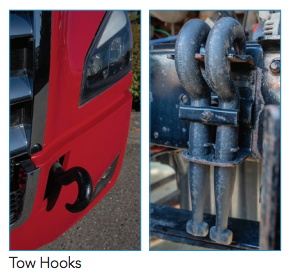
While you’re waiting, find your tow hooks (usually hanging on the side of the frame under the hood) and continue to dig yourself out. The shorter time the tow truck is on scene, the less it will cost.
Personal medical distress
If you have a sudden medical incident, do your best to stop and secure the vehicle and pull over if you can. Turn on your four-way flashers and get help however you’re able to. Call for help on a two-way radio if you have one, dial 911, or push the help or accident button on your Electronic Logging Device (ELD) if there is one. Flash your lights, honk your air horn — anything to attractattention!
Using anti-lock braking systems (ABS)
Anti-lock brake systems (ABS) are mandatory in Canada on all trucks and buses over 4,536 kg (10,000 lb) manufactured since April 1, 2000 and on all commercial trailers equipped with air brakes.
The system monitors wheel speed and adjusts air or hydraulic pressure in the brake chambers to prevent wheel lockup under severe braking. Continuous wheel speed sensing information is transmitted to an Electronic Control Unit (ECU) that processes the information for brake pressure application, allowing the system to accomplish its task.
The ABS allows the driver to steer while applying continuous brake application, but it doesn’t allow you to drive faster or stop sooner. In fact, on some surfaces such as gravel, the braking distance with ABS may be longer. ABS may also help you prevent jackknifing.
With good defensive driving skills, you’ll hopefully never have to use emergency braking techniques. The unexpected and uncontrollable can happen, however, so you should practice these techniques periodically.
Refer to instructions in your vehicle’s manual.
A few tips for emergency stopping with ABS:
• Apply firm, hard and continuous pressure to the brake pedal until the vehicle stops.
• Don’t pump the brakes — this turns the system on and off and increases your stopping distance.
• Don’t be alarmed by brake noise, pedal movement or shudder. This is normal. Keep applying firm pressure.
• Be extremely cautious when steering around obstacles. Remember that steering and handling characteristics will be affected by the size and load of the vehicle you’re driving and by the trailer you may be towing. Always steer smoothly and never jerk the steering wheel.
IMPORTANT: When you operate combination vehicles, make sure you know which of the units have ABS. If the tractor and trailers don’t all have ABS, apply the brakes as if you were operating a vehicle combination without ABS.
Stopping with threshold braking
Emergency braking with non-ABS brakes requires a sensitive touch on the brake pedal using a technique called “threshold braking.” Don’t “pump the brakes”. Pumping the brakes with no “feel” for what the wheels and brakes are doing will only extend the stopping distance and reduce air pressure.
Threshold braking means applying brake pressure right up to the point of almost locking the wheels, then backing off just enough to prevent the skid.
You’ll constantly adjust pressure on the brake pedal throughout the stop to keep it at that point. If the brakes lock, immediately ease up and reapply. Once mastered, the technique will stop you faster than any other.
Skid avoidance and possible recovery
Skids are usually caused by too much acceleration, braking or steering. The best practice is not to get into a skid in the first place. Avoid dangerous skidding by anticipating low-traction conditions and braking, steering and accelerating smoothly.
Loss of traction may be caused by:
• Tire failure resulting from under inflation or sudden deflation from a blowout
• Worn out tires — tread depth too low
• Faulty brakes
• Excessive acceleration or speed on curves
• Rough or slippery surfaces
• Hydroplaning resulting from travelling too fast on a wet road
• The oily film that develops on the road after the first few minutes of rain
• Loose or deep gravel
• Snow and ice
Recognize adverse road conditions:
• Constantly monitor for road conditions that could cause a loss of traction.
• If road conditions are questionable, reduce your speed and drive smoothly.
• Take your foot off the accelerator and reduce speed gradually without braking suddenly.
• If conditions worsen, consider putting on your tire chains or find a safe place to park until conditions improve.
• If safe to do so, travel closer to the fog line as this is where you should find accumulated sand for extra traction in the winter.
Anticipating a skid:
• Notice reduced traction — your vehicle may feel loose on the road or you may sense it is skidding.
• Reduce speed gradually and use the threshold braking technique instead of a single, hard brake application. Remember-you can only apply threshold braking if you don’t have ABS anywhere in your vehicle combination.
• Avoid sudden movement of vehicle controls. Keep everything smooth.
Reacting to a skid:
• Immediately release the brake if your wheels are locked up. It’s impossible to control a skid when the wheels of your vehicle are locked.
• Ease off the accelerator and let the vehicle slow down.
• Disengage the clutch to get drive wheels rolling again. Look and steer in the direction of the skid. Use counter-steering techniques to avoid over steering.
Jackknifing and trailer swing
A jackknife is typically caused by a loss of traction at the tractor drive tires which can be caused by:
• Poor weight distribution in the trailer.
• Using the service brakes when there isn’t enough traction due to a slippery surface or worn out tires.
• Activating the engine brake suddenly on slippery roads or at too high of a setting (this is a common cause).
The rear of the tractor will start to swing out as the drive tires accelerate due to a lack of traction. As the tractor begins to rotate, the weight of the trailer accelerates the rotation by pushing straight ahead.
Recovery from a jackknife situation requires quick action. As the angle between the tractor and trailer increases, the chances of recovery diminish. Once you pass a 15-degree angle, you’re at the point of no return.
There are two distinct kinds of skidding involving a tractor trailer:
• A trailer swing-out in which the rear of the trailer swings out.
• A tractor jackknife in which the tractor rear end slides sideways and is pushed by the trailer.
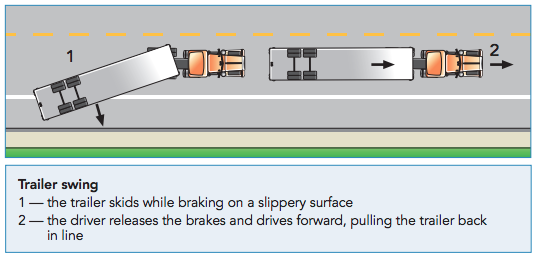
Recovery from a potential jackknife depends on which type of skid you’re experiencing. When the trailer skids, it will start to swing either left or right.
When this happens, release the brakes and provide gentle acceleration to pull the trailer straight again. Steer smoothly and then let your vehicle slow down again. This can be especially challenging when descending steep mountain grades as increasing your speed down the hill isn’t what you really want to do. In winter, look for areas of the road that will give you more traction (for example, accumulated sand) so you can slow down again but stay on your own side of the centreline. You’ll only be able to maintain directional control of your vehicle if the wheels are turning.
Once you start down a hill, you’re committed, so be sure you have enough traction. If conditions are poor, you can stay at the top of the hill until they improve. If you choose to continue, then installing tire chains on your drive axles along with a drag chain on one of your trailer axles may help your situation.
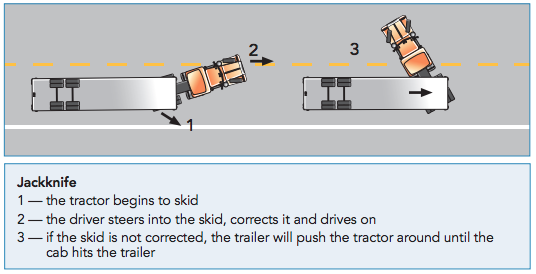
When the tractor skids at highway speeds, it typically results in a jackknife as the trailer you’re pulling wants to travel straight ahead. Once the tractor begins to rotate, it pushes into a jackknife position very quickly. Many drivers who have experienced a high-speed jackknife describe it as happening so quickly that they didn’t recognize what was happening until it was already over. Recovery from a high-speed jackknife is almost impossible, so prevention is the key.
If you’re travelling slow enough and recognize the beginning of the rotation, you can accelerate and get the tractor straight again to prevent a jackknife.
To avoid a jackknife:
• Know the weight distribution of your cargo
• Remember that a light or empty vehicle will slide more easily
• Reduce your travelling speed
• Increase following distance
• Brake smoothly
• Avoid braking in curves
• Avoid swerving and braking at the same time
• Use the engine brakes on lower settings when roads are slippery and test the traction carefully
• Install traction devices if road conditions are questionable
Tire failure
If you’re skilled in performing vehicle inspections, you’ll have few problems with the tires of your tractor and trailer. There are, however, hazards of the road that can’t be avoided. You may face an emergency if one of your tires has failed.
When a steer axle blowout occurs:
• Don’t apply the brakes immediately
• Firmly grasp the steering wheel and steer your vehicle straight down the centre of your lane
• Accelerate until control of the vehicle is stabilized then allow the vehicle to slow gradually
• When you have the vehicle under control and speed is reduced, brake gently until the vehicle comes to a complete stop, preferably off the travelled portion of the road
• Turn on your four-way flashers
Typically, when a drive tire or trailer tire blows, it doesn’t immediately impact vehicle control as it’s generally in a dual-wheel configuration. You’ll want to stop safely as soon as possible to prevent further damage to the vehicle or adjacent tire and then pull safely off the road, if possible. If you can’t get off the road, you’ll need to put out your warning triangles. Contact your supervisor with the pertinent information, such as tire size and wheel position, so they can arrange for a tire repairman to come out.
Flooded roadway
Water can reduce braking efficiency. Avoid driving through large amounts of water whenever possible. If you have to drive through flood water on the road, estimate the depth and whether you should drive through it at all. If you’re going to drive through:
• Slow to a crawl as you approach the water
• Place a slight drag (a light constant pressure) on the brakes while you drive through. The drag will reduce the amount of water on the brakes
• After driving through the water, apply the brakes for a short distance to dry them out
Emergency action
The use of emergency action in a situation may reduce the likelihood or severity of a crash. Emergency action includes braking to slow your vehicle, as well as smooth steering to avoid an obstacle if it’s safe to do so.
Prevention and a high level of awareness such as looking well ahead, slowing down and increasing your following distance in poor road conditions will reduce the need for emergency action. When you’re confronted with an impending crash, it takes a calm approach to achieve the best result. Instinctively, we don’t want to hit things, particularly if they’re alive, but our emergency actions need to be calculated so we don’t create a bigger problem.
Turning the steering wheel too aggressively in a tractor-trailer will create trailer whip and a likely roll over. Moving to another lane to avoid a crash is also risky — crossing the yellow centreline should be a last resort as you may put other motorists coming from the opposite direction at risk. First and foremost, you want to dissipate as much energy from your vehicle as possible so you need to brake and if your entire vehicle is equipped with ABS brakes then brake as hard as you can. Reducing speed is going to lessen any impact and if you need to steer, the vehicle will be under better control at the lower speed.
Wildlife — Animals crossing the road are a fact of life in B.C. and, sadly, result in many crashes. Drivers have lost their lives swerving to miss an animal which is a cost far too high. When faced with wildlife crossing the road, it’s important to stay in your lane and reduce your speed as much as possible with hard braking.
Releasing the brake just before impact will allow the front of the vehicle to rise up. This may help in having the wildlife go under the vehicle rather than come up over the hood and possibility into the vehicle.
Oncoming vehicle in your lane — Hopefully you’ll never experience a situation where another vehicle has crossed into your lane and there’s an impending crash. These situations require clear thinking with the first step being to reduce your speed as much as possible to lessen the impact. The second step will be to smoothly steer to avoid the other vehicle completely or to lessen the impact.
Steering to the shoulder is best to hopefully create a glancing blow versus a head-on crash. Try to avoid driving completely off the road.
Crossing the centreline to avoid a crash should be your last resort, since it puts drivers travelling in the opposite direction at risk. If the oncoming vehicle regains control, they’ll instinctively return to their side of the road and hit you.
Emergency steering — Although a truck can be turned faster than it can be stopped, emergency steering can be very risky. If a crash is inevitable, emergency steering may reduce the severity, but done incorrectly it may worsen the situation. Steering must be completed smoothly to remain in control. Remember that if you’re carrying a liquid bulk load, a product surge will be generated by any sudden manoeuvring.
To perform emergency steering:
• Reduce speed. If there’s sufficient space, brake to a slower speed before reaching the obstacle; however, only brake while steering if you have ABS.
• Select an alternative path:
– Hazard on a multi-lane roadway — check for a clear lane to move into
– Hazard on two-lane roadway — check if oncoming lane is clear and check for obstacles on shoulder
– Merging hazard — check for a clear lane to move into

• Perform emergency steering. Start steering as soon as the emergency is identified. Turn only enough to clear the obstacle. Don’t put your vehicle into the path of oncoming traffic! Steering must be smooth and gradual.
• Perform counter steering. Smoothly steer back in the other direction when safe.
Crash unavoidable — Where a crash is unavoidable, it’s best to avoid a headon crash or hitting pedestrians. Colliding at an angle reduces the force of the impact. If you have a choice, it’s far better to hit inanimate objects than people.
Running off the road is sometimes the best option. Be calm and make a clear decision.
At a glance, you must assess your escape path for the following:
• Is the escape path free of hazardous obstacles?
• Are clearances sufficient for the vehicle?
• Will an off-road surface still permit steering control?
• Is the path going to remain clear or will it be occupied by someone or something else by the time you get there?
Remember, if you focus only on the obstruction, you’ll be unable to assess your best escape path and likely steer towards the obstruction. Look to where you want to go, taking in the big picture. The size and weight of a larger vehicle limits its ability to swerve sharply to avoid an object or to leave the pavement with much control. Over steering is always a danger, especially when your wheels leave the pavement and are in soft ground. Steer firmly and as gradually as possible to clear the obstruction.
Gravel shoulder recovery
If the wheels of your tractor and/or trailer leave the roadway and begin to run on an unpaved shoulder, don’t be in a hurry to get them back on the road.
Swerving back onto the road at a higher speed may cause you to skid across to the other side or cause a rollover. To get back onto the road:
Reduce speed — Take your foot off the accelerator and gently apply the brakes.
If the shoulder is clear ahead
• If possible, keep one set of wheels on the pavement and steer straight until you stop
• Turn back onto the roadway when clear of traffic
If the shoulder ahead is blocked
• Confirm the distance you have and slow as much as possible
• Take your foot off the brake and turn the steering wheel carefully toward the roadway
• Don’t brake while turning
• As soon as the front wheel rides up on the surface, turn in the direction of the roadway and regain control of the vehicle
Loss of brakes
There’s a limit to the amount of heat that brakes can absorb and dissipate. The highest brake temperatures occur when braking from highway speeds while on long downgrades or from repeated use of the brakes without enough cooling time between applications. Almost all brake failures and downhill runaway crashes are caused by overdriving the ability of the brakes to deal with heat. In other words, driver error.
Drivers should always select a gear that will hold the vehicle back without the use of service brakes to descend hills. Keeping the service brakes cold so they’re available in an emergency is key to travelling safely downhill. If while you’re descending the grade your engine brake stops working, then simply
stop. Select a lower gear (likely low or first) to continue on without the use of service brakes until you find a safe place to pull over. Don’t continue down the hill until your engine brake is repaired. If you can’t fix the problem yourself, you’ll either need a mobile mechanic to come to you or you can uncouple from your trailer (ensure you’re on solid ground) and bobtail to the nearest repair shop to get it fixed.
As a professional driver, you will inevitably hold up the flow of traffic from time to time. Due to the size and weight of your vehicle, it takes more time and space to manoeuvre safely in all situations. One of the biggest challenges some new truck drivers have is learning to think about driving differently compared to being in a car. You will need to adapt your driving to start your downshifts early prior to turns so you’re in the correct gear when making a turn or tight manoeuvre. You’ll also need to accept that often there will be a long line of traffic behind you when you are ascending and descending grades because you must drive your vehicle within its limits.
In other words, don’t attempt to go down a hill faster just because you have traffic behind you. If there’s a safe place to pull over, you may want to use that space to allow traffic to clear, but only if you can do it safely. Even at a lower descent speed, you need to be safe. It only takes a few minutes longer to get to the bottom of the hill. Always remember, you can descend a grade thousands of times too slowly, but only once too fast!
If your air system gets a major leak from a hose being knocked off a tank by a broken tire chain or a rock, your low air warning will activate by 60 p.s.i. and you need to immediately find a safe place to pull off the road. Once stopped, if you’re not clear of the road, place your emergency triangles to warn other drivers. Call your supervisor and arrange for repairs before you proceed.
Runaway lanes
Runaway lanes enable vehicles that are having braking problems to safely stop.
There are several types of runaway lanes in use that are connected to a steep downhill grade section of a main road and designed to accommodate large vehicles. The ramp allows a moving vehicle’s kinetic energy to be dissipated gradually in a controlled and relatively harmless way, helping the driver to stop safely without a violent crash.
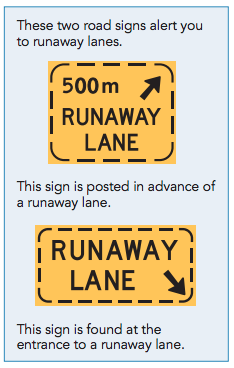
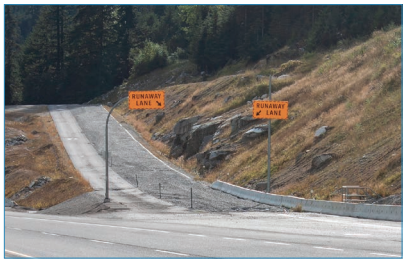
The runaway lane: a last resort
Runaway lanes are a final safety measure for when you lose your brakes. Use a runaway lane if applying the brakes has little or no effect on slowing the speed of your vehicle. If it feels like you have no brakes, don’t chance it, take action.
It’s extremely important to make the decision to use a runaway lane before your vehicle reaches an unmanageable descent speed. If you’ve lost your brakes and must use a runaway lane that goes up a steep grade, you need to be ready to secure your vehicle when it comes to a stop and before it begins to roll backwards down the grade again. If you’ve lost your service brakes due to overheating, your parking brake system also won’t function to hold your vehicle on the grade. As your vehicle rolls to a stop at the top of the runaway lane, place the transmission in low gear and attempt to continue driving up the grade. This will likely cause your drive tires to spin and dig a small hole, and may even cause your engine to stall, which will hopefully be enough to hold the vehicle at the top of the runaway lane. Apply your park brakes once the brakes cool down as they will become effective again. Call your supervisor and let them know your situation. You’ll likely need a tow truck to help you back down the hill. If your brakes have been overheated that badly, the entire unit will need to have a wheels-off brake inspection before being put back into service.
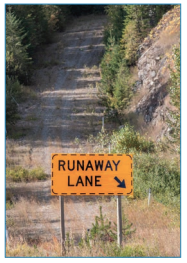
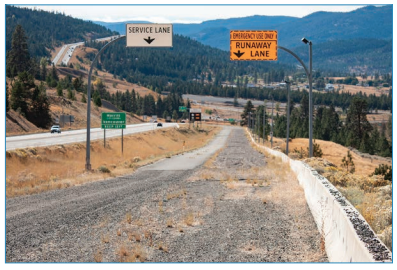
Examples of runaway lanes in B.C.
Runaway lanes come in various lengths and grades, with different materials and features designed to stop out-of-control vehicles. Here are two main types you can expect to see in B.C.
Gravity bed
This is the type of runaway lane that leads a truck up a slope. It uses a combination of gravity and in some cases a bed of gravel to slow the truck down and keep it from sliding backwards. You’ll notice these runaway lanes on various B.C. mountain highways.
Arrester bed
The arrester beds are filled with washed/loose rocks that cause your vehicle to sink slightly into the bed which dissipates the energy and brings you to a stop.
There’s a service lane beside them for a tow truck and other support vehicles to park on while they’re recovering a vehicle out of the arrester bed. When you’re entering the arrester bed, ensure you put your vehicle completely into the bed. If you straddle the service lane with one side of your vehicle, it will create uneven deceleration and likely a jackknife situation.
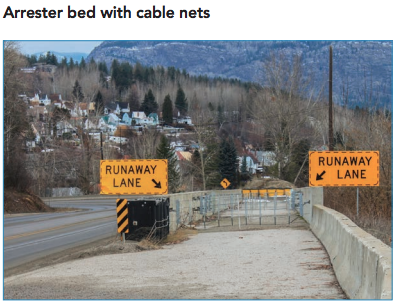
This type of runaway lane relies on a cable netting system and a rock bed to slow down the truck on either a horizontal or descending grade. You’ll need to be accurate with your entry as there are concrete walls on both sides of this runaway lane to support the cables. This again highlights why it’s important to use a runaway lane before you’re going too fast. The cables are spring-loaded and aligned with the height of your front bumper. As you enter the runaway lane, you stretch out the spring-loaded cables which helps to dissipate the energy in your vehicle along with an arrestor bed. Once these devices have been used, special equipment needs to be brought in to re-tension the cables.This type of system is used in locations where there isn’t enough distance to install a regular arrestor bed, such as at the Horseshoe Bay Ferry Terminal.
It’s important for all drivers to watch for runaway lanes. Brake loss is more common in commercial transport trucks, but it can happen to any vehicle. If driving a regular route, remember where the runaway lanes are and never park your vehicle in or in front of a runaway lane.
Loss of visibility
Snow and ice can build up on the windows and mirrors of your vehicle making it difficult to see. Build up can also occur on lights and reflectors. This makes it more difficult for other drivers to see your vehicle. At night, your vision is also affected. It’s necessary to clean the lights and reflectors more frequently, using a quality glass cleaner before your trip and every day if they’re dirty. It’s important to clean the inside of windows weekly as well to eliminate additional glare at night. If your defroster isn’t clearing your windows properly, have your shop check the cabin air filter as it may be plugged. Turn your system to re-circulate to help with air flow in the short term.
Blowing snow can reduce visibility to zero. This makes driving at any speed unsafe. It’s best in these situations to get off the road and wait it out. If the blowing snow is being caused by other vehicles, increase your following distance so the snow being blown by the vehicle ahead of you has time to settle so you can see. If the snow is being blown by vehicles passing in the other direction, reduce your speed when meeting them and direct your vision to the right edge of the road away from the snow cloud to maintain your road position. If you’re not comfortable in these driving situations, then find a safe place to park until conditions improve.
What can you do in each situation?
Your headlights fail:
• Turn on high-beams and/or auxiliary driving lights
• Activate your four-way flashers
• Slow your vehicle quickly but safely. The idea is to reduce your speed before a slight steering error results in a crash
• Pull over as far as practical out of traffic and stop
• Place warning devices on the road as required by law
Mud, slush or snow splash on the windshield suddenly:
• Turn on wipers and washers
• Look outside windows and slow the vehicle down
• If the windshield wipers have failed or you have no washer fluid, activate the right turn signal and pull over as far as practical out of traffic and stop
• Activate four-way flashers. If your vehicle will remain stationary for more than a moment, put out warning devices on the road as required by law. Clear the snow from your lights and flashers
Fire
Commercial vehicle drivers should know how to prevent fires and have a basic knowledge of fire-fighting techniques. It’s also essential to know what types of extinguisher or retardants to use on different types of fires.
Some common causes of truck fires:
• Running with a soft tire
• Overheated brakes, either from misuse or maladjustment. Check hub temperatures every time tires are checked during en route inspections
• Leaking fuel system, pump, filter, tanks or lines
• Unequal distribution of load, causing the trailer to lean and rub on tires
• Careless smoking habits. Lit cigarettes and cigars should always be disposed of in ashtrays, never thrown out windows. Never smoke while loading or unloading
• Carelessly placed flares, lamps or fuses used in an emergency
• Short circuits in the electrical system
• Occasionally, spontaneous combustion may occur in a van or trailer. Drivers must always know the nature of their cargo, so necessary fire-control precautions can be taken
• Stopping on dry grass during a drought. Heat from the truck can ignite the grass
• Failures or overheating of the truck’s aftertreatment system — the device that cleans exhaust gases to meet emission regulations.
When a fire occurs:
1. Stop in a safe position away from buildings and other vehicles.
2. Call 911 and give your location and any critical information about your cargo.
3. Ensure your safety and the safety of others nearby.
4. If it’s a combination unit, uncouple the unit when safely possible.
5. Based on the type of fire, take all possible steps to extinguish it.
6. If the fire might be due to a short-circuit, turn off the battery switch if equipped or remove battery cables, if possible.
7. If the cargo is of an explosive nature, stop traffic and warn people to stay back.
8. Call your supervisor.
Reporting forest fires
Within B.C., report grass, brush and forest fire sightings to:
• 1-800-663-5555
• Cell: *5555
In Canada, when you’ve been involved in a crash, do something that causes a crash or witness a crash, you must stay at the scene and provide assistance and information. If you weren’t involved in the crash, you should still stop and offer to help if the police or other help hasn’t yet arrived. You’d want others to do the same for you.
You’re protected by the Good Samaritan Act from liability for emergency aid provided to an ill, injured or unconscious person at the immediate scene of a crash or emergency, unless you’re grossly negligent. Similar rules apply in most U.S. jurisdictions.
Emergency contact information
If an emergency incident has occurred, you don’t want to be scrambling to look for emergency contact information. Keep a paper file in the truck and a copy on your phone for the following:
• Emergency services: police, fire and ambulance for the areas you travel (Not all areas in North America use 911 for emergencies)
• Forest fire reporting numbers
• Towing/recovery companies
• Your dispatcher
• Insurance companies
Legal reporting requirements
You must exchange the following information with the other driver, anyone who has been injured and anyone whose property has been damaged. You must also provide this information to a witness if requested.
• Your name and address
• The name and address of the registered owner of the vehicle
• The licence plate number
• Insurance information
You can report a claim to ICBC online or by phone, 24 hours a day, seven days a week.
Please provide the following when reporting a claim:
• The licence plate number of each vehicle involved
• Driver’s licence number of each driver
• Insurance information for vehicles not insured by ICBC
• Police file number (if applicable and available)
Crash/incident and near miss reports
Follow your company’s procedures when reporting any incidents or crashes. It’s also important to report “near misses” — an event that didn’t result in injury, illness or damage, but had the potential to do so. Only a fortunate break in the chain of events prevented an incident. Other terms for these events are “close call,” “narrow escape,” or “near hit.”
History has shown repeatedly that most serious and catastrophic events were preceded by warnings or near miss incidents. Recognizing and reporting these can significantly improve worker safety and enhance an organization’s safety culture.
A near miss could occur when driving or at other times such as loading/ unloading, doing vehicle inspections or other workplace activities.
According to the National Safety Council, best practices in establishing a near miss reporting system include:
• A reporting culture that reinforces that every opportunity to identify and control hazards, reduce risk and prevent harmful incidents must be acted on.
• A reporting system that is non-punitive and, if desired by the person reporting, anonymous.
• Investigating near miss incidents to identify the root cause and the weaknesses in the system that resulted in the circumstances that led to the near miss.
• Using investigation results to improve safety systems, hazard control, risk reduction and lessons learned. All of these represent opportunity for training, feedback on performance and a commitment to continuous improvement.
• Near miss reporting is vitally important to help prevent serious, fatal and catastrophic incidents that are less frequent but far more harmful than other incidents.
Help from bystanders
A crash scene can be chaotic. In addition to those who are actually involved, there will likely also be bystanders curious to see what’s happening. It’s a hard situation to be in and remain cool and calm, however that’s what’s required.
Most people at the scene of a crash would like to help, but often don’t know what to do. If you take charge in a calm and assertive manner, they can help you bring the crash scene under control by performing the following tasks:
• Providing first aid to the limit of their ability
• Finding witnesses
• Directing and diverting traffic, if able to do so competently
• Helping to set out emergency warning devices to protect the scene
• Obtaining blankets, bandages, first aid kit, fire extinguisher and so on
• Contacting medical, police and fire department
• Comforting victims
To maximize your chances of gaining assistance, the following points are suggested for organizing others to help you:
• Remain calm. This will instill confidence and increase the chances people follow your instructions.
• Assign responsible individuals to help. Ask for their help to carry out specific tasks.
• Give clear and brief directions.
• Ask them to repeat the directions back to you to ensure they clearly understand what’s required.
• When the task is complete, have them report back to you.
Minor crashes
In the event of a minor crash:
• Stop the vehicle and put on your safety vest before exiting the cab.
• Hit the accident button on your ELD.
• Under most conditions, don’t move the vehicle until directed by a police officer. However, if there’s a danger to other motorists, move the vehicle off the roadway, where possible. For example, don’t leave the truck across both lanes of traffic on a blind curve.
• Warn other commercial drivers on the radio to prevent a chain reaction.
• Assess the scene. Check on the condition of everyone involved and check the vehicles to ensure that there’s no danger of fire. Fire can occur when there’s a fuel leak, if you see smoke emitting from vehicles involved or if the crash occurred near flammable material.
• Set out approved warning devices, if required.
• Summon assistance, as needed.
• Exchange information with others, as required by law.
• Avoid discussing who’s at fault.
• Take photos of the scene from a distance and close up and/or make a diagram.
• Note the time and place of the crash, vehicle positions and any marks on the pavement.
• Report the particulars in accordance with the law and workplace policy and procedures.
Major crashes
In the event of a major collision, the severity of the crash will determine the order of the steps below:
• Call 911 for assistance (police, ambulance, fire department).
• Quickly assess the situation and evacuate, if necessary.
• Assign someone to protect the scene in order to prevent other motorists from becoming involved.
• Set out approved warning devices, if required.
• Treat the injured beginning with the most seriously injured first.
• Note the time and place of the crash, vehicle positions and any marks on the
pavement.
• Take photos of the scene from a distance and close up. Focus on the vehicles, skid marks, damage to the vehicles and position of the vehicles.
Don’t take pictures of crash victims.
• Report the particulars in accordance with local policy and procedures.
Loss of load and spills
Any spill that threatens the environmental quality of water, land or air must be reported. Possible threats include gas leaks, oil, diesel or chemical spills and any other release of hazardous material to the environment. Call 911 for assistance in controlling the spill — a fire department has access to many resources very quickly.
When a spill occurs or there’s the risk of one occurring, it must be reported immediately by calling 1-800-663-3456. This is known as the initial report or Dangerous Goods Incident Report (DGIR).
The initial report must be completed by the responsible person (spiller) if the quantity for the substance of the spill is equal to or greater than the quantity outlined in the schedule of the Spill Reporting Regulation in the Environmental Management Act available at www.bclaws.gov.bc.ca; or if the spill has, or might, impact a body of water.
For more information, search “Report a spill” at www2.gov.bc.ca.
For small spills, drivers should carry a spill kit. These are available in a variety of sizes and types.