[ultimatemember form_id=3702]
1 Overview of the trucking industry
This unit will introduce you to the trucking industry, what it’s like to be a professional truck driver and issues in trucking safety. You’ll learn about Class 1 licensing requirements, different types of trucking jobs, and be able to think about what type of driving you might be most suitable for.
This unit will help you learn to:
- Explain why truck drivers have a significant impact on the Canadian economy.
- Identify types of commercial vehicles that require a Class 1 driver’s licence to operate.
- Understand the roles and responsibilities of professional drivers.
- Understand the requirements and steps needed to obtain and maintain a Class 1 driver’s licence.
- Determine what type of commercial driving job you may be most suited for.
- Describe how to recognize when human trafficking may be occurring and how to report it.
- Identify employment requirements.
The trucking industry in Canada involves hauling goods locally, regionally and internationally. Approximately 90 percent of all consumer products and foodstuff movement between Canada and the United States are shipped by trucks (Canadian Trucking Alliance, 2017). There are approximately 300,000 professional truck drivers in Canada. Professional truck drivers are nearly one percent of the national population and more than 1.5 percent of the nation’s labour force. By keeping the national economy moving, trucking helps to keep millions of people working and is considered an essential service. https://www.statista.com/statistics/449859/trucking-industry-revenue-canada/ Canadian Industry Statistics (2016)
Truck driving is a big responsibility
Driving a commercial motor vehicle is a big responsibility requiring special skills and knowledge. British Columbia roads present unique challenges for drivers, such as mountain passes and unpredictable weather. Heavy commercial vehicles, such as dump trucks and tractor-trailer units, represent only three percent of vehicles on B.C. roads, but they’re involved in 19 percent of fatal crashes, according to B.C.’s Auditor General. A comprehensive training program and on-the-job training will give you the skills and knowledge you need to do the job safely. https://www.bcauditor.com/sites/default/files/publications/reports/OAGBC_ CVS_Report.pdf
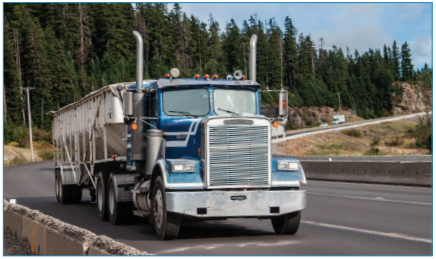
It’s important to understand the benefits of becoming a safe driver to avoid crashes and reduce their severity. There are numerous contributing factors in truck crashes. Vehicle defects, such as faulty brakes, overloads, improperly secured loads, driving too fast for conditions, and driver fatigue are some key factors in truck-related crashes. Understanding vehicle weight and stopping distance for big trucks is important to reduce crashes. A fully loaded transport truck travelling at 65 km/h (40 mph) takes 36 percent longer to brake and stop than a passenger car travelling at the same speed. The biggest contributing factor to crashes by far is driver error — sometimes the trucker — but often other drivers. For this reason, truck drivers must drive in a way that accommodates for the mistakes of others by being one step ahead of everyone else on the road.
What important information do the following government statistics reveal?
• Nearly 2,000 Canadians are killed each year and another 10,000 seriously injured in crashes involving a heavy truck. Even on a per-distance-travelled basis, large trucks have a fatality rate double the rate for all other vehicles.
• Between 2015 and 2019, there were on average 15000 crashes involving a heavy vehicle that resulted in 3400 injured victims and 57 fatalities, annually.
• In an average year in B.C., large trucks are involved in less than one percent of all crashes, but they’re involved in nearly 20 percent of fatal crashes.
• Studies across North America show that in crashes between cars and large trucks, the occupants of the passenger vehicle are at least four times more likely to be killed than the driver of the truck.
• Studies show that in fatal car-truck crashes, 2/3 or more of the incidents are found to be the fault of the passenger vehicle.
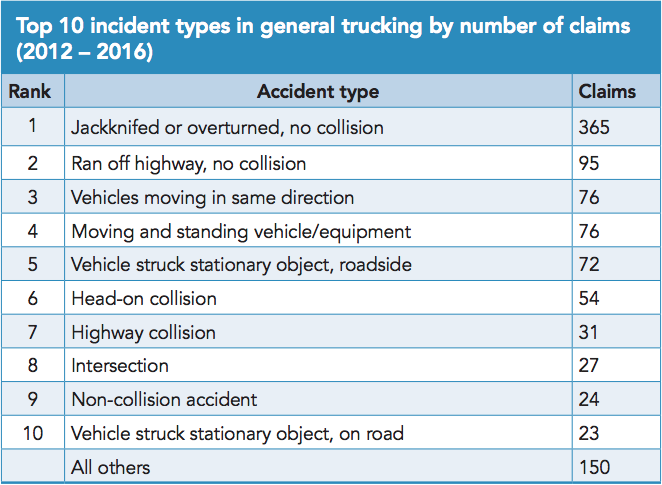
• Crashes are more likely to be caused by the actions or inactions of the drivers involved (both truck and passenger vehicle drivers), as opposed to other factors, such as weather, road conditions, and vehicle performance. The table below shows WorkSafeBC’s data from 2012 to 2016 listing the top 10 motor vehicle incident types for drivers employed in general trucking. The incident type with the highest number of WorkSafeBC claims during this period was “jackknifed or overturned” without involving a collision with another vehicle. What do you think the key contributing factors to the number one-ranked crash might have been?
Costs of crashes and incidents
There are many visible and hidden costs associated with a commercial truck crash or incident. These costs can take a tremendous toll on drivers, companies and, sometimes, the environment.
Some of the costs could include:
• Cargo damage
• Vehicle damage
• Injury costs
• Medical costs
• Loss of revenue
• Administrative costs
• Recovery, towing and storage costs
• Loss of customers
• Lost sales
• Meetings missed
• Lost wages
• Cost to hire or train replacement
workers
• Time
• Loss of personal property
• Vehicle replacement
• Equipment downtime
• Accelerated depreciation of equipment
• Collision/incident reporting
• Fines and punitive damages
• Collision/incident investigation and legal proceedings
• Insurance premium costs
• Poor public relations and publicity
• Increased public relations costs
• Government agency costs — police, fire, ambulance
Canada’s deadliest crashes involving a commercial vehicle
• Aug. 4, 1978 — Eastman, Que. — 41 dead
People from Quebec’s Asbestos region were travelling in a bus when, according to one passenger, the brakes failed and the driver was unable to make a turn. It went into Lac d’Argent, floating for as long as five minutes before it sank, according to United Press International (UPI).
• May 28, 1980 — Webb, Sask. — 22 dead
A car crashed into a bus carrying Canadian Pacific Railway workers, putting it on its side before a tanker truck hit it, the Regina Leader Post reported.
• Dec. 30, 1986 — Swift Current Broncos — four dead Four members of the Swift Current Broncos died after their team bus slid off the highway as they began a road trip.
• Mar. 9, 1988 — north of Prince George, B.C. — six dead Six members of the Bethel Christian School basketball team in Dawson Creek were killed as the van they were travelling in crashed into a truck en route to a tournament in Lillooet.
• Oct. 8, 1989 — Cormier Village, N.B. — 12 dead Members of a family had reunited for a Thanksgiving hay ride in New Brunswick’s Cormier Village. A logging truck hit their wagon killing 12 people, including five children and injuring 45 others, United Press International (UPI) reported.
• Oct. 27, 1989 — Kamloops, B.C. — five dead and 14 injured. At noon, a 38,100 kg (84,000 lb) truck pulling a load of steel beams crashed into a line of cars stopped at a red light.
• July 9, 1990 — Horseshoe Bay, B.C. — two dead and four injured A runaway dump truck carrying hot asphalt slammed into a passenger
van waiting for the ferry. The truck did stop at the brake check before the terminal, but the driver proceeded down the hill with his brakes not functioning correctly, reported the Prince George Citizen.
• Oct. 13, 1997 — Les Eboulements, Que. — 44 dead
To this day, it’s Canada’s deadliest crash. A bus was carrying 47 elderly people when it went down a hill, the brakes failed and it went into a ravine, killing 44 passengers, La Presse reported.
• Nov. 11, 2004 — West Vancouver, B.C. — two dead and four injured. A logging truck rounded a curve in the road and lost its load, with the logs landing on five cars that were travelling in the opposite direction.
• Jan. 12, 2008 — Bathurst, N.B. — eight dead
A van that carried members of the Bathurst High School basketball team collided with a semi-truck, killing seven teens and their coach’s wife.
• Feb. 5, 2012 — Hampstead, Ont. — 11 dead
This incident saw a flatbed truck hit a passenger van that was carrying migrant workers, The National Post reported. The crash pushed the van 75 metres and 11 were killed in the crash.
• April 16, 2018 — Near Armley, Sask. — 16 dead
Sixteen people were killed and 13 injured in the Humboldt Broncos bus crash. A northbound coach bus carrying high school kids was struck by a westbound semi-trailer truck that had run a stop sign.
Drivers must obtain a Class 1 learner’s licence before beginning the Class 1 Mandatory Entry-Level Training (MELT) course. For information on obtaining your learner’s licence, see the ICBC Driving Commercial Vehicles guide or visit ICBC.com.
Training requirements
The B.C. Class 1 MELT course is only available from ICBC-approved driver training schools, authorized to deliver the training. Class 1 driver’s licence applicants must successfully complete all course hours and assessments to be issued a Class 1 MELT Declaration of Completion before they are eligible to attempt a Class 1 road test.
Medical requirements
Commercial drivers need to be in good physical condition. A medical report is required to upgrade a driver’s licence to Class 1, 2, 3 or 4. All drivers are screened for vision, hearing, physical and medical conditions.
You’ll be given a Driver’s Medical Examination Report (DMER) form to be completed by your doctor or a nurse practitioner. Both of these medical professionals can complete a DMER and send the report to RoadSafetyBC, which will determine if you’re medically fit to hold a commercial driver’s licence. If you meet the driver medical fitness requirements to hold a B.C. Class 1 driver’s licence, issuance of your driver’s licence will be accepted as proof of your fitness to drive.
Licensed commercial drivers must also complete the examination report:
• every five years for Drivers 18–45 years of age, to be completed at ages 25, 30, 35, 40, and 45;
• every three years for Drivers 46–65 years of age, to be completed at ages 48, 51, 54, 57, 60, and 63; and
• every year for Drivers 66 years of age or older.
There are some medical conditions that can result in someone being deemed medically unfit to drive. These may include: heart disease, brain tumours,
hearing or vision problems, certain musculoskeletal conditions, sleep disorders and kidney disease.
If you have questions regarding your medical fitness, contact RoadSafetyBC.
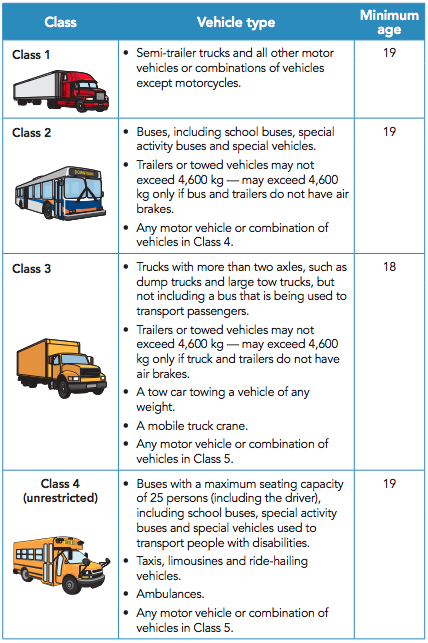
Those with a Class 1 driver’s licence are permitted to operate other vehicle types for which a Class 2, 3, 4 or 5 driver’s licence is normally required. The following chart provides more information:
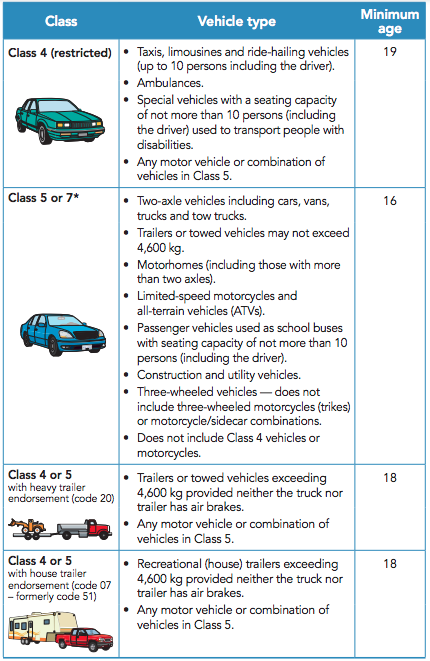
Truck drivers generally work very long hours, typically from 60 to 70 hours per week, and have to keep track of their time. They must get the cargo to its final destination on time, check the manifest sheet, make sure the load matches and often either load or unload the truck. Some truck drivers make deliveries on local routes, while others drive long distances all across North America. Driving a tractor-trailer is different from driving a smaller vehicle. You have to know what to do when going up or down a steep grade, so the brakes won’t overheat and know how to keep a load from shifting on a curve. The truck weighs 20 to 30 times more than a car and is typically 21 to 25 metres (70 to 85 feet) long.
Equipment options
As a professional driver, you may be called upon to drive a variety of vehicles:
• Tractors — used to pull trailers. Today’s tractors have computerized engines for increasingly cleaner emissions. Cabs for long-haul drivers have many of
the amenities of home.
• Trailers — the kind of trailer and the number of axles used on a particular trip usually depend upon the cargo being hauled. Semi-trailers with axles only at the rear of the trailer are the most common. Some of the semis you might drive include box vans, tankers, flatbeds, logging trucks, car carriers and refrigerated units.
• Straight trucks — a straight truck has a front steering axle and one or more rear driving axles and may have specialized equipment to handle cargo (power tailgate or Hiab).
• Truck/tractor — is a straight truck that can carry a load, as well as pull a trailer, such as dump or fuel trucks.
Career options
As a trained professional driver, you can seek work with a trucking company, invest in your own vehicle and become an owner-operator, or work through an agency as a leased driver. Within these categories, there are still more options to consider as you plan your new career.
Drivers can be classified into several subgroups:
1. Short-haul/regional drivers — These drivers typically leave their home terminal and either deliver goods to a distance within a half-day’s drive or may be gone overnight. The routes may be set and fairly routine. About 75 percent of today’s drivers fall into this category.
2. Long-haul drivers — These drivers are typically dispatched to destinations hundreds or thousands of kilometres away from home. They may travel on international routes across North America. Much of the trade between Canada and the United States is carried out by moving goods in trucks.
Drivers must be familiar with the procedures required for border crossing, and since they are on their own much of the time, they must be good at organizing themselves and planning their routes. These drivers spend a considerable amount of time away from home.
3. Local pick-up and delivery drivers — These drivers generally work in a localized area picking up and delivering numerous small shipments, combining them into one truck or trailer. They must be strategic in planning the loading and delivery of these items to ensure that they work efficiently. This type of work will typically involve more backing, interacting with customers and time in traffic.
4. Owner-operators — These drivers are small business owners who either find their own loads or contract their trucks and their driving services to trucking companies or distributors. They may do short or long hauls or local pick-ups and deliveries. They must have sound business skills, as well as driving skills.
5. Team driving — As a team driver, you’ll take turns driving with someone else. You’ll take time off resting in the sleeper when you’re not driving. The purpose of the team driver arrangement is to keep the truck and its cargo moving to its destination for as many hours in a day as possible. Team drivers normally run long-haul routes.
Myths and misconceptions about trucking
Many people have negative, preconceived notions of truck drivers and/or truck driving jobs as a profession. Here is a list of some of myths and their myth busters:
1. Myth: The trucking industry isn’t that important to the Canadian economy.
Myth buster: Approximately 90 percent of all consumer products and foodstuff movement between Canada and the United States are shipped by trucks (Canadian Trucking). There are more than 300,000 professional truck drivers in Canada. The trucking industry is the number one transporter of goods in the world and has significant importance to the national economy.
2. Myth: Drivers have to work day and night to earn a decent income.
Myth buster: Canadian drivers earn good wages, often significantly more than the national average. Driving long-haul trips and being away from home all the time is not the norm. Fewer than five percent of Canadian truck drivers have to be away from home for more than two days at a time.
3. Myth: Trucking is low tech.
Myth buster: The trucking industry is constantly applying new technology to improve its competitive edge. Laptop computers and onboard satellite systems are now common in cabs and drivers are skilled users of this advanced equipment.
4. Myth: The trucking industry is a man’s world.
Myth buster: In the Canadian trucking industry, a rapidly growing proportion of women and gender-diverse people work as transport drivers, dispatchers, sales representatives and managers of trucking companies.
There are more than 9,000 women in the trucking industry in Canada today and that number is growing. Operating as a professional truck driver requires managing deadlines, upkeep of detailed daily logs, and knowledge of safe cargo transport, depending on the load type.
5. Myth: All truck drivers do is sit.
Myth buster: Truck driving is actually a very demanding job. Besides having to stay focused for long periods of time, plus managing to drive huge semi-trucks, truckers also do a variety of tasks when they aren’t driving. They may also be responsible for loading and unloading their cargo.
6. Myth: Truck driving offers very little job security.
Myth buster: Not true, there’s a huge demand for drivers. As the North American population expands, the need for the movement of goods to supply the growing population is expanding with it. The trucking industry is one of the critical sectors within the Canadian economy that does offer career-long job security.
7. Myth: Truck drivers are lonely.
Myth buster: Just because truck drivers spend the majority of their time in the truck, doesn’t mean they’re lonely. In fact, many truck drivers are very sociable. They know the truck stop employees, the employees of the restaurants they frequent, the dispatchers, other truckers and so on. They’re constantly meeting new people and working with others.
8. Myth: Trucking is unsafe.
Myth buster: The transportation industry is highly regulated for safety and prepares truck drivers for the road. Canadian standards for equipment safety and driver skill are among the highest in the world.
9. Myth: Truck driving is easy work.
Myth buster: Truck drivers spend many hours on the road maneuvering through bad weather, perilous road conditions and traffic congestion. Driving a truck requires a huge amount of training and education, plus focus, motivation, concentration, patience and discipline. Operating as a professional truck driver requires managing deadlines, upkeep of detailed daily logs, and knowledge of safe cargo transport, depending on the load type.
10. Myth: Trucks emitting diesel smoke are major contributors to the degradation of our environment.
Myth buster: Trucking continues to impact the environment, but improvements made possible by new technologies have dramatically reduced the size and scope of that impact over the last two decades, even as consumer demand has dramatically driven up the tonnage of shipped goods. The North American Council for Freight Efficiency recently calculated that it takes 70 big trucks fresh off the showroom floor to emit as many pollutants in one year as just one truck did in 2002.
The transport industry is made up of numerous occupations, each with its own unique set of experience and training requirements. Occupations in greatest demand in the B.C. transport sector are Class 1 drivers and truck/trailer mechanics. Most jobs (60 percent) are with firms that conduct short-haul trips.
In a 2019 report, Trucking HR Canada* reported that:
• Employment of truck drivers has increased from 237,000 to 318,000 since 1998, and over the past decade the industry has added more than 26,000 jobs.
• The truck transportation industry has the highest job vacancy rate among all Canadian industries, averaging 6.6 percent in 2018, or more than double the Canadian average of 3.2 percent.
• Vacancies for truck drivers have more than doubled since 2016 with some 22,000 vacant positions in 2018.
• Unemployment among truck drivers has fallen from 6.6 percent to 3.8 percent between 2016 and 2018.
• There has been steady upward pressure on wages and other compensation for drivers over the past few years.
Truck driver salary
Class 1 truck driver salaries in Canada range from about $55,000 to $95,000.
Pay is higher in certain areas and for certain types of jobs. Do your research and remember, you’ll likely be working as many as 60 or up to 70 hours per week (Neuvoo, 2020).
The face of the Canadian truck driver
• 97 percent of transport truck drivers are male.
• Only 9.5 percent of truck drivers in Canada are younger than 30 years old, compared to 23.8 percent of the entire Canadian labour force.
• Only 27.8 percent of truck drivers are younger than 40, compared to 45.1 percent of the entire Canadian labour force.
• 32 percent of truck drivers are 55 years or older. Only 21 percent of the entire Canadian labour force is that age.
• 6.6 percent of truck drivers are already 65 years or older. Only 4.4 percent of all Canadians of that age are still working.
Finding employment in the industry
The high vacancy rate, combined with employment growth, low unemployment and an upward surge in wages provides greater demand for professionally trained truckers than the supply available.
Approximately 7 percent of transport truck drivers are 65 or older, which means they could retire and leave the industry soon, creating additional industry employment opportunities for well-trained drivers.
*Trucking HR Canada. (2019). LMI Interim Report. Ottawa: Trucking HR Canada
Prevention of human trafficking
Every year, trucks and the transportation system are used for illegal activities, including human trafficking. Worldwide, there are around 40 million victims of human trafficking, according to the International Labor Organization. Human trafficking is a $150 billion illegal enterprise, second only to drug smuggling. Traffickers prey upon their victims’ vulnerabilities, such as their youth, condition of poverty, migration status or dreams of love and opportunity, while profiting off their exploitation. The victims, who are mostly women and children, are deprived of their normal lives and coerced to provide their labour or sexual services. Exploitation often involves intimidation, force, sexual assault and threats of further physical violence to themselves and their families.
According to Truckers against Trafficking — an organization dedicated to reducing human trafficking — there are six red flags to look for:
• Anyone who has a lack of knowledge of their whereabouts and isn’t in control of ID/passport.
• Anyone who has restricted or controlled communication (not allowed to speak for themself or unable to come and go unrestricted and so on).
• Anyone mentioning a quota or having a pimp/daddy.
• Anyone with signs of branding or tattooing of a trafficker’s name (often on the neck).
• A van, RV or vehicle with multiple women in an area mostly frequented by men and/or dropping women off and picking them up 15-20 minutes later.
• Signs of bruising or other physical trauma.
Be vigilant and be aware of the signs of robbery and trafficking, particularly at truck stops, motels, rest areas and city streets where this type of activity generally occurs. If you believe there’s an illegal act in progress, call 911.
For questions about what you may or may not be witnessing, you can anonymously call the human trafficking hotline:
• Canada – 1-833-900-1010
• USA – 1-888-373-7888
For more information visit the Truckers Against Trafficking website at
https://truckersagainsttrafficking.org/
Drivers are a carrier’s most important asset. A good driver enriches the company’s value whereas a poor driver can become a serious liability. All carriers want to employ drivers who will drive safely and add value and esteem to the company’s operation. Regardless of a driver’s level of training and work experience as a tractor-trailer driver, a driver with a clean driving record is far more likely to find (and keep) employment than a truck driver with a record of traffic and criminal violations.
Prospective employers are looking for more than the licence classes and endorsements a driver has. They might also ask you to provide:
• A completed employment application form
• Your driver’s abstract — a public (P) record of your basic driving history in the last five years (dated within 30 days)
• Your National Safety Code (NSC) abstract — a record of your basic driving history and any commercial vehicle-related convictions in the last five years (dated within 30 days)
• Medical information
• A criminal record check (dated within a specified period of time)
• Records of your previous work experience and training that are relevant to your job
• Consent to participate in periodic drug screening
Some of these requirements may be required on a periodic basis and failure to provide any of these may affect the status of your job. Your ongoing driving history and medical condition can affect your ability to maintain your commercial driver’s licence.
Once you’re hired, you’ll be required to participate in the employer’s own training programs as employers are required to provide additional training to their drivers. Training may be specific to the operation of specialized equipment/features on a vehicle or within the workplace, transportation of specific cargo (for example, dangerous goods), occupation health and safety rules, company policies (such as dress codes, code of conduct and ethics, disciplinary policies, substance abuse policies and so on), duties and scope of your position, condition of employment and so on. Your success as a professional truck driver goes far beyond just your driving skills — your interpersonal skills are also important.
Employers also expect that you, as a professional driver, have basic knowledge and understanding of the laws and other compliance requirements that govern the operation of commercial vehicles. You’ll often have to rely on your knowledge of these requirements. These laws and regulations will be discussed in detail during this course.
What are employers looking for in a new driver?
Today’s employers are looking for drivers who can demonstrate safe driving skills, a good attitude and the ability to communicate effectively with customers, dispatchers and supervisors. Employers will assess your commitment to working safely and look for the ability to make sound decisions about how to handle your paperwork, equipment and cargo.
Professional behaviour is most often characterized by the following attributes:
• Responsibility and accountability
• Communication skills
• Integrity and honesty
• Commitment to learning
• Competence in performing work
• Loyalty to the company/employer
• A commitment to maintaining confidentiality
• Good work habits — punctuality, meeting obligations
• Respectfulness and courtesy to fellow employees and customers
• A commitment to follow rules and policies
The National Occupational Standard for Professional Drivers (NOS) identifies some specific attributes expected in the trucking industry — promoting a positive image of the driving profession, pursuing learning activities, demonstrating integrity, being dedicated and committed, managing money, coping with change, maintaining a good sense of humour, being empathetic, dealing effectively with different people and taking initiative.
In practice, what does professionalism look like in the workplace?
1. Driving skills. Understanding vehicle operation allows drivers to operate the unit smoothly and efficiently. A professional driver is competent behind the wheel and can adapt his or her driving skills to a variety of road conditions and driving situations to avoid incidents and crashes.
2. Adherence to laws and regulations. A professional driver keeps current with changes to rules and regulations, such as those governing hours of service and follows them in day-to-day work.
3. Preparedness. A professional driver is ready to handle the unexpected — modify a trip plan due to a road closure or respond to a request from the dispatcher. Professional drivers carry the necessary paperwork, tools and personal hygiene items that will help them through unforeseen situations.
4. Productivity. Finding ways to meet both company and personal goals for productivity and profit demonstrates a professional’s abilities. This means being organized, planning routes effectively and using safe and legal ways to make up for lost time.
5. Truck maintenance. A clean vehicle, like clean and appropriate clothing, conveys a professional image. A professional driver washes the outside of the truck on a regular basis and carries the cleaning supplies required to keep the cab clean and tidy. Papers are neatly organized in a file holder or clipboard. Routine maintenance helps to prevent costly breakdowns and delays due to mechanical issues.
6. Relationships. In dealings with employers, dispatchers, supervisors and customers, professional drivers maintain good relationships by having a sense of humour and listening carefully. A professional deals with everyone in a fair and ethical way, avoiding favouritism, sexism and racism.
7. Voice. People don’t respond just to what you say but also to how you say it. Professional drivers maintain good relationships with co-workers and customers by speaking calmly and pleasantly, even when in a stressful or difficult situation.
8. Dress. In social situations, you can dress to reflect your personality. While working, professional drivers should dress in clothes that create a good impression of themselves and their company. Always having the correct safety gear available to meet industry and customer requirements.
9. Actions. Actions speak louder than words — so make sure your actions say the right thing. For example, professional drivers follow the procedures demanded by the shipper/receiver even if they seem overly bureaucratic. They know company policies and if they wish to make changes to them, do so through appropriate channels.
10. Helping others. Professional drivers demonstrate empathy (the ability to understand what someone else is feeling) by providing roadside assistance, helping out fellow drivers and being patient with co-workers and customers who have their own workplace stresses to deal with.
11. Taking the initiative. Every company, large or small, benefits from employees who take initiative — that is, individuals who take the lead in finding or implementing new ideas and opportunities. Professional drivers take initiative when they find more efficient ways to do things, draw attention to new opportunities for the company to make money, suggest ways to save money, or propose ways to make improvements to safety.
As a new professional driver, if you demonstrate these traits in your day-to-day work, you’ll join the ranks of drivers who are making the public aware of the professionalism required for success in this business.
To apply for a job in the trucking industry, you must provide a copy of your NSC commercial driver’s abstract and a resume and be prepared to participate in an interview and on road driving evaluation.
Driver’s abstract
Driver’s abstracts are provided free of charge from ICBC. There are a few ways to obtain it.
• By phone: Call 1-888-715-7775 or 1-800-663-3051 and be sure to have your driver’s licence ready when you call.
• Online: Go to icbc.com and find “get your records online”. You can request a regular driver’s abstract or NSC (commercial) driver’s abstract to be emailed to you or your employer.
• By mail: Send a letter with your full name, date of birth and signature to: ICBC Licensing Support Services, Box 3750, 910 Government Street, Victoria, B.C., V8W 3Y5.
How to write a resume
A sample resume has been provided on the next page. For more information on writing resumes, visit the Skilled Immigrant InfoCentre (SIIC) at https://www.vpl.ca/
Provincial government WorkBC offices can help you prepare a resume and provide job search techniques. Go to WorkBC.ca for information.
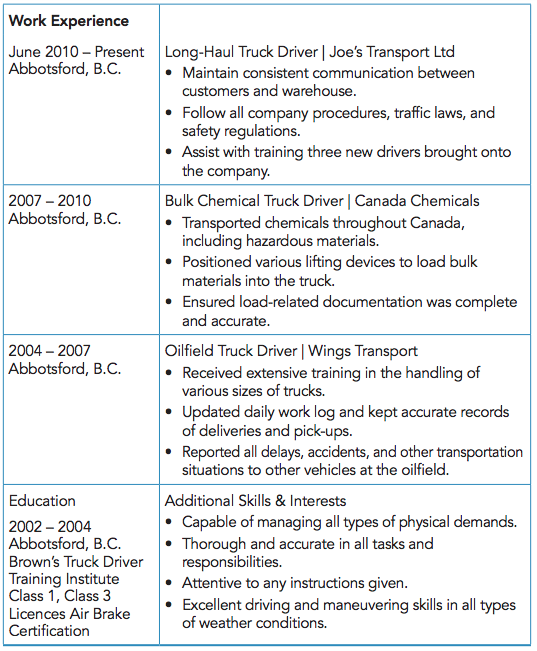
Sample resume
Name
123 Street
City, B.C.
123-456-7890 | name@mail.com
Summary
Truck driver adept at navigation and efficient, on-time deliveries. Personable and energetic. Dependable and committed to getting each job done quickly, efficiently and safely.