[ultimatemember form_id=3702]
7. Signs-Signals-and-road-markings
This unit is a handy reference that gives examples of the most common signs, signals and road markings that keep traffic organized and flowing smoothly.
Included are signs of particular interest to commercial vehicles.
This unit will help you learn to:
• Explain the meaning of the most common road signs and markings.
• Explain the associated traffic regulations that apply to commercial vehicles.
• Read road signs with particular messages that apply to commercial vehicles.
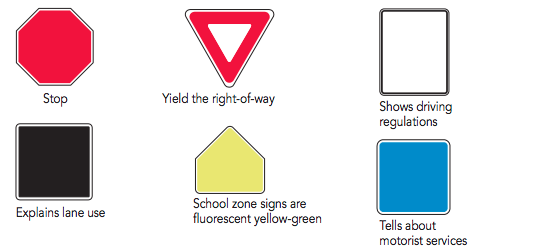
There are three ways to read signs: by their shape, colour and the messages printed on them. Understanding these three ways of classifying signs will help you figure out the meaning of other signs that are new to you.
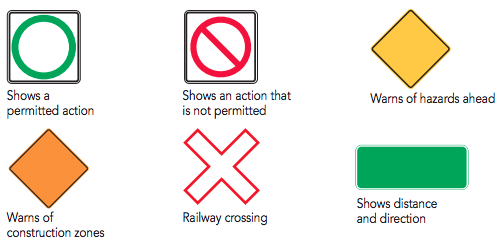
Regulatory signs
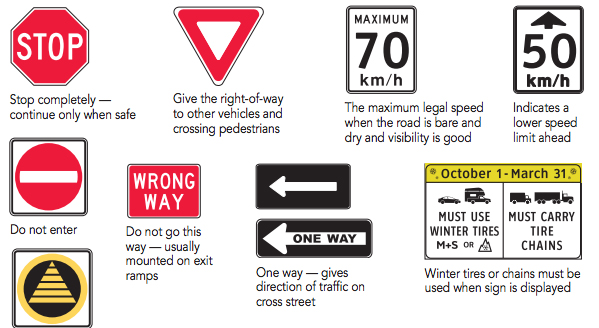
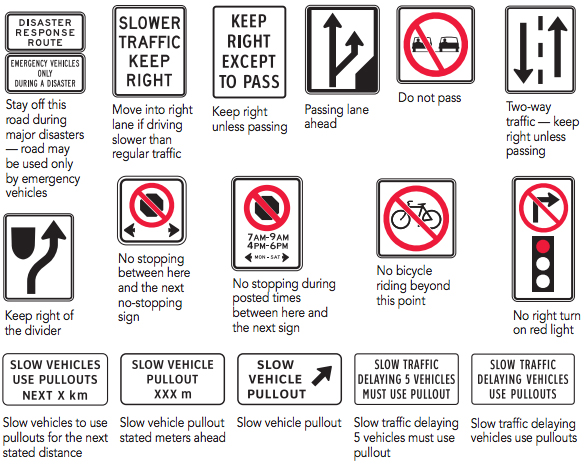
The following signs communicate driving laws and regulations and it’s an offence under B.C. law to disobey them. Drivers who don’t follow the instructions on these signs may receive penalties.
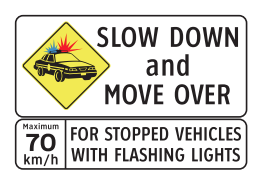
Slow down and move over when passing stopped vehicles with flashing lights.
Travel no faster than 70 km/h in zones with posted speed limits of 80 km/h or more and no faster than 40 km/h if the speed limit is less than 80 km/h.
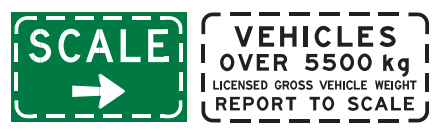
These highway signs direct you to pull into a weigh scale.
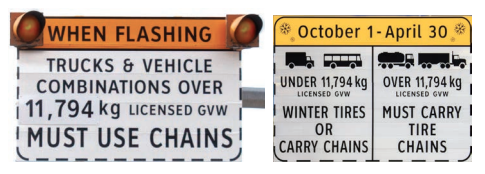
The sign on the left will flash when chains are mandatory.
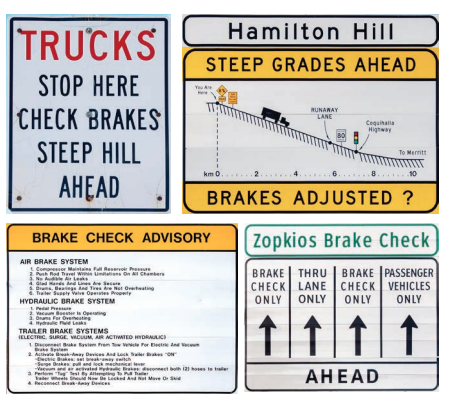
These signs will be in advance of hills or grades.
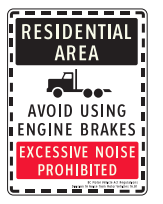
Many municipalities post signs restricting drivers from using engine retarders/engine brakes. Obey these signs.
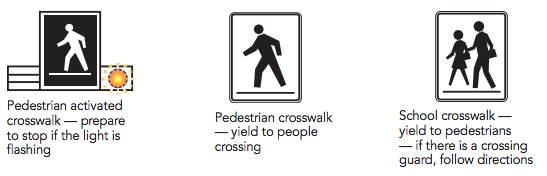
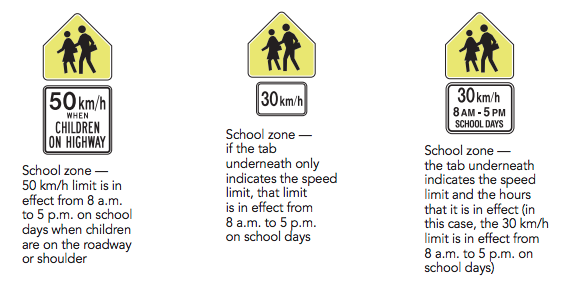
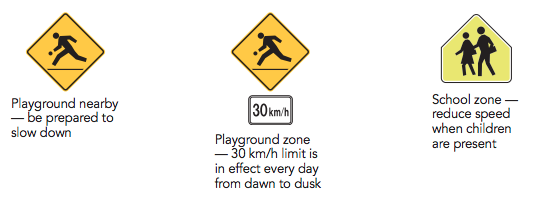
These signs illustrate the rules to follow in areas where you need to be extra cautious to ensure pedestrian safety
Designated road signs
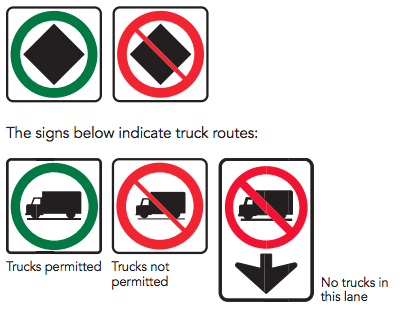
The sign on the left designates roads where vehicles transporting dangerous goods may travel. The one on the right designates roads where these vehicles are not allowed.
Lane use signs
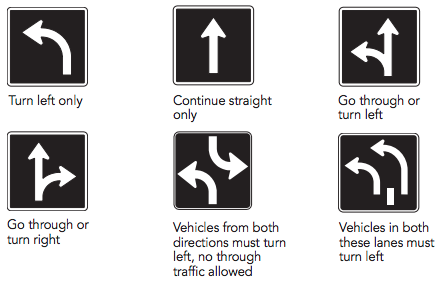
Signs showing which lanes may be used to turn or go straight are mounted above the lane or at the side of the lane before the intersection. If you’re in a designated lane, you must follow the direction indicated by the arrows. You may not move into or out of a designated lane while you’re in an intersection.
Turn control signs
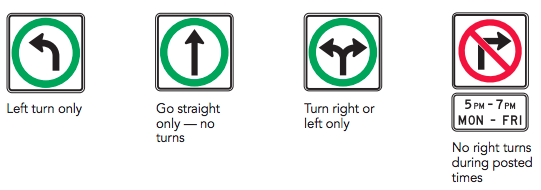
Turn control signs are mounted directly above the intersection. Always follow the direction of the arrow.
Parking signs
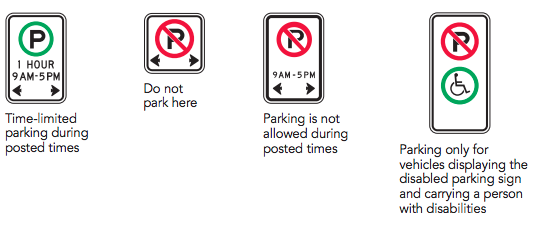
Parking signs let you know where and when you’re allowed to park. You may receive fines or have your vehicle towed (or both) if you park illegally.
Reserved lane signs
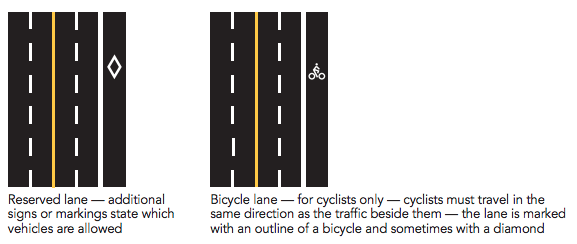
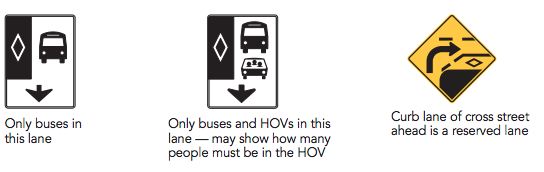
A white diamond painted on the road surface marks reserved lanes. Reserved lane signs are also placed over or beside lanes that are reserved for certain vehicles, such as buses or high-occupancy vehicles (HOVs). Other HOV signs may give additional information on who may use the HOV lane.
Warning signs
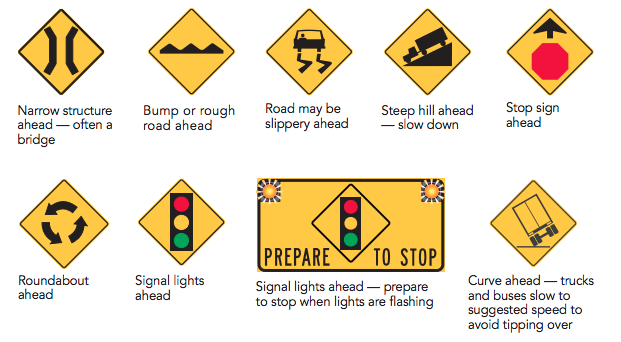
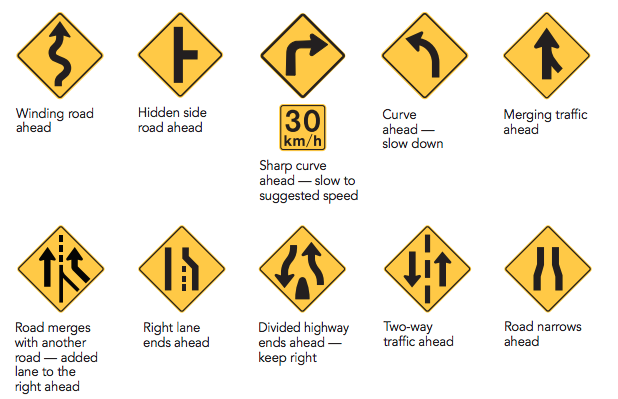
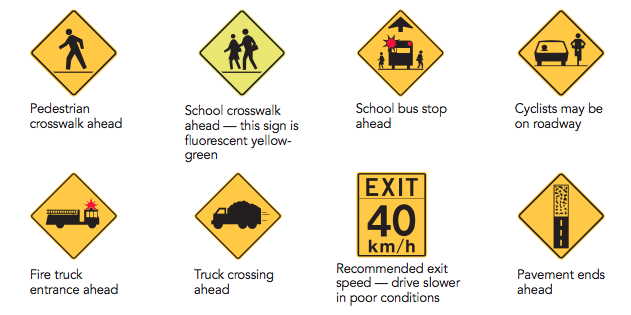
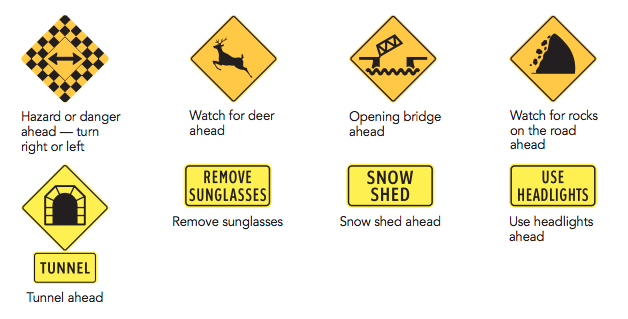
Most warning signs are yellow and either diamond-shaped, square or rectangle. They warn of possible hazards ahead.
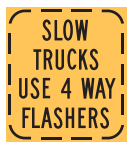
Use your 4-way flashers to warn other drivers if you can’t keep up with traffic.
In some areas, these road signs are posted as a reminder.
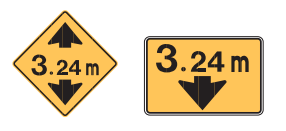
These signs indicate the height of an overhead structure, such as a bridge or overpass. The diamond-shaped sign warns of low clearance ahead and the rectangle sign may be mounted on the structure. Make sure your commercial vehicle has clearance or else choose a different route.
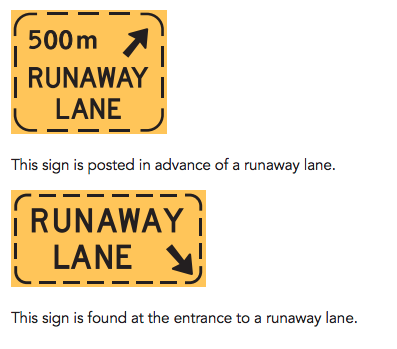
The following two signs alert you to runaway lanes.
Object markers
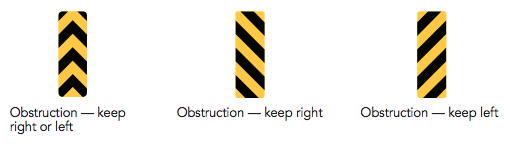
Pay special attention to object markers, which are mounted on obstructions.
Construction signs
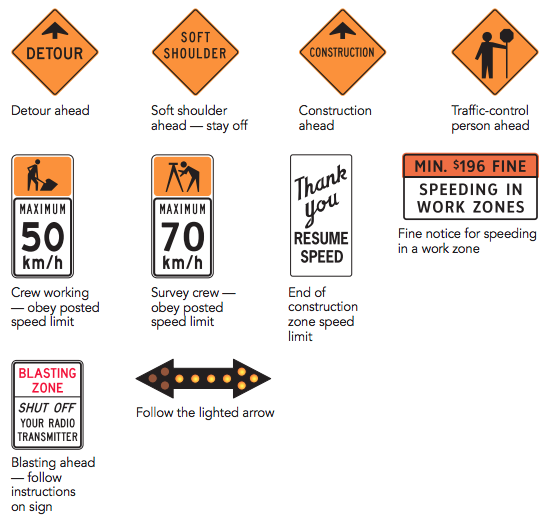
These signs warn of construction and maintenance work. Pay attention to the warnings and obey the instructions on these signs. Obey traffic-control persons who may also be present, travel within the posted speed, stay well back from all equipment and pass only when it’s safe. Traffic offences issued in construction zones may be double the usual cost.
Information and destination signs
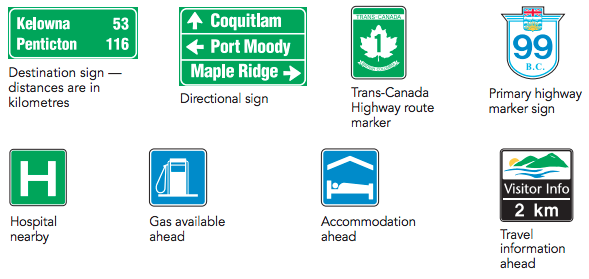
The following signs provide information about destinations, route numbers and facilities.
Railway signs
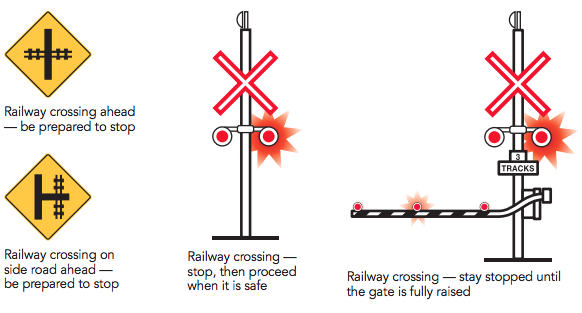
Public railway and highway crossings are indicated with signs or pavement markings and may also have mechanical or electrical warning devices for your protection.
Watch for them and remember to always yield to trains.
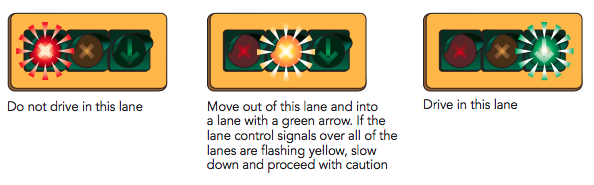
Lighted signals are a way of controlling traffic flow.
Lane control signals
Lane control signals are placed over lanes to indicate which ones are open for driving.
Traffic lights
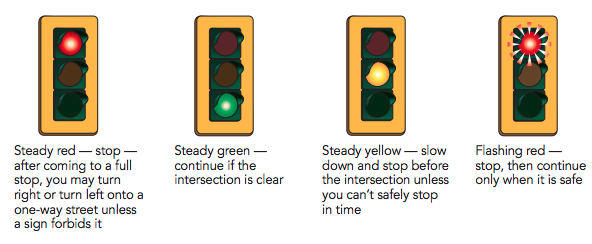
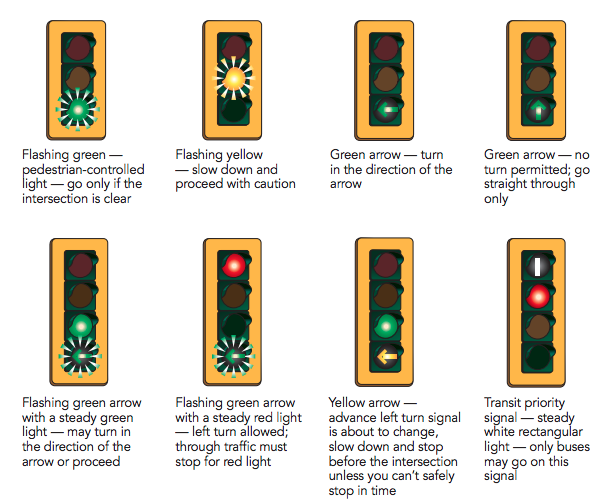
Traffic lights are used to help organize the flow of traffic at intersections or where roadways merge. The colour of the light determines which stream of traffic has the right of way. Generally, a red light means “stop,” a yellow light means “caution” and a green light means “go.” These signals can have slightly different meanings if they’re flashing or if they’re shaped as arrows rather than circles. In some places, green arrows may flash, but in others they might not.
Solid red light
When you face a traffic control signal displaying a solid red light, you must come to a complete stop before the stop line or crosswalk that’s directly in front of your vehicle. If there’s no stop line or crosswalk, stop before the intersection. In all cases, you must remain stopped at the red light until it turns green, unless safely turning right after stopping.
Unless a sign prohibits the turn, you may turn right at a red light after stopping completely before the stop line or crosswalk, if the turn can be made safely after yielding to other vehicles, cyclists and pedestrians.
Unless a sign prohibits the turn, the only left turn permitted at a red light is onto a one-way street. This turn is only permitted after your vehicle is brought to a complete stop before the stop line or crosswalk and if the turn can be made safely after yielding to other vehicles, cyclists and pedestrians.
Solid yellow light
When a green light changes to yellow, it indicates that the light will immediately change to red and drivers must prepare to stop or clear the intersection. When you’re approaching an intersection with a solid (not flashing) yellow traffic control light, you must come to a complete stop before the stop line or crosswalk, unless a point has been reached at the intersection where stopping can’t be done safely. If there’s no stop line or crosswalk, stop before the intersection. If you’re already in the intersection and facing a yellow light, you must safely clear the intersection.
Solid green light
When you’re facing a solid green traffic control light, you’re permitted to travel through the intersection without stopping, unless required to yield to vehicles lawfully in the intersection when it turns green, to oncoming traffic when turning left, or to pedestrians in the crosswalk when turning right or left.
When you’re approaching a green light, be aware that it may turn yellow. A good tip is to check the pedestrian walk light at the intersection. If it shows the WALK symbol, the light will stay green as you travel through the intersection. If it shows the DON’T WALK symbol, prepare to stop. If the traffic light does change, stop before the intersection if it can be done safely.
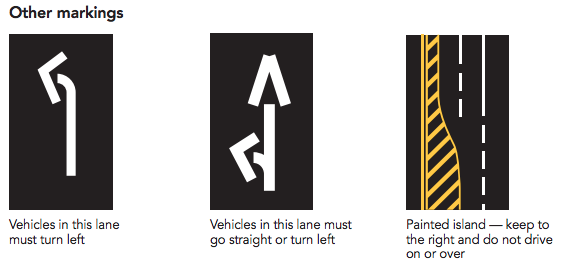
Road markings give you warnings or direction. They’re painted on the roadway, curbs or other surfaces. It’s illegal to drive over freshly painted, wet pavement markings.
Yellow lines
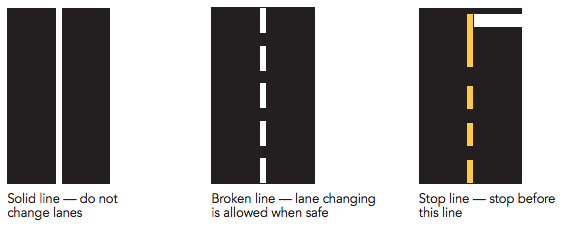
Yellow lines divide traffic moving in opposite directions. If there’s a yellow line to your left, there will be traffic coming toward you on the other side of that yellow line.
White lines
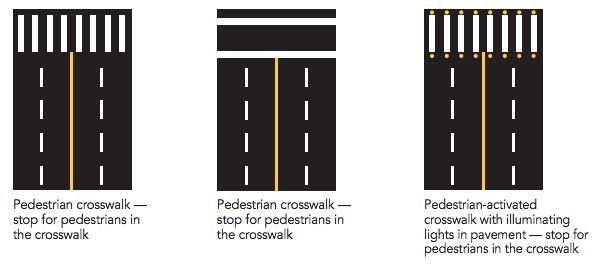
White lines are used to separate lanes of traffic moving in the same direction.
They also mark crosswalks, stopping positions and the right shoulders of highways.
Reserved lane markings
These markings indicate lanes for HOVs, buses and bicycles. HOV lanes are marked with thick solid or broken lines and white diamond symbols.