
[ultimatemember form_id=3702]
4. Vehicle components and systems
The purpose of this unit is to familiarize you with the systems of a commercial vehicle and how they function and work together.
This unit will help you learn to:
• Describe the general components and basic function of a typical commercial vehicle engine compartment and fluid systems.
• Describe the general layout and function of major body, frame and external vehicle components and systems.
• Explain the difference between single, tandem, tridem and other multi-axle configurations.
• Describe the basic types, features and function of tires and wheels.
• Describe the physical features and operation of common types of suspension systems.
• Describe the physical features and basic operation of drum and disc brake systems.
• Describe how stability control systems operate and affect vehicle operation.
• Describe different types of trailer coupling devices.
• Explain various instrument panel displays.
• Operate various switches and controls.
• Be aware of technological advances in commercial vehicles.
• Locate and operate all typical primary and secondary controls, gauges, switches and instruments.
• Explain the instrument panel indicators that display important vehicle operating information, warnings and safety system statuses.
An important step in becoming a professional driver is learning the components of your vehicle. Being able to identify and understand the function of components such as the drivetrain, suspension and wheel assemblies allows you to monitor their correct operation and condition, as well as identify and report any defects.
Tractor engine systems that support engine function are essential. They include air intake, exhaust, lubrication and the cooling system. Identifying each component and its role will help you understand the total system. This allows for more accurate inspections and assists with troubleshooting when there are problems with performance.
Many of these systems are monitored by the driver with warning lights, symbols and gauges. These inform the driver that a system or component needs attention or is outside its safe operating range. Any time a warning light is illuminated, it typically indicates a problem with the system. Gauges, symbols, lights and colors may differ slightly between manufacturers. Refer to the owner’s manual before driving.
Some components are controlled using switches. These control important functions, so it’s essential to know where they are, when to use them and if they’re in the correct operating position.
Different manufacturers of trucks will have different types, styles and configurations of switches. The switches will be identified by either names or symbols. They could be rocker, toggle, button or another style. For these reasons, it’s very important that you become familiar with all of the controls of the vehicle you’re driving, and refer to the owner’s manual if necessary.
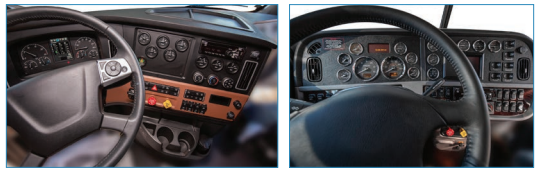
In your work you’ll encounter a variety of tractor body styles. The differences and similarities between tractor body styles are most obvious when you look at the body components outside the cab.
Cab design
Next to the axle arrangement (tandem axle and tri-axle for example), the body and cab designs of a tractor are its most recognizable features. Most tractor bodies fall into the conventional cab category. Other cab types are typically used in specialized applications or are older.
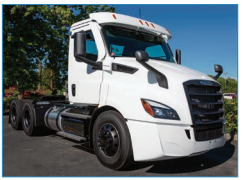
Conventional cabs
The placement of the driver and engine access in conventional cabs is just like the average car, with the engine located ahead of the driver. Hood fasteners secure the hood to prevent accidental opening.
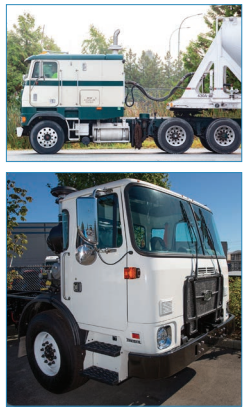
Low Cab Forward (LCF)/Cab over engine (COE)
These designs have the cab placed over the engine. Access to the engine is gained by tilting the cab forward.
The tilting cab of an LCF/COE tractor is extremely heavy, so hydraulically operated pumps that raise the cab are common. A safety brace prevents accidental lowering of the cab and protects personnel under the raised cab. In the closed position, safety latches prevent unintentional tilting of the cab. Securing and stowing all objects prior to lifting is important to prevent damage to belongings and the cab’s windshield. Engine oil and water levels may be checked without tilting the cab.
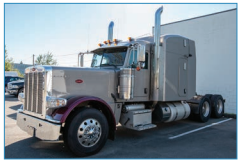
Sleeper berths
A sleeper berth is an area behind the seats where the driver can sleep. It may be found in both conventional cabs and LCF/COE designs. A sleeper berth is important in long haul units. The most common use is for a single driver to take advantage of the sleeper cab rather than using costly hotels or motels for overnight stops. When team driving, one driver will sleep while the other drives. Some sleepers are now equipped with TVs, microwaves, refrigerators, coffee makers and generators, to allow drivers to live comfortably and economically while on the road.
Accessories outside the tractor cab
There are a variety of other components that are found on commercial vehicles. If you’re driving a tractor-trailer with a specific application, you mayfind added accessories such as auxiliary power supplies, hydraulic pumps, auxiliary heaters and engine heaters.
Mirrors
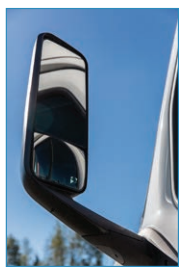
Mirrors are essential as they provide information about the space behind and around the sides of the vehicle. Without mirrors, a driver is unaware of the traffic around the vehicle.
There are two types of mirrors on tractors:
1. Convex mirrors: The convex mirror bulges outwards and shows a larger field of view than can be obtained from a flat mirror of the same size. When aimed properly, these mirrors allow you to see most spots around your vehicle. They can be independently mounted or attached as part of the main mirror assembly.
2. Flat mirrors: Flat mirrors can give you a truer image of what’s happening around and behind the tractor. Factors that affect visibility include the condition of the mirror, its cleanliness and its alignment.
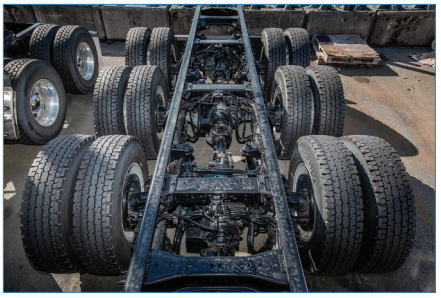
The frame is the backbone of the tractor and trailer. The entire drivetrain, and all other components of the vehicle are attached either directly or indirectly to the tractor or trailer frame rails. These frame assemblies are rigid enough to maintain their shape as well as drivetrain and suspension alignment while being flexible enough to absorb the twisting and stresses of normal operation of the vehicle.
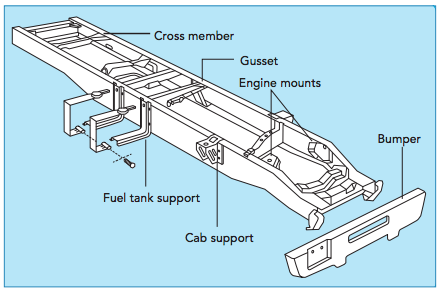
Frame rails — The two side rails that run the entire length of the vehicle are the frame rails. These are made of special steel or aluminum for tractors and trailers, and they’re sized to support the rated loads that the tractor and trailer are designed to carry. Some specialized vehicles require reinforced frames and in some cases double frames. Frame rails should only be welded or drilled by qualified technicians.
Cross members — Cross members connect the two frame rails together and provide support and strengthen the frame. They cross the frame rails to form a ladder shape. They’re sometimes made of aluminum to save weight.
Gussets — Gussets are brackets that attach the cross members to the frame rails. These hold the cross members at a 90-degree angle to the frame rails to maintain frame alignment.
Engine mounts —These are bolted to the frame rails and allow the engine to be attached to the frame through rubberized anti-vibration pads.
Suspension hangers — Suspension hangers are attachments to the frame. They connect the suspension to the frame rails.
Cab supports — The cab supports attach the truck cab to the frame.
Fuel tank supports — The fuel tank is attached to the fuel tank supports.
Exhaust mounts — Exhaust mounts are an attachment to the frame that securely hold the exhaust system in place and isolate it from vibration. The exhaust system includes a system that treats the exhaust before it leaves the vehicle. The exhaust pipe or stack of the vehicle may be vertical or horizontal.
Additional attachments — Options like tow hooks are available as attachments to the frame. When attached to the frame, tow hooks place the strain of a tow directly on the frame rather than on another component such as the bumper. A fifth wheel and/or a pintle hook will also be attached to the frame rails on a tractor to allow it to support and draw a trailer.
The suspension system connects the axles, wheels and tires to the vehicle. It must support the weight of the vehicle and its payload, cushion the vehicle from the road shock and transmit full braking and steering effort to the chassis or frame of the vehicle.
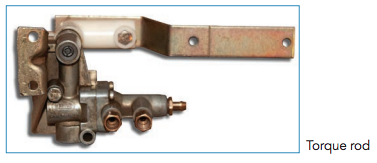
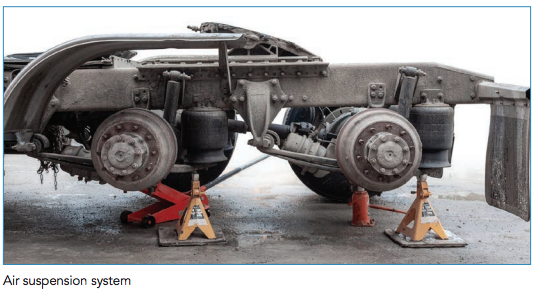
Air suspension — The air suspension system (most common in newer trucks and trailers) uses airbags (air springs) filled with compressed air. As the axle moves up, the air is compressed to absorb shock. The airbags are filled with air from the engine-driven air compressor. The ride height control valve maintains the airbag height by adjusting the air pressure in the bag as the vehicle’s load is increased or decreased. If your air suspension fails to inflate properly it’s usually due to a problem with the ride height control valve. The driver uses an air pressure dump valve to deflate the suspension while coupling or uncoupling the tractor and trailer. Torque rods control sideways, forward and backward movement of the axle. Torque refers to an engine’s rotational force, measured in pounds feet (lb-ft), and is often referred to as “twisting force.”
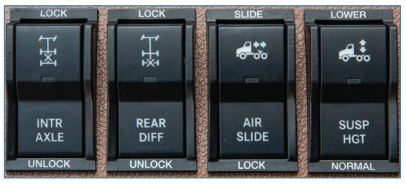
Air suspension dump switch — Used to dump the air out of the rear suspension of the tractor when coupling and uncoupling a trailer. This will help to avoid placing added stress on components, and to avoid scraping all of the grease off of the fifth wheel plate. The type of switch may vary from truck to truck, but they perform the same function. The air suspension should always be in the SUSP, UP, or RUN position unless you’re coupling or uncoupling a trailer.
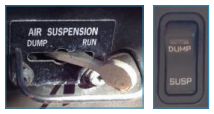
Wait for the airbags to inflate before driving away. Driving with the airbags deflated will cause damage to the tractor driveline components such as the driveshaft, constant velocity (CV) joints, the differential, axle shafts and universal joints (U joints).
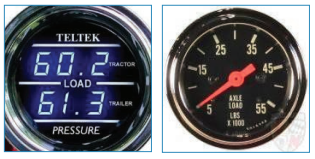
Weight/axle/suspension load pressure gauge — Measures the air pressure in your drive axle airbags. This number can be used to check the weight on your axles. You need to be parked on level ground with your air system up to pressure for it to be accurate. There may be a trailer gauge mounted on the trailer near the axles.The name and type of gauge may vary between vehicles, but they perform the same function.
Refer to the maximum allowable weights for the jurisdiction you’re driving in to ensure your trailer isn’t overweight.
Maximum allowable weights will differ based on vehicle configuration, type of road and jurisdiction.
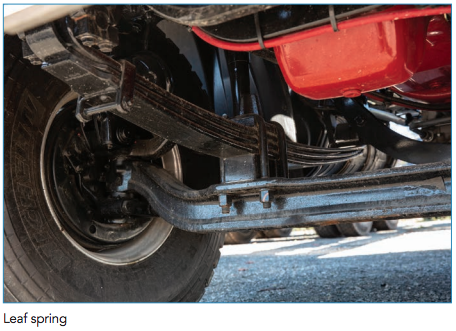
Leaf spring suspension — Leaf springs can be used in both tractor and trailer suspension systems. They’re constructed to support the maximum loaded weight of the vehicle chassis while permitting a flexing action that dampens the vertical movement of the wheel assemblies as they travel along the road surface.
The stack leaf system is composed of a series of narrow metal leaves, bolted together in stacks. These stacks are secured to the axle at their centre by U-bolts and their ends are secured to the frame by front bracket and rear shackles. The torque rod or trailing arm prevents the spring assembly from being distorted by axle torque. The leaf springs in the stack are all the same thickness but vary in length. They become progressively shorter down the height of the stack. Stress absorbed by the flexing of the stack is therefore distributed more evenly.
In the tapered leaf suspension, the ends of each leaf are tapered. The leaves in the tapered leaf system are all the same length. Each spring shares the stress of the load. This system is most common on front axles.
Walking beams — Walking beams are found on some tractors and trailers under a leaf spring or rubber block suspension. The assembly distributes weight evenly between the two axles, improving traction and enabling a smoother ride on rough roads.
Shock absorbers — Shock absorbers are used in the suspension system to control the rebounding effect of the springs and prevent side sway. Hydraulic shock absorbers are usually telescopic and operate on the principle of passing fluid through an orifice from one chamber to another to dampen the spring’s motion.
Axles — The axle is a shaft on which two or more wheels revolve. It connects the wheel to the rest of the vehicle and also supports the weight of the vehicle. Tractor axles, along with trailer axles, serve as connection points for brakes. Tractors have a front axle and one or more rear axles.
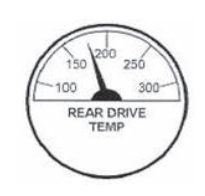
Front and rear drive axle temperature gauges — Measures the temperature of the lubricant in the front and rear drive axles. Temperatures vary with the type of load, driving conditions and type of lubricant. Normal operating temperatures can range between 26 C and 104 C ( 80 F to 220 F) depending on the type of manufacturer. Refer to the owner’s manual for normal temperatures for your vehicle.
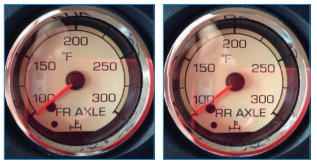
It’s normal for the front axle to read higher than the rear axle. High temperature readings indicate you should check the axle lubrication.
Driving with very hot temperatures in your drive axles can cause serious damage to axle bearings and seals.
When the truck is under a load such as climbing steep grades, it’s not unusual for the temperatures to exceed the normal operating range as long as the temperature returns to normal when the load decreases.
Live axles — Live axles, also known as drive axles, transfer engine torque to the vehicle’s drive wheels, and are directly connected to the vehicle’s drivetrain. These are usually the rear axles (single, tandem or tridem) but may also be the steer axles in certain specialized vehicles used by power companies or for extreme off-road hauling situations at some remote mines,for example.
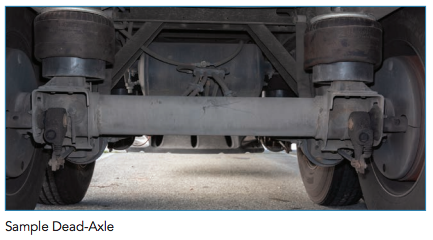
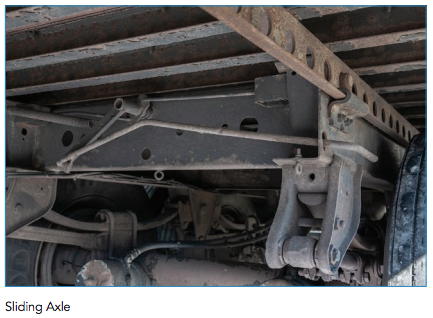
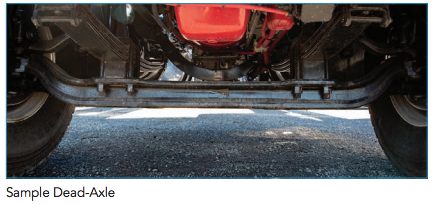
Dead axles — The wheels on a dead axle don’t drive the vehicle, but the axle serves as additional support for the chassis. This type of axle is found on the trailer and the front axle of the tractor. As dead axles don’t require internal drive gears, they can be shaped for a specific application. There are different types including straight, drop centre, I-beam, tube and box. These axles can also be fixed in a permanent location or be attached to an air lift system that allows them to be used only when required. Here are a couple of examples of dead axles:
Sliding axles — Sliding axles, or bogies, are adjustable axles found on a trailer only. It’s possible to slide them forward or backward to change the weight distribution and the wheelbase of the trailer.
Steering axles — Located at the front of the tractor, these axles are used for steering. Some vehicles may be equipped with twin steering axles.
Drive axle configurations
The rear drive system on the tractor can be configured as a single, tandem or triple axle (also known as tridem).
Tandem driver — Both axles are live. The forward axle has an input and an output drive shaft.
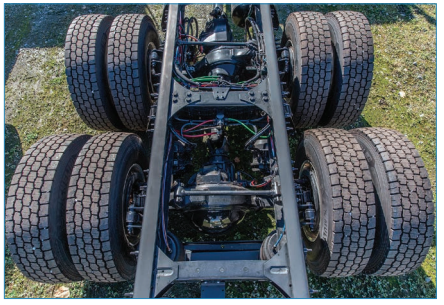
Tri-drives — Three axles systems or tri-drives distribute power to three live axles to provide additional traction.
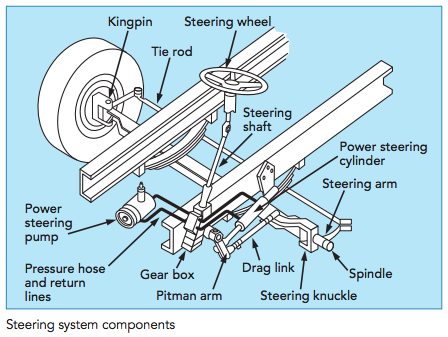
The steering system provides the driver with a means of controlling the vehicle direction. It’s made up of the following components:
Steering wheel — Most steering wheels include a tilt and telescopic feature.
Steering shaft — The steering shaft is a long shaft enclosed in the steering column. It connects the steering wheel to the steering gear box. All shafts incorporate universal joints to compensate for angles as cabs flex and move at different rates than the truck frame. Some universal joints are sealed and some require greasing as part of the vehicle’s maintenance.
Steering knuckle — The steering knuckle is the pivot point of the steering system, which allows the wheels to turn (also referred to as the hub).
Steering gear and power steering pump — The steering gear converts the turning motion of the steering shaft to forward/backward movement of the pitman arm to move the wheels. The power steering pump is driven by the engine and makes it easier to turn the wheels. Avoid dry steering as it’s hard on the components and tires.
Pitman arm — Connected to the steering gear sector shaft, the pitman arm moves forward and backward as the steering wheel is rotated right or left.
Drag link — The drag link is connected at one end of the pitman arm and to the upper steering arm at the other end. Movement of the drag link causes the left wheel to turn in the direction of the steering wheel movement.
Upper steering arm — Connected to the left steering knuckle only, the upper steering arm connects the drag link to the steering knuckle.
Lower steering arm — The lower steering arm is an angled arm that’s connected to the lower half of each steering knuckle. It provides a means of connecting both wheels to the tie rod.
Tie rod assembly — The tie rod assembly consists of two tie rod ends, and each one is connected to the lower steering arms. The tie rod ends are joined together by a connecting tube that ties both steering knuckles together and transmits movement of the left wheel to the right wheel. This rod is adjustable to provide for proper wheel toe alignment.
Kingpins — The kingpins attach the steering knuckle to the front axle and permit the front wheels to swivel in response to the turning steering wheel. The spindle attaches the wheel to the steering knuckle.
A power drivetrain is made up of six essential parts.
Engine — The engine takes energy in the fuel and converts it into mechanical motion that’s capable of performing work. The torque or twisting force produced is capable of turning the transmission and moving the truck and load. There are different sizes and types of engines to suit the size of vehicle and the loads that they carry. The most common type of engine found in highway trucks is the diesel engine, due to its high torque output capabilities and longevity. Electric motors are also available.
Transmissions — The function of a transmission whether manual, automated manual or automatic is to provide a number of gear ratios to allow for different amounts of engine torque multiplication. This enables the tractor to pull the trailer from a stop to highway cruising speed. Transmissions also must provide a reverse gear to allow the driver to back up, and a neutral position to allow the engine to operate when the vehicle is stopped. Transmissions are bolted to the rear of the engine and receive torque from the engine’s crankshaft through the clutch or torque converter.
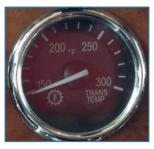
Transmission temperature gauge — This gauge should be monitored to ensure the transmission doesn’t overheat. The normal operating range for most transmissions is 82 C to 120 C (180 F to 250 F). If the transmission overheats, have it checked by a mechanic.
Manual transmissions (non-synchronized) — A manual transmission contains sets of various gears that produce different gear ratios. A typical manual transmission for a tractor-trailer has nine to 18 different gear ratios to allow the driver to select the appropriate gear ratio for the load and the terrain. The driver selects the various ratios by moving a gearshift. Most heavy truck transmissions consist of two sections, a front or main gearbox section and an auxiliary section. The main box contains the gears that are selected by moving the gearshift, and the auxiliary section provides ratios that are selected by operating additional buttons on the gearshift. The auxiliary section can provide low and high ranges as well as direct and overdrive ratios (deep reduction ratios are also available on some models).
Due to the loads and internal stresses inside the transmission, the proper type and level of transmission lubricant is required to prevent overheating. Many tractors have transmission temperature gauges in the instrument cluster to allow the driver to monitor the temperature during operation.
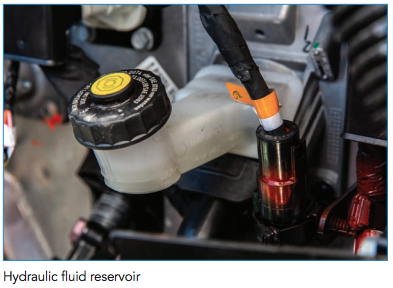
Clutch — Manual transmissions require the use of a clutch to connect and disconnect engine power from the transmission. This break in power transfer from the engine is required for initial gear engagement and when up or downshifting. A flywheel that’s bolted to the rear of the engine’s crankshaft drives the clutch. The clutch consists of one or two friction discs that are located between the flywheel and a clutch pressure plate assembly that provides the clamping force that applies the force against the clutch disc(s). The clutch is disengaged by a release bearing, which is operated by the clutch pedal through the use of mechanical linkage or hydraulic pressure. All of these clutch components are located inside a housing on the front of the transmission called the clutch housing. Be sure to check the level of your hydraulic fluid as part of your pre-trip inspection. The reservoir for the hydraulic clutch is attached to the firewall of your engine compartment.
Automated manual transmissions (AMTs) — It’s important to understand that AMTs are not automatic. While many are a two-pedal operation (using only an accelerator and a brake pedal, along with a shift stalk to select drive, neutral, manual, low or reverse) and offer a similar driving experience to automatic transmissions, AMTs basically function internally the same as manuals with the clutch engaging automatically via centrifugal force. AMTs are generally lighter and cheaper than automatics, which means you can maximize your payload by having less total vehicle weight.
AMTs produce ideal shifts under all of the various driving conditions at the correct times. This reduces wear on the internal transmission components and provides increased fuel economy. The transmission uses an onboard computer, sensors and shift motors to complete the shifts. The transmission manufacturers offer different models that provide varying ranges of automation depending on the owner’s preference. The fully automated models don’t require the use of a driver-controlled clutch, so only a throttle and brake pedal are present in the cab.
AMTs have many benefits compared to true manuals in terms of safety, driver fatigue, maintenance and fuel economy. When driving AMTs, drivers are able to be safer by maintaining their undivided focus on the road and lessen the physical and mental fatigue that comes with continual manual clutch/gear stick shifting situations. Due to these factors, AMTs are often the preferred transmissions for on-highway applications. The driver still influences the performance of the transmission based on the position of the throttle pedal when accelerating from a stop as an example. The driver also needs to place the transmission in the manual mode and select the correct gear to safely descend steep grades. There are some unique features of these transmissions and drivers should receive training for their specific brand/model.
Drive shaft — Drive shafts carry the power from the transmission to the rear axles and between the axles. They are tubular in shape and vary in length to suit the distance from the transmission to the axle. Due to their speed of rotation and length, drive shafts must be balanced, aligned or phased and installed at the correct angle to prevent torsional vibration.
Centre support bearings — If the distance between the transmission and the first differential is too long, a centre support bearing will be installed. This bearing allows for the use of two shorter drive shafts. Using two short shafts prevents whipping from occurring from an imbalance in a longer, heavier drive.
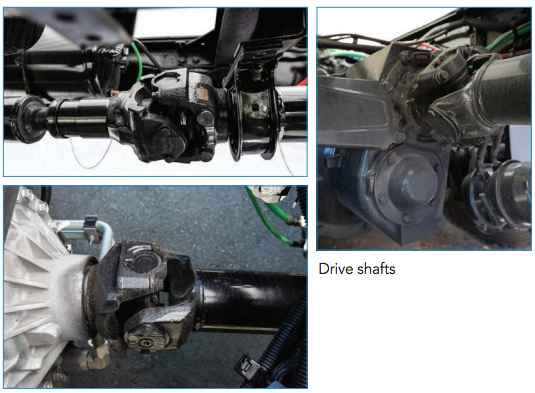
Slip joints — The drive shaft on all vehicles has a slip joint. The transmission is bolted rigidly to the engine while the axle is supported by the suspension.
As the axle moves up and down to compensate for irregularities in the road surface, the distance between the transmission output shaft and the differential input shaft changes so the length of the drive shaft needs to be able to increase or decrease as needed.
A slip joint consists of internal splines that fit over external splines on one end of the drive shaft. These splines allow the two shafts to rotate while permitting the two shafts to move lengthwise. The overall length of the drive shaft can increase or decrease as necessary.
Universal joints — The universal joint is a coupling that transmits torque (twisting force) from one drive shaft component to another. Universal joints allow the transmission of torque through a slight angle. This means that the shaft can move up and down with the movement of the suspension or motor mounts during operation.
Final drive assemblies — Tractors are equipped with one, two or three final drive assemblies. These assemblies are responsible for taking the rotating drive torque from the drive shaft and turning it 90 degrees to drive the axle shafts.
This also provides a final gear reduction to allow the engine and transmission to operate under less stress. The assembly consists of an axle housing, carrier, drive gears, differential case and gearing and the axle shafts. When more than one drive is used, the forward drive has an additional component called a power divider to allow drive torque to be distributed to both front and rear drives. In the case of a tridem, the two forward axles would have power dividers.
Rear axle differential — If a vehicle were to travel in a straight line all the time, a differential wouldn’t be required. Both wheels would travel the same distance and speed. However, when a vehicle turns a corner or rounds a curve, the outer wheel must travel further and faster than the inner wheel. Axle shaft gearing inside the differential allows one wheel to go faster than another during cornering or when travelling on uneven terrain.
Final drive housing (drive axle assembly) — The drive axle housing is a sturdy steel housing to which all of the final drive components are bolted. It’s also the lower mounting point for the suspension.
The drive housing holds all of the components in correct alignment while also providing a reservoir for the axle lubricant. On the top of the housing is a vent to prevent any pressure buildup from the lubricant that expands as it heats during operation. This vent must be checked routinely to ensure that its top cover is unobstructed and able to vent correctly. Axle seals prevent the lubricant from leaking out. Temperature sensors are mounted in most housings to detect the lubricant temperature and send a signal to the drive axle temperature gauge(s) found in the tractor’s instrument cluster.
Inter-axle differential or power divider (first differential) — The inter-axle differential found on multiple drive axles takes the drive shaft torque and shares it between the driving axles. Since it’s a differential, it will allow one axle to turn faster than the others. This may be necessary because of slight variations in tire sizes and operation on rough roads.
In conditions where traction is poor (slippery roads, mud, snow and ice for example) the driver can lock in the power divider. This prevents differential action between the axles and forces equal drive to both final drives. The power divider can be locked and unlocked while the tractor is moving, but it must not be locked if any wheel slip is present. To do this, however, the driver must break torque by releasing the accelerator to smoothly complete the transitions.
Note: The power divider should only be selected when extra traction is required.
Differential (Diff) lock — Also called “main differential lock” or “driver controlled differential lock” (DCDL). This locks both sets of dual wheels on the same axle to ensure they both spin together at the same speed. It should be used when operating on slippery or uneven surfaces.
Not every truck will be equipped with a differential lock. This feature comes as an option for the forward drive axle, the rear drive axle or both. If a truck is equipped with both, there will be a separate switch to operate each one as pictured.
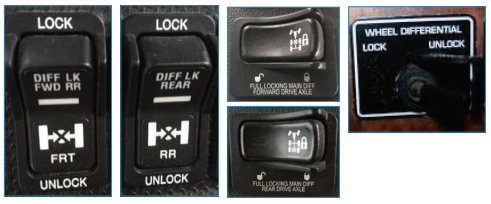
Move the switch to the lock position to lock the wheels together.
Move the switch to the unlock position to allow each set of wheels to spin independently. It may take a few kilometres before the axle lock disengages.
The differential lock should only be used at low speeds such as 40 km/h or slower. Some manufacturers have designed the switch to automatically disengage if the transmission is shifted from fourth to fifth gear.
Switch to the lock position when the wheels are all turning at the same speed or stopped to avoid damage.
You may experience oversteer while driving with your differentials locked especially if you have more than one locked. If conditions are that slippery, you should consider using tire chains instead of having all your axles locked.
Note: Never use DCDLs while driving downhill as this could make steering difficult.
Modern diesel engines have sensors throughout their inner workings that are constantly sending messages regarding various engine performance characteristics to the computer or electronic control module (ECM) mounted on the engine. Electronic controls are designed to make driving easier and safer, help maximize fuel economy and instantly identify faults in the engine’s operation.
In North America a number of jurisdictions have introduced legislation to reduce energy costs, vehicle emissions and crash risks by limiting the maximum operating speed of large trucks on freeways and highways.
However, British Columbia does not require speed limiters to be installed on heavy trucks.
Ontario and Quebec both have legislation mandating speed limiters. This means heavy commercial vehicles must have speed limiters installed, limiting them to a maximum of 105 km/h.
Reducing the speed of a vehicle results in lower fuel consumption, helps reduce greenhouse gas emissions and saves money on fuel. The risk of collision is also reduced when driving at lower speeds. Speed-related, at fault crashes involving large commercial vehicles fell by 73 percent after mandatory speed limiter legislation took effect in Ontario (Ontario Ministry of Transportation Report, 2018).
The fuel system sends fuel to the engine. In newer models, fuel management is handled by a computerized element of the system.
Low fuel warning light — Displays when the fuel level is low
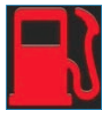
Fuel tanks — Most large trucks have two fuel tanks; one strapped to each side of the frame. They come in a variety of sizes. Fuel tanks are vented to maintain equal pressure on the inside and outside.
Fuel tanks serve both as a supply reservoir for the fuel pump to draw from and as a destination for fuel returned from the engine. Many engine designs oversupply the injection system so that the excess fuel serves as coolant.
Returned to the tanks, the fuel radiates heat out through the tank walls.
To prevent fuel contamination when refueling, make sure that the areas around the tank caps are cleaned of dirt and debris. Fuel levels in the tanks should be maintained as high as possible to permit settling of water and sediment in the tanks. Maintaining full tanks when the vehicle is parked overnight also prevents airborne moisture from condensing in the tanks.
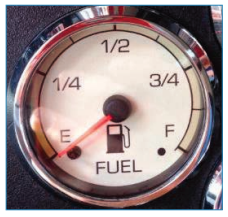
Fuel gauge — Measures the approximate level/amount of fuel in your fuel tank(s). This gauge should be checked regularly to ensure there’s plenty of fuel to reach your destination. If you notice that the needle is stuck in one position for too long, this can indicate an issue with the gauge, the sensor in the tank(s), or the fuel is not leveling out between the two tanks. The next time you stop the vehicle, remove the cap(s), and ensure you still have enough fuel to reach your destination.
If it’s a leveling problem, one tank may still be full while the tank where fuel is being drawn from is almost empty.
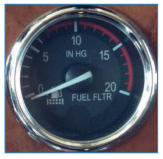
Fuel filters — This component keeps contaminants out of the fuel system by cleaning the fuel as it flows from the tank through the fuel lines into the fuel injector. Water separators or fuel dryers remove water droplets emulsified in the fuel supply. Several models of filters include separators in the primary filter elements.
Fuel filter gauge — Indicates the condition of the fuel filter. Monitors for a dirty fuel filter or one that might be gelling up on a cold day. Usually consists of two sections: White zone and red zone.
If the needle stays in the red zone it can indicate a clog in the fuel filter. A clogged fuel filter should be changed to maximize engine performance.
Air intake and exhaust systems ensure that fresh air is constantly supplied into, and burned gases expelled from, the engine to enhance smooth running of the tractor-trailer. A diesel internal combustion engine is not only powered by fuel but a mixture of fuel and air. This system supplies the air that causes combustion in the cylinder. It’s composed of an air cleaner, turbocharger, charge air cooler and intake manifold.
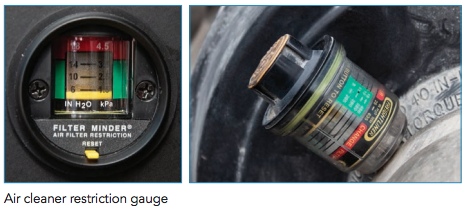
Air cleaner — Clean air flows into the turbocharger through the charge air cooler (CAC) and into the intake manifold. Valves regulate the flow of air into the cylinders. It’s important to check the air cleaner’s restriction gauge regularly so you know when to change the filters. Dirty filters will impact the power of the engine and your fuel economy.
Turbocharger — This is a turbine-driven forced induction device that increases an internal combustion engine’s efficiency and power output by pressurizing the intake air. As the exhaust gases leave the engine they go through the turbo charger’s hot side, spinning the turbine that’s connected to the matching turbine on the cold or intake side of the turbo. This is “free” power provided by pressurizing the intake air going into the engine which allows the computer to inject more fuel and still have it burn cleanly. The additional fuel allows for a bigger explosion in the cylinder thus producing more power to move your truck down the road.
The turbine shaft and bearings, rotating at high speed, require a constant supply of oil lubrication to reduce friction and dissipate heat. For this reason, engines with turbochargers must be allowed additional time to warm up before being placed under load, and time to cool down at idle speed before being shut down.
Manifold pressure/turbo boost gauge — Indicates the power the engine is putting out by showing the amount of turbo boost in pounds per square inch (p.s.i). The name and look of this gauge may vary from truck to truck, but they perform the same function. A driver can drastically improve fuel efficiency by monitoring and attempting to keep the pressure low when accelerating.
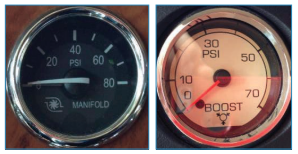
The amount of p.s.i indicated on the gauge will vary depending on the load placed on the engine. If the pressure goes down when the engine is under a load, there may be something wrong with the engine and it should be checked by a mechanic.
Charge air cooler — This assists in cooling the intake air received from the turbocharger to a lower temperature level. The cooler air is also denser, so more air can be squeezed into the cylinder. This means more fuel can be added and results in more horsepower.
Pyrometer — The pyrometer, found on some instrument panels, measures the temperature of the exhaust gases. It’s important that the temperature doesn’t get too high (over 538 C/1,000 F). Most tractor units are equipped with an electronic control module (ECM) which manages the exhaust temperature for you. The pyrometer is a very important gauge on older trucks that don’t have ECMs. If the temperature of the exhaust gases gets too high, the engine can become damaged.
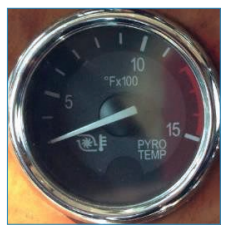
If excessive exhaust temperatures occur, give the engine a chance to cool by gearing down to raise the engine RPM. If the other gauges are also outside of their normal ranges, the problem might be more serious. Stop and find the cause of the problem. Refer to your owner’s manual for normal operating temperatures.
Exhaust — This system removes burned gases and fumes from the engine cylinder. After combustion has taken place, the exhaust valves open and the burned gases are discharged. These gases go out of the cylinder through the exhaust ports to the exhaust manifold, then on to the turbocharger. Most engines manufactured after 2004 recirculate a percentage of exhaust gases back into the engine through an exhaust gas recirculation (EGR) cooler and the intake manifold as part of their pollution control system. The rest of the gases proceed to the after treatment system and, subsequently, to the exhaust pipe or stack. An exhaust pipe is mounted horizontally, while an exhaust stack is mounted vertically. Most exhaust stacks have curved ends to prevent rain from entering.
Aftertreatment systems
Pollution control regulations have been evolving since 1998, with significant changes in 2004, 2007 and 2010.
2004 (2005 model year trucks) — Exhaust gas recirculation was added to most diesel engines. This resulted in a metered amount of the exhaust gases being routed back to the intake side of the engine through an EGR cooler. After coming out of the EGR cooler the gases are routed back into the intake side of the engine.
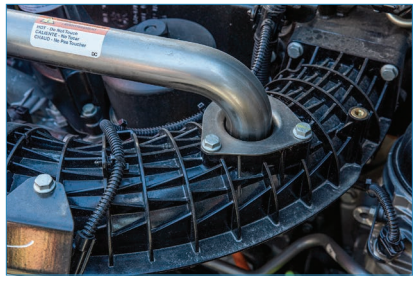
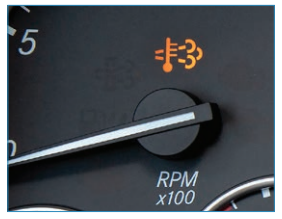
2007 (2008 model year trucks) — Diesel particulate filters are added to the exhaust after treatment systems. Most systems have two filters. As they become plugged, the vehicle will start a regeneration procedure (also called regen) to clean them out. If the vehicle is operating at speeds consistently above 60 km/h, the regen will occur without you noticing, but it will use some extra fuel to burn off the accumulated ash. If your vehicle is not travelling above 60 km/h consistently then a light on your dash will indicate that a parked regen is required. A parked regen may take up to 45 minutes to complete and you should park in an area with no combustibles nearby. The exhaust system will get very hot and the truck will run on high idle with the fan on so it will be noisy. If the driver ignores the regen light it will eventually start to flash. If you continue to ignore it, the ECM will derate the engine (where the computer reduces engine power to protect the engine and limits road speed) to a point where you’ll have to stop and perform the parked regen. There are two warning lights related to this system:
Diesel particulate filter (DPF) regeneration lamp
Illuminates yellow when the diesel particulate filter requires a regeneration (regen) or when the regeneration operation is active. If the light is flashing you have a limited amount of time to stop and perform a parked regen before an engine derate occurs.
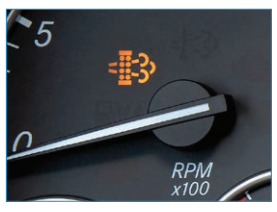
HEST light — warning of high exhaust system temperature
This warning light illuminates when the exhaust gas temperature and exhaust components become extremely hot, usually during and right after a regen. Eventually the DPF will reach their capacity.
They’ll need to be replaced and the ash counter in your ECM will need to be reset. Check with your engine manufacturer for new or remanufactured filters. Filters will typically last between 400,000 km to 500,000 km (248,548 mi to 310,685 mi) before needing replacement. This will vary with how much time your vehicle spends idling versus running up to temperature on the highway.
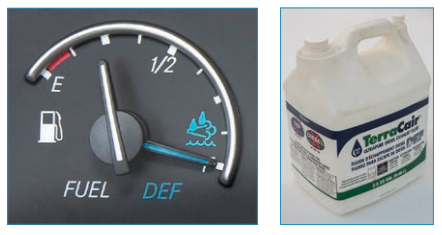
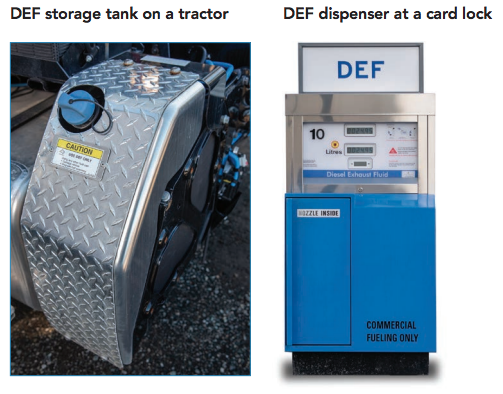
2010 (2011 model year trucks) — The next level of exhaust after treatment included the addition of selective catalytic reduction (SCR) catalyst and diesel exhaust fluid (DEF) into the trucks’ exhaust systems. DEF is stored in a separate tank and is injected into the exhaust stream after the DPF and works to further clean the exhaust. DEF is used at a rate of 2 to 3 per cent of diesel fuel burned and the tank needs to be filled about every third time you buy diesel depending on its size. The DEF gauge is normally found on the bottom of the fuel gauge and has four bars to indicate how full the tank is. Some trucks have a separate gauge. If you allow the vehicle to run out of DEF the ECM will derate the engine to the point where you will have to park and get the tank refilled. Once the gauge is down to one green light you should be looking for a place to refill it. DEF is available in bulk at most card locks and in 9 litre jugs in many auto supply stores and truck stops.
Fuel gauge with DEF gauge built in
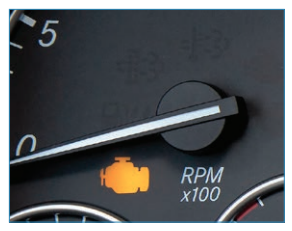
The malfunction indicator lamp (MIL) indicates problems specifically with the after treatment system. It’s yellow in colour and shaped like the outline of an engine, similar to the check engine light. Trucks with MILs will usually have the word “check” added to the inside of the check engine light so you can tell the difference. Typically, you can continue to drive with your MIL on and report it to maintenance at the end of your trip.
If you see the MIL and check engine light on at the same time, you may experience an engine derate — where the computer reduces engine power to protect the engine and limits road speed. This situation needs to be reported to your support team as soon as possible. Ensure you’re in a safe place (preferably at a repair shop) before you shut off your engine in this situation as depending on the problem you may be limited to a speed of 8 km/h upon restart until the issue is repaired.
The check engine light indicates a problem with the engine. The vehicle can still be safely driven, but should be serviced to correct the problem.
This is a system that assists with the distribution of oil to various parts of the engine. The presence of oil in the engine enables the moving parts to slide smoothly instead of rubbing together, thereby reducing friction between the surfaces of the engine parts. A well-lubricated engine will increase engine efficiency and extend the life of the engine’s parts. Oil changes should be a part of regular maintenance as recommended by manufacturers.
The oil capacity of a typical tractor engine is 40 to 50 litres (10.5 to 13.2 gal).
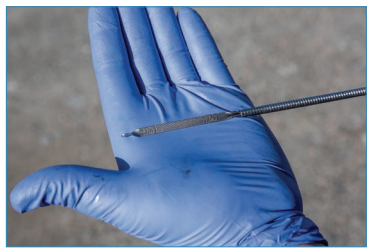
The oil level is checked using a dipstick (be careful not to over tighten dipsticks). The space between the high and low marking on the dipstick represents 4 to 6 litres (1 to 1.5 gal) of oil. Only add oil if the level nears the low mark on the dipstick. It’s important not to overfill the engine with oil.
Oil is circulated through the lubrication system under pressure to ensure constant flow. Air pressure is built up within the system by the action of the crankshaft and other engine components. This could cause leakage if the system is not properly vented. A road draft tube extending from the top of the engine vents the crankcase.
Oil temperature varies with the terrain, load and condition of the engine. The driver must determine the normal operating temperature range for each power unit, keeping a watch on the gauge for variations.
Engine oil temperature gauge
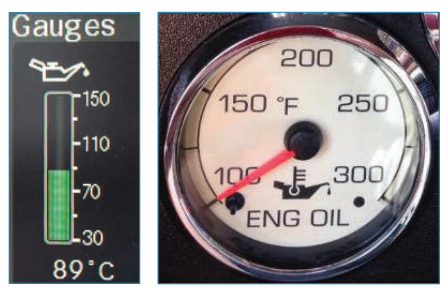
Viscosity (thickness) of oil is much higher at lower temperatures, and oil subjected to heat that’s too high can lose its lubrication properties which results in loss of lubrication of the engine components.
After starting a cold engine, you should wait for the engine oil temperature to rise before moving the vehicle to allow for proper lubrication and reduce engine damage. This is especially important in colder temperatures.
If you can’t wait for the engine oil temperature to rise before driving, then it’s important to slowly accelerate after each shift and not overwork the engine until the temperature reaches its normal operating range.
Normal operating temperature will differ among different types of engines.
Refer to the engine manual for normal ranges.
If oil temperature rises above the normal operating temperature, you should reduce the load being placed on the engine or transmission to help reduce the temperature, and then determine the cause and have it repaired to avoid engine damage.
High temperatures can indicate a failing oil pump, a shortage of oil or a blockage.
Typically the maximum oil temperature is 120°C (250°F).
Engine oil pressure gauge and warning light —
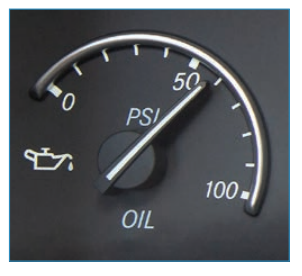
Under normal operating conditions, oil pressure will register on the oil pressure gauge immediately after the engine is started. Oil pressure will gradually rise to normal operating levels and remain stable.
Normal pressure will vary depending on the engine.
Typically, newer engines operate at lower oil pressure than older ones. Watch for variations and fluctuations in oil pressure. A sudden drop in oil pressure may indicate a failure of the lubrication system. Shut down the engine immediately.
The light may illuminate as the tractor-trailer is being started, but should go off right after the engine starts. If it remains on, the vehicle should be inspected. Low pressure means there either isn’t enough oil in the system or the oil pump isn’t circulating enough oil to keep the critical bearing and friction surfaces lubricated.
Oil dipstick — This is used to indicate the level of oil in the engine. The dipstick is marked in increments from low/add to full.
Oil pan — The oil pan acts as a reservoir to hold a quantity of oil for lubricating purposes. It allows returned oil to cool and large contaminant particles to settle out of the oil.
Oil pump — The oil pump draws the oil from the oil pan and forces it under pressure through the oil filter and on to the oil galleries where it’s distributed to and lubricates all moving parts.
Oil filter — Contaminated particles are removed from the oil by the oil filter. If the filter becomes plugged the oil will bypass the filter and go directly to the engine.
Oil cooler — Engines incorporate an oil cooler. Here, coolant from the cooling system circulates around pipes containing circulating engine oil. This cools the oil when it is hot, and warms the oil when it’s cooler than the engine coolant temperature.
Oil galleries and lines — These are passages within the engine block construction and in some cases, external lines that direct oil to its required locations.
Oil pressure sending unit — This unit is a small device threaded into the engine block main oil gallery. It drives the oil pressure gauge up or down depending on the oil pressure in the galleries. There’s a separate sensor which sends a signal to the ECM.
Heat is generated in the vehicle engine and may destroy the engine if not controlled. The cooling system assists in keeping the temperature of the engine consistent.
Coolant — Coolant is the fluid that circulates through the engine block and cylinder head and keeps the engine cool. The coolant flows through a channel called a water jacket, picking up heat as it goes. The channel then takes the coolant to the radiator for cooling. The coolant returns to the engine to repeat the cycle. The coolant is also used to heat the cab through a heater core.
Coolant pump — The coolant pump circulates the coolant from the radiator through the engine’s coolant jackets when the engine is running. It’s driven by the engine crankshaft.
Water manifold/jackets — Coolant from the radiator travels through these passages within the engine block and cylinder head to absorb heat created through friction and combustion.
Thermostat — The thermostat regulates the flow of coolant through the engine block. When engine temperature is too low, the thermostat blocks coolant flow. When the engine reaches operating temperature, the thermostat opens to permit coolant to circulate. Modern diesel engines operate at higher temperatures than older models. This design ensures the cleanest combustion of the diesel fuel possible to minimize pollution.
Water temperature gauge — This gauge should be monitored regularly to avoid engine damage. After starting a cold engine, you should wait for the water temperature to rise before moving the vehicle. Normal operating temperature is generally between 85°C and 96°C (185°F to 205°F). Refer to the engine manual for specifics for your engine. Engine fans will turn on at approximately 96°C (205°F). Some tractors will run beyond 104°C (220°F) before the engine overheat light comes on.
Overheating can happen when there are low coolant levels, a sudden loss of coolant or severe operating conditions such as climbing a steep grade. If overheating occurs from climbing a steep grade you can usually continue driving, but select a lower gear to take the stress off the engine and allow it to cool down. Shut off your air conditioning as well to lessen the load on the engine. The overheating may also be caused by your engine fan failing to engage. In this case you’ll need to turn the fan on manually.
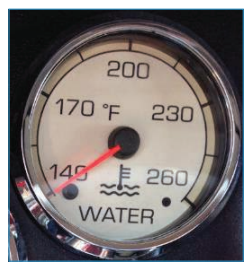
If the engine overheats and the engine coolant temperature warning light illuminates:
• Stop the vehicle but leave the engine running unless a low water warning device indicates a loss of coolant.
• With the transmission in neutral, check to ensure that the oil pressure gauge is within normal range. Increase the engine speed to between 1,100 to 1,200 RPM maximum. Return the idle speed to normal after two to three minutes. If the warning light doesn’t go off or the temperature gauge doesn’t begin to drop, turn the engine off.
• If the overheating came from severe operating conditions, the temperature should have cooled by this time. If it has not cooled, stop the engine and let it cool before checking to see if the coolant is low.
Note: Never open the radiator cap on a hot engine.
Radiator — The radiator is a large heat exchanger (reservoir to store coolant) that cools large quantities of coolant that gets circulated to and from the engine block. The radiator is sealed by a pressure cap, which allows excess liquid to be vented into an overflow tank. The cap should be removed only when the engine is cold.
Fan — For the radiator to maintain a constant coolant temperature, airflow is required to draw off excess heat. The fan draws air through the radiator to cool the coolant, and a shroud around the fan directs the airflow. Fans are temperature controlled, engaging automatically when the coolant temperature gets too high and shutting off again when it has cooled to an acceptable level. Most trucks have a manual override switch on the dash to turn the fan on in case the temperature sensor fails to do so. A typical fan on a newer tractor will use up to 75 horsepower when operating.
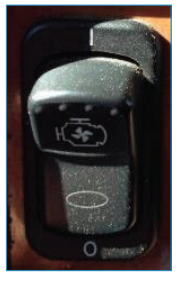
Engine fan override — This switch allows you to control the engine fan manually or automatically. When the switch is on, the fan will run regardless of engine temperature.
When the switch is off, the fan will automatically start when the coolant/water temperature reaches approximately 96°C (205°F), and stop once the temperature has dropped to the normal operating range.
Don’t operate the engine fan in the manual “on” position for extended periods of time. It’s designed for intermittent operation only.
It may be used in conjunction with your engine brake to help hold your vehicle back while going down long, steep grades.
Fan belts — Fan belts transmit the turning motion of the crankshaft to the water pump, fan and other accessories such as the alternator and air conditioning compressor. Proper tension of belts is important for effective operation of the cooling system because belts that are too loose or too tight can cause damage to the fan, hub and water pump bearings. Most newer trucks use serpentine belts which are self-tensioning. It’s an important part of your pre-trip inspection to check the condition of your belts.
Coolant filters — Coolant filters are small canisters that filter impurities (sludge, scale and foreign material) from the coolant. They’re routinely changed when the tractor is serviced. A supplemental additive in the cooling filter assists in neutralizing the coolant to prevent harmful etching and erosion of engine components. This prolongs the life of the cooling system and engine components.
Cab heater — Like the radiator, the cab heater works as a heat exchanger. It has a heater fan which blows air through a heater core. This heats the cab of the tractor. There’s an air filter in this system to keep dust out of your cab. If your fan isn’t putting out enough airflow, the filter could be plugged. The filters are usually located on the firewall of the cab on the passenger side.
Check the owner’s manual for the location of yours. In wet or moist conditions, especially in the winter, it may be difficult to keep your windshield defogged when airflow is restricted due to a plugged cab filter.
Block and auxiliary heaters (optional) — Block heaters are electrically powered devices (120 V) that are used before the vehicle is started to warm the engine coolant in cold weather conditions. The auxiliary heater is a fuelfired heater that uses the vehicle’s own battery for starting and a gun type burner to produce heat. The water pump in the auxiliary heater circulates the engine coolant. This keeps the cab and engine block warm. This makes it easier to start the engine. Most modern diesel engines will start without a problem down to -10°C (14°F). For colder temperatures, use a heater.
Winter front cover (optional) — In areas of Canada where the temperature gets very low (below -20°C or -4°F) a winter front cover may be needed to help maintain the engine operating temperature. They limit the flow of air through the radiator. On after cooled engines, a front cover must not cover the entire opening as a sufficient air flow through the aftercooler must be maintained.
Batteries — Most trucks will have three or four batteries on board. Batteries are 12 volts and their stored power is needed to start the engine. Once the engine is running it gets its power from the alternator. Batteries are mounted securely in the vehicle and should be visually checked as part of your pre-trip inspection if they’re easily accessible. The battery light indicates a battery charging problem.
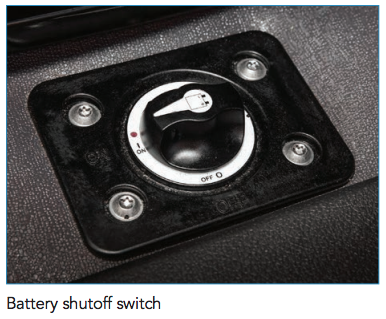
Battery shutoff switch — Disconnects power to most of the vehicle systems so the batteries don’t discharge if the vehicle is parked for several days. The switch is normally located beside the driver seat. It must be in the on position for the engine to start.
Starting system — The starter is an electrical motor with a drive used to turn the engine crankshaft. When the ignition is turned to the start position or the starter button is pressed, current from the battery flows to the starter motor. A solenoid on the starter is activated and moves the drive pinion gear into mesh with the teeth on the ring gear of the flywheel or torque converter. This spins the flywheel allowing the engine to start. The ignition or start button is then released and the drive pinion moves back out of mesh with the ring gear.
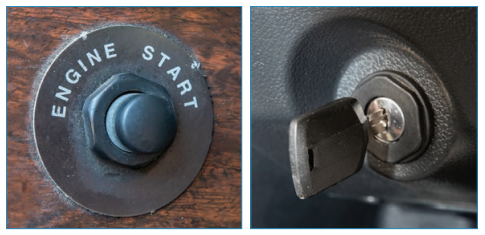
Some older trucks will have a separate ignition switch and then a push button to start the engine. Most late model trucks have the same style ignition/start/accessory key switch as most cars and light trucks today.
Stop engine — Illuminates red with an audible alarm tone when a major engine system problem exists. This is considered an emergency situation and you should stop the vehicle as soon as possible and turn the engine off. The vehicle must be serviced and the problem corrected before starting up again to avoid further damage to the engine.

Wait to start engine — Illuminates yellow when the intake air heater (grid heater) needs to warm the intake air, or glow plugs need to warm the cylinder, before starting the engine.

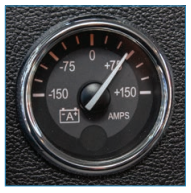
Ammeter — This is the gauge on the instrument panel used to indicate the amount of charge or discharge the battery is receiving from the alternator. With the engine running, the normal position of the needle is in the centre or slightly on the charge side. High rates of charge or discharge usually indicate a problem.
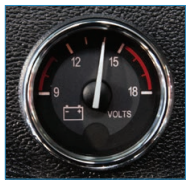
Voltmeter — Indicates voltage in the electrical system. When you first turn the vehicle’s ignition on it will show you the stored voltage of the batteries. Once the engine is running, the charging voltage is displayed and should be around 12.75 to 14.0 volts. If the gauge is reading higher than this it could indicate an over charge situation that could boil your batteries. If it’s reading lower than this you could have a charge system problem and the vehicle may be running on battery power only. Check your ammeter (if equipped) to see if the system is charging or not.
Voltage regulator — This is mounted inside the alternator. It controls the amount of electricity produced by the alternator so that the electrical components aren’t damaged and the battery isn’t overcharged.
Wiring — Wires carry the electricity produced by the alternator. Wiring must be of sufficient size to carry the current. Any weak spot (loose connections, partially broken or corroded wire) will reduce the ability of the wire to carry electricity. Wiring is grouped in a wiring harness that provides protection and support for the individual wires.
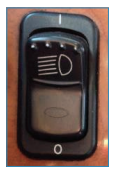
Headlights — Used to turn headlights on and off. When the headlights are on, the dash lights, front park lights, side marker lights and tail lights are also illuminated. Turning on the headlights will turn the daytime running lights off.
Push switch up to turn lights on and push down to turn lights off.
Some headlight switches have three positions: up for all lights on, middle for all lights off and down for marker lights only.
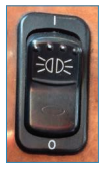
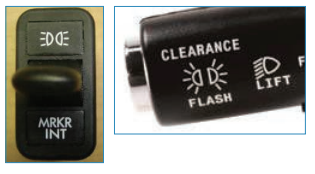
ID and clearance lights — These are the amber lights on the top, exterior of the truck cab and top, front and sides of the trailer, as well as the red lights at the rear of the truck and trailer. Some trucks have these lights included with the main headlight switch.
Push switch up to turn lights on and push down to turn lights off.
Marker interrupter/ID and clearance lights flash — Generally used at night to thank other drivers who assisted you in passing them. It can be a switch on the dash or a button on the end of the headlight dimmer lever located on the steering column. Some trucks have this button on the steering wheel.
It only works when the lights are on.
Dash switch: Push switch down to momentarily turn off all marker and clearance lights. Release the switch to turn the lights on.
Lever button: Push button in towards the steering wheel to momentarily turn off all marker and clearance lights.
Release button to turn the lights on.
Both types can be flashed multiple times to thank drivers by alternately pushing and releasing the switch or button.
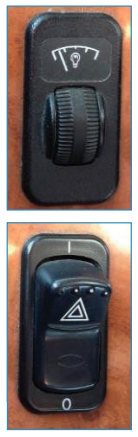
Panel light dimmer — Used to vary the brightness of the instrument panel lights. Dimming the panel lights at night can help increase visibility of the road ahead, and decrease eye strain.
When the headlight switch is on, rotate the thumb wheel up to brighten the panel lights and rotate down to dim the panel lights.
Hazard lights/four-way emergency flasher — To be used when the vehicle is disabled, parked under emergency conditions or any time you have to stop on the side of the road, day or night.
They warn other motorists that you’re stopped so they can easily avoid you. Also commonly used when backing up and to warn motorists that you’re traveling up or downhill slowly (usually at 40 km/h or slower). All turn signals on both the truck and trailer will flash simultaneously.
The flasher will work when the ignition switch is in the on or off position. Push switch up to turn lights on and push down to turn lights off. May be used in conjunction with emergency flares/reflectors.
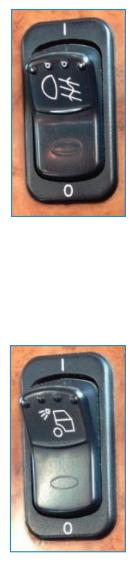
Fog lights/driving lights — To be used in foggy or blizzard-like conditions to assist with visibility. Provincial, territorial and state requirements vary as to when high beams and fog lights can and cannot be used together. Make sure you know the law where you’re traveling.
Push switch up to turn lights on and push down to turn lights off.
Most switches are wired so the fog lights will only operate with the low beam headlights or running lights and that the driving lights will only operate when your high beams are on.
Work light/utility lights — Most truck tractors come equipped with lights mounted to the side of the cab or bunk. Use these lights at night when backing up, coupling and uncoupling, chaining up or doing circle check inspections. This switch will either be located on the dash or a toggle switch will be installed on the inside of the cab wall behind the driver’s seat.
Push switch up to turn lights on and push down to turn lights off.
Remember to turn these lights off when you’re done using them.
Advantages of cruise control include: Improving driver comfort, maintaining a consistent speed and improving fuel economy. Only use cruise control when conditions are ideal.
Cruise control on/off — This master switch turns the cruise control on or off. When conditions are less than ideal, turn the cruise control off to maintain better control of the vehicle and increase your reaction time. Don’t use cruise control when operating on road surfaces with poor traction or in heavy traffic.
Cruise control must be turned off when descending steep grades.
Cruise control set/resume — When the master switch is on, this switch is used to set the desired speed and to resume the set speed when the cruise control has been interrupted. When the master switch is on and the parking brake is applied, it’s used to set a high idle speed while the truck is parked with the engine running.
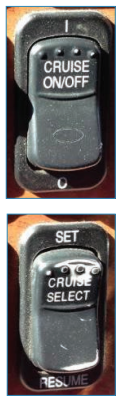
Cruise control:
• Push switch up to set desired speed and release.
• Push switch down to resume a previously set speed and release.
• Some trucks are programmed to automatically resume the set cruise speed after making a gear shift.
When cruise control is in use, the switch may be used to increase or decrease the desired speed.
Setting idle speed:
• Use the accelerator to bring the idle up to the desired RPM, then push the switch up to set.
• Push the switch down to resume idle speed. Some trucks will have the idle speed preset. In this case, simply push the switch up or down to set depending on the manufacturer.
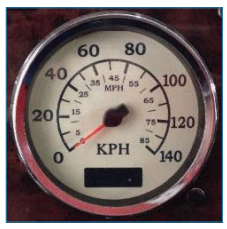
Two key gauges you will be checking regularly are the speedometer (including the message centre) and the tachometer.
Speedometer and message centre — The speedometer indicates vehicle speed and the message centre is usually an electronic area at the bottom of the speedometer or somewhere on the instrument panel in front of the driver.
It displays the following information:
• Odometer: records the distance travelled in kilometres or miles. The far right hand number represents tenths of a kilometre or mile. Like the speedometer, every vehicle is required to have a properly functioning odometer.
• Trip meter
• Hour meter
• Warning and diagnostic messages
If the speedometer is indicating speeds that are slower or faster than what they should be, have the vehicle checked by a mechanic to correct the problem.
Malfunctioning cruise control could indicate a problem with the speed sensor.
If the message centre displays a warning or diagnostic message, and it’s accompanied by a red stop engine light, pull over to determine the cause immediately. Contact your dispatcher to discuss and follow company policy.
Refer to the owner’s manual or contact a repair shop that specializes in the vehicle you’re driving.
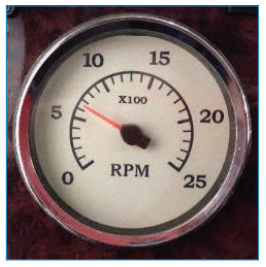
Tachometer — Measures engine speed in revolutions per minute (RPM) and allows the driver to operate the vehicle efficiently by matching speed and gear selection to the operating range of the engine. It may also contain an hour meter that measures the total time of engine operation.
If the engine speed gets too high, select a higher gear to lower the RPMs. If the engine speed drops too low, select a lower gear to raise the RPMs.
To avoid engine damage, don’t let the engine exceed maximum governed RPM.
Refer to your engine’s manual for RPM recommendations.
The brake system for commercial vehicles is designed to safely decelerate large masses in short distances. The brake systems are subject to high demands regarding safety, durability and wear.
As with many other vehicle components, brake systems for commercial vehicles are being constantly developed for better performance.
Park brake — Illuminates red when the parking brake is applied.

Air brake vs hydraulic brake systems
Air brake systems use compressed air for braking action; hydraulic brake systems use hydraulic brake fluid. Some hydraulic systems may also be vacuum assisted. Hydraulic brake systems are more often used in cars and light trucks than in tractor-trailer units.
Hydraulic brake system — Hydraulic brakes apply instantly. Brake fluid is held in a reservoir and brake lines so the system is constantly full. Brake fluid cannot be compressed as opposed to the air brake system.
Air brakes — This is a system that uses pressure from compressed air to increase braking force. Heavy vehicles require a more complex and powerful braking system than ordinary vehicles and air brakes are used as a way to gather the power of compressed air to control momentum, braking both the tractor wheels and the wheel of the trailers. An air compressor takes in air from the atmosphere and compresses (pressurizes) it and pumps it into storage tanks. The size of the air tanks depends on the air volume required for the airlines and chambers. With air brakes, there’s a slight delay in brake activation as the air travels through the system. For more detailed information on the air brakes, see the air brakes unit.
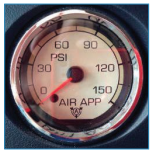
Air application gauge — Measures the amount of air pressure being applied to the brakes from either the foot valve or hand valve. Use this gauge to ensure you’re making a minimum of a 100 p.s.i. brake application when performing a leak test.
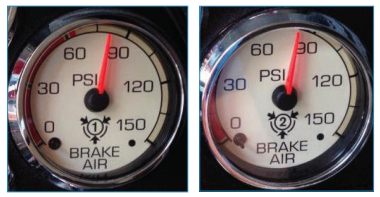
Primary (1) and secondary (2) air pressure gauges
Ensure the air pressure gauges register maximum pressure on both gauges before moving the vehicle. Monitoring the gauges while driving will give you an early warning of any air leaks in the system.
Primary (left image) — measures primary reservoir air pressure for the truck’s rear drive axle brakes.
Secondary (right image) — measures secondary reservoir air pressure for the truck’s front steering axle brakes.
Other option: Single dual air pressure gauge with two different coloured needles indicating primary and secondary air system.
The engine retarder or engine brake helps to slow the truck down. It’s useful when descending steep grades or slowing down to come to a stop. It helps to limit the amount of actual braking required, which keeps your brakes from heating up.
Engine brake on/off — Used to turn the engine brake on or off.
It’s illegal to use engine brakes within some urban areas and most request that you avoid using them. Watch for signs indicating this as you enter cities and towns.
With the switch turned on, you must release both the clutch (if equipped) and throttle pedal for the engine brake to activate.
There’s approximately 1.5 millimetres (1/16 inch) of free play in the throttle pedal. When you take that up, the engine brake will shut off but no fuel will be delivered to the engine.
Ensure you have adequate traction between the drive tires and the road surface before activating the engine brake or you could create a dangerous jackknife situation. There are four types of auxiliary brakes (engine brake, exhaust brake, hydraulic retarder and electric retarder). More information can be found in the air brakes unit.
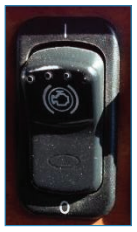
This symbol illuminates green when the engine brake master switch is turned on.

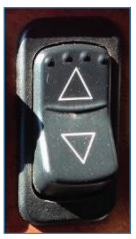
Engine brake mode selector — Selects the progressive braking function that controls the amount of engine holdback. Most trucks are equipped with three modes: low, medium and high. Some trucks only use a single switch. In this case, the up position activates the high setting, the middle position is off and the down position activates the low setting.
Most switches are designed to be used this way:
• Push up to select the high mode which will give the most braking power.
• Set switch to the middle for medium braking power.
• Push switch down for low braking power.
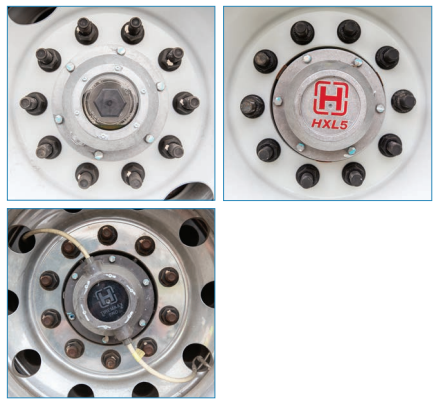
The wheels of the tractor and trailer are mounted to axle hubs. They distribute the weight of the vehicle to the tires and the road surface below.
Wheel bearings — Wheel bearings are located at the ends of the axles.
Bearings may be lubricated by grease or in an oil bath. The hubcap on the wheel end may have a plastic window to allow daily inspection of the oil level.
On drive axles, lubrication must be checked at the oil fill port on the final drive housing. Some wheel ends are filled with grease instead of oil and some also support tire inflation systems as seen in the following pictures.
Rims — Tires are mounted on rims or wheels that are then installed on your truck or trailer. A one-piece rim is used for tubeless tires (radials) which are most common today.
Disc wheels — The one-piece wheel is known as a disc or budd wheel and is constructed of aluminum or steel.
There are two types of mounting systems for disc wheels: stud piloted and hub piloted.
Stud piloted — This mounting system uses the wheel studs of the vehicle as well as tapered nuts to center the rim on the wheel end and clamp it on. The wheel rim will have tapered or beveled holes to match the nuts and studs which are carrying the weight of the load.
When mounting dual wheels, there’s an inner nut that attaches the inside wheel to the stud. This then becomes the stud for the outer wheel to mount to with an outer nut. Nuts and studs used in this mounting system will be right hand threaded for the passenger side of the vehicle and left hand threaded for the driver side of the vehicle. Be careful not to mix them up.
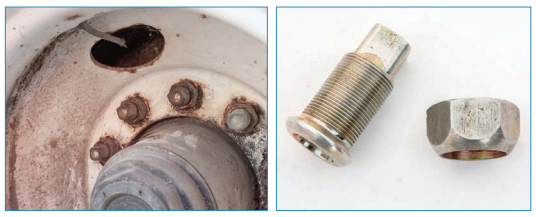
Hub piloted — This mounting system uses the centre or hub of the wheel to carry the weight and align it properly. The holes in these rims for the studs to go through are flat and the wheel nuts used come with a built-in flange washer, so the nut doesn’t dig into the rim when you’re tightening it up.
The hub on the wheel end of the truck or trailer has flanges to keep the wheel centred. Be sure to check for cracked or broken flanges when you’re doing your pre-trip inspection. When mounting dual wheels with this system, slide the inner and the outer wheel onto the hub flange over the studs and use a single nut to clamp the two wheels onto the vehicle.
The hub piloted system has superior clamping force, uses fewer wheel nuts overall and all wheel nuts in this system are right hand threaded. The hub piloted system became industry standard when it was introduced in the early 1990s so you’ll only see the stud piloted system on older vehicles.
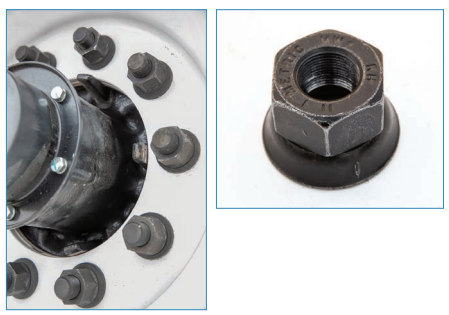
Note: All wheel nuts, for all types of wheels, must be checked that they’re tight and are torqued by a qualified installer. After installation it’s required to get wheels retorqued usually within 150 km. Make sure you pay extra attention to any recently installed wheels during your vehicle inspections to ensure they’re staying tight.
Tires provide traction, reduce vibration and absorb shock. It’s important to have tires with good tread that are adequately inflated and are checked frequently for wear and tear.
Tubeless type tires — Tubeless type tires are mounted on single-piece rims.
The tire itself holds the air. Air pressure causes the tire bead to seat against the rim. The valve stem mounts in the rim and is held in place by a nut. Tubeless rims have a recessed dropped centre that assists in mounting the tire. Tubeless type tires are safer to install than tube type tires.
Super single tires — One super singles tire replaces a set of dual tires. They provide lower rolling resistance, reduce weight and lower vehicle height.
Canadian rules now allow super single tires to carry the same weight as dual tires. There are specific requirements for use of super single tires in B.C. that you should be aware of under section 7.25 of the Commercial Transport Regulations.
Advantages of radial tires — Although radial tires are more expensive than other tires, the tread on radials lasts from one and a half to three times longer than on bias and belted bias tires. More of the surface area of radial tires meets the road; therefore, radial tires have greater traction while creating 50 per cent less friction. The result is greater fuel economy and reduced tire wear, hence a lower cost per kilometre driven.
Matching tires — Mixing different tire types can create problems because of differences in traction and turning capabilities. Because of this, the tires on your vehicle should be of consistent size and construction and, if possible, the same brand. Never put tires of different sizes or construction on the same axle.
Never combine the use of radial and bias tires on an axle.
Reconditioned tires
• Full recap — The remaining tread is completely shaved, and a new tread is bonded directly onto the old tire. In the full recap or full retread method, the edges of the new tread extend slightly down the sidewall of the old tire. You can choose from a variety of tread patterns when having your tires recapped depending if you want to use them on a trailer (rib pattern) or tractor drive axle (traction pattern).
• Recap tires are illegal for use on steering axles.
Load Ratings — Commercial tires may display information on the number of body plies in the tire construction.
The construction of the tire determines the load rating which is printed on the tire sidewall. For example:

Tire inflation — Having tires inflated to the proper pressure for the load you normally carry is essential to the effective operation of your vehicle. Tires should be inspected thoroughly and often. For correct tire pressure, refer to the vehicle’s owner manual or company policy.
When inflating tires, keep in mind:
• A visual check of tire shape is not an effective way to determine proper inflation.
• Suggested tire pressures are stated for cold tires. If tires have been driven and are heated, they will have a higher pressure. If tires show less than proper pressure after they’ve been heated from use, they should be inflated to the correct tire pressure. They should then be rechecked the next time they’re cold.
• Note the maximum pressure for the load that you’ll be carrying; make sure not to exceed the rim or wheel rating.
• Replace the valve stem caps to maintain a tight air seal and prevent dirt and moisture from entering.
• If you’ve mounted new tires, check their pressure after 24 hours to get an accurate reading.
• During regular operation of your vehicle, you can expect tire pressure increases of 10 to 15 p.s.i. (pounds per square inch). Greater increases may suggest under inflation, overloading, excessive speed, incorrect tire size or any combination of these. As soon as you realize that one of these factors may be present and creating abnormal heat, stop and correct it.
Effects of underinflation
Underinflation is detrimental to the life of a tire in several ways:
• The tire tread wears down more quickly.
• The temperature can increase within the tire and cause the tread to separate from the body or belt ply.
• Over deflection can occur. As the soft tire travels over the road, the centre of the tread deflects upwards weakening the body cords. If this continues, the body cord construction deteriorates resulting in a sudden release of air (a blowout).
Dual wheels — If operating dual wheels with one of the tires underinflated or flat, the internal and external functions acting upon the tire can lead to heat build-up and the destruction of the tire (tire shredding). An equally disastrous alternative is that the other (good) tire could fail through overwork. This could be extremely dangerous for both the driver and other road users.
Radial tires — Radial tires may appear soft while actually maintaining their proper pressure. However, you should make sure that the pressure doesn’t go too low. There will be serious consequences if excessive heat is generated and the tires fail. In an emergency situation, you’ll have difficulty controlling your vehicle if the tires are underinflated.
Effects of tire overinflation
Overinflation, like underinflation, isn’t good for the tire in several ways:
• The centre of the tread will wear out quickly and the tire won’t provide optimal traction.
• Over rigidity of the tire makes it more susceptible to damage from objects on the road surface. This means it’s easier for the tire to be cut, snagged or punctured.
• The tire’s ability to absorb shock is decreased. Body breaks can occur, stressing the rim and causing it to fail.
It’s important to remember that you can’t increase the recommended maximum load capacity of your vehicle by increasing tire pressure.
Tire tread life — It’s difficult to determine the exact tread life of tires because there are so many varying conditions under which tires and vehicles operate.
Tread life depends on tire quality, usage and positioning:
• Tires on front axles — Front axle tires should be checked regularly and changed when required. This is recommended because the front tires are relied upon for steering. If they fail there would be serious consequences. If they’re still in good condition, they can be used on a rear axle or trailer where the risk is lower.
• Tires on tandem drive axles — On tandem drive axles, average tire tread life is noticeably longer than on single drive axles. This is because the drive traction is distributed over both axles and not concentrated on one axle.
• Driving habits and style — As a driver, you can greatly increase the life of your tire treads by taking care to shift smoothly and by driving responsibly. Tread life can be cut in half if you drive exceedingly fast or brake sharply.
Routine monitoring and maintenance — Pay close attention to the condition of the tires and drive systems. Check for damage such as bulging or sidewall cuts and ensure the proper functioning and alignment of the suspension system and axles. Always check that the tires are properly inflated and matched for the vehicle load.
Proper matching of dual tires — Tires in dual assembly should be matched with regards to design and dimensional tolerances. If two tires of differing diameters are positioned together, the larger tire will begin to overheat and bulge out at the sides because it takes on more of the load. The smaller tire will wear irregularly because of its improper road contact and may result in tread separation. If the larger tire bulges too far, it will begin to touch or “kiss” the other tire. This increases the friction and heat between the two and could result in a blowout in one or both of the tires.
Note: All wheel nuts, for all types of wheels, must be checked that they’re tight and are torqued by a qualified installer. After installation it’s required to get wheels retorqued usually within 150 km. Make sure you pay extra attention to any recently installed wheels during your vehicle inspections to ensure they’re staying tight.
Did you know?
Gators are a result of some tire blowouts.
This can happen when the tires are driven underinflated or damaged due to striking an object. As a result of the sudden explosion of a tire casing there will sometimes be pieces of the tire or “gators” strewn across the road behind you. This creates a hazard for other road users as they may have to take evasive action to avoid them. If you blow a tire be sure to check your vehicle for any additional damage from the blowout and clear the debris from the highway if safe to do so. Find a safe place to pull over and call your dispatcher to get a tire repair service truck sent to help you.
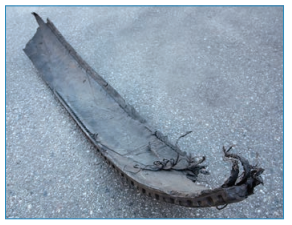
The coupling system connects the tractor to a trailer. There are two main types: Semi-trailer connected to a tractor with a fifth wheel and kingpin, or pintlehitch with a hook and eye to connect a trailer to the rear of a truck/tractor or to the back of another trailer. Proper coupling of the trailer is one of the major responsibilities you have as a professional truck driver.
The following details are provided as an overview only. See the unit on in-yard manoeuvres for details on how to couple and uncouple a trailer.
Fifth wheel — The fifth wheel is a coupling device that’s mounted on the vehicle chassis. It consists of a skid plate, associated mounting brackets and a latching mechanism that couples or connects to a kingpin located on the trailer or other vehicle component. Its purpose is supporting and towing a semi-trailer. Many fifth wheels can slide to a different position if you need to redistribute weight or allow for swing clearances between the tractor and trailer.
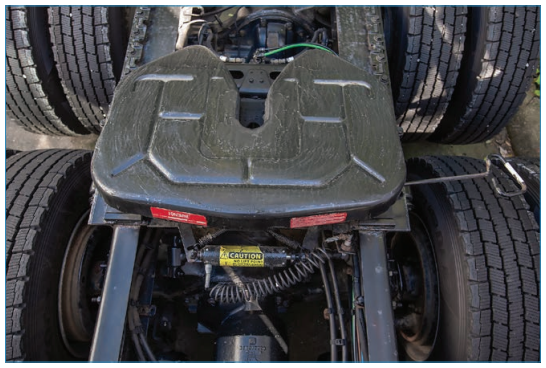
Fifth wheel slide lock — Used to slide the fifth wheel to various positions in order to adjust weight distribution between the steering axle and the drive axles, as well as to accommodate a trailer with a deep kingpin setting, for example.
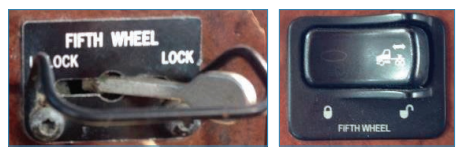
Generally once the fifth wheel has been set you don’t have to move it again.
Never operate the vehicle with the switch in the unlock position. Always ensure the switch is in the lock position and the pins are locked in place before driving the vehicle. Otherwise, the trailer could come unhitched from the tractor.
Don’t move the fifth wheel while the tractor-trailer is in motion. Move the switch to the unlock position to release the pins that hold the fifth wheel in place. Once the fifth wheel is moved to the position that you want, move the switch to the lock position. Always visually confirm the fifth wheel has relocked.
Fifth wheel slide unlocked — Illuminates red with an audible warning tone to remind the driver that the fifth wheel slide is unlocked.
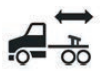
Trailer kingpin — This is a minimum 5 cm (2 in) strengthened steel pin that fits and locks into the jaws of the fifth wheel to couple the tractor to the trailer.
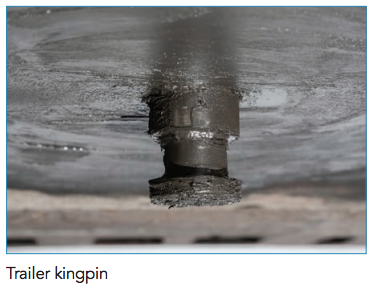
Pintle hitch — A pintle hitch is a type of tow hitch that uses a ring-to-hook configuration for a more secure mount that’s ideal for rougher terrain. This type of coupler is a mechanism that’s bolted or welded onto the end of a trailer tongue. It fits securely over — and pivots on — the tow vehicle hook.
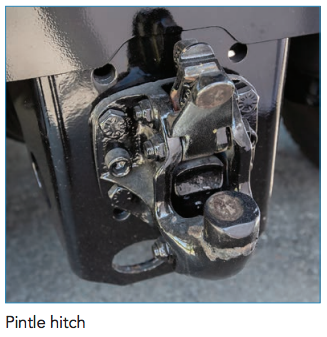
Roll coupling hitch — This is a low-lash coupling that provides the same function as a universal joint. It allows motion around the yaw axis (turning corners) and pitch axis (driving over bumps) and prevents twisting unless the hitch is equipped with optional selective roll-coupling.
Landing gear — This provides stationary support for the front of a semi-trailer when it’s not coupled to a tractor.
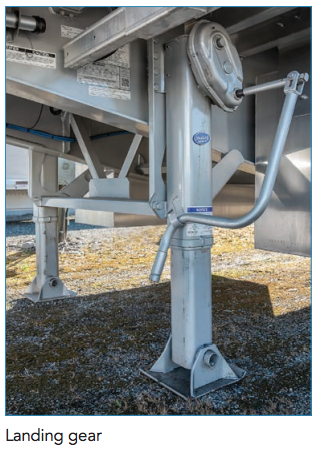
Technology innovations play a huge part in pushing the trucking industry forward and keeping efficiencies for customers and carriers at the forefront.
New products are entering the marketplace monthly so the following list is likely already out of date. Subscribe to and read online trucking publications to stay informed about the latest improvements in the trucking industry.
Electric heavy trucks
A lot of manufacturers now have electric heavy-duty trucks that are ready to replace the diesel and gasoline-powered models of today. While pure battery powered technology is available (mostly in smaller delivery trucks), most of the heavy vehicle industry is focused on hydrogen fuel cell powertrains.
These provide significant weight and space saving advantages over electric technology for heavy-duty trucks. They also allow for greater range of operation for longer hauls.
The advantages of electric trucks include a quieter environment and less pollution. Further, many cities have noise restrictions during evening hours.
Because electric trucks are so much quieter, they can perform tasks overnight that diesel-powered trucks are barred from doing. More trucks on the road at night means less congestion on the roads during the day.
Electric motors also hit peak torque almost instantly, allowing them to accelerate up to two times faster than a stock diesel tractor. New electric trucks have better aerodynamics, using energy only when needed with no idling, and use regenerative braking — a process that uses the vehicle’s motor as a generator to convert much of the kinetic energy lost when decelerating back into stored energy in the vehicle’s battery.
Driver-assist systems and self-driving vehicles
Several companies have begun developing self-driving truck technology. This innovation reduces, and in some cases eliminates, active driver steering. It requires a well-marked highway so onboard cameras can read road lines and position the vehicle. Among other technologies, self-driving trucks use:
• Radar-based adaptive cruise control (ACC) which automatically accelerates and decelerates, maintaining safe distances.
• Lane departure warning system (LDWS) that uses cameras to detect lane edges and striping to alert drivers when the vehicle is drifting.
Detection technologies
Detection technologies alert drivers when a bicycle, pedestrian or slowmoving or stationary obstacle has been detected when driving at low speeds, generally around 40 km/h. Some systems can only detect bicyclists, pedestrians or obstacles when they’re traveling directly in front of the vehicle and when moving in the same direction. Typically the sensors are radarbased. Warnings can come in the form of sounds, visuals, vibrations or a quick brake pulse, or a mix of warnings. The beeps become faster as the vehicle moves closer to the obstacle. A crash is imminent when the beeps become continuous. For some versions of obstacle detection, it will apply the vehicle brake automatically.
Blind spot monitoring and warning
Blind spot monitoring and warning technology warns the driver of other vehicles driving in their blind spots. The warning can be a displayed symbol, a sound or a vibration. The system may provide an additional warning if a driver uses their turn signal when there are other vehicles in the adjacent lane.
The warnings provided by the blind spot monitor can be helpful to the driver when making a lane change, but the driver should still always check their mirrors and perform a shoulder check.
Blind spot monitors are intended to provide an additional monitoring resource to mirrors and shoulder checks. Drivers should not become complacent and dependent on blind spot monitors alone for changing lanes.
Side view cameras
Some newer vehicles are equipped with side view cameras that give the driver an expanded view of the lane beside the vehicle when they use the turn signal or when they activate the feature manually. This feature shares similar uses to blind spot monitors.
The feature shows the driver a video view of what’s next to or coming up alongside the vehicle. They may be used in conjunction with or in place of traditional mirrors. The driver can use the turn signal or activate the feature through a button usually located on the turn signal lever. If the driver wants to use this feature while backing up, it may only turn on if they’re at low speeds.
Forward collision warning systems
Forward collision warning systems alert drivers of an impending collision with a slower moving or stationary vehicle or object ahead so a driver can brake in time to avoid a collision. Sensors located in the front of the vehicle are able to detect how close you are to other vehicles ahead. These typically are camera or radar-based. Warnings can come in the form of sounds, visuals, vibrations or a quick brake pulse, or a mix of warnings. The forward collision warning system scans the traffic ahead 20 times per second up to 150 m (492 ft) in front of the driver and then warns the driver to brake if a hazard is in their path.
In August 2017, the National Highway Traffic Safety Administration in the USA and Transport Canada mandated that ESCs were to be installed on all three-axle truck tractors manufactured after that date. The rule was expanded to cover all tractors as well as buses by August 1, 2019. This is an upgrade to existing roll stability systems.
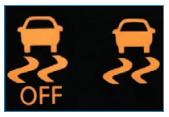
Since the RSS and ESC systems have been installed on trucks, there’s been an increase in skid marks from tires going into certain curves on B.C. highways. In general, this is caused by drivers who push their safety margins when driving which causes the RSS or ESC systems to activate. This primarily happens with empty vehicles and drivers who are pushing the limits causing their vehicle to sway or lean into curves thus causing an activation of the system. When brakes are automatically applied on an empty trailer it will skid quite easily. If you find your driving style is activating these systems then perhaps you should slow down more before entering turns and curves.
This system will be installed on many of the vehicles you drive but will hopefully never activate if you are driving within the abilities (speed, available traction) of your vehicle.
Anti-lock brake systems are mandatory in Canada on all trucks and buses over 4,536 kg (10,000 lb) manufactured since April 1, 2000 and on all commercial trailers equipped with air brakes.
The system monitors wheel speed and adjusts air or hydraulic pressure in the brake chambers to prevent wheel lockup under severe braking. Continuous wheel speed sensing information is transmitted to an electronic control unit (ECU) that processes the information for brake pressure application, allowing the system to accomplish its task.
The ABS allows the driver to steer while applying continuous brake application. ABS doesn’t allow you to drive faster or stop sooner. In fact, on some surfaces such as gravel, the braking distance with ABS may be longer. ABS may also help you prevent jackknifing.
Truck/tractor ABS symbol
The symbol illuminates yellow when the ignition switch is first turned on and will remain on until the system self-test has been completed successfully. Sometimes you need to drive the vehicle above 4 km/h before it can complete its self-check.
If the light doesn’t illuminate at all or stays on for more than three seconds and doesn’t shut off, contact a repair shop.
The truck/tractor ABS symbol illuminates during normal operating conditions to indicate a problem with the ABS system.

Trailer ABS symbol
The trailer ABS symbol illuminates yellow for a bulb check when the ignition switch is first turned on whether or not a trailer is connected to the vehicle. If the light does not illuminate at all, have the problem checked.
• With no trailer connected or a trailer not equipped with ABS, the light will go off after one second.
• If an ABS-equipped trailer is connected properly, the light will remain illuminated for a few more seconds while the trailer ABS is tested. If no problems are detected, the light will go off.
If problems are detected, the light will remain on, and the driver should have the problem corrected before the vehicle is driven with that trailer attached.
The symbol illuminates during normal operating conditions to indicate a problem with the trailer ABS.
Note: Tractors/trucks and trailers built on or after March 1, 2001 must be equipped with an in-cab trailer ABS warning light. Trailers built prior to March 1, 2001 are designed to verify ABS status via the required external yellow warning light mounted on the trailer.
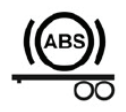
Automatic traction control (ATC) is an optional addition to an ABS. It uses the pulsating signal from the speed sensors to detect loss of drive wheel traction on slippery road surfaces.
Using the same wheel sensors used by ABS, ATC can sense if a wheel has lost traction and is spinning instead of helping to accelerate the vehicle. If a drive wheel begins to spin, the traction control system will apply that brake, transferring power to the opposite side. In extremely slippery conditions, the traction control system will reduce engine power, allowing the wheels to regain traction.
Most vehicles equipped with ATC will have an information decal on the dashboard and a dash-mounted indicator that will light up if wheel spin occurs. ATC is always active. If you find yourself in especially slippery conditions you can turn the ATC switch on which will allow for additional wheel spin before derating the engine which may be desirable in some situations.
When on, a wheel spin control warning light will illuminate when drive wheel spin is detected and power will be reduced until the wheel stops spinning.
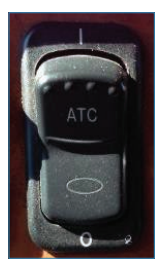
The introduction of these sophisticated electronic tracking systems has helped carriers become more efficient and have better data to base business decisions on. For example, they can use the information available to decide whether a given load would be profitable to them or not. They can monitor the location of the vehicle and re-route a driver to an unscheduled stop on the fly thanks to real-time two-way communication.
When the systems are shared with customers, they can also improve customer satisfaction. A customer may have access to tracking information that indicates when they can expect a shipment to arrive, helping them to plan and reducing calls to dispatchers.
Some of the available applications also save time and reduce record keeping for drivers by automatically recording log book data and completing a number of forms.
The communication components of electronic fleet management systems
are usually part of a broader system that may do all or some of the following,
depending upon which modules your employer has purchased:
• Track the location and status of loads, trailers and cabs using Global Positioning System (GPS) technology
• Record when a trailer is connected and disconnected
• Provide information about the performance of a vehicle (braking and idling information, oil pressure, coolant temperature, and so on)
• Container tracking
• Verify the delivery of a load
• Let customers check where a load is at any given time
• Monitor the operation of reefers (temperature, failure of cooling system, for example) and notify dispatch of any problem
• Monitor partial loads and allow the office to identify new loads a driver could add en route
• Automate some billing processes
• Speed up some customs processes
• Usage-based insurance (in some jurisdictions)
Most engine manufacturers offer remote engine, after-treatment and automated transmission diagnostic systems. When a MIL, check engine or stop engine light illuminates, an email is sent to the authorized representative of that vehicle describing the problem and possible solutions. If the vehicle is in cell range the message is sent immediately and will indicate if it’s a “service now” or “service later” event. Typically, these programs come with a free subscription when you purchase a new vehicle but will be required to be renewed to maintain the service.