
[ultimatemember form_id=3702]
14. Vehicle inspection and maintenance
In this unit, you’ll learn how to inspect the tractor-trailer before, during and after a trip and how to fill out a vehicle inspection report.
This unit will help you learn to:
• Understand your role as a professional driver in ensuring no unsafe vehicles are on the road.
• Explain the importance of conducting pre-trip, en route and post-trip inspections.
• Describe a systematic sequence to use in a complete pre-trip inspection.
• Conduct an inspection using a checklist and pre-planned procedure.
• Complete an inspection report.
• Understand basic checks and service needed for the vehicle.
• Explain the requirement for a preventative maintenance program.
• Describe some basic maintenance procedures.
Canada’s National Safety Code (NSC) sets out minimum standards of vehicle maintenance and inspection for drivers, mechanics and government vehicle inspectors to ensure safe vehicle and equipment operation on roads. These minimum standards (or best practices) have been adopted by Canadian provinces and territories through each jurisdiction’s various regulations, and may differ from what is set out in the NSC. The following NSC standards have informed B.C.’s provincial vehicle and inspection maintenance requirements:
– NSC Standard 11 — Maintenance and Periodic Inspection Standards:
Part A contains the recommended standards for a commercial vehicle maintenance program and the minimum criteria that should be evaluated in an audit of a carrier’s operation. Part B contains the recommended schedule frequency for periodic motor vehicle inspections at an authorized facility and the standards to which the vehicle will be inspected. In B.C., these standards are set out under the Commercial Vehicle Inspection Program (CVIP) and carried out at Designated Inspection Facilities (DIF), under responsibility of the B.C. Commercial Vehicle Safety and Enforcement (CVSE) branch.
– NSC Standard 12 — Commercial Vehicle Safety Alliance On-road Inspection: The Commercial Vehicle Safety Alliance (CVSA) is a non-profit association made up of local, provincial, territorial, as well as U.S. state, and federal commercial motor vehicle safety officials and industry representatives.
CVSA developed the North American Standard Inspection Program as the roadside inspection process for inspecting commercial motor vehicles and drivers throughout North America. In B.C., it is CVSE that carries out these onroad inspections based on CVSA’s inspection criteria.
– NSC Standard 13 — Trip Inspection: This standard sets out the daily vehicle trip inspection criteria a driver or other designated personnel must check to ensure early identification of vehicle problems and defects, and to prevent the operation of vehicles with conditions that are likely to contribute to a vehicle crash or breakdown. NSC Standard 13 — Part 2 contains a schedule of inspection items for trucks, tractors and trailers, referred to throughout this chapter and by industry as “Schedule 1.” This is the minimum standard used by industry when conducting a daily vehicle trip inspection.
The following table shows the different requirements of each of the NSC standards, which have been implemented through B.C. regulations in the MVAR and by CVSE policy requirements for industry:
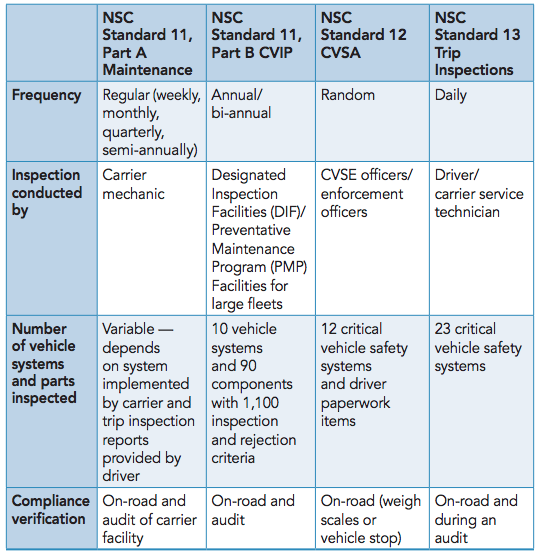
The daily pre-trip and post-trip inspections conducted by the professional driver are critical to the whole system of vehicle inspections shown in the table above. When you conduct trip inspections thoroughly and completely, the information provided to the carrier ensures small problems are identified and corrected as part of the maintenance process. In addition, diligence in conducting daily trip inspections ensures a vehicle is not placed out of service by an enforcement officer roadside, avoiding costly repairs away from the terminal and customer dissatisfaction over delays in product delivery. This also protects your earning ability as many driving jobs are paid per kilometre or a flat-rate trip fee. If your vehicle is broken down or out of service, you won’t be able to earn any money. It is important to make sure that the vehicle you are operating is free from defects that might cause a vehicle breakdown or safety concerns for yourself and the general public.
The Canadian rules are similar to U.S. Federal Motor Carrier Safety Regulations (FMCSR), Section 393, which covers parts and accessories for safe operation and Section 396, which describes the annual inspection requirements, as well as repair and maintenance requirements.
Generally, the Canadian trip inspection rules require professional drivers to complete more thorough daily trip inspections than are required in the U.S.
There are no Canadian federal trip inspections, but most provinces have adopted the Canadian NSC standard. The Canadian trip inspection rules provide additional guidance on what must be inspected and how to conduct the daily trip inspection and record the results. CVSA on-road inspections performed by enforcement officers are identical in both countries.
In general terms, the Canadian rules are much more specific and complete in laying out the steps that must be taken by drivers and carriers to comply with preventative maintenance and inspection rules. For example, in the U.S., if a vehicle passes a CVSA on-road inspection, proof of this inspection can be used to comply with the U.S. annual inspection requirements. However, this practice isn’t allowed in Canada, where the annual inspection is much more thorough — it includes 10 major vehicle systems and more than 90 parts and must be completed in a provincial Designated Inspection Facility (DIF) by governmentcertified technicians (mechanics).
While there’s a reciprocity agreement in place between Canada and the U.S.
on periodic (annual) inspection programs, Canadian drivers and carriers aren’t required to inspect to U.S. part 396 rules. All Canadian registered vehicles must be inspected to the standards set out by each province and territory.
In B.C., commercial vehicles must meet provincial inspection requirements under the Commercial Vehicle Inspection Program (CVIP) set out under authority of Division 25 of the Motor Vehicle Act Regulations (MVAR), and managed by the B.C. CVSE branch. These B.C. requirements align with NSC Standard 11 — Maintenance and Periodic Inspections Standards. The goal of the CVIP is to ensure all commercial vehicles are subject to a systematic, regular preventative maintenance program. Regular preventative vehicle maintenance ensures small problems can be corrected before they result in crashes, major repairs, or a vehicle breakdown a long way from a service facility.
Inspections under B.C. CVIP requirements are completed every 6 or 12 months, based on vehicle type, at a designated inspection facility (DIF) or at Preventative Maintenance Program (PMP) facilities in the case of large fleets. Vehicles with a licensed GVW over 8,200 kg but less than 17,300 kg, as well as trailers and semi-trailers must be inspected every 12 months. Taxis, limousines, buses, dump and logging trailers, as well as vehicles with a licensed GVW over 17,300 kg, must be inspected every 6 months. It is generally the responsibility of the carrier to ensure that each vehicle in its fleet meets the CVIP inspection requirements and schedule. However, as a commercial driver you need to be aware that a vehicle inspector or enforcement officer may issue a Notice and Order to require a vehicle to have a CVIP inspection at any time. If a vehicle fails inspection, the necessary repairs must be done to bring the vehicle into compliance.
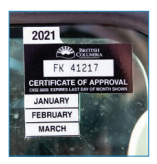
Vehicles that have met CVIP inspection requirements will receive an inspection report and certificate of approval in the form of a CVIP decal, placed on the outside lower left hand or lower right hand of the vehicle’s windshield, or other outside glazed surface to the right hand of the driver. In the case of a trailer, the CVIP decal is placed on the outside left or right, lower front corner of the trailer. A vehicle with a valid B.C. CVIP decal meets the annual inspection requirements in other Canadian jurisdictions and the U.S.
As a commercial driver, you must confirm that both the truck-tractor and the trailer you are hauling have a valid CVIP inspection decal on each unit before you drive or park your vehicle on a highway or other roadway. A copy of the DIF’s inspection report must also be carried in the vehicle. It’s an offence to operate a commercial vehicle that has failed an annual inspection or with an expired CVIP inspection decal.
Learning how to perform a good inspection is a very important step in
becoming a professional driver. It requires that you can identify and recognize
the operational status of each part and system on your rig as part of your
daily routine, because the public expects its operation to be legal, safe and
professional. Passing roadside inspections demonstrates a sincere respect for
the rules and regulations of the transportation system. Meeting operational
safety standards reduces the frequency of breakdowns and incidents.
The goals of inspection include:
• Taking a systematic approach to determine which system or parts are
functioning properly, deteriorating or malfunctioning.
• Meeting the driver’s legal responsibility to ensure that the vehicle and cargo
are safe for the road.
• Providing a record that demonstrates the current operational state of a
vehicle during roadside spot checks.
• Communicating maintenance issues to mechanics in a technically accurate form.
Vehicle inspections by the driver
Every commercial vehicle registered in B.C. with a licensed GVW of 5,000 kg (11,023 lb) or more must receive a daily trip inspection, but the following commercial vehicles also require a daily trip inspection report to be filled out by the driver or person authorized by the carrier: taxis, buses, commercial vehicles with a licensed GVW over 8,200 kg, vehicles licensed under the Motor Carrier Act, or a trailer/semi-trailer defined under the CTA, as well as vehicles owned or leased by a driver training school, and those under a temporary operating permit under the Passenger Transportation Act. As a commercial driver, you are responsible for the following three types of vehicle inspections:
1. Pre-trip inspection: A check of systems and parts done before each trip, including how the cargo is loaded and secured. These inspections must be recorded on the Driver’s Vehicle Inspection Report (DVIR) listing any defects.
• Has routine maintenance been performed?
• Have previously noted mechanical problems been repaired?
• Are all parts and systems operating in a safe fashion?
• Is the cargo safely loaded and secured?
• Is the rig ready to leave the yard?
2. En route inspection: A check of the truck, including controls and instruments while en route.
• Are all controls and instruments still operating properly?
• Are the tires at the proper inflation and in good condition?
• Are all the lights still functioning correctly?
• Are your brakes still in adjustment?
• Do you have any air leaks?
• Is the cargo still secure?
3. Post-trip inspection: A check at the end of the shift, trip or day. These inspections must be recorded on the DVIR listing any defects.
• Are all parts and systems operating in a safe fashion?
• What repairs must be performed before the next trip?
Commercial vehicle safety and enforcement agencies in each province and territory are responsible for commercial vehicle compliance with provincial and federal acts and regulations that align with NSC Standard 12 — Commercial Vehicle Safety Alliance On-road Inspection. B.C. has adopted NSC Standard 12 for its roadside inspections of commercial vehicles, which are carried out by CVSE officers based on CVSA inspection criteria. All of the CVSE enforcement officers and some police officers are CVSA trained and certified to perform CVSA level 1 inspections (the most thorough). B.C.’s CVSE officers conduct more than 30,000 vehicle inspections each year, issuing violation tickets and removing unsafe vehicles from the provincial roadways on a daily basis.
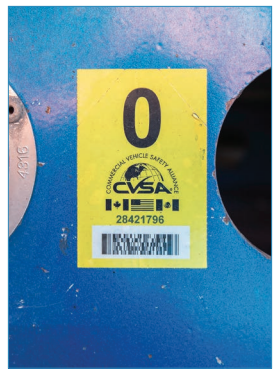
All vehicles must be in safe operating condition at all times and must meet the minimum CVSA standards to receive a CVSA decal. If a vehicle meets the minimum standards, it will be given a decal. The decal is valid for the month in which it was issued, plus an additional 2 months. The colour of the decal indicates when the CVSA level 1 inspection was passed:
Green – January to March
Yellow – April to June
Orange – July to September
White – October to December
The results of these vehicle inspections, which may be conducted randomly at roadside or at weigh-scale inspection stations, are recorded on a “carrier’s profile,” and can affect the carrier’s safety rating under B.C.’s NSC program.
A carrier’s profile includes information on driver and carrier contraventions (guilty and pending), CVSA inspection results, carrier audits, crash information, driver and vehicle information, CVIP vehicle inspection history, Notice and Order history, primary type of business and jurisdiction, among other information.
The following are levels of CVSA inspection that CVSE officers may carry out roadside for Class 1 drivers of a tractor-trailer vehicle:
Level 1: Full inspection (vehicle & driver)
Level 2: Walk around inspection
Level 3: Driver only inspection
Level 4: Special inspection
Level 5: Vehicle only inspections
Level 6: Enhanced – Radioactive
Level 7: Other provincial
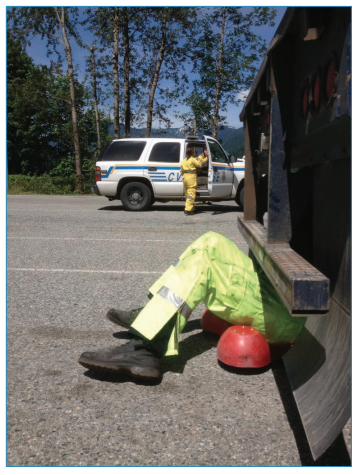
During any given time, CVSE may conduct a road safety commercial vehicle inspection sweep to check the condition of vehicles being operated on B.C. roads. Mechanical deficiencies, load security issues, bald tires, faulty brake and steering component conditions are some of the unacceptable issues they encounter.
On average, over the past 10 years in B.C., about 300 people per year have died in crashes, with almost 20 percent of them involving a heavy commercial vehicle.
The following are some examples of why a driver may be taken out of service after an inspection by a CVSE officer or other enforcement officer:
• Hours of service violation
• Being impaired by drugs, alcohol, fatigue or sickness
• Incorrect or no driver’s licence/endorsements
• No Transportation of Dangerous Goods certificate when required
A vehicle may be placed out of service for the following:
• Unsafe vehicle
• Insecure or leaking cargo
Inspection stations
In addition to mobile patrol units, CVSE inspection stations exist at fixed locations throughout B.C. All commercial vehicles with a licensed GVW exceeding 5,500 kg are required to report to scales when they are open or when directed by an enforcement officer, including those being used for bobtailing.
Vehicles are checked at the scales to measure the dimensions of the vehicle, weigh all or part of the vehicle, or to allow enforcement officers to inspect any
defects in the vehicle or the load carried, and for any other purpose under the Commercial Transport Act and its regulations. It may be necessary to rearrange the load on the vehicle, or remove all or part of the load, to comply with vehicle weight, dimension and load requirements before you can continue operating.
An enforcement officer may also inspect your vehicle and trailer brakes, as well as operate the vehicle for the purpose of testing the brakes. You must ensure you have all of the necessary vehicle, driver and cargo paperwork and documents in order when presenting at an inspection station or engaging with an enforcement officer.
What to do at a weigh scale
If you’re driving a vehicle that’s required to report to an inspection station, follow these procedures:
• Loaded vehicle — drive slowly across the scale lane watching the light board for direction.
• Empty vehicle — even if your vehicle is empty, you must cross the scale by law. However, some scale sites may have lane options for empty vehicles. Drive slowly and make eye contact with the scale master in case they want to wave you in.
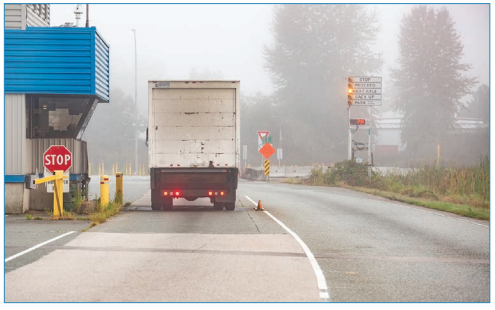
The light board communicates what the scale master needs you to do:
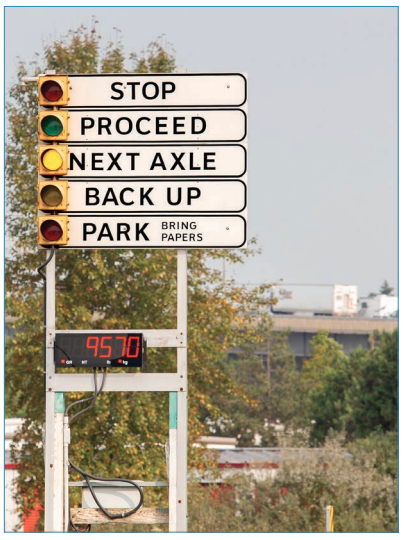
• If the STOP light is activated, stop and wait for further instructions.
• If the BACK UP light is activated, slowly and safely back up keeping in mind that there may be other vehicles behind you.
• If the NEXT AXLE light stays on, roll slowly and smoothly across the scale deck and carry on your way.
• If the PARK light is activated, park in the lot and bring all vehicle and driver documents to the scale building.
Note: Procedures may vary by scale location.
Weigh2GoBC
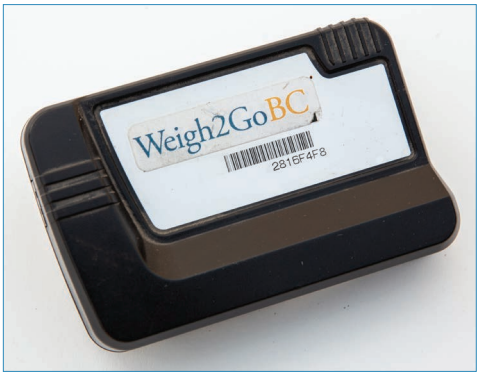
Technology is boosting efficiency at inspection stations. In the past, all commercial vehicles carrying a load with a licenced GVW of more than 5,500 kg (12,125 lb) were required to stop at fixed scales (inspection stations) when they’re open. Now, Weigh2GoBC technology allows commercial carriers to bypass Weigh2GoBC inspection stations. A vehicle with a registered transponder communicates with a weigh-in-motion-equipped station upon approach, and the vehicle is identified and checked for height, weight and safety credentials while travelling at highway speed. Based on NSC standards, data is collected on all commercial vehicles and determines a carrier’s rating taking into account history, such as violation tickets, out-of-service records and at-fault crashes. The transponder in your truck will turn green if you’re okay to bypass the scale or red which would require you to report as normal. You can find Weigh2GoBC at gov.bc.ca/gov/content/transportation/vehicle-safetyenforcement/services/weigh2gobc-join/weigh2gobc-inspection-stations.
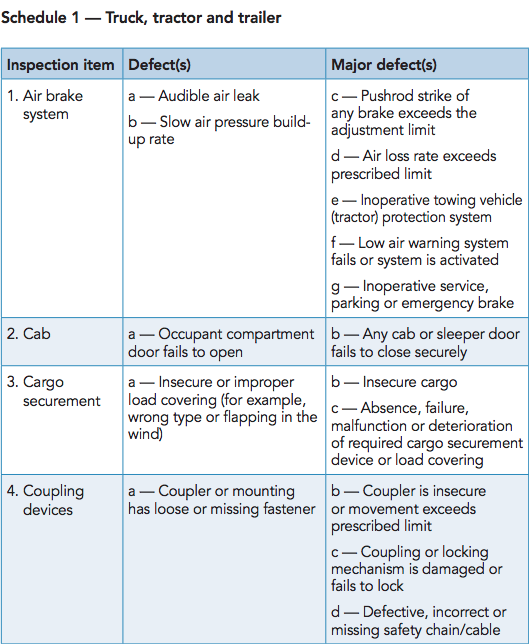
NSC Standard 13 — Trip Inspection, sets out the daily vehicle trip inspection criteria a driver or other designated personnel must check to ensure early identification of vehicle problems and defects, and to prevent the operation of vehicles with conditions that are likely to contribute to a vehicle crash or breakdown. Part 2 of the standard contains a schedule of inspection items for trucks, tractors and trailers, referred to throughout this chapter and by industry as “Schedule 1.” This is the minimum standard used by industry when conducting a daily vehicle trip inspection. The following chart lists the Schedule 1 minor and major defects:
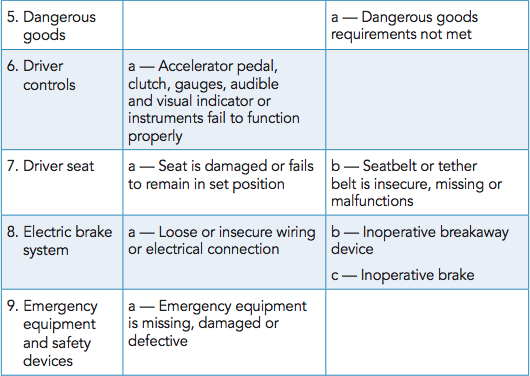
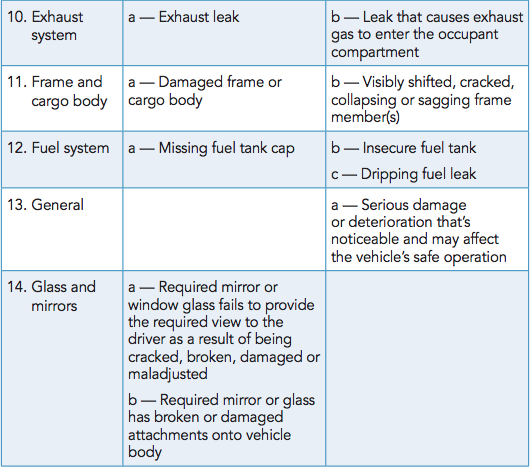
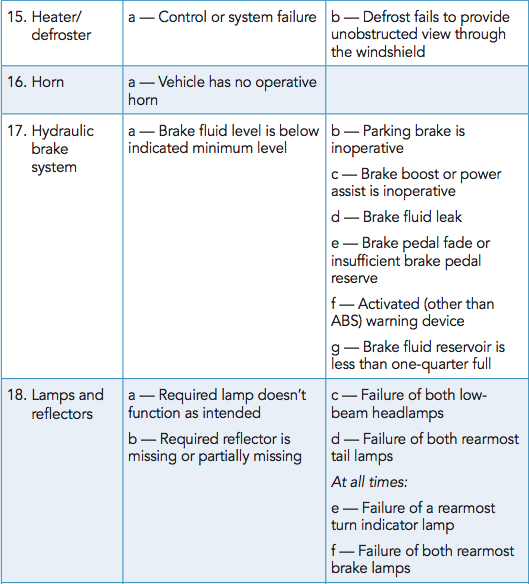
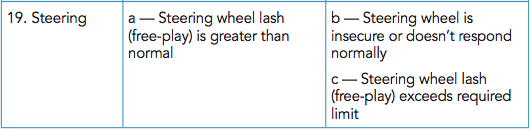
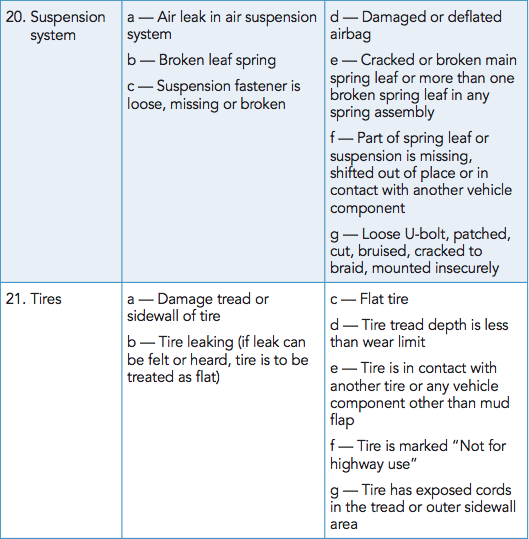
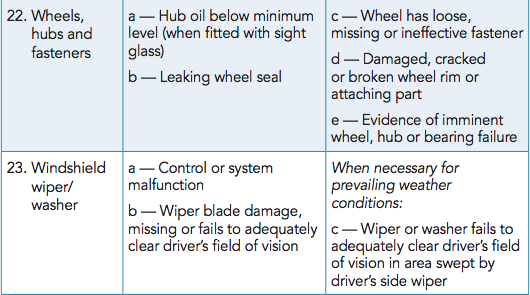
You’re not permitted to drive a truck or tow a trailer unless you or another person has conducted a trip inspection of the vehicle(s) within the previous 24 hours. In addition to drivers, others authorized by the carrier, such as maintenance or yard staff, are also permitted to conduct inspections and complete and sign reports. The requirement to complete daily pre-trip and post-trip inspections that align with the NSC 13 standard is intended to identify problems before they become critical.
B.C. regulations under MVAR Division 37 require that:
1. Before and after each trip, the driver or a person specified by the carrier, ensures that the commercial motor vehicle is in a safe operating condition.
The inspection is performed daily before the first trip of the day.
2. If the trip lasts more than one day, the inspection is carried out on the second and every subsequent day of the trip no later than the first rest stop of the day.
3. A copy of the trip inspection is carried in the vehicle for the day in which it was done.
The person who conducts the inspection and signs the report is responsible under law for the inspection and information contained in the report. The driver may rely on such an inspection and must produce the daily inspection report to an officer if requested, unless the driver has reason to believe the inspection and report don’t meet the requirements or the driver is aware or ought to be aware that the vehicle has a defect.
All information required to be in a report must be accurately completed in full.
There are vehicle inspectors throughout the province who conduct commercial vehicle inspections. On the demand of an enforcement officer, a driver must produce the inspection schedule and trip inspection report.
En route inspections — In addition to the initial inspection, whether conducted by the driver or not, you’re required to monitor the condition of the vehicle(s) for defects while and immediately record and report any defects found. Under NSC Standard 10 – Cargo Securement, the best practice is for a driver to inspect the vehicle’s cargo and the cargo securement system used and make necessary adjustments before driving the vehicle, and within 80 km (50 mi) from the point where the cargo was loaded, and then every three hours or 240 km (149 mi). If you’re hauling dangerous goods, the inspections are required every two hours or 160 km (99 mi).
Reporting defects — For the purposes of reporting defects to the carrier, an employee may be designated to receive reports. Any major or minor defects listed in the NSC 13 Schedule 1 must be reported immediately by the driver or inspection person to the carrier upon discovery of the defect. This may be done in person, by phone, via written report or by electronic means.
Driving with defects — You may continue to drive with a minor defect that’s listed on an inspection schedule if you have immediately entered the defect on the daily inspection report and reported it to the carrier.
Under Part 1 — General Requirements of NSC Standard 13, no carrier shall permit a person and no person shall drive a commercial vehicle on a highway when a major defect that’s listed on an inspection schedule is present on the vehicle.
En route inspections
Your pre-trip inspection will help ensure your vehicle is safe before you start your day’s trip. As you drive, the condition of your vehicle may change. It’s important to inspect your vehicle at regular intervals en route so you can identify any problems as soon as possible.
Before performing the en route inspection, keep the following in mind:
• Make sure the vehicle is completely off the road.
• Enter and park at a rest or check stop so that you don’t have to back up.
• Avoid stopping at the bottom of a hill or on an uphill slope.
• The stop area should have an adequate acceleration lane to allow you to merge back onto the highway at an appropriate speed.
At a minimum, an en route inspection for your vehicle should include the following checks:
• All lights are clean and in working order.
• There are no air leaks.
• All the wheels are secure and tires are properly inflated and not hot.
• Wheel hubs aren’t hot.
• There are no broken or loose items on the vehicle.
• The load/cargo is secure — nothing has shifted or can fall from the vehicle.
• Dangerous goods placards are clean and secure (if applicable).
• Coupling devices/glad hands and electrical cords are secure.
• The trailer locking mechanisms are secure and in good condition.
• The brakes are properly adjusted.
• There are no fluid leaks under the vehicle.
• Mirrors and windshield are clean.
Post-trip inspections
B.C.’s MVAR section 37.22 (6) requires a driver or a person authorized by the carrier to conduct a post-trip inspection of the commercial vehicle and to document any defects observed at the end of the final trip of the day or that may have occurred throughout the day. It is acceptable to note defects on either a written paper copy of a report or in an electronic format, so long as the carrier is made aware of any vehicle defects so repairs may be made. While a post-trip inspection is always required, there is no requirement in B.C. to do a written post-trip inspection report if no defects are identified during your inspection. This is consistent with NSC Standard 13 and other North American jurisdictions, including the U.S. Despite this, a carrier may still require a written post-trip inspection report be done to support overall vehicle maintenance of its fleet and for record-keeping purposes.
Postponing post-trip inspections can result in problems that are frustrating, time consuming, costly and unsafe. Though your carrier may require a more comprehensive inspection, at minimum, a post-trip inspection should include the following:
• Check your diesel exhaust fluid and fuel levels while finishing your day. Have a plan as to when you’ll top them up. In the winter, keeping tanks full can help minimize condensation buildup.
• Park your vehicle and allow the engine to cool down on low idle if the water temperature is above 200 degrees Fahrenheit.
• Secure your tractor-trailer and turn all switches off (fans, AC and heaters).
Shut down the vehicle.
• Complete a circle check of the truck’s exterior looking at:
– Body condition (no new damage)
– Exterior lights (ensure they’re functioning properly)
– No leaks
– Brakes adjusted
– Hub oil levels
– The condition of the wheels, tires and tire pressure
• Complete a check of the interior looking at:
– Floor (clean, nothing left behind)
– Controls (sanitize as required)
– Seats (no new damage)
– Windows (close and clean)
– Seatbelts (set back in order)
– Log book/post-trip inspection paperwork are completed
Note: Ensure trailer brakes cool before activating the park or spring brakes in winter to prevent moisture from freezing between the brake shoe and drum.
Pre-hill inspections
It’s important to understand when and how to do pre-hill inspections. B.C.
has many mountainous roads so you need to know how to perform these inspections properly and do them frequently.
In some areas of the province, signs are posted in advance of steep or long downhill grades. You must stop in the pullout area and inspect the vehicle’s braking system before proceeding. Do a general en route inspection at the same time.
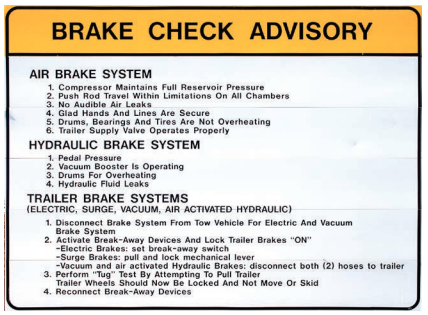
Depending on the vehicle you are operating, at minimum you must check the items listed on brake check advisory signs posted at pull-outs located at the top of steep grades. If you are operating a vehicle with an air brake system on the tractor and the trailer, for example, you must check that:
• The compressor maintains full reservoir pressure
• There are no audible air leaks and the trailer supply valve operates properly
• Glad hands and air lines are secure
• Brake drums and hubs are not overheated
• Pushrod travel is within limits on all chambers
• There are no fluid leaks
Note: You must check pushrod travel even if your vehicle is equipped with automatic slack adjusters.
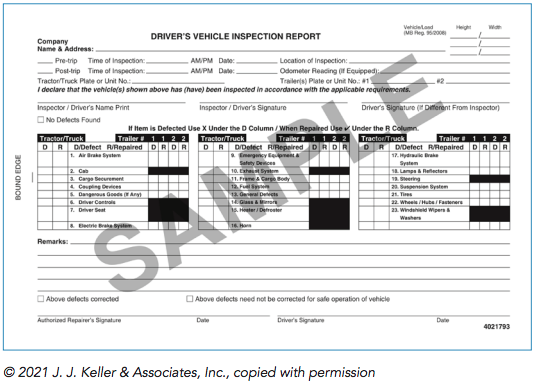
A trip inspection report is the document that confirms you have completed an inspection. The report is completed at the beginning and end of the day when driving is finished (pre-trip inspection and post-trip inspection). The report serves several purposes:
• Provides evidence that the required inspection has been completed.
• Shows when and where an inspection was conducted and who conducted it.
• Shows that the vehicle has no defects or is a record of defects found by the driver.
• A place for drivers to add any defects discovered during their work day.
• Provides a method for the driver to report defects to the carrier. Reports showing vehicle defects are retained as part of the vehicle maintenance and repair records.
• Some employers may have a separate form for you to complete to report defects to the maintenance department or request maintenance to be performed.
The format and layout of an inspection report is flexible, but the following information must be included on every report:
• Licence plate or unit number of the vehicle(s)
• Name of the motor carrier
• Date and time that the inspection was completed
• A declaration that the vehicle identified on the report has been inspected as required
• State any minor or major defects or that no defects were discovered
• The name and signature of the person who conducted the inspection
• The signature of the driver (if other than the person who conducted the inspection)
• The odometer reading
Driver’s vehicle inspection report form
A pre-trip inspection generally takes about 45 minutes.
Before beginning the inspection
Ensure you’re wearing appropriate personal protective equipment such as gloves, high visibility (hi-vis) vest and boots. A hard hat and safety glasses may also be required.
Gather the following items:
• Clean rag to wipe off lenses and reflective tape
• Tire pressure gauge
• Pipe or tire hammer
• Flashlight
• Pen and inspection report booklet
You may also need some of these basic hand tools:
• Wrench to adjust brakes
• Pry bar to check slack adjustment such as a tie rod end puller
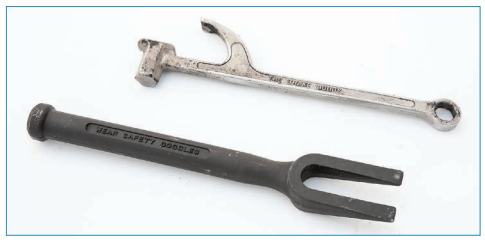
Before you begin a pre-trip inspection:
• Choose terrain that’s level and park the vehicle safely away from traffic.
• Ensure that the engine has been shut off and the parking brakes have been applied.
• Remove the key to ensure the vehicle can’t be moved while you’re checking underneath.
• Chock the wheels and ensure the chocks will keep the vehicle from moving especially for vehicles equipped with air brakes that are to be released later.
The minimum size for square blocks should be 15 by 15 centimetres (six by six inches).
• Check that all paperwork is in the truck and valid: vehicle registration, operating authority, insurance certificate, daily trip inspection report, NSC Schedule 1 trip inspection defect list, safety certificates, log books and the CVIP inspection certificate (decal).
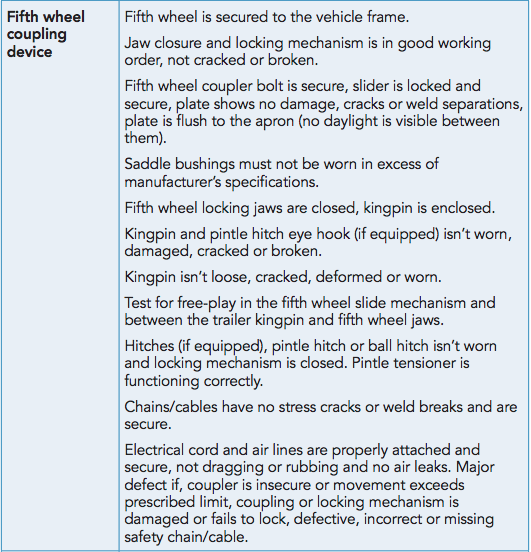
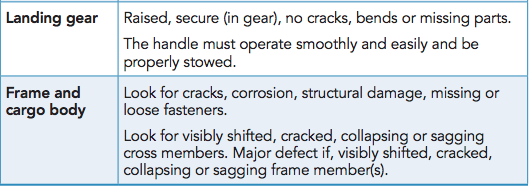
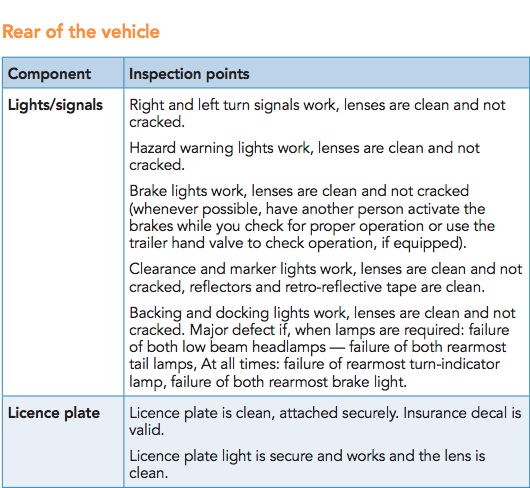
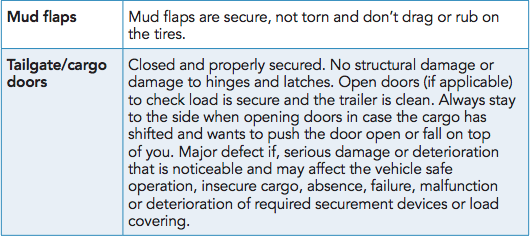
A systematic approach — You may choose an inspection procedure that best suits the vehicle and its location. Whatever procedure is used, each regulated inspection item must be inspected and where a defect is discovered, the defect must be recorded on the report and reported to the carrier.
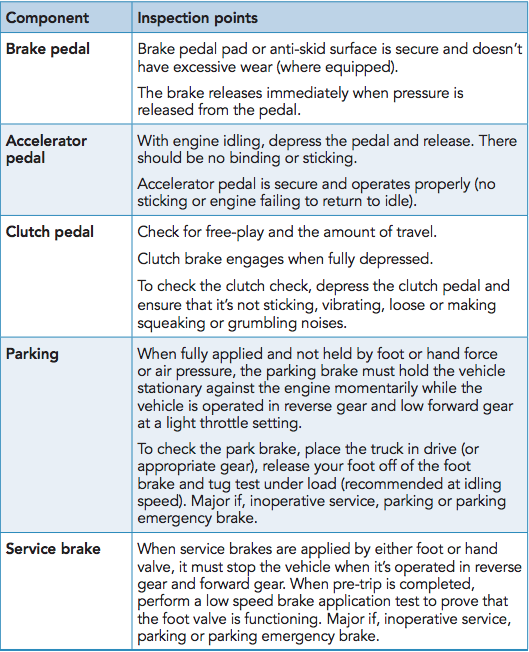
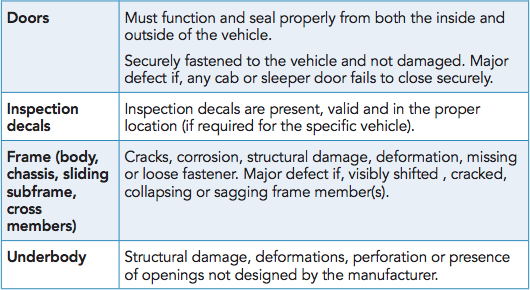
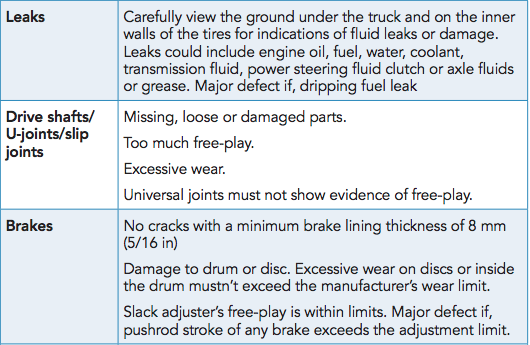
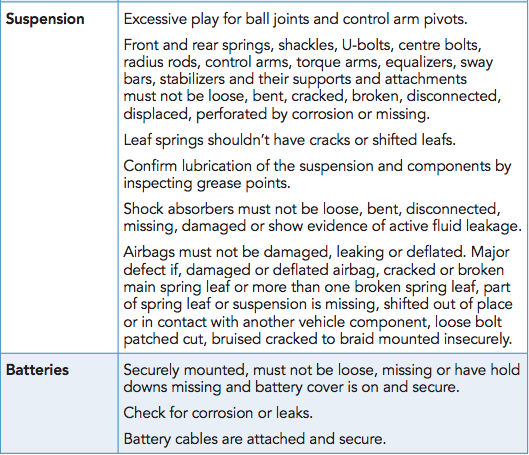
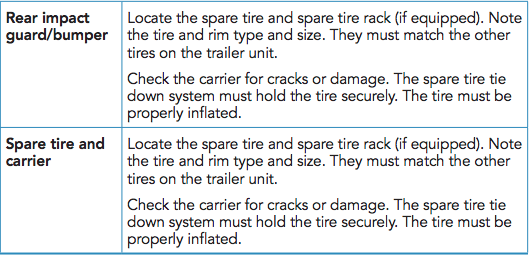
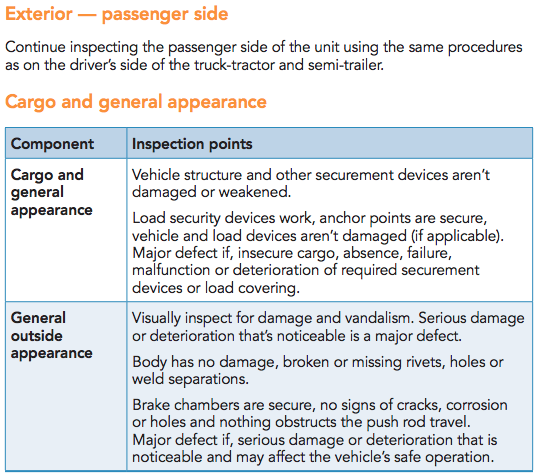
The tables in this section show a general method of making a systematic daily inspection of your vehicle, based on the NSC Schedule 1 trip inspection list of possible minor and major defects, provided earlier in this chapter.
Walk up/approach
When approaching the truck, assess the overall condition of the truck.
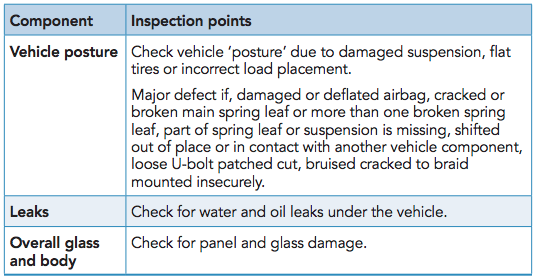
Under-hood checks
Check for any cracks in the front of the hood before unlatching.
Unlatch and open up the engine compartment and check the following:
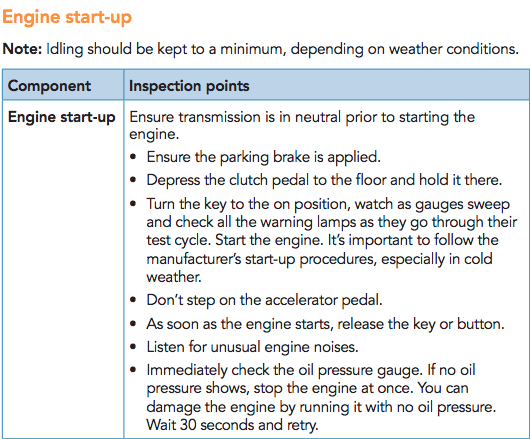
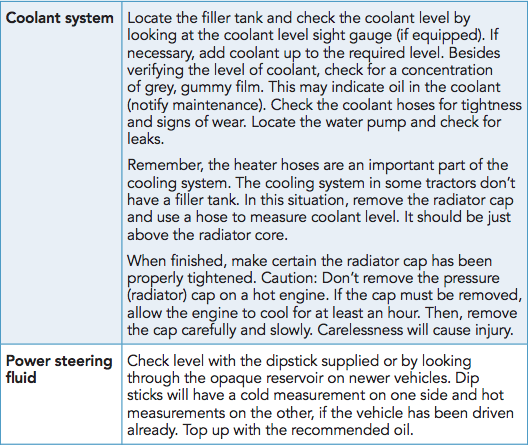
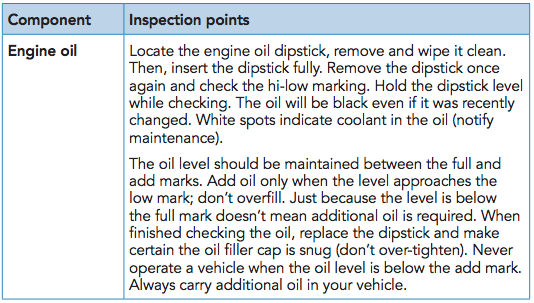
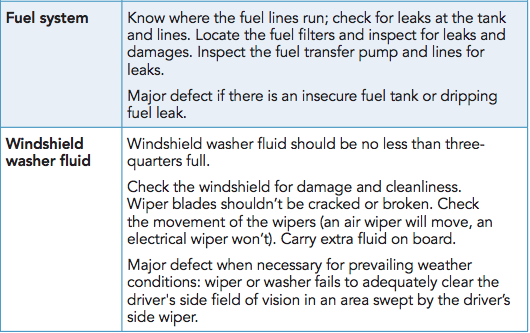
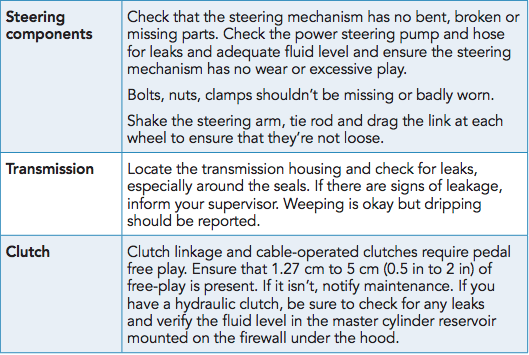
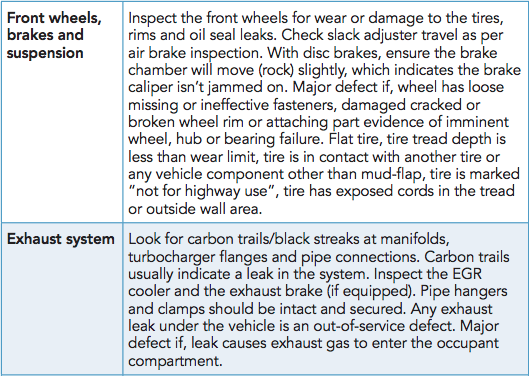
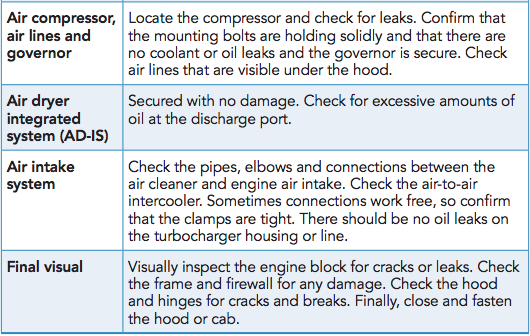
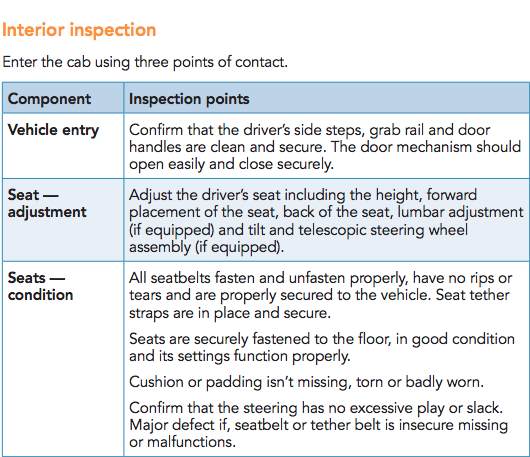
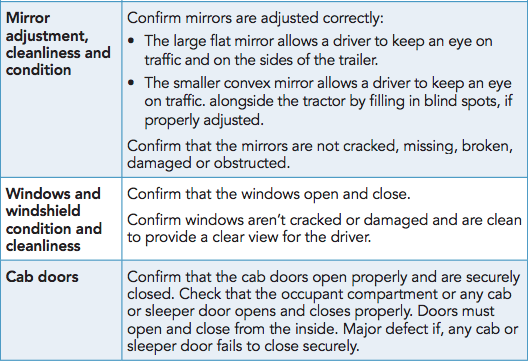
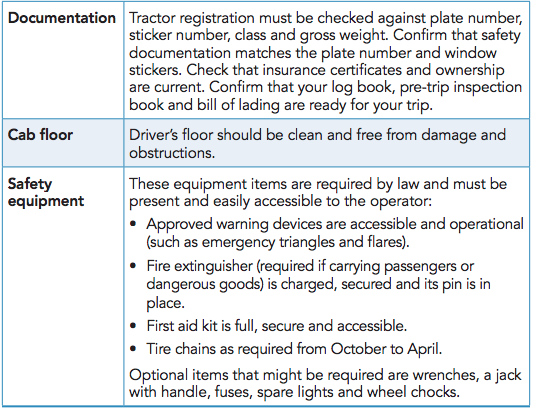
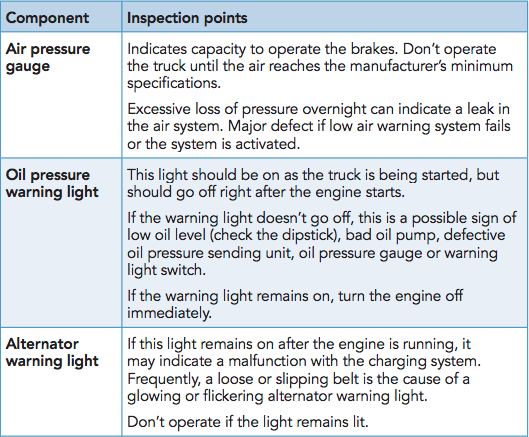
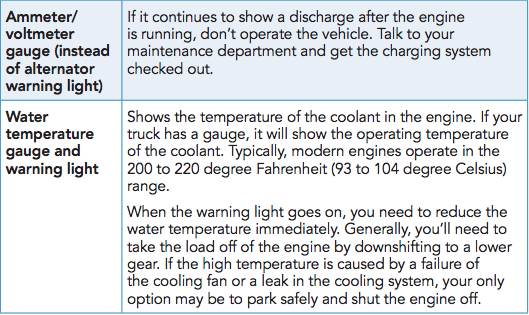
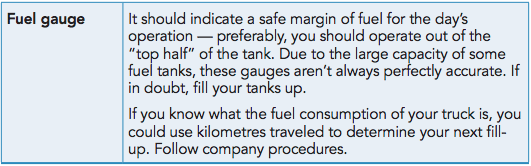
Check gauges: Once the engine is running, ensure gauges are displaying correctly and no warning lights are on. All gauges must be functioning and giving normal readings, otherwise you shouldn’t operate the truck. Immediately report any issues to your supervisor.
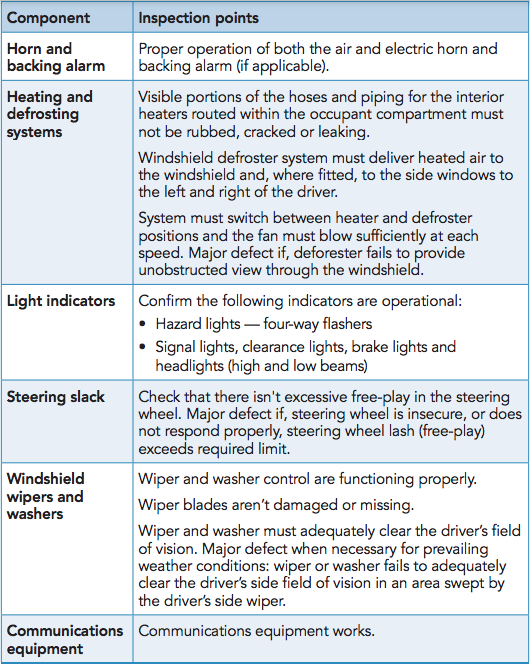
Check light indicators and other controls:
Check all pedal operations and brakes:
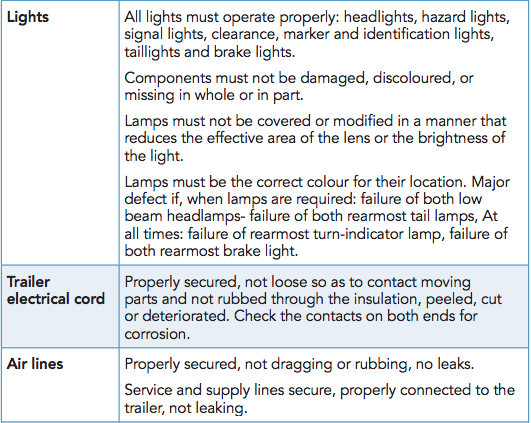
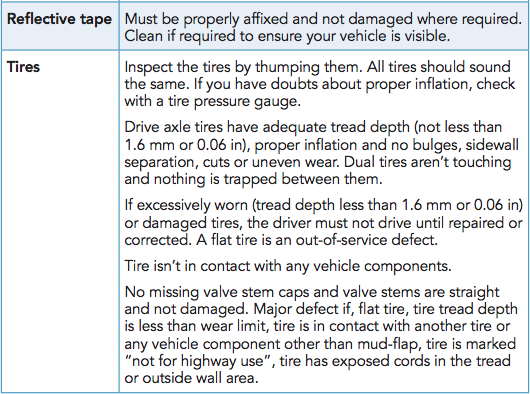
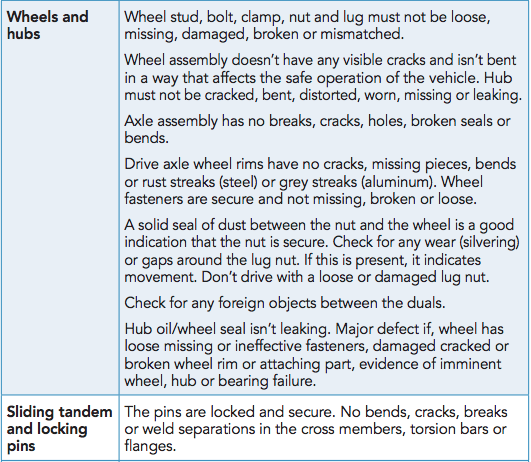
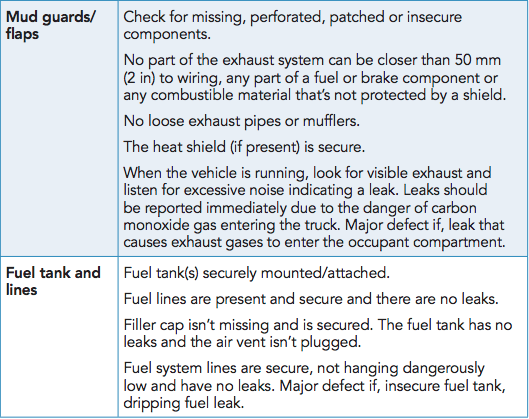
An air brake trip inspection will be done as part of your daily vehicle pre-trip and post-trip inspections. The order you complete the steps in an air brake and vehicle trip inspection can vary, depending on the systematic approach you prefer once you get familiar with the requirements. The following information is a guide only. As with the vehicle pre-trip and post-trip inspections, any defects in the air brake system or brake components must be documented and reported so the necessary repairs can be done.
Before you begin:
• Park the truck and trailer on level, stable ground
• Set the parking brakes
• Block the wheels
• Drain the wet air tank (if equipped) or point out that vehicle has an air dryer integrated system (AD-IS). This would be located beside the governor.
Vehicles equipped with AD-IS won’t have a wet tank.
– The air dryer would be located between the compressor and the first air tank. It cleans the air (moisture and contaminants) and prevents freezing.
Filtration system filled with desiccant (like kitty litter).
– The air dryer purges at maximum pressure — this you can hear. It can be located in a variety of locations on the truck. Draining the wet tank first checks that the one-way check valve works.
• Gather tools: pry bar, flashlight, timer and a pen
Step 1: Under the hood
With the engine off, check the security and condition of the following components:
• Compressor
• Compressor belt tension (if equipped)
• Air lines
• Governor
• Air dryer
• Steering axle foundation brake components
On the steering axle, manually check that the brakes are adjusted properly by checking the push rod travel or “free-play.” It should be 13 mm to 19 mm (0.5 in to 0.75 in) and adjust manual slack adjusters to 13 mm (0.5 in), if equipped. If there’s more than 19 mm (0.75 in) of free-play with an automatic slack adjuster, then an applied stroke check should be completed. The acceptable measurement will vary depending on the size of the brake chamber and the method you use to check the pushrod travel (applied stroke or pry method), but generally:
• Automatic slack adjusters — 19 mm (0.75 in) or less of free-play.
• Manual slack adjusters — 13 mm to 19 mm (0.5 in to 0.75 in) free-play.
Note: 13 mm (0.5 in) is recommended.
Step 2: Governor operation
Pressure build-up
• Start the engine and run at 1000 RPM to 1200 RPM
• Check that pressure builds from 50 p.s.i. to 90 p.s.i. (345 kPa to 620 kPa) within three minutes [first air pressure gauge needle hits 50 p.s.i. (345 kPa), you start timing and when the last needle gets to 90 p.s.i. (620 kPa), stop timing].
• It would be a minor defect if pressure build-up time is greater than three minutes.
Governor cut-out pressure
• Allow the air to build up to maximum pressure.
• The governor must cause the compressor to stop pumping (governor cut-out) between 105 p.s.i. to 135 p.s.i. (724 kPa – 931 kPa).
Release all parking brakes. Observe governor cut-in pressure:
• Fan down the brakes (by pumping the brake pedal) until air pressure drops to about 20 p.s.i. to 25 p.s.i. (138 kPa to 172 kPa) less than cut-out pressure.
• Pause and check that air pressure begins to build (to confirm governor cut-in pressure). It should cut in at 20 p.s.i. (138 kPa) below the maximum, but in all cases, the governor must cause the compressor to cut in at a minimum of 80 p.s.i. (552 kPa).
Step 3: Tractor protection system
With the air pressure above 100 p.s.i. (690 kPa) and trailer brakes released, shut off engine and turn ignition key to the ‘on’ or ‘run’ position.
• Fan down the brakes until the tractor valve closes, which should occur when the highest reservoir pressure gauge reads between 45 p.s.i. and 20 p.s.i. (310 kPa – 138 kPa). Exit the truck and go to the back of the trailer to check that the trailer spring brakes have applied.
• Return to the front of the trailer and disconnect the supply and service air lines. There should be no air loss from either the tractor or trailer air lines.
• Enter the truck and apply the service brakes. There should be no air loss from the supply and service air lines.
• Reconnect the air lines.
Step 4: Air system leaks
Start the engine and let the air pressure build up to maximum pressure. Release all brakes, shut off engine and turn ignition key to the ‘on’ or ‘run’ position:
• Make and hold a full foot brake application.
• After the air pressure gauge(s) have stabilized, start timing for one minute.
• Watch the air pressure gauge(s) for any loss of air and listen for audible air leaks (window open).
• Maximum air loss must not exceed 4 p.s.i. (28 kPa) in one minute with a single trailer and 6 p.s.i. (41 kPa) per minute with multiple trailers.
Step 5: Low air pressure warning devices
With the air pressure above 60 p.s.i. (414 kPa), all brakes released, engine off and ignition in the ‘on’ or ‘run’ position:
• Fan down the brakes to lower the air pressure.
• Low air warning light must come on at a minimum of 60 p.s.i. (414 kPa).
• If equipped with an audible warning device, it must activate at the same time as the warning light.
Step 6: Brake response test
With the engine running and the air pressure built up to maximum pressure, apply the park brakes and remove the blocks from the wheels.
Perform the following four brake response tests:
Truck parking brake
• Truck park brake valve closed (yellow button out).
• Trailer supply valve open (red button in).
• Place transmission in a low forward gear and gently try to pull ahead to check that the truck spring brakes are holding.
Trailer parking brake
• Trailer supply valve closed (red button out).
• Truck park brake valve open (yellow button in).
• Place transmission in a low forward gear and gently try to pull ahead to check that the trailer spring brakes are holding.
Hand valve (spike), if equipped
• Truck park brake valve open (yellow button in).
• Trailer supply valve open (red button in).
• Place transmission in a low forward gear and move slowly ahead while applying the hand valve (spike) to check that the trailer service brakes are working. This will also serve to double check your fifth wheel is locked.
Foot brake
• Truck park brake valve open (yellow button in).
• Trailer supply valve open (red button in).
• Place transmission in a low forward gear and move slowly ahead and make a foot brake application to check that the service brakes are working.
Winter preparedness
Make sure your vehicle is ready before driving in winter weather. Conditions can change quickly in the winter and being prepared is key to successfully operating in snow, ice and extreme cold.
Winter preparedness should concentrate on parts of the vehicle that can be affected by extremely cold weather, snow and ice.
• You may find yourself in conditions where you can’t drive without chains, even to get to a place of safety. Carry the right number of chains and extra cross-links. Make sure they fit your drive tires. Check the chains for broken hooks, worn or broken cross-links and bent or broken side chains. Learn how to put the chains on before you need to do it in snow and ice.
• Fill the top half of your fuel tank in the winter to minimize condensation and ensure you have enough fuel on board if you get stranded.
• Clean the cab, body and undercarriage weekly to remove road salt.
• Assure that all the glass and mirrors are kept clean.
• Make sure that the emergency kit includes road flares, fire extinguisher, reflective triangles, first aid kit, water, solar blanket, jumper cables and anything else you may need to survive through extreme weather overnight.
• Carry extra clothing and a thermal sleeping bag if you’re travelling through the mountains and particularly into Northern B.C.